
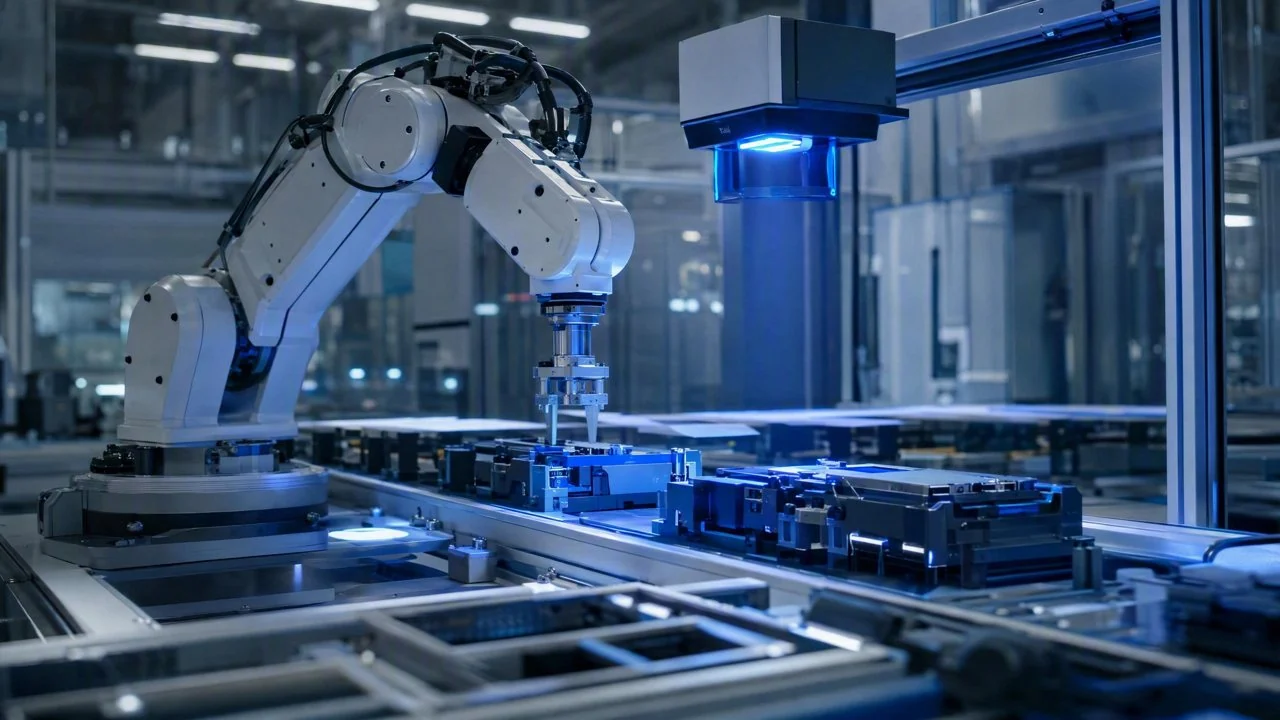
DaoAI 3D robotic vision from WeLinkirt (self-developed 3D camera + 6D pose estimation, bin picking, gluing/assembly/loading and unloading guidance, brain-eye-body closed-loop, sub-millimeter hand-eye coordination) reduces the false alarm rate in the detection of missing or mis-assembled parts in assembly from 15% to 3% through advanced algorithms and imaging technology. In the consumer goods/general industry, the product assembly process has extremely high requirements for quality control. Missing or mis-assembled parts can seriously affect product performance and brand image. A customer's production line mainly manufactures various small household appliances. Its assembly process is complex, involving the installation of many small components. The detection of missing and mis-assembled parts is a key process to ensure product quality.
Industry background and user scenario: In the consumer goods/general industry, the assembly quality of products is directly related to product performance and market competitiveness. The DaoAI 3D robotic vision system from WeLinkirt plays an important role in the detection of missing or mis-assembled parts in assembly with its advanced functions. As mentioned before, the system effectively reduces the false alarm rate from 15% to 3%. A customer's production line focuses on the production of small household appliances, with numerous assembly processes and complex and small components. Traditional detection methods are difficult to accurately identify missing and mis-assembled parts, while the application of this system provides an effective solution to this problem.
Pain points: Why is this hurdle difficult to cross?
Multidimensional quantification of pain points: In the traditional detection of missing or mis-assembled parts in assembly, there are many difficulties. In terms of the false alarm rate, traditional methods reach about 15%, which means that a large number of normal products are misjudged as unqualified, increasing the re-inspection workload. The missed-detection rate is about 1%, which may cause defective products to enter the market and damage the brand reputation. The manual re-judgment time is relatively long, averaging 2 minutes per product, which reduces the production efficiency. The change-over downtime is also long, requiring 30 minutes for each change-over, affecting the continuity of production.
Root cause analysis: From the process level, the assembly process of small household appliances is complex, and the installation positions and angles of components are diverse. Traditional detection methods are difficult to adapt to this variability. In terms of imaging, small components are not clearly imaged under traditional cameras, which easily leads to misjudgment. In terms of materials, some components have similar colors and materials, increasing the difficulty of identification. Combined with the trend of the embodied intelligent robot industry, traditional detection methods lack intelligent decision-making and self-adaptive capabilities, and cannot meet the requirements of efficient and accurate detection.
Technical principle
In-depth mechanism: The DaoAI 3D robotic vision from WeLinkirt uses a self-developed 3D camera to obtain the three-dimensional shape information of components. Through the 6D pose estimation algorithm, it accurately determines the position and posture of components. During the detection process, the system uses the brain-eye-body closed-loop technology to achieve real-time interaction between visual information and robot actions. At the same time, the sub-millimeter hand-eye coordination ability ensures the high precision of detection. This multi-technology integration method enables the system to accurately identify missing and mis-assembled parts.
Comparison with traditional methods: Compared with traditional rule-based AOI and manual visual inspection, DaoAI 3D robotic vision has obvious advantages. Traditional rule-based AOI relies on preset rules and is difficult to adapt to complex and changeable assembly situations, while this system can quickly adapt to new products and assembly processes through transfer learning. Manual visual inspection is inefficient and prone to fatigue and missed judgment, while this system can achieve 100% full inspection, reducing the false alarm rate to 3% and greatly improving the accuracy and efficiency of detection.
Typical application scenarios
- Screw assembly detection: Obtain the three-dimensional information of screws through a 3D camera to detect whether screws are missing or not installed in place. The difficulty lies in the small size of screws, which are prone to blurry imaging, and the possible deviation of installation positions. DaoAI 3D robotic vision uses high-precision 3D imaging and pose estimation technology to accurately identify the state of screws.
- Buckle installation detection: Detect whether the buckles are correctly installed to ensure the firm connection between components. The difficulty lies in the diverse shapes and installation methods of buckles, which are difficult to accurately judge by traditional detection methods. This system can quickly and accurately identify the installation situation of buckles by analyzing their three-dimensional shapes.
- Plugin insertion detection: Check whether the plugins are fully inserted into the corresponding positions to avoid product failures caused by improper insertion. The difficulty lies in the difficulty of detecting the insertion depth and angle of plugins. This system can accurately detect the insertion state of plugins through 6D pose estimation and sub-millimeter hand-eye coordination technology.
- Component direction detection: Determine whether the installation direction of components is correct to prevent assembly failure caused by wrong directions. The difficulty lies in the similar appearance of some components, making it difficult to distinguish the direction. DaoAI 3D robotic vision uses advanced vision algorithms to accurately identify the direction of components.
Implementation case
Comparison before and after the implementation for an anonymous customer: A small household appliance manufacturer with a medium-scale production line. Before the implementation of the DaoAI 3D robotic vision system from WeLinkirt, the false alarm rate of the production line was 15%, the missed-detection rate was 1%, the manual re-judgment time was 2 minutes per product, and the change-over downtime was 30 minutes. After the implementation, the false alarm rate was reduced to 3%, the missed-detection rate was reduced to 0.2%, the manual re-judgment time was reduced to 0.5 minutes per product, and the change-over downtime was shortened to 5 minutes. This shows that the system significantly improves the accuracy of detection and production efficiency.
DaoAI 3D robotic vision from WeLinkirt makes the detection of missing or mis-assembled parts in assembly more accurate and efficient.
WeLinkirt's solution and products
Product capabilities and implementation methods: Centered on DaoAI 3D robotic vision, this solution has powerful modeling capabilities. It can quickly establish a detection model through a small number of positive samples (1-20 good samples). The change-over process is simple and efficient, only requiring 5 minutes to complete. In terms of deployment, it supports multiple methods such as SDK / API / Docker and can achieve 100% local private deployment to ensure data security. At the same time, this solution can be integrated with other equipment on the production line to realize automated detection. The supporting DaoAI ACI (AI-AOI) software system can perform semantic false-alarm filtering to further improve the accuracy of detection.
Quantitative results and business value: After the implementation of DaoAI 3D robotic vision from WeLinkirt, the false alarm rate is reduced by 80%, the missed-detection rate is reduced by 80%, the manual re-judgment time is reduced by 75%, and the change-over downtime is shortened by 83%. These results not only improve product quality and reduce production costs but also enhance production efficiency and the market competitiveness of enterprises.
FAQ
What is DaoAI 3D robotic vision?
DaoAI 3D robotic vision is a product of WeLinkirt. It includes a self-developed 3D camera, 6D pose estimation and other functions. It can be used for bin picking, gluing/assembly/loading and unloading guidance, etc., realizing the brain-eye-body closed-loop and sub-millimeter hand-eye coordination, and improving the accuracy and efficiency of assembly detection.
What are the advantages of DaoAI 3D robotic vision compared with traditional detection methods?
Compared with traditional methods, DaoAI 3D robotic vision has a lower false alarm rate, which can be reduced from 15% to 3%. The missed-detection rate is also greatly reduced. The change-over time is short, only 5 minutes. It can also achieve 100% full inspection, improving the accuracy of detection and production efficiency.
What is the cost of using DaoAI 3D robotic vision?
The cost is affected by various factors, such as production line scale, detection requirements, and deployment methods. If you want to know the specific quotation, you can make an appointment to communicate with us, and we will provide a detailed plan according to your actual needs.
Full solution for this scenario: Consumer / general industry solutions · Assembly Missing-Part & Misassembly Detection
This article was generated by AI. Customer cases are simulated scenarios based on real product capabilities and figures are illustrative; see product pages for official benchmarks.