
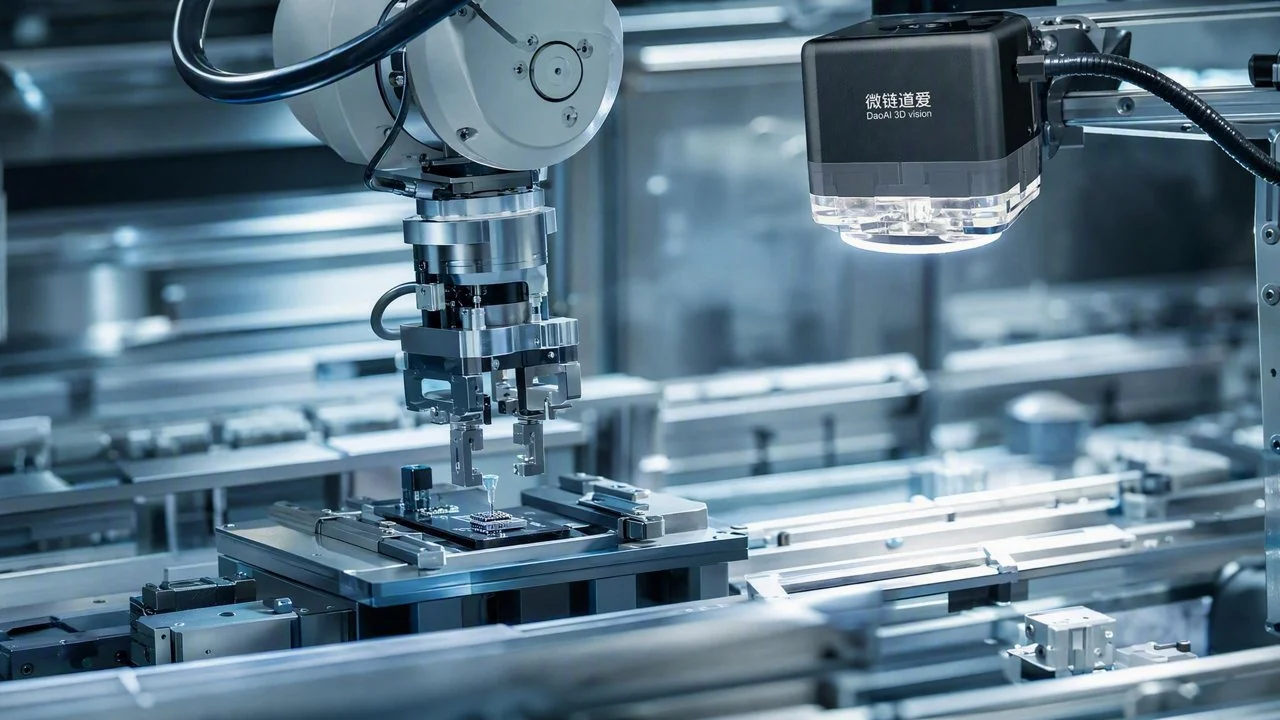
The locally deployed WeLinkirt DaoAI 3D Robotic Vision system, with its proprietary 3D camera and advanced 6D pose estimation algorithms, precisely identifies and corrects missing or incorrect components in consumer goods assembly, significantly reducing the typical 0.8% false negative rate of traditional manual inspection to <0.1%, while offering customers ultimate data security and compliance.
In the consumer goods industry, particularly for automated production lines of small electronic products, home appliances, or daily necessities, quality control at the assembly stage is critical. These products often contain numerous small, structurally complex parts, and production cycles are fast. Any missing, incorrectly assembled, or misoriented component can lead to product malfunction or even safety hazards. Traditional sampling or manual full inspection methods face significant challenges in terms of efficiency, cost, and accuracy, especially in a consumer market that demands high quality and low cost, placing higher demands on refined and intelligent quality control. The WeLinkirt DaoAI 3D Vision solution brings groundbreaking transformation to the industry in this context.
Pain Points: Why This Hurdle Is Difficult to Overcome
Detecting missing or incorrect components in consumer product assembly faces multiple challenges with traditional solutions. Firstly, there's a high false negative rate; human visual inspection, under long-duration, high-intensity repetitive tasks, commonly results in a false negative rate of up to 0.8% due to fatigue and distraction, especially when inspecting tiny, hidden, or reflective parts. Secondly, high re-inspection costs and low efficiency mean that once a defect is found, significant manual effort is required for re-inspection and rework, severely impacting production rhythm and potentially leading to downtime, increasing per-unit cost by approximately 1.5%. Thirdly, data security and compliance risks are a major concern; some enterprises have extremely strict requirements for localized storage and processing of production data and process parameters, which traditional cloud-dependent AI solutions struggle to meet, posing risks of data leakage and compliance issues. Finally, in multi-variety, small-batch production, frequent product changeovers mean traditional rule-based vision or AI models relying on extensive labeled data can take hours or even days to reprogram for new models, severely limiting production flexibility.
The root causes of these difficulties include: process complexity, as consumer product assembly often involves multi-layered, multi-angle component stacking, making it difficult for 2D vision to acquire complete depth information and prone to occlusion or shadow interference; imaging challenges, as many consumer product components have diverse surface materials, such as highly reflective metals, transparent plastics, and matte textures, making it difficult for traditional light sources and cameras to achieve stable imaging, leading to feature extraction difficulties; and cycle time pressure, as consumer product lines typically demand extremely high production cycles, leaving very little time for inspection, and traditional algorithms' high computational load makes it challenging to complete high-precision detection within the allotted time. Furthermore, while the current industry hot topic of low-cost, open-stack humanoid robot development platforms aims to accelerate the adoption of embodied AI, they still require robust 3D vision and hand-eye coordination technology for industrial precision, sub-millimeter accuracy, and high cycle times, which is precisely the core strength of WeLinkirt DaoAI 3D Robotic Vision.
Technical Principles
The WeLinkirt DaoAI 3D Robotic Vision system, through its self-developed high-precision 3D camera, can acquire real-time 3D point cloud data of the detected object, overcoming the limitations of 2D vision in depth information. This system employs advanced 6D pose estimation algorithms to precisely identify the 3D position and orientation (X, Y, Z, Roll, Pitch, Yaw) of components in space, enabling accurate grasping and assembly guidance even for disorderly stacked or randomly placed parts. Compared to traditional rule-based vision systems, DaoAI 3D Robotic Vision eliminates the need for manually writing complex rule codes, instead using deep learning models to automatically learn 3D features of components, significantly enhancing detection robustness and generalization. Its performance far exceeds traditional methods, especially when dealing with varying lighting, complex backgrounds, and interference from similar parts. Furthermore, the sub-millimeter hand-eye coordination capability of WeLinkirt DaoAI 3D Robotic Vision ensures extremely high precision in robot grasping and placement, controlling misalignment errors to sub-millimeter levels, which is crucial for precise assembly.
Compared to traditional manual inspection, the WeLinkirt DaoAI 3D Robotic Vision system not only eliminates errors caused by human fatigue and subjective judgment but also increases detection speed by several folds, achieving 100% full inspection and reducing the false negative rate from a typical 0.8% to <0.1%. Unlike AI vision solutions that rely on external cloud services, DaoAI 3D Robotic Vision supports 100% local private deployment, with all data processing and model inference completed on the client's local servers, ensuring absolute security of sensitive production data and fully complying with stringent enterprise data compliance requirements. Its built-in brain-eye-body closed-loop mechanism enables real-time collaboration between the robotic vision system and the robotic arm, forming a complete closed loop of perception, decision-making, and execution, greatly enhancing automation and production efficiency.
Typical Application Scenarios
- **Multi-component assembly missing/incorrect part detection:** On assembly lines for electronic consumer goods like smartphones or smart speakers, detecting whether tiny parts such as screws, springs, or connectors are missing or correctly assembled. The challenge lies in the small size and large number of parts, which might be obscured by other structures; traditional 2D vision struggles to penetrate occlusions, while WeLinkirt DaoAI 3D Vision can reconstruct complete 3D models for precise identification.
- **Irregular part orientation detection and correction:** For irregularly shaped plastic or metal parts, detecting if their assembly orientation is correct. The difficulty arises from part symmetry or subtle differences that can cause confusion; DaoAI 3D Robotic Vision's 6D pose estimation can precisely identify spatial orientation and guide the robot to adjust.
- **Bin picking and assembly guidance for disordered materials:** Consumer product manufacturing often uses bins containing large quantities of randomly scattered parts, such as buttons or casings. DaoAI 3D Robotic Vision's bin picking function quickly identifies the optimal grasp points and poses for disordered stacked parts, guiding the robotic arm to efficiently pick and deliver them to the assembly station, solving the pain point of traditional solutions unable to handle unordered materials.
- **Glue/sealant application guidance:** In the application of glue or sealing strips for home appliance casings and waterproof components, guiding the robot to precisely follow a preset path, ensuring uniform, unbroken, and spill-free application. The challenge is the precision of the application path and adaptability to 3D curved surfaces; WeLinkirt DaoAI 3D Vision can provide real-time 3D guidance to ensure application quality.
Case Study
A leading consumer electronics manufacturer has a high-speed production line for assembling a smart wearable device. This device comprises dozens of miniature components, traditionally relying on manual inspection for final missing/incorrect part checks. However, due to the extremely fast production cycle, exceeding 150,000 units per shift, the manual inspection's false negative rate remained consistently high, averaging around 0.8%, leading to hundreds of customer complaints in the market each month and severely damaging brand reputation. Furthermore, this client had extremely stringent requirements for production data security; all data from any production stage had to be processed within the local network, strictly prohibiting upload to external cloud platforms. The WeLinkirt team deployed the DaoAI 3D Robotic Vision system for this scenario, utilizing a 100% local private deployment solution.
After the WeLinkirt DaoAI 3D Robotic Vision system was deployed, the client's false negative rate for assembly missing/incorrect parts significantly decreased by 87.5%, from 0.8% to <0.1%, effectively eliminating customer complaints caused by quality control issues.
Before deployment, the client's false negative rate was 0.8%, resulting in monthly market returns and rework costs amounting to hundreds of thousands of yuan due to missed defects. After deployment, the WeLinkirt DaoAI 3D Robotic Vision system, with its high-precision 3D imaging and intelligent recognition capabilities, consistently controlled the false negative rate for assembly missing/incorrect parts to <0.1%, representing a 87.5% reduction in the false negative rate. Moreover, as all visual data and model training were conducted on local servers, it fully met the client's stringent data security requirements, eliminating the risk of data leakage. The system also features APDT few-shot self-training capability; when product models are slightly adjusted or similar new parts are added, model iteration can be completed with just 1–5 good sample images, reducing changeover debugging time from the previous 3 hours to <10 min, greatly enhancing production flexibility and efficiency.
The figures above are a typically achievable range in anonymized industry scenarios — a different line or a different batch of parts will move the result either way; on-site measurement governs.
WeLinkirt Solution and Products
The WeLinkirt DaoAI 3D Robotic Vision system is the core of this solution. It integrates WeLinkirt's self-developed high-resolution 3D camera, capable of rapid and precise 3D morphological reconstruction of consumer product components, accurately capturing even micron-level morphological differences. Combined with powerful 6D pose estimation algorithms, the system can analyze the object's spatial position and orientation in real-time, providing precise assembly guidance for robots. For deployment, WeLinkirt offers various flexible deployment options such as SDK/API/Docker, supporting 100% local private deployment to ensure sample and inspection images never leave the factory, meeting the highest level of data security requirements. For model training, we utilize APDT positive/few-shot learning technology, requiring only a minimal number (1–20) of good sample images to complete model training, significantly shortening model development and iteration cycles. Furthermore, the WeLinkirt DaoAI World Model, as a unified foundation, endows the system with powerful semantic understanding and cross-scenario generalization capabilities, enabling continuous learning from production line feedback to constantly optimize detection accuracy and efficiency.
The implementation of this solution involves: first, performing 3D scanning of target components with WeLinkirt's 3D camera to build high-precision digital twin models; second, training models using the DaoAI platform, employing transfer learning to identify missing or incorrect assembly patterns; finally, deploying the trained models to local edge computing devices and integrating them with the robot control system to achieve a brain-eye-body closed-loop for automated assembly and inspection. The sub-millimeter hand-eye coordination precision of WeLinkirt DaoAI 3D Robotic Vision ensures that robots can perform intricate operations even at high cycle times, for example, achieving ±0.05mm precision in grasping and placing tiny components on consumer product lines. This not only addresses the pain points of traditional manual inspection but also significantly elevates the intelligence level and market competitiveness of production lines, delivering tangible business value to customers.
FAQ
How does the DaoAI 3D Robotic Vision system ensure data security with local deployment?
The WeLinkirt DaoAI 3D Robotic Vision system supports 100% local private deployment. This means all visual data acquisition, processing, model training, and inference are completed on the client's local servers, ensuring sample and inspection images never leave the factory. We offer various deployment methods such as SDK/API/Docker, guaranteeing secure data flow within the client's internal network environment, meeting strict enterprise data compliance and privacy protection requirements.
What are the main advantages of DaoAI 3D Robotic Vision compared to traditional 2D AOI or manual inspection solutions?
The core advantage of DaoAI 3D Robotic Vision lies in its 3D perception capabilities and intelligent algorithms. Compared to traditional 2D AOI, it can acquire depth information, solving challenges like occlusion, reflection, and coplanarity, leading to more precise detection of missing or incorrect parts. Versus manual inspection, the DaoAI system achieves 100% full inspection, significantly reducing false negative rates, eliminating human fatigue and subjective errors, while greatly improving detection efficiency and production cycle time, and supporting rapid changeovers for enhanced flexible manufacturing.
What is the approximate cost budget for deploying the WeLinkirt DaoAI 3D Robotic Vision system?
The cost of the DaoAI 3D Robotic Vision system is influenced by various factors, including the number and precision of cameras required, the complexity of robotic arm integration, specific software customization needs, and the scale of deployment. We offer flexible, modular solutions that can be tailored to the client's specific application scenarios and budget. We recommend contacting our sales engineers, who will provide a precise evaluation and quotation based on your detailed requirements.
Full solution for this scenario: Consumer / general industry solutions · Assembly Missing-Part & Misassembly Detection
This article was generated by AI. Customer cases are simulated scenarios based on real product capabilities and figures are illustrative; see product pages for official benchmarks.