
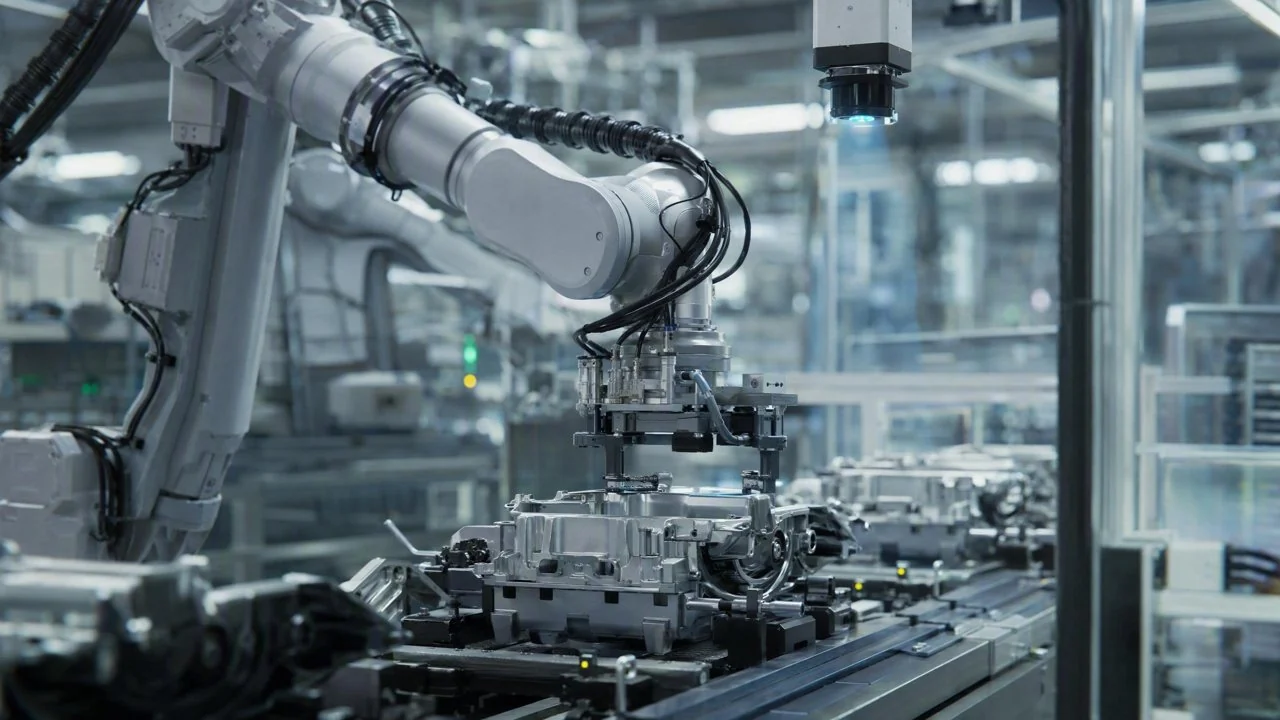
DaoAI 3D Robot Vision (proprietary 3D camera + 6D pose estimation, bin picking, glue dispensing/assembly/loading/unloading guidance, brain-eye-body closed loop, sub-millimeter hand-eye coordination) achieves 100% full inspection and high-precision error/missing part detection in automotive assembly. This reduces the missed detection rate from a traditional 2.5% (manual inspection and rule-based vision) to below 0.3%, while ensuring production cycle time is maintained, significantly improving product quality and production efficiency.
In the automotive and parts manufacturing industry, assembly is a critical stage that determines the final quality and performance of products. With the accelerating trend of automotive intelligence and electrification, the complexity of assemblies is increasing, and the demands for assembly precision and consistency have reached unprecedented levels. Any subtle error or missing part can lead to serious quality issues, even affecting driving safety, resulting in huge recall costs and brand reputation risks. Traditional inspection methods, such as manual visual inspection or rule-based 2D vision systems, often struggle to balance comprehensive inspection with production line efficiency when faced with high-beat, multi-variant, and complex 3D structures in automotive assembly lines. This is particularly true for the assembly of critical sub-assemblies (e.g., engines, transmissions, battery packs), where internal structures are compact, parts are numerous, and the risk of errors or missing parts is higher. Once such issues occur, troubleshooting and rework costs are extremely high.
Pain Points: Why This Hurdle Is So Difficult to Overcome
Detecting errors and missing parts in automotive assembly faces multiple challenges. Firstly, there are **extremely high production cycle time requirements**. A typical automotive assembly line might complete several assemblies per minute, leaving a very short inspection window, which makes traditional manual inspection or line stoppage for inspection impractical. Secondly, the **complexity of the inspection objects** is a major issue. Assemblies contain numerous parts of various shapes, often with occlusions, reflections, and similar colors, leading to persistently high missed detection rates. Statistics from a Tier-1 supplier show that traditional solutions have a missed detection rate of up to 2.5% in complex assembly stages, directly leading to subsequent rework and customer complaints. Thirdly, **changeover difficulties in multi-variety, small-batch production models** are significant. With increasing vehicle model diversity, production lines require frequent product model switches. Traditional rule-based vision systems often take hours or even days for parameter adjustment and reprogramming during each changeover, severely impacting production efficiency and flexibility. Finally, **inspection precision and reliability** are crucial. For some critical fasteners or connectors, it's not enough to just detect their presence; their proper installation, such as whether bolts are tightened or clips are fully engaged, must also be assessed. These sub-millimeter details are difficult for traditional solutions to identify effectively, and false positive rates often exceed 5%, leading to extensive manual re-inspection workloads.
The root cause of these pain points lies in the limitations of traditional inspection methods in 3D spatial cognition and real-time decision-making. Manual inspection is susceptible to fatigue and subjectivity, and cannot sustain 100% full inspection on high-speed lines. Rule-based vision systems rely on pre-set geometric features and lighting conditions, making them highly sensitive to environmental changes and object pose variations, thus struggling to cope with complex and dynamic assembly scenarios. The current trend of embodied AI robots moving from labs to real-world applications highlights a key challenge: how to enable robots with 'brain, eye, and body' coordination, enabling them to perceive the 3D world like humans, understand task intentions, and execute operations with precision. For automotive assembly, this means robots need high-precision 3D perception to verify component integrity and correctness, and to work with robotic arms to perform inspections at high cycle times. This is precisely the core problem that Micro-Chain DaoAI's DaoAI 3D Robot Vision system aims to solve.
Technical Principles
Micro-Chain DaoAI's DaoAI 3D Robot Vision system provides a transformative solution for automotive assembly error and missing part detection by integrating **proprietary high-precision 3D cameras** with **advanced 6D pose estimation algorithms**. Our 3D cameras utilize structured light or laser triangulation principles to rapidly acquire complete 3D point cloud data of the inspected object, achieving sub-millimeter precision. Unlike traditional 2D cameras that only capture planar grayscale or color images, DaoAI 3D cameras directly obtain true 3D morphological information of objects, completely resolving detection difficulties caused by lighting variations, object color, surface reflections, or occlusions. Based on this high-precision point cloud data, Micro-Chain DaoAI has further developed **deep learning-based 6D pose estimation models**. These models can identify the category of each component within the assembly in real-time and accurately, calculating its precise position (X, Y, Z) and orientation (Rx, Ry, Rz) in 3D space – i.e., 6 degrees of freedom. By comparing the 6D pose of detected components with standard CAD models, the system can precisely determine the presence of errors, missing parts, incorrect orientation, or improper installation, and even identify minute gaps or deformations.
Compared to traditional rule-based AOI, Micro-Chain DaoAI's DaoAI 3D Robot Vision system offers significant advantages in robustness and generalization. Rule-based AOI relies on manually set thresholds and geometric features, making it highly sensitive to environmental factors such as lighting, background, and part variations. Any slight change in the production environment or product requires extensive time for parameter adjustment and reprogramming, often leading to false positives and missed detections. In contrast, DaoAI's deep learning models, trained on vast datasets, can autonomously learn and extract complex 3D features, exhibiting stronger adaptability to various interferences. For example, even with oil stains, scratches, or slight deformations on component surfaces, the Micro-Chain DaoAI system can accurately identify their 6D pose. Furthermore, combined with **brain-eye-body closed-loop control**, the DaoAI 3D vision system not only detects defects but also provides real-time, precise pose information feedback to industrial robots, guiding them for accurate assembly, gripping, or rework operations, forming an efficient intelligent manufacturing closed loop that ensures sub-millimeter hand-eye coordination precision. This integrated solution enables Micro-Chain DaoAI to achieve 100% full inspection capacity while maintaining production cycle times, reducing the missed detection rate for complex assembly to <0.3%.
Typical Application Scenarios
- **Engine/Transmission Assembly Component Integrity and Error Detection:** Inspecting whether various bolts, gaskets, sensors, and pipelines within the engine or transmission housing are installed as per drawing requirements, checking for any missing, incorrect, or reversed installations. The challenge lies in dense components, complex structures, and significant occlusions.
- **Battery Pack Module Assembly Consistency Inspection:** Checking the arrangement of cells, busbar connections, fastener installation within the battery module, and the correct connection of external cooling lines and wire harnesses. The difficulty lies in the highly integrated internal structure of battery packs, coupled with extremely high demands for detection speed and precision.
- **Car Body Welding Point and Sealing Bead Integrity Inspection:** Evaluating the number, position, and quality of weld spots on the car body frame, as well as the path, width, and continuity of sealant application. Micro-Chain DaoAI 3D vision can identify micron-level weld spot morphology defects and sealing bead breaks or overflows.
- **Chassis Suspension System Assembly Guidance and Inspection:** Guiding robots to precisely assemble complex suspension components (e.g., shock absorbers, control arms, steering knuckles) onto the chassis, and real-time inspection of whether fasteners at each connection point are in place and angles are correct. The challenge involves large, heavy components and strict assembly tolerance requirements.
- **Interior Trim Clip/Harness Connection Inspection:** Checking whether various clips on interior panels, dashboards, and other components are fully engaged, and whether wire harness connectors are properly inserted and secure. The difficulty lies in clips and connectors often being small and located in hidden positions, making effective detection challenging for traditional 2D vision.
Case Study
A leading domestic automotive Tier-1 supplier, specializing in new energy vehicle powertrain systems, faced significant challenges in the assembly line for one of its core electric drive assemblies. Due to the complex structure and numerous component types, their traditional manual visual inspection combined with limited 2D vision solutions resulted in a persistent missed detection rate of around 2.5% at high production cycle times. This led to several rework incidents and customer complaints each month due to assembly errors or missing parts, severely impacting production efficiency and product delivery. Concurrently, the production line demanded an extremely high cycle time, requiring one assembly to be inspected every 45 seconds. Traditional solutions, when attempting to increase inspection coverage, invariably slowed down the cycle time. The manufacturer's challenge was to significantly reduce the missed detection rate and achieve 100% full inspection coverage without affecting the existing production cycle time.
The Micro-Chain DaoAI team deployed a DaoAI 3D Robot Vision system for their assembly inspection. By installing multiple proprietary high-precision 3D cameras from Micro-Chain DaoAI at critical inspection stations, combined with customized 6D pose estimation models, the system performed comprehensive, blind-spot-free inspection of hundreds of critical components within the electric drive assembly. Before deployment, the complex assembly missed detection rate for this line was approximately 2.5%, with a false positive rate of about 5.0%, and 100% full inspection was not achievable. After the DaoAI 3D vision system went live, model training and production line integration were completed in just 3 weeks, integrating with the existing PLC system. After three months of stable operation, the **missed detection rate for assembly errors and missing parts decreased to below 0.3%**, the **false positive rate significantly reduced to 0.8%**, and the **inspection cycle time remained stable at 42 seconds/assembly**, not only fully meeting but even slightly improving the production cycle time requirements. More importantly, the Micro-Chain DaoAI solution achieved 100% full inspection coverage for all critical components, effectively preventing missed detections due to human fatigue or oversight, saving the manufacturer millions in rework and warranty costs annually.
Micro-Chain DaoAI's DaoAI 3D Robot Vision system reduces automotive assembly missed detection rates to <0.3% while maintaining production cycle times, truly enabling high-quality, high-efficiency intelligent manufacturing.
Micro-Chain DaoAI Solutions and Products
Micro-Chain DaoAI's core solution is based on the DaoAI 3D Robot Vision system, dedicated to solving complex assembly inspection challenges in the automotive and parts industry under high precision and high cycle time demands. The system centers on Micro-Chain DaoAI's proprietary 3D cameras as the core sensing hardware, combined with powerful 6D pose estimation algorithms and deep learning models, enabling precise identification and judgment of complex nested structures and varied components within assemblies. For modeling, we support **0-code automatic programming**, allowing rapid model training and deployment with minimal good sample data (typically 1-20 images), significantly shortening the go-live period. For multi-variety, small-batch production, the DaoAI 3D vision system supports **changeovers within 5 minutes**, requiring only the selection of the corresponding product model, without the need for reprogramming or parameter adjustments, greatly enhancing production line flexibility. Deployment is flexible, supporting SDK/API/Docker and other forms, and can achieve **100% local private deployment** to ensure customer data security. Furthermore, through **brain-eye-body closed loop**, the system provides real-time detection results feedback to robotic arms, guiding them for precise gripping, assembly, or defect marking, achieving integration from perception to execution.
Through Micro-Chain DaoAI's DaoAI 3D Robot Vision system, customers gain significant business value. Firstly, **product quality is substantially improved**, with missed detection rates reduced by over 88%, effectively preventing recalls and customer complaints due to assembly defects. Secondly, **production efficiency is significantly enhanced**, with inspection cycle times stably maintained at 42 seconds/assembly while ensuring 100% full inspection coverage, safeguarding production capacity. Thirdly, **operating costs are reduced**, by decreasing a large amount of manual re-inspection hours and rework costs. Finally, **production line flexibility is strengthened**, with 5-minute rapid changeover capability enabling enterprises to respond more agilely to market changes and product iterations. Micro-Chain DaoAI is committed to enabling automotive manufacturing enterprises to achieve higher levels of automation and intelligent production through advanced embodied intelligent vision technology.
FAQ
How does the DaoAI 3D Robot Vision system ensure 100% full inspection capacity at high production cycle times?
Micro-Chain DaoAI's 3D Robot Vision system achieves high-speed data acquisition through its proprietary high-frame-rate 3D cameras. This is combined with optimized deep learning models and an efficient parallel computing architecture, enabling complex 3D data processing and 6D pose estimation within extremely short inspection windows. Furthermore, we support tight integration with production line PLC systems, synchronizing with production beats in real-time to ensure comprehensive inspection of every assembly without impacting existing line speeds, effectively guaranteeing 100% full inspection capacity.
What is the typical deployment period and cost for the DaoAI 3D Robot Vision system?
The deployment period for the DaoAI 3D Robot Vision system typically ranges from 3-6 weeks, depending on the complexity of the production line and integration requirements. Costs are primarily influenced by the number of inspection stations, the required camera models and precision, and the extent of customized software development. We offer flexible integrated hardware-software solutions or pure software SDK deployments, supporting 100% local private deployment. We recommend contacting our sales team with your detailed requirements to obtain a customized proposal and quotation that best fits your budget and technical needs.
What are the core advantages of DaoAI 3D Vision in automotive assembly inspection compared to traditional 2D vision or manual inspection?
The core advantages of DaoAI 3D Vision lie in its 3D perception capabilities and the robustness of deep learning. Traditional 2D vision is susceptible to lighting, occlusion, and reflections, cannot acquire depth information, and struggles to identify 3D assembly errors. Manual inspection is limited by fatigue and subjectivity, unable to meet high-cycle-time full inspection demands. DaoAI 3D Vision directly acquires sub-millimeter 3D morphology, combined with 6D pose estimation, to precisely determine component presence, correct position, and proper orientation. This thoroughly solves detection challenges in complex 3D scenarios, significantly improving detection rates and reducing false positives, while maintaining production cycle times.
Full solution for this scenario: Automotive / parts industry solutions · AI Vision Inspection for Vehicle Assembly Errors & Missing Parts
This article was generated by AI. Customer cases are simulated scenarios based on real product capabilities and figures are illustrative; see product pages for official benchmarks.