
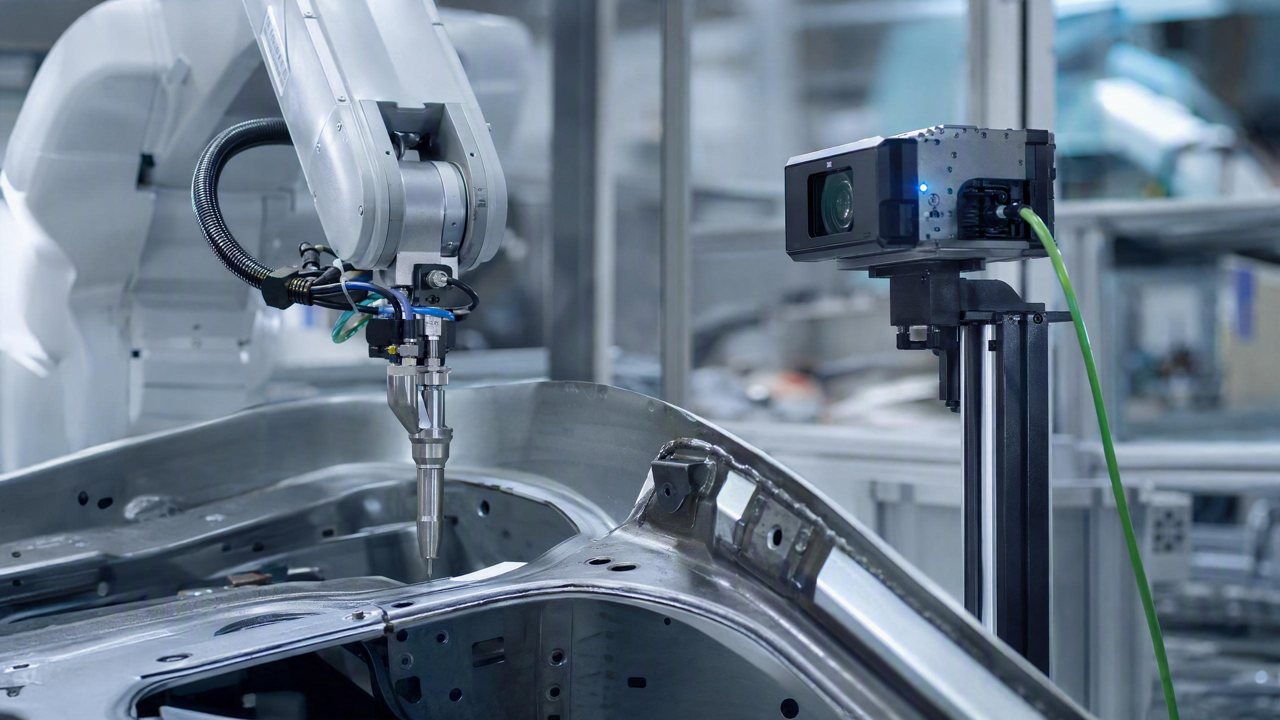
DaoAI 3D Robot Vision (proprietary 3D camera + 6D pose estimation, bin picking, adhesive application/assembly/loading-unloading guidance, brain-eye-body closed loop, sub-millimeter hand-eye coordination) reduces the need for manual inspection in automotive component sealing by over 90% through high-precision 3D morphology reconstruction and intelligent algorithms, shifting from human-dependent judgment to automated, data-driven quality control.
The automotive/components industry demands stringent product quality, especially in critical functional parts involving adhesive application and sealing processes. Even minor defects can lead to reduced product performance or safety hazards. A leading automotive component supplier, whose main products include door seals and engine cylinder head gaskets, requires high-precision adhesive application or sealing treatments. In traditional production models, the final quality check for adhesive application often relies on extensive manual inspection. Workers meticulously check the integrity, width, height, and presence of overflow, breaks, or bubbles in the adhesive path. This labor-intensive method is not only inefficient but also highly susceptible to subjective factors like worker fatigue and experience, leading to missed defects or misjudgments, which can result in rework or even recalls. As the automotive industry moves towards greater intelligence and automation, coupled with rising labor costs in China, finding an efficient, accurate, and significantly labor-reducing adhesive inspection solution has become an urgent need for the industry.
Pain Points: Why This Hurdle Is Difficult to Overcome
Traditional quality control methods in automotive component adhesive inspection face multiple challenges. Firstly, **high labor costs and a growing labor gap**: for a medium-sized component factory, the adhesive inspection alone requires dozens of skilled workers operating in shifts, with annual labor costs reaching millions of RMB. Secondly, **poor inspection consistency and risk of missed defects**: the average missed detection rate for manual inspection typically fluctuates between 3% and 5%, and can be even higher during night shifts or when production tempo increases. Furthermore, **inspection efficiency bottlenecks**: manual inspection of a single component takes 10-20 seconds, struggling to keep pace with the ever-increasing tempo of modern automotive production lines, becoming a constraint on capacity improvement. Finally, **lack of quantitative data and traceability**: manual inspection results are often qualitative “pass/fail,” lacking precise 3D morphological data of the adhesive, making defect analysis difficult and unable to provide effective support for process optimization.
The root cause of these difficulties lies in the complexity of adhesive application itself: adhesive materials come in various colors (black, gray, transparent, etc.), sometimes with low contrast against the substrate; the adhesive cross-section shape may vary slightly due to pressure, speed, or nozzle wear; and workpiece surfaces may have oil stains, reflections, and other interferences. Traditional 2D vision solutions struggle to obtain precise 3D morphological data and cannot accurately measure key parameters like height and width. Manual inspection is limited by the physiological limits of human eyes and subjective judgment, making it difficult to maintain high accuracy and consistency on high-speed production lines. Recent breakthroughs in “dexterity” key technologies for humanoid robots in complex, precise operations directly address these human-machine collaboration bottlenecks in traditional industrial scenarios, emphasizing the necessity of combining high-precision, adaptive vision with robot control. The emergence of DaoAI 3D Robot Vision by WeLinkirt is precisely to solve these deep-seated pain points.
Technical Principles
WeLinkirt's DaoAI 3D Robot Vision system offers a revolutionary solution for automotive component adhesive inspection through its core **proprietary high-precision 3D camera** and advanced **6D pose estimation algorithms**. Our 3D camera utilizes structured light or laser triangulation principles to rapidly acquire complete 3D point cloud data of the workpiece surface with sub-micron precision, reconstructing the accurate 3D morphology of the adhesive. This stands in stark contrast to the limitations of traditional 2D vision, which only captures planar images and cannot measure height information. The DaoAI 3D Robot Vision system analyzes this 3D data using deep learning models, not only identifying the integrity and continuity of the adhesive but also precisely measuring its width, height, cross-sectional shape, and detecting various defects such as overflow, breaks, bubbles, and burrs. Its average detection rate can consistently reach over 99.5%. Compared to traditional rule-based AOI, DaoAI 3D Vision does not require manual coding of complex inspection rules; instead, it achieves high-precision inspection through training with a small number of good samples, greatly simplifying the configuration process and enhancing generalization capabilities.
Furthermore, WeLinkirt's DaoAI 3D Robot Vision's **“brain-eye-body closed-loop”** technology is another highlight. Through 6D pose estimation, the system can precisely perceive the workpiece's position and orientation in 3D space. Even with slight deviations in the workpiece, it can dynamically adjust the robot end-effector's adhesive path in real-time, achieving **sub-millimeter hand-eye coordination**. This means the robot not only “sees” defects but can also “understand” and “correct” them, for example, by guiding the robot to reapply adhesive to missed areas or adjusting the path for the next adhesive application step to adapt to the workpiece's actual pose. This closed-loop control capability is unattainable with traditional manual inspection or simple 2D vision guidance solutions, which can only identify defects without providing real-time corrective feedback. DaoAI's solution significantly reduces the stringent requirements for workpiece positioning accuracy, enhancing the flexibility and adaptability of the production line.
Typical Application Scenarios
- **Automotive Sealing Strip Inspection:** Conducts 100% full inspection of adhesive paths for sealing strips on car doors, windows, and sunroofs to ensure continuity, width, and height meet design standards, preventing water leakage or drafts. Challenges include diverse strip colors, complex shapes, and susceptibility to lighting.
- **Engine Cylinder Head Gasket Adhesive Inspection:** Precisely inspects the quality of sealing adhesive applied to engine cylinder head gaskets, including the integrity of the adhesive path, adhesive line width, height, and the presence of bubbles or breaks, ensuring engine sealing performance. Challenges include extremely high adhesive application accuracy requirements and fine adhesive lines.
- **Car Body Weld Seam Sealant Inspection:** Performs 3D inspection of sealant on car body weld joints to ensure uniform coverage without gaps, preventing body corrosion and noise. Challenges include irregular weld seam geometries and strong reflections.
- **Electronic Component Potting Compound Inspection:** Detects the fullness, surface flatness, and presence of bubbles in potting compounds inside automotive electronic control units (ECUs) and sensors, ensuring moisture and vibration resistance of electronic components. Challenges include transparent or translucent potting compounds and difficulty in detecting internal defects.
Case Study
A leading Tier-1 automotive supplier in East China, providing body structural components to several well-known domestic car manufacturers, had long relied on extensive manual inspection for the sealing adhesive application process on critical body parts. Each production line was staffed with 8-10 inspectors working three shifts. The average missed detection rate for manual inspection was approximately 3.5%, leading to hundreds of products requiring rework each month due to poor sealing, and in rare cases, problems were discovered only after products entered the market, posing significant quality risks and aftermarket costs. To improve product quality and reduce rising labor costs, the client introduced the WeLinkirt DaoAI 3D Robot Vision adhesive inspection system. In the initial phase, the WeLinkirt team rapidly deployed the system and trained the model using a small number of good samples (approximately 10-20 images) provided by the client. After deployment, the WeLinkirt DaoAI 3D Robot Vision system achieved 100% online full inspection and consistently controlled the missed detection rate for this segment to <0.4%. Concurrently, because the system could precisely identify defects and provide 3D data, the efficiency of rework personnel also significantly improved. The most notable change was that the client successfully replaced 80% of manual inspection positions with the DaoAI 3D Vision system, reducing the number of manual inspectors per line from 8-10 to just 1-2 responsible for anomaly handling and re-verification, drastically cutting operating costs.
WeLinkirt DaoAI 3D Robot Vision transitions automotive component adhesive inspection from 'human judgment' to 'data-driven,' significantly reducing labor costs and enhancing quality control.
WeLinkirt Solutions and Products
WeLinkirt's DaoAI 3D Robot Vision solution, built upon its proprietary 3D camera hardware and powerful AI vision algorithms, focuses on addressing the pain points of automotive component adhesive inspection. The core capability of this solution lies in its high-precision 3D morphology reconstruction and intelligent defect recognition. For deployment, the WeLinkirt DaoAI 3D Robot Vision system supports various integration methods such as SDK / API / Docker and offers 100% local private deployment to ensure client data security. For adhesive application processes, we deploy multi-angle 3D cameras to achieve comprehensive scanning of complex curved surface adhesives. Combined with the cross-scene generalization capabilities provided by the DaoAI World model, it can quickly adapt and maintain high detection accuracy even when facing new materials or geometric structures. The modeling process for WeLinkirt DaoAI 3D Robot Vision is highly automated; utilizing the APDT positive/few-shot learning function, it requires only 1-20 good sample images to complete model training and deployment within minutes, significantly shortening line changeover and debugging times, reducing changeover downtime from hours to less than 5 minutes. Coupled with the DaoAI AI AOI software system, it enables semantic understanding of defects and false alarm filtering, further enhancing detection robustness.
Upon deployment, the WeLinkirt DaoAI 3D Robot Vision system delivered significant quantifiable results for the client. The system **reduced the missed detection rate** in the adhesive inspection segment **by −88%**, from an average of 3.5% to <0.4%. Concurrently, due to precise detection and path correction, **manual rework was reduced by −90%**. More importantly, by replacing a large portion of manual inspection positions, it **saved the client millions of RMB in annual labor costs** and achieved simultaneous improvements in production line tempo and capacity. WeLinkirt is committed to advancing automotive component manufacturing towards higher quality, lower cost, and greater intelligence through cutting-edge vision technology.
FAQ
How does WeLinkirt's DaoAI 3D Robot Vision system reduce labor costs?
WeLinkirt's DaoAI 3D Robot Vision system significantly reduces labor costs by enabling 100% online automated inspection, replacing the extensive manual inspection traditionally relied upon in adhesive application. The system performs inspection tasks with accuracy and efficiency far exceeding human capabilities, drastically reducing the demand for skilled workers and directly cutting annual labor expenses while addressing labor shortages.
What's the difference between DaoAI 3D Robot Vision and traditional 2D vision for adhesive inspection?
Traditional 2D vision primarily relies on planar image analysis, struggling to acquire 3D information like adhesive height and cross-sectional shape, thus limiting accuracy in judging defects such as overflow or breaks. WeLinkirt's DaoAI 3D Robot Vision utilizes its proprietary 3D camera for 3D morphology reconstruction, precisely measuring various 3D parameters of the adhesive. Combined with 6D pose estimation for sub-millimeter hand-eye coordination, it can detect all types of adhesive defects more comprehensively and accurately, and supports robot path correction.
How long does it take to deploy WeLinkirt's DaoAI 3D Robot Vision system, and what is the approximate budget range?
The deployment cycle for WeLinkirt's DaoAI 3D Robot Vision system varies depending on specific production line complexity and integration requirements, typically ranging from several weeks to a few months. Our APDT few-shot learning feature can shorten model training time to minutes, significantly accelerating the go-live process. Regarding the budget, as it involves hardware configuration, software feature customization, and integration services, the exact cost needs to be evaluated based on the client's actual needs and scenarios. We recommend scheduling an expert consultation to receive a customized solution and detailed quotation.
This article was generated by AI. Customer cases are simulated scenarios based on real product capabilities and figures are illustrative; see product pages for official benchmarks.