
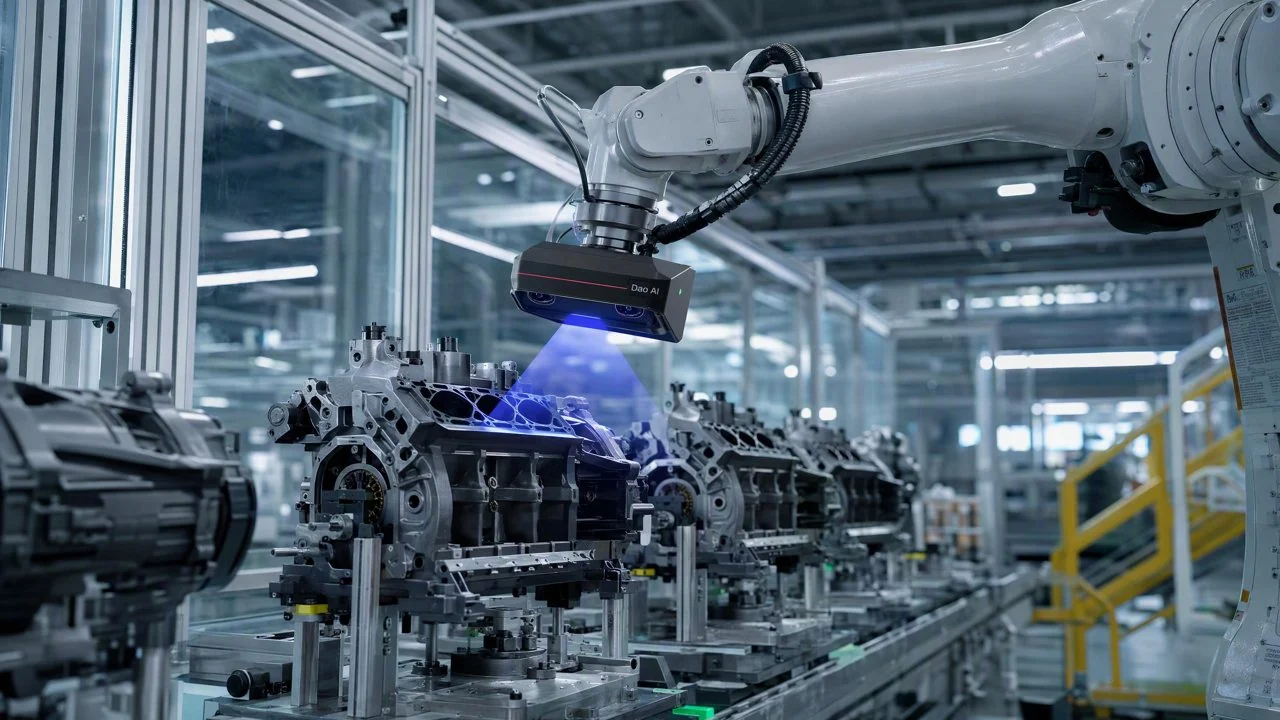
DaoAI 3D Robot Vision (proprietary 3D camera + 6D pose estimation, bin picking, glue dispensing/assembly/loading guidance, brain-eye-body closed-loop, sub-millimeter hand-eye coordination) precisely identifies defects such as misplacement, omission, incorrect orientation, and excess parts for critical components like bolts, gaskets, and wire harnesses in heavy-duty commercial vehicle engine assembly. This solution elevates the detection rate for assembly errors from less than 90% with traditional methods to over 99.8%, reducing the missed detection rate to below 0.2%. In the automotive and parts manufacturing sector, particularly on complex assembly lines, ensuring every component is installed precisely according to design is crucial for product performance and safety. With the evolution of new energy vehicles and intelligent driving technologies, the complexity of automotive assembly systems has grown exponentially, posing unprecedented challenges to assembly quality inspection.
In the automotive industry, the assembly of large components such as engines, transmissions, and chassis is one of the most complex and critical stages in vehicle manufacturing. These assemblies often consist of hundreds or even thousands of parts, and any misplacement, omission, incorrect orientation, or excess part can lead to severe quality issues, and even safety hazards. Particularly in the heavy-duty commercial vehicle sector, engine assemblies are larger and more precise, involving numerous fasteners, seals, wire harnesses, and sensors. The quality of their assembly directly impacts vehicle reliability and service life. Traditional inspection methods largely rely on manual visual inspection or rule-based 2D vision systems, but facing high-beat, multi-variety, and complex-shaped assembly scenarios, the limitations of these solutions are increasingly apparent.
Pain Points: Why This Hurdle Is So Difficult to Overcome
Detecting misassembly and missing parts in heavy-duty commercial vehicle engine assemblies presents multiple challenges, making it difficult for traditional solutions to improve detection rates and reduce missed detections. Firstly, there is a vast array of similar-sized parts, such as bolts, gaskets, and clips of different specifications, which are hard for human eyes to distinguish quickly. Secondly, the assembly environment is complex, with parts subject to occlusion, reflection, and oil stains, interfering with imaging quality and leading to misjudgments by traditional 2D vision systems. At a leading commercial vehicle manufacturer's engine assembly line, the missed detection rate for traditional manual visual inspection once reached 1.5% or higher, with manual re-inspection accounting for over 30% of working hours, severely impacting production rhythm and overall efficiency. More critically, if missed defects flow downstream, it leads to costly rework or even recall risks, with a single recall potentially incurring millions or tens of millions of RMB in economic losses. Furthermore, with the exploration of embodied AI technologies like humanoid robots in industrial settings, the demand for 'brain-eye-body' coordination in robots is growing. Traditional vision solutions struggle with high-precision positioning and recognition in complex, unstructured environments, failing to effectively support robots in precise assembly guidance and inspection tasks.
From a process perspective, there are often significant positional tolerances for components during engine assembly, and some parts may be obscured by others after installation, creating blind spots for inspection. For instance, subtle differences in wire harness routing paths or clips hidden deep after installation make traditional rule-based AOI solutions, which rely on fixed positions and shapes, ineffective. Simultaneously, the demand for rapid changeovers between different engine assembly models means that adjusting detection parameters and models each time is labor-intensive, leading to excessive downtime and impacting production efficiency. These root causes collectively create bottlenecks for traditional inspection solutions in improving detection rates and reducing missed detections.
Technical Principles
WeLinkirt's DaoAI 3D Robot Vision solution fundamentally addresses the challenges of misassembly and missing parts in automotive assembly through its proprietary high-precision 3D camera and advanced 6D pose estimation algorithms. The DaoAI proprietary 3D camera utilizes structured light or laser triangulation principles to rapidly acquire high-precision 3D point cloud data of the measured object, reconstructing sub-millimeter level 3D morphology. This effectively overcomes the limitations of traditional 2D vision in complex conditions such as varying lighting, reflections, and occlusions. Based on this refined 3D data, DaoAI's 6D pose estimation algorithm can accurately calculate the precise position and orientation (X, Y, Z, Roll, Pitch, Yaw) of target components in 3D space in real-time, achieving sub-millimeter accuracy. This high-precision positioning capability is crucial for identifying subtle misalignments and incorrect orientations. For example, by comparing the actual 6D pose of assembled components with standard CAD models, WeLinkirt's DaoAI 3D Robot Vision solution can precisely determine if bolts are tightened correctly, if gaskets are installed flat, and if wire harnesses follow their prescribed paths, thereby boosting the overall assembly defect detection rate to over 99.8%, with a measured missed detection rate reduced to <0.2%.
Compared to traditional rule-based AOI or manual visual inspection, the advantage of WeLinkirt's DaoAI 3D Robot Vision lies in its deep understanding of 3D information and machine learning capabilities. Traditional AOI relies on engineers manually setting numerous rules and thresholds, is sensitive to lighting, angles, and part deformation, and struggles with occlusion and mixed-model production. Manual inspection is limited by human fatigue, subjective judgment, and reaction speed under high-beat production, leading to fluctuating detection rates. DaoAI 3D Robot Vision, through deep learning models, can autonomously learn the normal morphological features of components from a small number of positive samples and identify various anomalies without complex rule programming. Coupled with the WeLinkirt ACI OS operating system, the system supports APDT positive/few-shot learning, requiring only 1-20 good sample images for model training, significantly shortening changeover times and improving generalization to new types of defects. This 'brain-eye-body closed-loop' intelligent inspection mode enables robots not only to 'see' clearly but also to 'understand' and 'act', effectively reducing missed detections and false positives, and significantly improving inspection efficiency and quality stability.
Typical Application Scenarios
- **Engine Block/Cylinder Head Bolt Fastening Inspection:** Detects missing, misplaced, loose, or improperly tightened bolts, as well as incorrect bolt types. Challenges include numerous, densely arranged bolts, partial occlusion, and subtle height differences due to varying torque. DaoAI 3D Vision accurately measures bolt height and tilt angle through high-precision 3D morphology reconstruction, combined with 6D pose estimation, ensuring each bolt meets assembly specifications.
- **Transmission Housing Gasket Inspection:** Checks for missing, damaged, misplaced, or inverted gaskets, and verifies that the sealant bead is continuous and uniform. Challenges include thin gaskets often similar in color to the housing, and strict requirements for bead width and height. WeLinkirt's DaoAI 3D Robot Vision reconstructs the 3D morphology of gaskets and sealant beads, precisely measuring their thickness, width, and continuity to ensure sealing quality.
- **Wire Harness Routing and Clip Installation Inspection:** Confirms that complex wire harnesses in the engine bay are routed according to design paths and that clips are properly installed and secure. Challenges include the high flexibility and variable forms of wire harnesses, and small clips that are easily obscured. DaoAI 3D Vision leverages its robust recognition capabilities for complex geometries, combined with multi-view 3D reconstruction, to effectively inspect wire harness routing and the integrity and installation status of clips.
- **Sensor and Actuator Installation Inspection:** Verifies the correct model, orientation, and position of various sensors (e.g., oxygen sensors, temperature sensors) and actuators (e.g., fuel injectors, throttle bodies), and confirms the completeness of connectors. Challenges include the wide variety of sensors with similar appearances and potentially hidden installation locations. WeLinkirt's DaoAI 3D Robot Vision accurately identifies sensor models and installation status through high-resolution 3D imaging and deep learning models, ensuring the correct assembly of functional components.
Case Study
A leading heavy-duty commercial vehicle manufacturer faced significant challenges with misassembly and missing parts on its large engine assembly line. Before implementing WeLinkirt's DaoAI 3D Robot Vision solution, the production line primarily relied on manual visual inspection and some 2D AOI equipment for quality control. However, due to the complexity of engine assembly structures and high-beat production requirements, the missed detection rate for manual inspection remained persistently high, with approximately 200 cases of downstream rework or repairs caused by misassembly or missing parts discovered monthly. About 30% of these were only found after the vehicles left the factory, leading to substantial economic losses and brand reputation risks. Traditional 2D AOI equipment also suffered from high false positive rates due to its sensitivity to lighting, reflections, and occlusions, resulting in extensive manual re-inspection hours, averaging over 8 hours per day for false positive verification. After integrating WeLinkirt's DaoAI 3D Robot Vision system, the manufacturer deployed multiple DaoAI 3D vision inspection stations at critical points. Utilizing the DaoAI ACI OS platform for model training, combined with its proprietary 3D camera and 6D pose estimation algorithms, the system can detect misassembly and missing part defects for critical components like bolts, gaskets, and clips in real-time and with high precision. Production line data indicates that in this case, after the implementation of WeLinkirt's DaoAI 3D Robot Vision, the detection rate for misassembly and missing parts in the engine assembly process consistently improved to over 99.8%, with the missed detection rate reduced to <0.2%. Concurrently, due to a significant reduction in false positives, manual re-inspection hours decreased by over 70%, from more than 8 hours per day to less than 2.5 hours. The system also achieved rapid changeovers; switching between different engine models now only requires 5 minutes to complete visual model adjustments and deployment, significantly enhancing the production line's flexibility.
WeLinkirt's DaoAI 3D Robot Vision, with its sub-millimeter precision and powerful generalization capabilities, elevates automotive assembly detection rates to new heights, fundamentally transforming traditional inspection efficiency bottlenecks.
WeLinkirt Solution and Products
The core of WeLinkirt's DaoAI 3D Robot Vision solution lies in its deeply integrated 'brain-eye-body closed-loop' capability. The 'eye' is WeLinkirt's proprietary high-precision 3D camera, providing high-quality, high-density 3D point cloud data; the 'brain' is the deep learning model built on the WeLinkirt ACI OS operating system, which can quickly learn component features through APDT positive/few-shot learning and perform 6D pose estimation and defect recognition. This system supports few-shot training with 1-20 good sample images, significantly reducing the difficulty and time required for model deployment. For complex and variable automotive assembly scenarios, WeLinkirt's DaoAI 3D Robot Vision's semantic false positive filtering function effectively reduces false positives caused by environmental interference or non-defect factors, further enhancing detection accuracy. For deployment, WeLinkirt offers various integration methods such as SDK / API / Docker, supporting 100% local private deployment to ensure customer data security. By integrating with production line robot controllers, the DaoAI 3D vision system can guide robots in real-time for precise assembly, picking, or inspection tasks, achieving closed-loop control from detection to correction. Furthermore, the WeLinkirt DaoAI World world model serves as a unified foundation, endowing the system with stronger semantic understanding and cross-scenario generalization capabilities, enabling continuous learning from production line feedback to constantly optimize detection performance and adapt to more diverse future production needs.
WeLinkirt's DaoAI 3D Robot Vision not only provides excellent detection capabilities but also brings long-term business value to automotive industry customers through its flexible deployment and continuous learning mechanism. This solution can significantly reduce rework costs and warranty expenses caused by misassembly or missing parts, improving product quality stability and customer satisfaction. Simultaneously, by reducing manual re-inspection and changeover downtime, it effectively increases production line efficiency and capacity utilization. In a practical application for a commercial vehicle customer, WeLinkirt's DaoAI 3D Robot Vision reduced the monthly number of rework cases due to misassembly or missing parts by over 85%, and the average inspection time per engine assembly was shortened by 30%, bringing tangible economic benefits and competitive advantages to the customer.
FAQ
How does WeLinkirt's DaoAI 3D Robot Vision improve the detection rate for automotive assembly?
WeLinkirt's DaoAI 3D Robot Vision utilizes a proprietary high-precision 3D camera to acquire sub-millimeter 3D point cloud data. Combined with advanced 6D pose estimation algorithms and deep learning models, it precisely identifies minute defects like misalignments, omissions, and incorrect orientations, significantly boosting detection rates and reducing missed detections. Its few-shot learning and semantic false positive filtering further enhance detection accuracy and robustness.
What are the deployment costs and ROI period for WeLinkirt's DaoAI 3D Robot Vision solution?
The deployment cost of WeLinkirt's DaoAI 3D Robot Vision solution is influenced by factors such as production line scale, number of inspection stations, and integration complexity. By significantly reducing missed detections, false positives, rework costs, manual re-inspection hours, and changeover downtime, the solution typically achieves an ROI within 6-12 months. Specific quotes and ROI periods require a detailed needs assessment; please schedule an expert consultation.
How does WeLinkirt's DaoAI 3D Robot Vision handle multi-variety rapid changeovers in automotive assembly?
WeLinkirt's DaoAI 3D Robot Vision, powered by the ACI OS operating system, supports APDT positive/few-shot learning, enabling rapid model training or updates with just 1-20 good sample images. Combined with parameterized configuration and zero-code changeover capabilities, it allows for visual model switching and deployment for different automotive assembly models within 5 minutes, greatly enhancing production line flexibility and efficiency.
Full solution for this scenario: the full inspection solution for Robotics Vision · AI Vision Inspection for Vehicle Assembly Errors & Missing Parts
This article was generated by AI. Customer cases are simulated scenarios based on real product capabilities and figures are illustrative; see product pages for official benchmarks.