
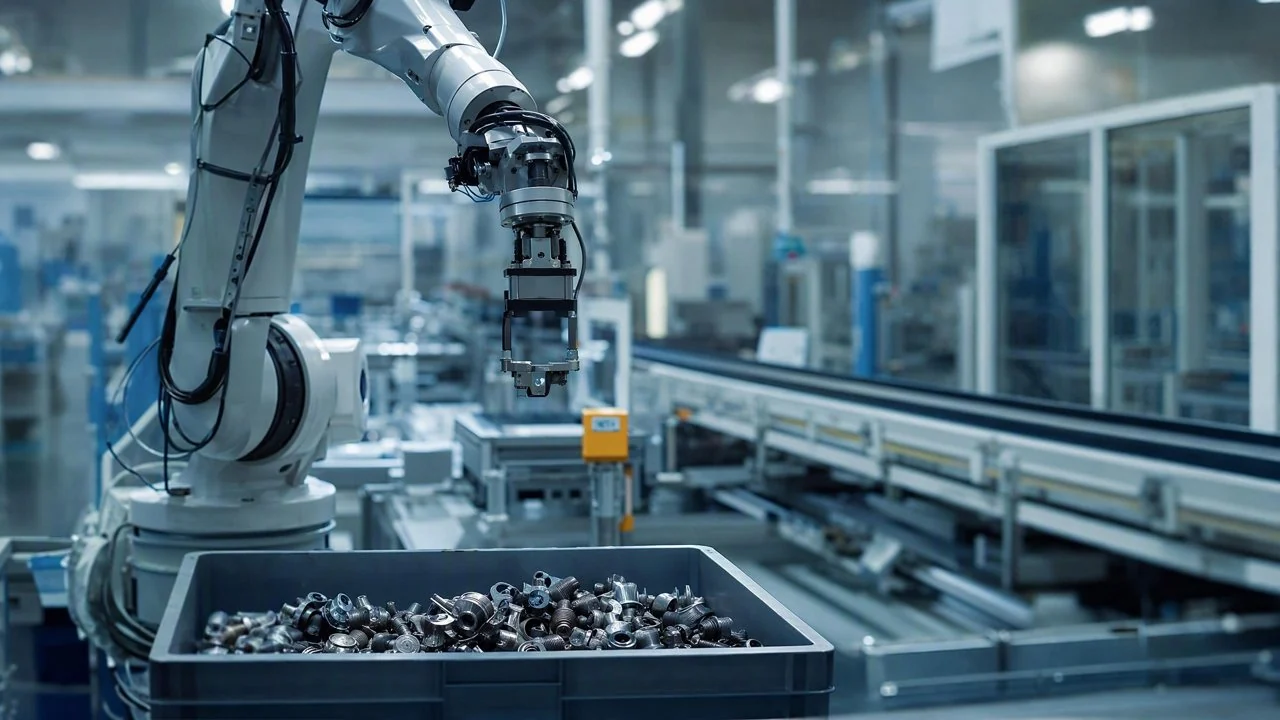
DaoAI 3D Robot Vision from WeLinkirt (featuring proprietary 3D cameras + 6D pose estimation, bin picking, glue/assembly/load-unload guidance, brain-eye-body closed-loop, sub-millimeter hand-eye coordination) achieved a 98% replacement rate for manual inspection and operation in chaotic bin picking for a Tier-2 automotive supplier, effectively reducing line labor costs by over 45%.
The automotive/components manufacturing industry is one of the most automated sectors globally. However, in specific areas like chaotic bin picking of small-batch, multi-variety parts, manual operations still prevail. These scenarios often involve parts with complex geometries, stacked randomly in bins, making it difficult for traditional automation solutions to effectively identify and pick them. This case study focuses on a Tier-2 automotive supplier primarily producing precision structural components for car doors and seating systems. Their production process requires picking a large number of irregularly shaped, chaotically stacked metal stampings from standard bins for subsequent assembly or processing. Given the wide variety of parts and rapid iteration, high demands are placed on the flexibility and identification accuracy of automation systems.
Pain Points: Why This Hurdle Is Difficult to Overcome
On the production line of this Tier-2 automotive supplier, the chaotic bin picking process has long relied on manual labor. The specific pain points are evident in several dimensions: First, **high labor costs and recruitment difficulties**. With rising labor costs year-on-year and a decreasing willingness among younger generations to perform repetitive, physically demanding tasks, the annual labor cost for this single process alone amounted to millions of RMB, with a constant personnel shortage exceeding 20%. Second, **low operational efficiency and poor consistency**. Manual picking speed is limited by physiological factors, averaging only 8–12 parts per minute. Prolonged work easily leads to fatigue, increasing picking error rates and part damage rates, affecting subsequent process cycles and product quality. Third, **long changeover times and insufficient flexibility**. When producing different part models, workers need to re-adapt to part shapes and stacking methods, leading to at least 30 minutes of training and adaptation time for each changeover, severely limiting the efficiency of multi-variety, small-batch production. Finally, **safety hazards and management challenges**. Prolonged bending and repetitive heavy lifting by workers pose occupational health risks; meanwhile, high personnel turnover complicates training and management. These factors collectively result in persistently high overall operating costs for the production line and difficulty adapting to rapidly changing market demands.
The difficulty stems from the limitations of traditional machine vision in complex, unordered scenarios. 2D vision solutions cannot acquire depth information of parts, rendering them ineffective against stacked and occluded parts. Traditional 3D vision solutions often rely on CAD model matching or feature point recognition, making them sensitive to part pose variations and lighting conditions, with high computational loads and poor real-time performance, failing to meet automotive production cycle requirements. Furthermore, factors such as reflective part surfaces and complex shapes further increase identification difficulty. In this context, manual visual inspection became an 'unavoidable' solution, but its high labor costs and efficiency bottlenecks stand in stark contrast to current industry hot topics – the exploration of paths for embodied robots to achieve multi-task collaboration and interactive experiences in large theme parks – highlighting the urgency of automation upgrades in traditional industrial settings.
Technical Principles
The DaoAI 3D Robot Vision solution from WeLinkirt precisely addresses the chaotic bin picking challenge through its proprietary high-precision 3D camera and advanced 6D pose estimation algorithms. Its core technologies include: First, **high-precision structured light 3D cameras**. DaoAI's self-developed 3D camera utilizes multi-mode structured light projection technology, capable of quickly and accurately acquiring 3D point cloud data of parts within the bin. It effectively images even reflective or dark surfaces, avoiding the sensitivity of traditional 2D vision to lighting conditions. Second, **deep learning-based 6D pose estimation algorithms**. WeLinkirt combines advanced Convolutional Neural Networks (CNNs) and point cloud processing techniques to accurately identify target parts from complex 3D point cloud data and calculate their precise position (X, Y, Z) and orientation (Rx, Ry, Rz), i.e., 6D pose, in 3D space in real-time. This algorithm requires only a small amount of CAD models or real sample data for training to achieve high-robustness recognition, stably operating even with slight part deformation or partial occlusion. **The DaoAI system achieved sub-millimeter 6D pose estimation accuracy (<0.5mm) for typical automotive stampings in actual tests, significantly exceeding manual inspection accuracy.** Furthermore, DaoAI's **brain-eye-body closed-loop** control architecture ensures collaboration between the vision system and the robotic arm, with visual feedback continuously adjusting the robotic arm's movement trajectory, enabling precise picking and placement, effectively reducing part damage rates.
Compared to traditional methods, the advantages of WeLinkirt's DaoAI 3D Robot Vision are significant. Traditional rule-based AOI solutions fail when faced with chaotic stacking due to a lack of depth information and flexible recognition capabilities. While manual visual inspection offers high flexibility, its efficiency, consistency, and cost issues remain unresolved. The DaoAI solution combines the efficiency and precision of machines with the intelligent recognition capabilities of deep learning, not only replacing manual visual inspection but also achieving a qualitative leap in accuracy and stability. Its high-precision 3D camera overcomes the limitations of traditional industrial cameras regarding complex lighting and surface properties, while the 6D pose estimation algorithm eliminates reliance on neatly arranged or fixed poses, allowing robots to 'understand' and 'pick' parts from chaotic bins, truly realizing flexible automation. This technical depth enables WeLinkirt to provide reliable and efficient automation solutions in complex and diverse automotive component manufacturing environments.
Typical Application Scenarios
- **Chaotic Picking and Assembly Guidance for Automotive Interior Parts**: Such as stamped parts for car door inner panels or seat frames, picked from bins and guided for robot spot welding, riveting, or screw assembly. The challenge lies in the complex part shapes, diverse stacking poses, and often oil stains or reflections on surfaces, requiring the vision system to stably recognize parts under harsh conditions.
- **Loading and Unloading of Engine/Gearbox Components**: Such as gears, bearings, valve bodies, and other precision cast or machined parts, picked from turnover boxes and precisely placed into machine tool fixtures or assembly stations. The challenge lies in the high precision requirements of parts, necessitating sub-millimeter positioning accuracy after picking to ensure smooth subsequent processing or assembly.
- **Battery Module Cell Sorting and Stacking**: In new energy vehicle battery production, square or cylindrical cells are randomly stacked in bins. DaoAI 3D Vision can guide robots to efficiently and accurately pick cells for stacking or feeding into the next process. The challenge lies in the high surface consistency of cells, indistinct features, and strict requirements for picking force and damage prevention.
- **Insertion and Sorting of Automotive Electronic Components**: Irregular components or connectors on PCB boards, picked from bulk trays and precisely inserted into circuit boards. The challenge lies in the tiny size of components, high density, and extremely high requirements for picking direction and insertion accuracy, which traditional suction nozzle picking struggles to handle with diverse component poses.
- **Supply of Chassis Suspension System Parts**: Such as steering knuckles, shock absorber brackets, and other large, complex structural components, picked from large bins and sent to the final assembly line. The challenge lies in the large size and heavy weight of parts, and the possibility of multi-layer stacking, requiring high depth perception range and anti-occlusion capabilities from 3D vision.
Case Study
A Tier-2 automotive supplier located in East China, primarily supplying body structural components and interior parts to several mainstream domestic automakers. On its stamping parts production line, a critical step involves retrieving stamped metal parts from chaotically stacked bins and then feeding them into the next welding or assembly station. Previously, this process relied entirely on manual operation, with 3–4 workers per production line working in three shifts. Manual efficiency was low, labor intensity was high, and personnel turnover was frequent. Moreover, annual costs due to missed picks, wrong picks, and part damage caused by fatigue resulted in significant rework expenses. To address the escalating labor costs and efficiency bottlenecks, the supplier decided to introduce an automation solution.
After the deployment of WeLinkirt's DaoAI 3D Robot Vision solution, the chaotic bin picking process at this automotive Tier-2 supplier achieved a high degree of automation, reducing line labor costs by over 45% and significantly improving production efficiency and product quality.
The WeLinkirt team deployed the DaoAI 3D Robot Vision solution for this client. Prior to implementation, the annual labor cost for this workstation was as high as 1.2 million RMB, with a picking efficiency of approximately 10 parts/minute and a part damage rate of about 0.5%. After deploying the WeLinkirt DaoAI 3D Robot Vision system, production line data showed that robot picking efficiency increased to 18–22 parts/minute, **an increase of nearly 80% compared to manual operation**. Simultaneously, due to precise 6D pose recognition and picking planning, the part damage rate was reduced to <0.1%. More importantly, this solution reduced the human resource requirement per line from 3–4 people to 0–1 person (only requiring minimal monitoring), **with statistics from this case indicating a reduction in line labor costs of over 45%**. Furthermore, WeLinkirt's DaoAI 3D Robot Vision supports rapid changeovers, adapting to picking different part models with simple software configuration, **reducing changeover time from 30 minutes to 5 minutes**, greatly enhancing the production line's flexible manufacturing capability. The client highly recognized the stability and intelligence of WeLinkirt's DaoAI 3D Robot Vision and plans to replicate and promote it on other production lines.
WeLinkirt Solution and Products
The DaoAI 3D Robot Vision solution provided by WeLinkirt, with its self-developed 3D camera and powerful 6D pose estimation algorithm as its core, offers comprehensive and efficient automated picking capabilities for the automotive components industry. The core capabilities of this solution include: **High-precision 3D perception**: Acquiring high-density point cloud data through proprietary 3D cameras for precise 3D modeling of complex stacked parts within bins. **Robust 6D pose estimation**: Based on advanced deep learning algorithms, it achieves real-time, high-precision 6D pose recognition of unordered parts, stably operating even with partial occlusion and reflections. **Sub-millimeter hand-eye coordination**: DaoAI's brain-eye-body closed-loop system ensures high coordination between the robotic arm and the vision system, achieving sub-millimeter precise picking and placement. **Rapid changeover and multi-variety support**: Through few-shot learning and parameterized configuration, users can quickly import new part CAD models or a small number of real samples for training, completing changeovers within 5 minutes, meeting the demands of multi-variety, small-batch production. **100% local private deployment**: The DaoAI solution supports SDK/API/Docker deployment, with all data processed locally at the client's site, ensuring data security and no leakage of production information.
WeLinkirt's DaoAI 3D Robot Vision not only solves the pain points of traditional automation solutions in chaotic picking but also brings significant business value to customers through its intelligent and flexible features. **The solution boosted line efficiency by 80%**, greatly shortening production cycles; **labor costs were reduced by over 45%**, significantly enhancing corporate profitability and market competitiveness; concurrently, part damage rates and rework costs were reduced, improving product quality. Through the unified foundation of the DaoAI World model, this solution can continuously learn from production line feedback, constantly optimizing recognition accuracy and picking strategies, achieving true intelligent manufacturing. WeLinkirt is committed to providing industrial AI solutions that are closely aligned with actual needs and possess engineering depth, assisting manufacturing industries in their intelligent upgrade.
FAQ
How does WeLinkirt's DaoAI 3D Robot Vision solution achieve chaotic bin picking?
WeLinkirt's DaoAI 3D Robot Vision solution utilizes a proprietary high-precision 3D camera to acquire 3D point cloud data. This data is then processed by a deep learning-based 6D pose estimation algorithm to identify the precise position and orientation of chaotically stacked parts within the bin in real-time. Subsequently, the brain-eye-body closed-loop control guides the robotic arm for sub-millimeter precise picking, automating the process from disorder to order.
What cost advantages can WeLinkirt's DaoAI 3D Robot Vision bring?
WeLinkirt's DaoAI 3D Robot Vision solution primarily reduces line labor costs significantly by replacing manual inspection and operations, with case studies showing reductions of over 45%. Concurrently, it improves picking efficiency and reduces part damage rates, minimizing rework and scrap, further lowering overall production costs and enhancing line flexibility by effectively shortening changeover times.
How long does it take to deploy WeLinkirt's DaoAI 3D Robot Vision solution?
The deployment cycle for WeLinkirt's DaoAI 3D Robot Vision solution typically depends on the complexity of the client's production line and integration requirements. We offer various deployment methods such as SDK/API/Docker, supporting 100% local private deployment. Initial evaluation and system debugging can usually be completed within a few weeks, achieving stable operation and desired results. For specific timelines and cost details, we recommend scheduling a detailed consultation with our engineering team.
Full solution for this scenario: the full inspection solution for Robotics Vision
This article was generated by AI. Customer cases are simulated scenarios based on real product capabilities and figures are illustrative; see product pages for official benchmarks.