
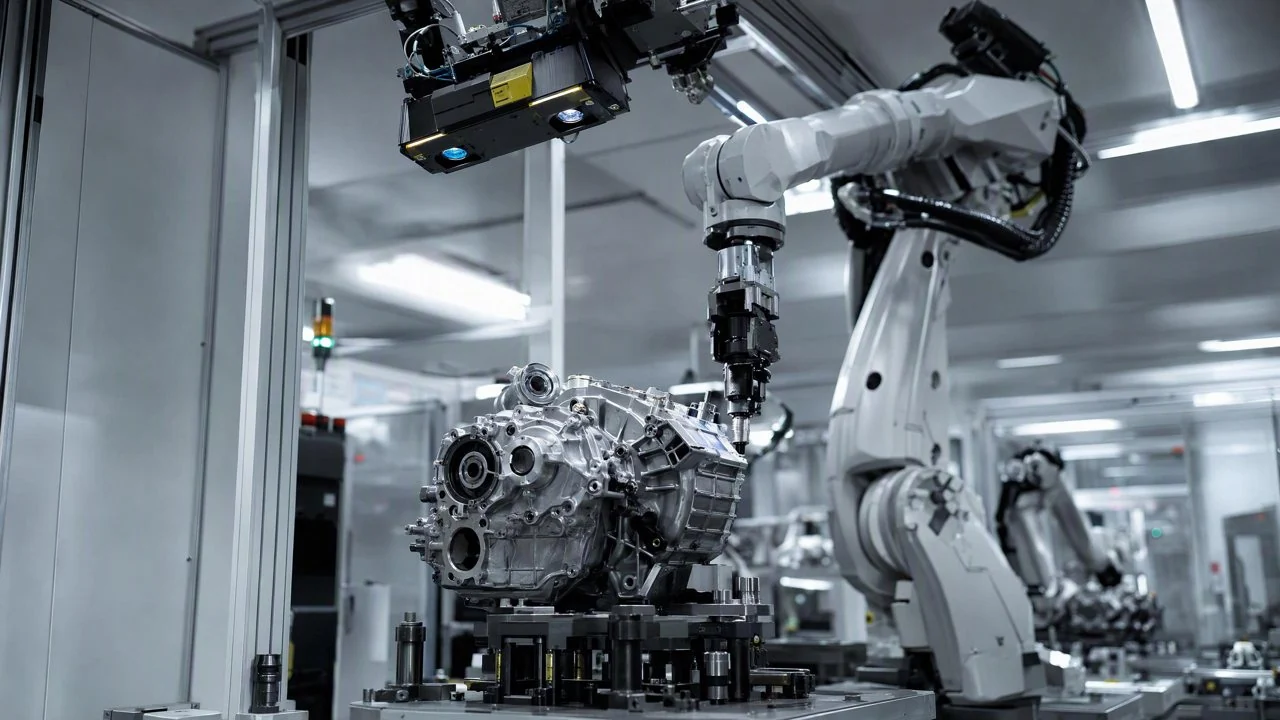
DaoAI 3D Robot Vision (proprietary 3D camera + 6D pose estimation, bin picking, guidance for dispensing/assembly/loading/unloading, brain-eye-body closed loop, sub-millimeter hand-eye coordination), leveraging its unique APDT few-shot self-training capability, elevated the detection rate of misassembly and missing parts in automotive powertrain assembly, caused by part mix-ups or improper installation, from approximately 95% with traditional industry solutions to over 99.7%, effectively ensuring product quality and production efficiency.
DaoAI 3D Robot Vision (proprietary 3D camera + 6D pose estimation, bin picking, guidance for dispensing/assembly/loading/unloading, brain-eye-body closed loop, sub-millimeter hand-eye coordination), leveraging its unique APDT few-shot self-training capability, elevated the detection rate of misassembly and missing parts in automotive powertrain assembly, caused by part mix-ups or improper installation, from approximately 95% with traditional industry solutions to over 99.7%, effectively ensuring product quality and production efficiency. In the automotive/parts manufacturing industry, the powertrain, as the core component of a vehicle, directly impacts vehicle performance, safety, and reliability. With the increasing diversity of automotive product lines and accelerating production cycles, the multitude of sub-components within the powertrain and complex assembly processes demand higher standards for automated inspection. Especially in the assembly of critical components like engines and transmissions, misassembly, missing parts, or model mix-ups of small components such as bolts, gaskets, sensors, and wire harnesses can lead to serious quality issues, even recall risks. Currently, the application of embodied AI robots in automotive manufacturing is gradually shifting from simple repetitive tasks to more complex assembly and inspection tasks, making vision inspection systems increasingly vital in ensuring the quality of critical components and mitigating potential risks.
Pain Points: Why Is This Hurdle So Difficult to Overcome?
On automotive powertrain assembly lines, traditional inspection solutions face multiple challenges. First, [high missed detection and false positive rates] have been a long-standing issue. According to internal data from a Tier-1 supplier, when using traditional rule-based vision or manual inspection, the missed detection rate for powertrain assembly errors could average 0.5% – 1.2%, while the false positive rate fluctuated between 3% – 5%. This led to a large number of good products being incorrectly flagged, increasing unnecessary rework hours. Second, [high changeover costs and cycles]. Facing accelerated automotive product iteration and the increasing demand for co-production of different powertrain models, traditional vision systems often require engineers to spend hours or even days modifying code and adjusting parameters, resulting in long production line downtime and high changeover costs. Furthermore, [difficulty in visual inspection of complex parts]. Powertrain interiors are compact, featuring numerous complex visual scenarios such as reflections, varying colors, stacking, and occlusions. For example, verifying whether bolts are properly seated in deep holes, distinguishing subtle differences in appearance between various sensor models, or confirming correct wire harness routing, all pose severe challenges to the stability and accuracy of traditional 2D vision, and make manual inspection highly prone to fatigue errors.
The root causes of these pain points are multifaceted. From a process perspective, automotive assembly involves multi-level, multi-layer component nesting, with some critical assembly points located in areas difficult for human eyes or traditional cameras to reach. From an imaging perspective, specular reflections on metal parts, oil stains, and subtle color differences between different batches of parts severely interfere with 2D vision's feature extraction. From a cycle time perspective, automotive production lines demand extremely high inspection speeds, disallowing delays in the inspection stage that could affect overall line efficiency. From a risk management perspective, any minor misassembly or missing part can lead to significant quality risks and recall costs. Moreover, when embodied AI robots perform complex assembly tasks, without high-precision, adaptive visual feedback, their operational accuracy and reliability will be greatly compromised, increasing operational risks and complicating subsequent insurance coverage and risk management.
Technical Principles
WeLinkirt's DaoAI 3D Robot Vision system, with its proprietary 3D camera and deep learning algorithms, fundamentally addresses these challenges. Its core technology lies in high-precision 3D morphology reconstruction and 6D pose estimation, coupled with innovative APDT (Auto-Programmed Deep Learning Training) few-shot self-training capabilities. The proprietary DaoAI 3D camera utilizes structured light technology to rapidly acquire high-density point cloud data of the workpiece surface, reconstructing 3D morphology with sub-millimeter precision. This enables the system to overcome reflection, shadow, and low-contrast issues that traditional 2D vision struggles with, directly obtaining the true geometric information of parts. Building on this, DaoAI 3D Robot Vision employs advanced deep learning models for 6D pose estimation, simultaneously identifying the target object's position (X, Y, Z) and orientation (Rx, Ry, Rz) in 3D space, providing precise guidance for robotic arms. For instance, when inspecting whether a bolt is fully tightened, the system can not only confirm the bolt's presence but also accurately measure its protrusion height and tilt angle to determine if it is fully seated.
Compared to traditional rule-based AOI systems or manual inspection, WeLinkirt's DaoAI 3D Robot Vision offers advantages in several areas: First, the [APDT few-shot self-training] capability is its most significant highlight. Traditional deep learning models typically require thousands or even tens of thousands of annotated images for training, whereas DaoAI's APDT allows users to complete model training and deployment within 5 minutes using only 1-20 good samples. This means that when the production line undergoes changeover or introduces new products, production line operators can quickly adapt the model without needing specialized vision engineers, greatly reducing downtime and changeover costs. Second, [robustness to complex scenarios] is significantly improved. WeLinkirt's DaoAI 3D camera combined with AI algorithms effectively handles complex conditions such as metal reflections, part color variations, and partial occlusions, ensuring stable and accurate inspection. Finally, the [brain-eye-body closed-loop] capability achieves deep integration between robots and vision systems. DaoAI 3D Robot Vision not only provides inspection results but also feeds high-precision 6D pose information back to the robotic arm in real-time, guiding it for precise gripping, assembly, or correction, forming an intelligent closed-loop control system that elevated a client's powertrain assembly accuracy to sub-millimeter levels, far exceeding traditional solutions.
Typical Application Scenarios
- **Engine Block/Cylinder Head Assembly Inspection:** Detects whether critical components such as bolts, gaskets, injectors, and spark plugs are complete, of the correct model, properly installed, and whether seals are correctly seated. The difficulty lies in the wide variety of components, some of which are installed in concealed positions, making it hard for traditional 2D vision to obtain complete depth information. DaoAI 3D Robot Vision, through high-precision 3D reconstruction, can accurately measure bolt depth in deep holes and gasket thickness, identifying minute deformations.
- **Transmission Housing Assembly Inspection:** Checks the assembly sequence, orientation, and fasteners of components like valve bodies, oil pumps, and gears to ensure they meet requirements. The difficulty lies in the complex internal structure of the transmission, severe reflections from metal parts, and multi-layer stacking, which can create visual blind spots. WeLinkirt's DaoAI 3D Vision effectively mitigates reflection interference, using 6D pose estimation to precisely determine the installation position and angle of each component.
- **Wire Harness Plugging and Fastening Inspection:** Verifies whether wire harness connectors are fully inserted, clips are fastened, and wire routing conforms to design specifications, preventing electrical failures due to loose connections or incorrect routing. The difficulty lies in similar wire colors, flexibility, and dense connection points. DaoAI 3D Robot Vision, combined with AI semantic segmentation, can accurately identify the path and connection status of each wire harness, ensuring no errors or omissions.
- **Sensor and Actuator Installation Inspection:** Confirms the correct model, position, orientation, and connections of various sensors (e.g., oxygen sensors, crankshaft position sensors) and actuators (e.g., throttle bodies). The difficulty is that different sensor models may have only subtle appearance differences, leading to misjudgments by traditional methods. DaoAI 3D Robot Vision's APDT few-shot self-training capability can quickly learn and distinguish these subtle differences, achieving high-precision inspection.
- **Powertrain Final Appearance and Dimensional Consistency Inspection:** Performs a comprehensive scan of the assembled powertrain to check for bumps, scratches, deformation, and whether key dimensions meet tolerance requirements. The difficulty lies in the large inspection area and the high demands for both speed and accuracy. DaoAI 3D Robot Vision can perform full-dimensional scanning and defect detection at high cycle rates, ensuring overall powertrain quality.
Case Study
A leading Tier-1 automotive parts supplier's powertrain assembly line had long faced rework and quality risks due to misassembly and missing parts. Previously, this production line primarily relied on manual inspection and some rule-based vision systems for quality control. In one particular case, their core pain point was the misassembly and missing parts of the engine control unit (ECU) bracket and wire harness clips, as well as the confusion of individual sensor models. Before implementation, production line data showed that the missed detection rate for this process was approximately 0.8%, with a false positive rate as high as 4.5%, leading to an additional daily input of 2-3 workers for re-inspection and rework, severely impacting production efficiency. Concurrently, due to the complexity of component models, each product changeover required at least 8 hours of downtime for vision system adjustments.
The APDT few-shot self-training capability of WeLinkirt's DaoAI 3D Robot Vision reduced our line changeover time from 8 hours to less than 10 minutes, significantly increasing production flexibility.
The client adopted the WeLinkirt DaoAI 3D Robot Vision system, with a focus on its APDT few-shot self-training function. In the initial phase of the project, by collecting only 15 good samples of the assembled ECU bracket and wire harness clips, the DaoAI system completed model training within 8 minutes. After deployment, actual measurement data showed that the detection rate for assembly defects consistently improved to over 99.7%, with the missed detection rate reduced to <0.3%. Concurrently, the false positive rate significantly decreased to 0.8%, substantially reducing the pressure of manual re-inspection. More importantly, in this case, when the production line switched product models, operators only needed to provide 3-5 good samples of the new product to complete model self-training and deployment within 5 minutes. This reduced changeover downtime from the original 8 hours to less than 10 minutes, greatly enhancing the flexibility and efficiency of the production line. The successful deployment of WeLinkirt's DaoAI 3D Robot Vision not only improved the client's quality control but also provided reliable visual assurance for the broader application of embodied AI robots in complex assembly scenarios.
WeLinkirt Solutions and Products
WeLinkirt provides a comprehensive solution for automotive powertrain assembly errors and missing parts, based on DaoAI 3D Robot Vision. This solution centers on a proprietary high-precision 3D camera, combined with advanced deep learning algorithms, to achieve accurate perception of complex 3D scenes. Core capabilities include: [Sub-millimeter 6D pose estimation] to ensure precise judgment of assembly position and orientation; [Bin Picking] capability, enabling robots to accurately identify and pick target parts from cluttered bins, enhancing automation in feeding; [Guidance for dispensing/assembly/loading/unloading] functions, providing real-time, high-precision visual navigation for collaborative robots, ensuring the accuracy of assembly actions. In practical application, WeLinkirt's DaoAI 3D Robot Vision system, through its APDT few-shot self-training function, greatly simplifies model building and changeover processes. Users do not need deep learning expertise; they can simply upload a small number of good samples via an intuitive graphical interface, and the system automatically completes model optimization and deployment. Furthermore, WeLinkirt's DaoAI World model, as a unified AI foundation, endows the system with powerful semantic understanding and cross-scenario generalization capabilities, allowing it to continuously learn from production line feedback, constantly improving detection accuracy and efficiency. Deployment methods are flexible and diverse, supporting various integration methods such as SDK/API/Docker, and allowing for 100% local private deployment to ensure customer data security.
Through the deployment of WeLinkirt's DaoAI 3D Robot Vision, clients can achieve [high-precision full inspection] of powertrain assembly defects, reducing the missed detection rate to <0.3%, and significantly [lowering the false positive rate], reducing unnecessary re-inspection steps, thereby [reducing operational costs]. Concurrently, its [APDT few-shot self-training] capability shortens production line changeover time from hours to minutes, greatly [enhancing production line flexibility and efficiency]. These quantifiable results directly translate into significant business value, including: improving product quality, reducing recall risks; decreasing manual re-inspection efforts, optimizing human resource allocation; shortening product time-to-market, enhancing market competitiveness; and providing robust technical support for the broader application of embodied AI robots on production lines, effectively managing potential risks brought by automation.
FAQ
How does DaoAI 3D Robot Vision's APDT few-shot self-training differ from traditional deep learning training?
Traditional deep learning models typically require large-scale, diverse, and annotated datasets for training, which is time-consuming and labor-intensive, and has poor adaptability to new product changeovers. DaoAI 3D Robot Vision's APDT (Auto-Programmed Deep Learning Training) few-shot self-training technology, through innovative self-supervised learning and transfer learning mechanisms, requires only 1-20 good samples to complete model training and deployment within minutes. This significantly reduces data annotation costs and model iteration cycles, making it particularly suitable for multi-model, small-batch production scenarios in the automotive industry.
How does DaoAI 3D Robot Vision handle complex reflections or occlusions in automotive assembly?
DaoAI 3D Robot Vision utilizes a proprietary structured light 3D camera that actively projects specific light patterns and captures their deformation to precisely reconstruct the workpiece's 3D morphology. Unlike traditional 2D vision, which is susceptible to reflections and shadows, 3D data directly reflects the object's geometry, offering stronger robustness to lighting and surface material variations. Combined with advanced 6D pose estimation algorithms, it can accurately identify and locate target parts even under partial occlusion or complex structures, ensuring assembly precision.
What is the investment and payback period for deploying the DaoAI 3D Robot Vision system?
The investment for deploying the DaoAI 3D Robot Vision system is influenced by specific application scenarios, required inspection accuracy, and integration complexity. While the initial investment may be higher than traditional rule-based vision, the benefits of high precision, low false positives, rapid changeover, and reduced manual re-inspection and rework typically lead to a return on investment within 6-18 months. We offer flexible deployment options and professional evaluation services. We recommend contacting our sales team for a detailed quote and ROI analysis tailored to your specific needs.
Full solution for this scenario: Robotics Vision industry solutions · AI Vision Inspection for Vehicle Assembly Errors & Missing Parts
This article was generated by AI. Customer cases are simulated scenarios based on real product capabilities and figures are illustrative; see product pages for official benchmarks.