
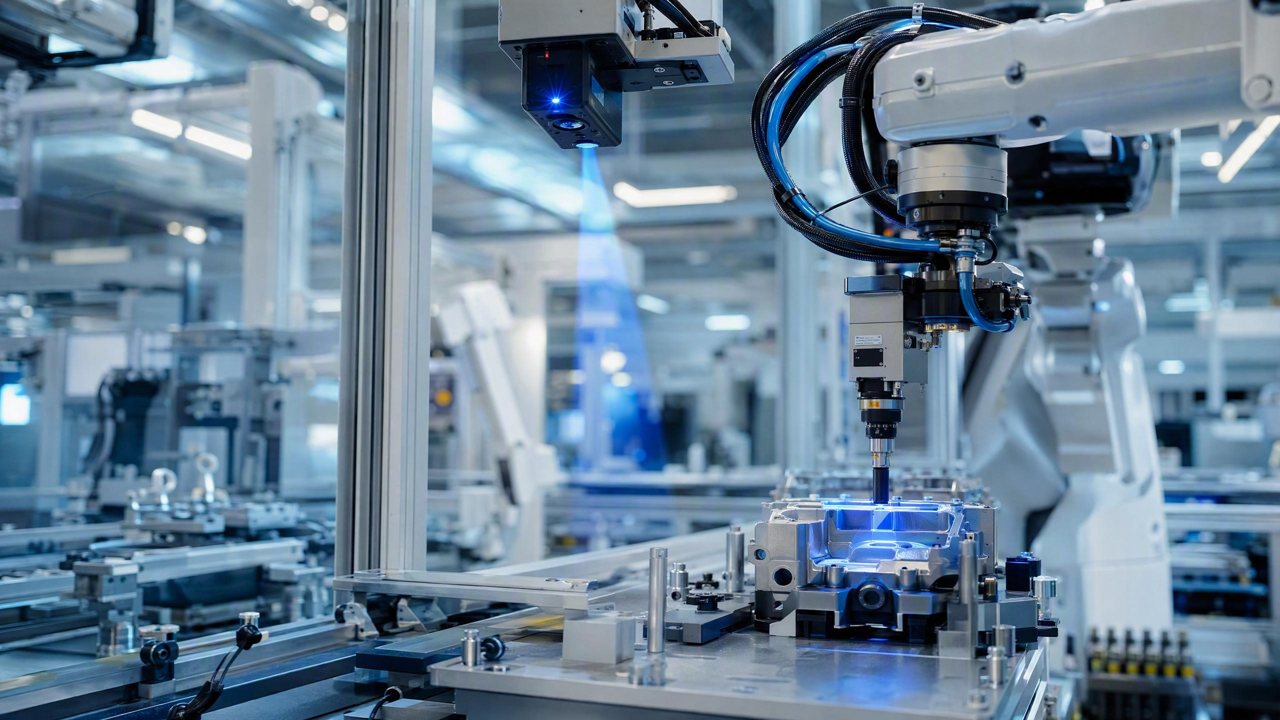
DaoAI 3D Robot Vision (proprietary 3D camera + 6D pose estimation, bin picking, glue dispensing/assembly guidance, brain-eye-body closed-loop, sub-millimeter hand-eye coordination), through high-precision 3D perception and intelligent decision-making, has reduced the false positive rate in automotive fastener tightening from an industry-typical 15% to <3%, significantly alleviating the burden of manual re-inspection.
The automotive/parts manufacturing industry, as the cornerstone of modern industry, sees its level of automation and intelligence directly determine product quality, cost, and market competitiveness. In the assembly process of automotive components, fastener tightening is a critical step, directly related to the vehicle's structural strength, safety, and long-term reliability. Any misalignment, missed tightening, stripped threads, or insufficient torque can lead to serious quality defects and even safety incidents. Therefore, efficient and precise inspection of fastener tightening quality is a common challenge for automotive manufacturers. Traditional inspection methods often rely on manual sampling or rule-based 2D vision systems. However, in complex and variable production environments, these methods have limitations in inspection accuracy and efficiency, especially when dealing with visual occlusion, reflection interference, and multi-model mixed-line production. The high false positive rate consistently burdens downstream manual re-inspection.
Pain Points: Why This Hurdle Is Difficult to Overcome
In the quality inspection of automotive fastener tightening, enterprises commonly face multiple pain points. First, **high false positive rates lead to significant manual re-inspection pressure**. In a mid-sized automotive parts assembly plant, the false positive rate of traditional 2D vision solutions reached 15%. This meant that for every 1000 fasteners inspected, approximately 150 were incorrectly marked as defects, requiring manual re-verification. This not only added substantial re-inspection hours—production data showed that this step required at least 3 quality inspectors working 6 hours daily for re-inspection—directly increasing operational costs and slowing down the overall production rhythm. Second, there was a **risk of missed detections in complex conditions**. Due to the wide variety of fasteners (bolts, nuts, screws, etc.), varying sizes, and potential differences in installation depth and angle, coupled with partial occlusion, surface glare, or oil stains in some areas, traditional vision systems struggled to acquire stable and accurate image information, leading to a higher risk of missing actual defects. Finally, **poor adaptability to multi-model mixed-line production** was a major issue. The automotive industry experiences rapid model iterations, and production lines often need to produce multiple types of parts simultaneously, involving different fastener models. Traditional solutions required several hours for parameter adjustment and recalibration during model changeovers, severely impacting production efficiency and flexibility.
The root cause of these difficulties lies in the fact that traditional 2D vision systems can only acquire planar grayscale or color information, unable to perceive the true three-dimensional spatial form of objects. When fasteners have slight tilts, depth variations, or are partially obscured by cables or other components, 2D image features change drastically, leading to misjudgments. Simultaneously, metal fastener surfaces are prone to specular reflection, easily generating false defects under uneven lighting or changing ambient light, further pushing up the false positive rate. Moreover, traditional rule-based AOI systems lack generalization capabilities and perform poorly in identifying new defect types or with limited samples, requiring extensive manual intervention. These issues align with the urgent demand for high-precision, low-false-positive visual perception capabilities in the development of low-cost humanoid robot platforms for lightweight industrial applications, highlighting the critical role of 3D vision technology in enhancing automation.
Technical Principles
The WeLinkirt DaoAI 3D Robot Vision system fundamentally addresses these pain points through its core **proprietary high-precision 3D camera** and **6D pose estimation algorithm**. Our 3D camera utilizes structured light projection technology to quickly and accurately acquire high-density point cloud data of object surfaces, reconstructing fine 3D geometries with sub-millimeter precision. This means the system is no longer limited by the planar information of 2D images but directly perceives the true height, depth, tilt angle, and other 3D features of the fastener. For example, to detect if a bolt is fully tightened, the DaoAI system can measure the height difference between the bolt head and the mounting surface, and whether the threads are fully recessed. Even under uneven lighting or partial occlusion, it can make accurate judgments based on 3D geometric data.
Compared to traditional rule-based 2D AOI or manual inspection, the advantages of WeLinkirt DaoAI 3D Robot Vision are manifold: First, **high-precision 6D pose estimation** accurately identifies the spatial position and orientation (X, Y, Z, Rx, Ry, Rz) of fasteners. Even if fasteners are randomly stacked in a bin or slightly shaking on the assembly line, they can be precisely located and guided for robotic manipulation. Second, the **powerful AI vision foundational model** combined with APDT (Active Positive Data Training) few-shot learning capability allows for rapid training of robust detection models with only 1-20 good samples. This enables the system to effectively filter out pseudo-defects caused by glare, oil stains, etc., significantly reducing the false positive rate. In actual production lines, WeLinkirt DaoAI 3D Robot Vision consistently keeps the false positive rate for fastener tightening below <3%, far surpassing traditional solutions. Finally, **brain-eye-body closed-loop control** achieves deep integration between the vision system and the robot body, attaining sub-millimeter hand-eye coordination accuracy through real-time feedback and adjustment. This ensures that the robot can precisely guide tightening tools or re-verify/correct detected defects, thereby enhancing automation and product quality. This advanced technical architecture also provides a solid foundation for the future application of humanoid robots in complex industrial scenarios.
Typical Application Scenarios
- **Bolt/Nut Tightening Completion Detection**: Through 3D geometry reconstruction, detect whether bolts or nuts are flush with the mounting surface or have reached a specified depth, preventing loose connections or component damage due to under- or over-tightening. Challenges include varying bolt head features and mounting hole depths for different models.
- **Fastener Missing/Misplaced Detection**: Utilize 6D pose estimation and object recognition to accurately determine if a fastener is present at each preset position and if its model is correct, preventing omissions or incorrect installations. Challenges involve precise identification of small fasteners and rapid switching in multi-variety mixed-line production.
- **Lock Washer/Circlip Installation Status Detection**: Inspect whether lock washers are correctly installed, missing, deformed, or misaligned, ensuring their anti-loosening function. Challenges lie in the thin profile of washers and their color similarity to the main component.
- **Thread Stripping/Damage Detection**: Analyze thread integrity through high-resolution 3D images to identify stripped, broken, or deformed threads. Challenges involve micron-level defect features and complex helical thread structures.
- **Torque Marking/Adhesive Application Guidance**: For some critical fasteners requiring torque marking or adhesive sealing after tightening, DaoAI 3D Robot Vision can guide robotic arms to precisely execute these subsequent operations, ensuring the accuracy of marking or adhesive application position and trajectory.
Case Study
A leading automotive Tier-1 supplier, primarily manufacturing critical powertrain components, needed to inspect the tightening quality of hundreds of key fasteners on its engine block assembly line. Previously, the production line used a rule-based AOI system with 2D cameras. However, due to the complex structure of engine blocks, varying depths of fastener installation, and reflective oily surfaces, the false positive rate remained high. Production data showed an average false positive rate of 18%. This resulted in a large number of “false positive” defects requiring daily manual re-verification. According to the supplier's statistics, at least 4 experienced quality inspectors were needed per shift, spending 5-7 hours on re-inspection, severely hindering overall production efficiency and increasing labor costs. After introducing the WeLinkirt DaoAI 3D Robot Vision solution, the supplier's production line significantly improved. Following initial deployment and model training, the system quickly became stable. Before deployment, the false positive rate for fastener tightening on this line was as high as 18%. **After the WeLinkirt DaoAI 3D Robot Vision system was implemented, the measured false positive rate consistently dropped to <2.5%**. This drastically reduced the number of fasteners requiring manual re-inspection daily, cutting manual re-inspection volume by approximately 86%. Consequently, the re-inspection workload, which previously required 4 quality inspectors, was reduced to just 1 quality inspector for minimal spot checks and anomaly handling, significantly lowering labor costs and operational burden.
"The DaoAI 3D Vision system not only solved our long-standing false positive problem on the production line, but more importantly, it freed up our human resources from tedious re-inspection work, allowing them to focus on more valuable quality management and process optimization." – Production Manager, a leading Automotive Tier-1 Supplier.
WeLinkirt Solutions and Products
For automotive fastener tightening inspection, WeLinkirt provides a core solution based on the DaoAI 3D Robot Vision system. This system centers on our proprietary high-precision 3D camera as the core sensing hardware, combined with powerful 6D pose estimation and “brain-eye-body” closed-loop control capabilities, achieving precise 3D perception of fasteners and robotic operation guidance. For deployment, we offer various integration methods such as SDK/API/Docker, supporting 100% local private deployment to ensure customer data security. For multi-model mixed-line production, the DaoAI 3D Robot Vision system, with its robust APDT few-shot learning capability, can complete new product changeover programming in just 5 minutes, greatly enhancing production line flexibility. Furthermore, the system leverages the unified DaoAI World model foundation for semantic understanding and cross-scenario generalization, continuously learning from production line feedback to optimize detection performance and reduce manual intervention. For instance, in fastener tightening guidance scenarios, DaoAI 3D Robot Vision guides the robot to precisely align the tightening tool with the target through accurate 6D pose feedback, and its sub-millimeter hand-eye coordination accuracy ensures the stability and reliability of the tightening process. For specific inspection needs, we can also integrate the DaoAI AI AOI software system, utilizing its visual foundational model's feature recognition and semantic false positive filtering functions to further enhance detection accuracy and robustness.
Through this solution, WeLinkirt DaoAI 3D Robot Vision has not only significantly reduced false positive and missed detection rates but also substantially improved overall production efficiency and automation levels. Specifically, the solution achieved a **false positive rate reduction of −86%** for fastener tightening defects on the client's production line, cutting manual re-inspection hours from 6 hours to less than 1 hour daily. Simultaneously, its rapid changeover capability reduced traditional multi-hour downtime to just 5min, effectively increasing line utilization. This not only brought direct cost savings to the client but also enhanced product quality and strengthened market competitiveness.
FAQ
What are the core advantages of DaoAI 3D Robot Vision system over traditional 2D vision systems for fastener inspection?
The DaoAI 3D Robot Vision system utilizes a proprietary high-precision 3D camera to acquire 3D morphological data, allowing it to perceive the true height, depth, and pose of objects. This effectively resolves occlusion, glare, and depth variation issues that 2D vision cannot handle. As a result, the system significantly reduces false positive rates and improves inspection accuracy, performing more stably in complex conditions.
What is the approximate cost of deploying the WeLinkirt DaoAI 3D Robot Vision system?
The deployment cost of the DaoAI 3D Robot Vision system is influenced by various factors, including production line scale, inspection accuracy requirements, integration complexity, and required functional modules. We offer flexible hardware and software configuration options and support 100% local private deployment. We recommend contacting our sales team, who will provide a customized solution and detailed quotation based on your specific needs to ensure optimal return on investment.
How does DaoAI 3D Robot Vision adapt to the rapid changeover demands of multi-model mixed-line production in the automotive industry?
The DaoAI 3D Robot Vision system, with its robust APDT few-shot learning capability and the unified DaoAI World model foundation, can quickly train new models with only 1-20 good samples, enabling new product changeover programming to be completed within 5 minutes. This greatly enhances production line flexibility, reduces downtime due to changeovers, and meets the rapid iteration production demands of the automotive industry.
This article was generated by AI. Customer cases are simulated scenarios based on real product capabilities and figures are illustrative; see product pages for official benchmarks.