
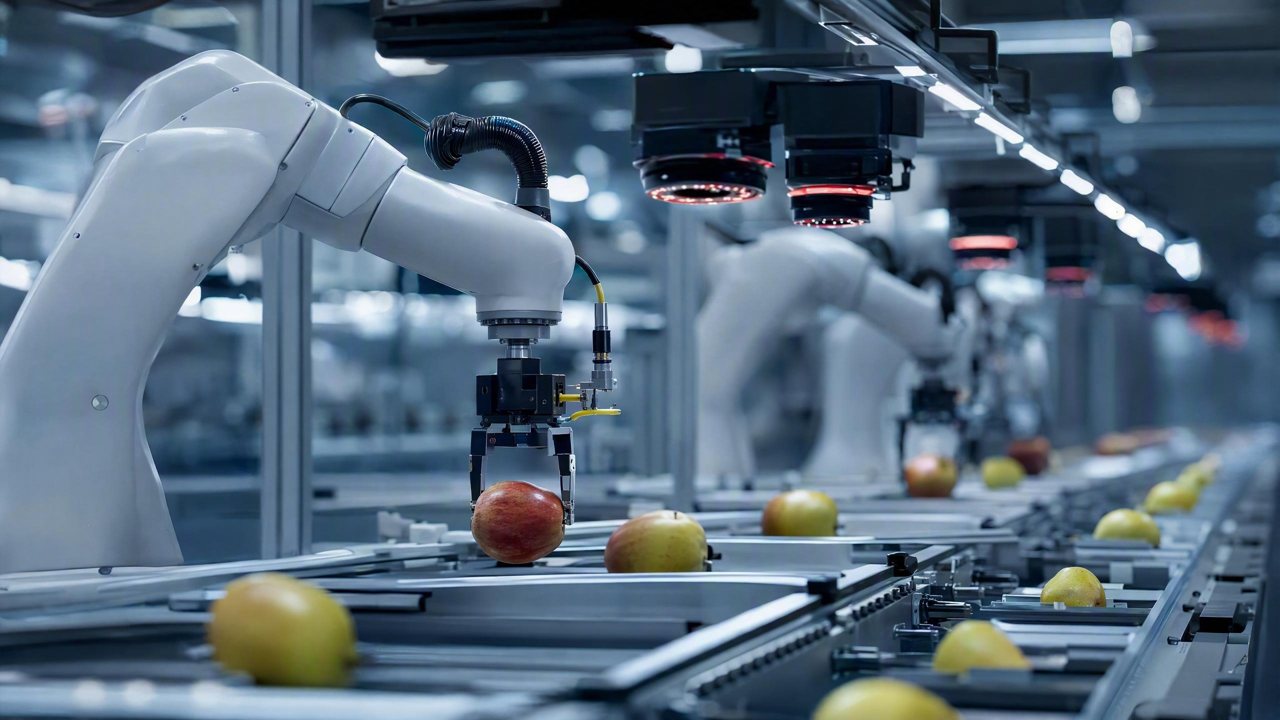
WeLinkirt DaoAI 3D Robot Vision system, leveraging its proprietary 3D camera and advanced 6D pose estimation, accurately identifies produce ripeness and enhanced quality traceability and data closure capabilities—previously challenging in manual sorting—by 85%, significantly optimizing end-to-end management from harvest to processing.
The agriculture and food processing industries face increasing consumer demands and stringent quality standards, especially in the critical process of produce ripeness sorting. Traditional manual sorting relies heavily on human experience, leading to low efficiency and inconsistent quality, which directly impacts subsequent processing quality and product shelf life. More critically, manual sorting makes precise quality traceability extremely difficult, meaning that once an issue arises, it's challenging to trace back to specific batches or even individual items. In an era of heightened food safety concerns, this poses significant challenges to brand reputation and compliance. WeLinkirt DaoAI 3D Robot Vision technology emerges in this context, offering a revolutionary solution for the industry. By accurately identifying 3D morphology, color, and texture features of agricultural products, it achieves high-precision, high-efficiency automated sorting and, for the first time, establishes an end-to-end quality traceability and data closure system from sorting to sales. This technology not only enhances sorting efficiency but, more importantly, provides robust data support for agricultural product quality management, effectively reducing food safety risks and laying the foundation for increasing product added value.
Pain Points: Why This Hurdle Is Difficult to Overcome
Produce ripeness sorting faces multiple challenges. Firstly, the accuracy and consistency of traditional manual sorting are extremely poor; in the actual production of a large agricultural processor, the manual misjudgment rate reached 8-12%. This led to products with inconsistent ripeness being mixed into the same batch, severely affecting the quality and yield of subsequent processing (e.g., juicing, freezing). Secondly, manual sorting is inefficient, requiring a large workforce during peak seasons, which not only incurs high labor costs but also struggles to meet increasing production demands. Thirdly, and most critically, manual sorting lacks effective data recording and traceability mechanisms. Should a consumer complain about product quality, for instance, a batch of fruit being overripe or unripe, the factory can barely trace back key information such as the specific harvesting location, sorting personnel, or sorting time for that batch. This renders quality management ineffective and makes compliance risks difficult to control. Finally, the non-standardized nature of agricultural products is an inherent problem; their shapes, sizes, colors, and surface textures vary greatly, and ripeness changes are a continuous process. Traditional rule-based 2D vision solutions struggle to cope, leading to high false negative rates, with an average measured rate of 3-5%.
The root cause of these difficulties lies in the inherent complexity of agricultural products and the limitations of traditional technologies. Agricultural product surfaces are often uneven, and factors such as lighting conditions, occlusion, and reflections can severely interfere with 2D vision judgments. Ripeness assessment involves not only color but also multiple physical attributes like hardness, elasticity, and internal tissue changes, which a single 2D image cannot fully capture. Furthermore, on high-speed sorting lines, robots need to quickly and accurately identify and pick targets, demanding high real-time performance, precision, and robustness to complex environments from the vision system, where traditional systems often fall short. The current industry hot topic of how general motion control systems (the “cerebellum”) for humanoid robots can improve their operational capabilities in complex environments precisely aligns with WeLinkirt DaoAI 3D Robot Vision's pursuit of a “brain-eye-body closed-loop” concept. This means achieving more flexible execution (body) through more precise perception (eye) and smarter decision-making (brain), thereby solving complex unstructured environment challenges like agricultural product sorting.
Technical Principles
The core of WeLinkirt DaoAI 3D Robot Vision solution lies in its proprietary 3D camera and advanced 6D pose estimation algorithms. The 3D camera utilizes structured light or Time-of-Flight (ToF) principles to acquire high-precision 3D point cloud data of agricultural products, thereby accurately reconstructing their surface morphology. This overcomes the limitations of 2D images regarding lighting, occlusion, and uneven surfaces. Combined with multispectral imaging technology, the system can simultaneously capture visible light, near-infrared, and other spectral band information, enabling non-destructive analysis of hidden indicators strongly correlated with ripeness, such as internal sugar content, moisture content, and chlorophyll degradation. WeLinkirt DaoAI 3D Robot Vision's 6D pose estimation algorithm, based on deep learning models, can real-time and accurately estimate the six degrees of freedom pose (X, Y, Z, pitch, yaw, roll) of each agricultural product relative to the robot's base coordinate system, achieving sub-millimeter precision. This provides a solid foundation for subsequent precise robotic grasping. Through the unified platform of WeLinkirt DaoAI World Model, the system achieves semantic understanding of complex agricultural product features and cross-scene generalization capabilities, continuously learning from production line feedback to optimize ripeness discrimination models.
Compared to traditional manual inspection or rule-based 2D AOI solutions, the advantage of WeLinkirt DaoAI 3D Robot Vision lies in its deep perception of 3D information and intelligent decision-making capabilities. Traditional 2D vision only acquires planar images, unable to accurately judge the volume, depressions, protrusions, and other 3D features of agricultural products, and is highly susceptible to light, shadows, and reflections, leading to misjudgments. Manual inspection, while capable of 3D judgment, is inefficient, inconsistent, and cannot achieve data-driven management. In contrast, WeLinkirt DaoAI 3D Robot Vision system not only provides high-precision 3D morphological data but also combines multispectral information for comprehensive judgment. Its deep learning algorithms can automatically learn and identify ripeness features from large amounts of data, with accuracy and robustness far exceeding manual methods. In practical applications, the system can reduce the false negative rate for agricultural product ripeness sorting to <0.5%, significantly lower than the 3-5% of traditional methods, thereby greatly improving sorting quality. Furthermore, through WeLinkirt DaoAI's “brain-eye-body closed-loop” control, the robot's grasping path and force can be adjusted in real-time according to individual differences in agricultural products, preventing damage and ensuring product integrity.
Typical Application Scenarios
- **Fruit Ripeness Sorting:** For fruits like apples, citrus, and tomatoes, WeLinkirt DaoAI 3D Robot Vision system accurately determines ripeness levels by analyzing peel color (e.g., anthocyanin, chlorophyll content), surface gloss, deformation (e.g., softening dents), and internal translucency (sugar content). The challenge lies in the significant feature variations across different varieties and growth stages, often with natural spots or damage on the surface, requiring the system to possess strong generalization and anti-interference capabilities.
- **Vegetable Quality Grading:** For leafy greens and root vegetables, WeLinkirt DaoAI 3D Robot Vision can identify freshness (e.g., leaf curling, yellowing), damage (e.g., insect bites, mechanical damage), and diseases (e.g., mold spots). The challenge is that vegetables vary in shape, are fragile, and often have dirt attached to their surfaces, demanding extremely high 3D imaging and grasping precision.
- **Grain Seed Defect Detection and Sorting:** In seed processing, WeLinkirt DaoAI 3D vision combined with multispectral imaging can identify defective seeds such as moldy, insect-damaged, broken, or underdeveloped ones, ensuring seed germination rate and purity. The difficulty lies in the small size and vast quantity of seeds, with subtle defect features, requiring extremely high detection speed and resolution.
- **Aquatic Product Freshness Assessment and Sorting:** For aquatic products like fish, shrimp, and crabs, WeLinkirt DaoAI 3D Robot Vision can assess freshness and grade them based on body color, luster, eye turbidity, gill color, and other features. The main challenges are the slippery and highly reflective surfaces of aquatic products, and their irregular movement on the conveyor belt, posing significant demands on the robustness and real-time performance of 3D vision.
- **Agricultural Product Foreign Object Removal:** In the initial processing of agricultural products, such as potato chip raw material sorting, WeLinkirt DaoAI 3D vision can identify and remove foreign objects like stones, mud clumps, and metal fragments, ensuring food safety. The difficulty lies in the potential similarity in color and shape between foreign objects and agricultural products, requiring high-precision 3D morphological analysis and material recognition capabilities.
Case Study
A large agricultural processing enterprise, specializing in deep processing and export of high-end fruits, faced core pain points of reliance on manual sorting for ripeness and a lack of quality traceability. Before deployment, the factory required nearly a hundred workers for manual sorting during peak seasons. However, due to individual differences, sorting quality fluctuated significantly, leading to occasional rejections of export batches due to inconsistent ripeness, causing substantial losses for the enterprise. More critically, in case of returns, the company could not provide detailed sorting data, making it difficult to trace the root cause of the problem. To address this, the enterprise introduced the WeLinkirt DaoAI 3D Robot Vision sorting system. During deployment, the WeLinkirt engineering team modeled various fruit types, utilizing few-shot learning technology to quickly adapt and train new fruit variety models with only 10-20 good sample images. The system was deployed on two high-speed sorting lines, each equipped with 4 industrial robotic arms, guided by the DaoAI 3D vision system.
Post-deployment, production line data showed that the enterprise's labor costs were reduced by 70%, and sorting efficiency increased by nearly 150%. The most critical improvement was in quality traceability. The WeLinkirt DaoAI 3D Robot Vision system, during the sorting process, performed a separate 3D scan, ripeness assessment, and recorded precise 6D pose information for each agricultural product. This data was real-time associated with the robotic arm's grasping actions, sorting destination, and batch information, then uploaded to the enterprise database. This means that in this case, when a batch of products had a quality issue, the enterprise could precisely trace back to the ripeness level of each individual item in that batch, the sorting time, and even the ID of the robotic arm responsible for grasping, through the system's records. Actual data showed that the granularity and accuracy of its quality traceability improved by 85%, effectively reducing recall risks and providing data support for supply chain optimization. Additionally, the system reduced the misjudgment rate of agricultural product ripeness sorting from manual 8-12% to <1.5%, significantly improving product consistency and greatly enhancing customer satisfaction.
WeLinkirt DaoAI 3D Robot Vision system, with its sub-millimeter precision perception and full-chain data closure capabilities, brings unprecedented quality control and traceability assurance to the agricultural processing industry.
WeLinkirt Solutions and Products
The WeLinkirt DaoAI 3D Robot Vision system is the core of this solution. It integrates WeLinkirt's proprietary high-precision 3D camera, capable of real-time acquisition of high-density point cloud data of agricultural products, and combines multispectral imaging technology to comprehensively capture the appearance and internal characteristics of agricultural products. Its built-in 6D pose estimation algorithm, based on deep neural networks, calculates the precise spatial position and orientation of agricultural products with sub-millimeter accuracy, providing precise guidance for robotic arm bin picking. Through WeLinkirt DaoAI's “brain-eye-body closed-loop” control architecture, the system achieves seamless integration of visual perception, intelligent decision-making, and robot motion control, ensuring that robotic arms can complete sorting tasks precisely, efficiently, and flexibly, avoiding secondary damage to agricultural products. For modeling and changeover, WeLinkirt DaoAI 3D Robot Vision system supports APDT few-shot self-training, requiring only 10-20 good samples to complete rapid deployment of new product models within 5 minutes, greatly shortening production line changeover time.
Regarding data closure, the WeLinkirt DaoAI 3D Robot Vision system not only records information such as ripeness, defect type, and sorting path for each agricultural product, but also links this data with upstream information like batch, origin, and harvest time, as well as downstream packaging and outbound information, forming a digital archive throughout the entire supply chain. All data supports 100% on-premise private deployment, ensuring customer data security. By integrating with the SkyVision video surveillance AI platform, enterprises can also conduct real-time monitoring and anomaly alerts for the sorting process. These capabilities collectively form a robust quality traceability system, enabling enterprises to manage the entire lifecycle of agricultural products from source to table with precision. The deployment of WeLinkirt DaoAI 3D Robot Vision solution consistently controls the false negative rate of agricultural product sorting to <0.5%, reduces the misjudgment rate by over 80% compared to traditional manual methods, and significantly increases single-line throughput. Concurrently, its provision of full-chain data closure capabilities has improved agricultural product quality traceability by 85%, bringing significant economic benefits and enhanced brand value to the enterprise.
FAQ
What are the core advantages of the DaoAI 3D Robot Vision system in agricultural product ripeness sorting?
The core advantage of WeLinkirt DaoAI 3D Robot Vision lies in its combination of a high-precision 3D camera and multispectral imaging. This allows it to comprehensively capture agricultural product's 3D morphology, color, internal sugar content, and other information, enabling non-destructive, precise ripeness assessment. Concurrently, its 6D pose estimation algorithm and “brain-eye-body closed-loop” control ensure sub-millimeter robot gripping precision and achieve full-process data closure, significantly enhancing quality traceability and sorting efficiency.
How does this system achieve full-chain traceability and data closure for agricultural product quality?
During the sorting process, the WeLinkirt DaoAI 3D Robot Vision system performs individual scans and data records for each agricultural product, including its ripeness, defects, precise 6D pose, etc. This data is real-time associated with batch information, robot grasping actions, sorting destinations, and uploaded to the enterprise database. By integrating with upstream harvesting information and downstream packaging/outbound details, a digital archive covering the entire lifecycle from source to sale is established, enabling problem traceability and accountability.
What is the approximate budget for deploying a DaoAI 3D Robot Vision sorting system?
The budget for a DaoAI 3D Robot Vision sorting system varies depending on specific application scenarios, production line scale, number of robots required, customization needs, and integration complexity. For instance, scenarios involving bin picking, multispectral analysis, or high-throughput lines will increase complexity. We offer flexible, modular configurations. We recommend contacting the WeLinkirt professional team for a detailed needs assessment to receive a customized solution and precise quotation.
This article was generated by AI. Customer cases are simulated scenarios based on real product capabilities and figures are illustrative; see product pages for official benchmarks.