
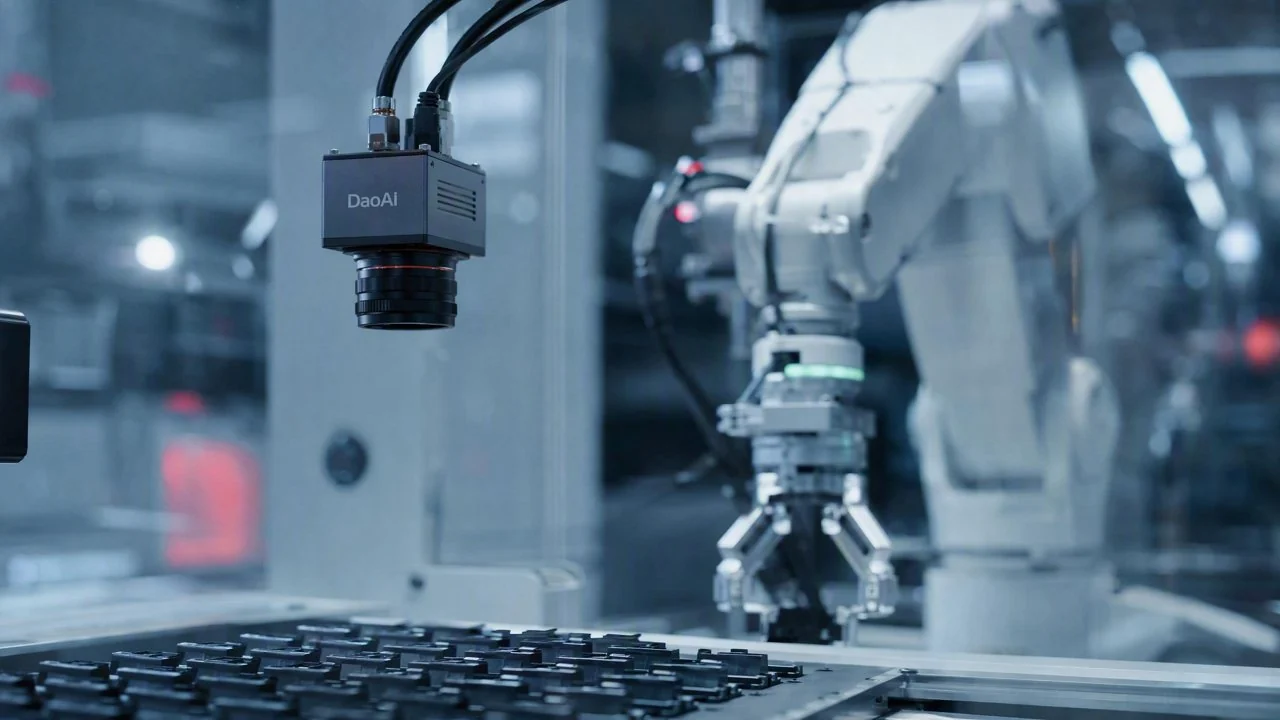
WeLinkirt DaoAI 3D Robot Vision (self-developed 3D camera + 6D pose estimation, bin picking, gluing/assembly/loading & unloading guidance, brain-eye-body closed-loop, sub-millimeter hand-eye coordination) effectively solves missing and wrong part issues in consumer product assembly through high-precision 3D perception and intelligent decision-making, reducing assembly defect-induced production line rework rate by 60%.
In the consumer goods manufacturing sector, particularly on complex assembly lines for electronics and small appliances, products often involve numerous tiny components. Assembly processes are intricate and demand high cycle times. Any missing, wrongly assembled, or improperly fitted part can lead to product malfunction, or even safety hazards. Traditional sampling or manual visual inspection methods often fall short when facing high-speed and high-precision requirements, proving inefficient and prone to missed defects, thus failing to meet the stringent quality demands of modern manufacturing. Especially with the growing trend of large-scale commercial deployment of embodied intelligent robots in industrial scenarios, empowering robots to 'understand' complex assembly scenes and achieve precise quality control with data closed-loop has become a key industry focus.
Pain Points: Why This Hurdle Is Difficult to Overcome
Quality control on consumer product assembly lines faces multiple challenges. Firstly, traditional manual visual inspection, when dealing with complex and diverse components and high-intensity repetitive tasks, is susceptible to fatigue and distraction, leading to inconsistent detection. Actual data from a consumer product factory shows that the average missed detection rate for manual inspection is around 0.8%, with a false alarm rate as high as 5%. Secondly, even with traditional rule-based machine vision systems, issues like lighting variations, product surface reflections, similar component colors, and minute size differences often lead to insufficient model generalization and lengthy changeover downtime. Production line data indicates that each product changeover typically requires 2-4 hours of downtime for visual parameter adjustments. Furthermore, subtle assembly deviations, such as loose screws, incompletely latched buckles, or improper cable routing, are hard to detect with the naked eye, and traditional 2D vision struggles to identify their 3D states. These pain points not only directly impact product quality but also significantly increase rework costs and customer complaint risks, hindering the advancement of embodied intelligent robots towards more refined and intelligent assembly operations.
The root cause of these difficulties lies in the fact that components for consumer product assembly are often tiny, structurally complex, and feature numerous repetitive characteristics, making it challenging for traditional vision algorithms to differentiate them precisely. Simultaneously, positional changes, occlusions, and the optical properties of materials themselves (e.g., high reflectivity, semi-transparency) during assembly pose significant challenges for imaging and recognition. Moreover, fast production line cycles demand that detection systems complete high-precision judgments within extremely short periods, a balance that traditional solutions struggle to achieve. A deeper reason is the lack of a closed-loop system that tightly integrates 'perception (eyes),' 'decision-making (brain),' and 'execution (body),' preventing robots from achieving adaptive, self-learning quality control in complex, dynamic assembly environments.
Technical Principles
WeLinkirt DaoAI 3D Robot Vision system fundamentally solves the problem of missing and wrong parts in consumer product assembly through its self-developed high-precision 3D camera and advanced 6D pose estimation algorithm. Our 3D camera can acquire high-density point cloud data, accurately reconstructing the 3D morphology of the object under inspection, effectively capturing even micron-level morphological differences. Combined with WeLinkirt's unique APDT positive/few-shot learning technology, the system only requires 1-20 good sample images to complete model training and automatic programming within 5 minutes, significantly shortening deployment and changeover times. More importantly, DaoAI 3D Robot Vision integrates visual perception, AI decision-making, and robot motion control through a “brain-eye-body closed-loop” mechanism. When the 3D camera detects an assembly defect, the AI decision engine immediately analyzes the defect type and location, guiding the robotic arm to correct or mark it, achieving sub-millimeter hand-eye coordination accuracy, ensuring each assembly meets standards, and controlling assembly precision errors within ±0.05mm.
Compared to traditional rule-based AOI or 2D vision systems, WeLinkirt DaoAI 3D Robot Vision's advantage lies in its deep understanding of 3D information. Traditional 2D vision has blind spots when dealing with 3D features like height, depth, and coplanarity, and is susceptible to lighting and shadows, whereas 3D vision provides complete spatial information. Furthermore, our system employs transfer learning and semantic false alarm filtering technology, effectively identifying and filtering out false alarms caused by background interference, reflections, etc., significantly enhancing detection robustness and accuracy. This deep learning-based 3D vision solution not only achieves precise detection of missing and wrong parts but also quantitatively evaluates minute deformations and positional deviations during assembly, providing a solid data foundation for quality traceability. In practical applications, this system can reduce the false alarm rate by over 85%, significantly reducing the burden of manual re-inspection.
Typical Application Scenarios
- **Missing/Wrong Component Detection on Electronic Product Motherboards:** On assembly lines for motherboards in consumer electronics like smartphones and tablets, WeLinkirt DaoAI 3D Robot Vision can precisely detect whether miniature resistors, capacitors, connectors, and other components are missing, correctly oriented, or have adequately soldered joints. The challenge lies in the extremely small size and high density of components, along with many similarly colored and shaped parts, which confuse traditional 2D vision, while 3D vision can use height information for differentiation.
- **Small Appliance Casing Buckle/Screw Assembly Integrity Detection:** In the casing assembly of small appliances like hair dryers and electric toothbrushes, ensuring all buckles are fully latched and screws are tightened to the specified height is crucial. DaoAI 3D Vision can detect buckle gaps and screw protrusion heights through 3D morphology reconstruction to determine if assembly is complete. Challenges include plastic part deformation, reflections, and the deep structure of screw holes.
- **Cable Routing and Connector Insertion Detection:** In the internal wiring connection process of consumer products, correct cable routing and complete connector insertion directly affect product functionality. WeLinkirt DaoAI 3D Robot Vision can identify the 3D path and bending radius of cables and detect the insertion depth of connectors to ensure reliable connections. Challenges include the flexibility and varied colors of cables, and the difficulty of judging connector insertion status from 2D images.
- **Missing Accessory Detection in Packaging Boxes:** In the final packaging stage of consumer products, ensuring all accessories like chargers, manuals, and additional parts are present. DaoAI 3D Vision can perform 3D scans inside packaging boxes to identify and count internal items, preventing omissions. Challenges include varied shapes of packaged items, inconsistent stacking, and potential occlusions.
Case Study
A leading consumer electronics manufacturer, producing smart speakers, faced severe challenges with missing and wrong parts on its assembly line. Each speaker contained hundreds of tiny components, making manual visual inspection inefficient and prone to missed defects, leading to high rework costs. The factory's previous manual inspection method averaged about 1200 reworked products daily due to assembly issues, with a manual re-inspection false alarm rate between 5-7%. To improve quality control and reduce operational costs, the manufacturer introduced the WeLinkirt DaoAI 3D Robot Vision system. In the initial deployment, we focused on detecting missing and wrongly assembled key connectors and button modules on the speaker's mainboard. Through DaoAI 3D Robot Vision's precise perception and AI decision-making, the system achieved 100% inspection of these defects. Production line data showed that this system reduced manual re-inspection volume by 75%, significantly easing the burden on quality inspectors. Furthermore, thanks to the rapid deployment and low-sample learning capabilities of the WeLinkirt system, the debugging time for the visual inspection system for new product launches was reduced from the original 2-4 hours to less than 15 minutes, significantly enhancing production line flexibility.
“WeLinkirt DaoAI 3D Robot Vision not only helped us achieve a leap in assembly quality, but more importantly, it built a closed-loop system from perception to decision-making to execution, making quality traceability possible.” — Production Director, a Consumer Electronics Manufacturer
WeLinkirt Solutions and Products
WeLinkirt's core solution for consumer product assembly missing/wrong part scenarios is the DaoAI 3D Robot Vision system. This system uses a self-developed high-precision 3D camera as its “eyes” to acquire accurate 3D point cloud data; and the DaoAI AI AOI software system as its “brain,” utilizing visual foundation models and APDT few-shot learning technology to intelligently identify and judge complex assembly defects, requiring only 1-20 good samples for model training. The system deployment supports SDK / API / Docker in various forms and can be 100% privately deployed on-premises, ensuring customer data remains in-house and meets data security compliance requirements. In practical implementation, WeLinkirt's engineering team conducts customized integration and deployment based on the client's specific production line environment and product characteristics. For example, by seamlessly interfacing with existing robotic arms and PLC control systems, it achieves full-process automation from bin picking to precise assembly guidance, and then to post-assembly quality inspection. The DaoAI World model, serving as a unified foundation, endows the system with powerful cross-scenario generalization and continuous learning capabilities, ensuring high performance across evolving product iterations. The WeLinkirt DaoAI 3D Robot Vision system, on a consumer electronics manufacturer's production line, reduced the rework rate due to assembly defects by 60%, effectively improving overall production efficiency.
Through the introduction of WeLinkirt DaoAI 3D Robot Vision, the client not only achieved significant improvements in assembly quality but also established a comprehensive quality traceability system. The assembly process and inspection results for each product are digitally recorded, allowing for rapid traceability to specific stages and batches in case of quality issues. This data closed-loop mechanism provides valuable data support for continuous optimization of production processes and product design. The implementation of this solution reduced the client's overall defect rate by 0.4%, directly cutting after-sales costs and brand reputation risks associated with quality problems, bringing significant return on investment for the enterprise.
FAQ
What is the approximate deployment cost of the DaoAI 3D Robot Vision system on a consumer product assembly line?
The deployment cost of the DaoAI 3D Robot Vision system varies depending on the specific application scenario, required detection precision, integration complexity, and the client's existing equipment infrastructure. Key influencing factors include the number of 3D cameras needed, AI computing hardware configuration, software licensing model, and the effort required for integration with existing production lines. We offer flexible hardware and software configuration options and support 100% on-premise private deployment. We recommend scheduling a consultation with our experts for a detailed needs assessment, after which we will provide a customized quote and ROI analysis tailored to your specific situation to ensure an optimized solution.
What are the advantages of DaoAI 3D Robot Vision compared to traditional 2D AOI systems for consumer product assembly inspection?
The core advantage of DaoAI 3D Robot Vision lies in its ability to acquire and process three-dimensional spatial information. Traditional 2D AOI relies on planar images, struggling to effectively detect 3D defects such as height, depth, coplanarity, and deformation, and is susceptible to interference from lighting, shadows, and reflections. In contrast, DaoAI 3D Vision reconstructs the 3D morphology of objects using high-precision 3D cameras, accurately identifying minute missing parts, wrong placements, and incomplete assemblies, especially suitable for complex structures and high-precision requirements in consumer product assembly. Furthermore, our system, combined with AI deep learning, offers stronger generalization capabilities and lower false alarm rates.
How does DaoAI 3D Robot Vision achieve rapid changeover and new product introduction?
WeLinkirt's DaoAI 3D Robot Vision system significantly simplifies new product introduction and changeover processes through its APDT positive/few-shot learning technology. You only need to provide 1-20 good samples, and the system can complete model training and automatic programming within 5 minutes, without the need for complex rule settings or a large number of defect samples. This capability dramatically reduces production line downtime and enhances manufacturing flexibility, enabling consumer product manufacturers to respond more quickly to market changes and product iteration demands.
This article was generated by AI. Customer cases are simulated scenarios based on real product capabilities and figures are illustrative; see product pages for official benchmarks.