
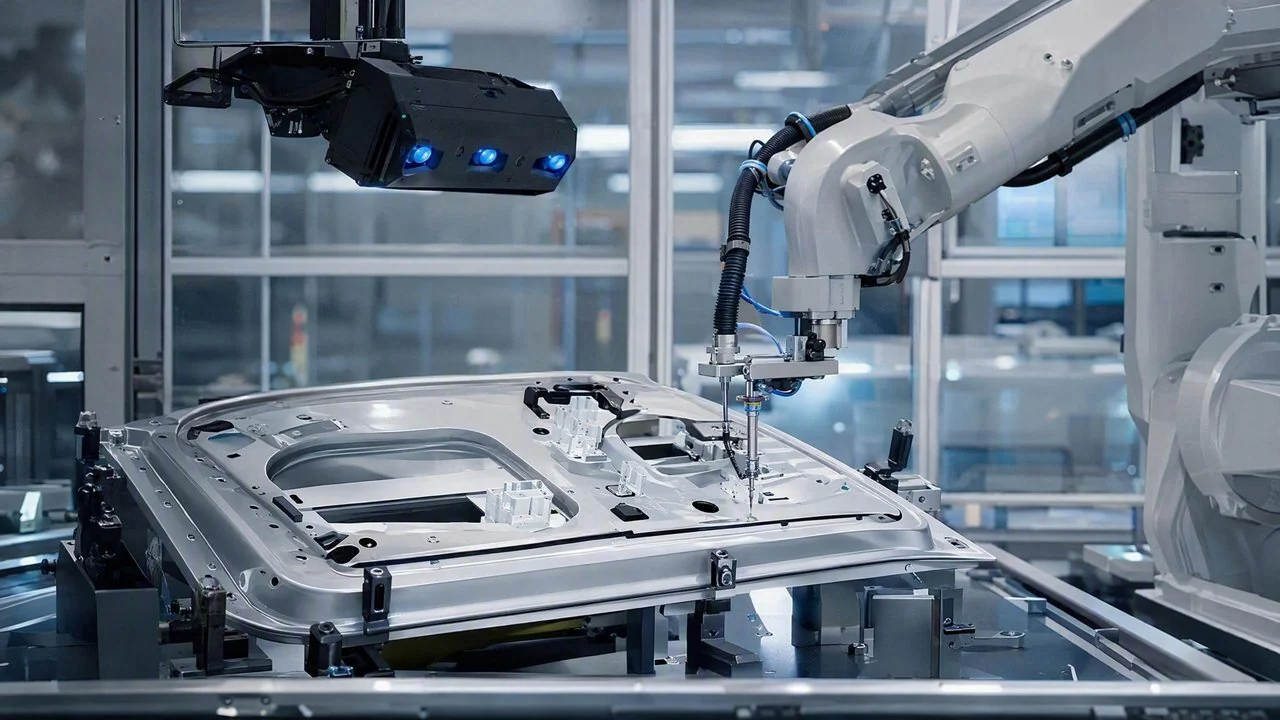
WeLinkirt DaoAI 3D Robot Vision (proprietary 3D camera + 6D pose estimation, bin picking, glue dispensing/assembly/loading guidance, brain-eye-body closed-loop, sub-millimeter hand-eye coordination) achieves high-precision 3D morphology reconstruction and real-time path correction, consistently reducing the missed detection rate for automotive component sealing processes to <0.3% while maintaining a single-piece inspection cycle time under 2.5 seconds, effectively guaranteeing the throughput requirements for 100% online inspection. In automotive manufacturing, sealing is a critical step to ensure vehicle airtightness, waterproofing, and NVH (Noise, Vibration, and Harshness) performance. For seals or liquid sealants on car bodies, engine covers, doors, sunroofs, and various electronic modules, the quality of application directly impacts the final product's function and reliability. Traditional manual inspection or 2D vision-based solutions often struggle with complex curved surfaces, minute air bubbles, discontinuities, or overflows, failing to balance detection accuracy with production line cycle times.
WeLinkirt DaoAI 3D Robot Vision (proprietary 3D camera + 6D pose estimation, bin picking, glue dispensing/assembly/loading guidance, brain-eye-body closed-loop, sub-millimeter hand-eye coordination) achieves high-precision 3D morphology reconstruction and real-time path correction, consistently reducing the missed detection rate for automotive component sealing processes to <0.3% while maintaining a single-piece inspection cycle time under 2.5 seconds, effectively guaranteeing the throughput requirements for 100% online inspection. In automotive manufacturing, sealing is a critical step to ensure vehicle airtightness, waterproofing, and NVH (Noise, Vibration, and Harshness) performance. For seals or liquid sealants on car bodies, engine covers, doors, sunroofs, and various electronic modules, the quality of application directly impacts the final product's function and reliability. Traditional manual inspection or 2D vision-based solutions often struggle with complex curved surfaces, minute air bubbles, discontinuities, or overflows, failing to balance detection accuracy with production line cycle times.
Pain Points: Why This Challenge Is Difficult
Automotive component sealing quality inspection faces multiple challenges. Firstly, there's a contradiction between inspection accuracy and cycle time: traditional 2D vision, limited by viewing angle and lighting, struggles to accurately capture 3D morphological defects such as uneven bead height/width, minute air bubbles, or depressions. These often require time-consuming manual re-inspection, leading to over 30% manual re-inspection hours, severely slowing down the production line cycle. Secondly, the hidden nature and diversity of defects: sealing defects like internal air bubbles, poor bottom adhesion, or local omissions are difficult to identify in 2D images, with missed detection rates often around 1.5%, directly impacting product quality and rework costs. Finally, insufficient adaptability of inspection solutions to flexible production line demands: facing different models and curvatures of components, traditional inspection solutions require frequent changeover and parameter adjustments, with each changeover causing 20-30 minutes of downtime, significantly reducing equipment utilization. Furthermore, as the potential of open-source robot operating systems like MoveIt in multi-joint robot path planning and obstacle avoidance becomes more prominent, the disconnect between traditional vision systems and robot motion control complicates real-time path correction and defect handling for sealing applications.
The inherent complexity of the sealing process also exacerbates inspection difficulties. Factors such as the rheological properties of the adhesive, spraying pressure, and environmental temperature/humidity can all affect the final sealing quality. For example, precise sealing in confined spaces or on complex curved surfaces, where even minor deviations in bead width or height, can lead to sealing failure. These deviations appear as blurry edges or subtle grayscale changes in traditional 2D images, making them difficult to effectively identify. Moreover, automotive components often have reflective or matte surfaces, making it challenging for traditional vision light sources to achieve uniform illumination, easily leading to false positives or missed detections. These fundamental issues make it a significant technical challenge to ensure 100% comprehensive inspection while maintaining high production line cycle times.
Technical Principles
WeLinkirt DaoAI 3D Robot Vision system achieves sub-millimeter level 3D morphology reconstruction capability through its independently developed high-precision 3D camera. The system employs structured light or laser triangulation principles to rapidly acquire 3D point cloud data of the component surface. This point cloud data is processed by DaoAI's unique algorithms, enabling precise restoration of the actual height, width, and continuity of the adhesive bead's geometric features. Unlike traditional 2D vision, which relies solely on grayscale or color information, DaoAI 3D Vision directly obtains the object's 3D dimensional information, completely solving the impact of lighting, reflections, and insufficient contrast on detection accuracy. Even micron-sized air bubbles, depressions, or slight curling of the adhesive bead edges can be accurately identified. Furthermore, the DaoAI system integrates 6D pose estimation algorithms, capable of real-time calculation of the component's precise position and orientation in space, providing accurate guidance for subsequent adhesive path correction.
Compared to traditional rule-based AOI or manual inspection, the advantage of WeLinkirt DaoAI 3D Robot Vision lies in its “brain-eye-body closed-loop” intelligent detection and correction mechanism. Traditional rule-based AOI relies on engineers manually setting numerous thresholds and rules, has weak recognition capabilities for complex defect patterns, and struggles to cope with production line fluctuations. Manual inspection, on the other hand, is inefficient, inconsistent, and susceptible to fatigue. DaoAI 3D Vision, however, utilizes deep learning models trained on vast amounts of good and defective data, enabling autonomous learning of acceptable sealing standards and various defect patterns. During inspection, the system real-time compares the acquired 3D morphological data with a preset golden standard. Upon detecting a deviation, it immediately feeds correction commands to the robot controller using the 6D pose estimation results. This closed-loop control enables real-time online detection and path adjustment of the sealing process, allowing the robot to “see” and “correct” sealing defects, improving the sealing qualification rate to over 99.7% and significantly reducing rework rates. In a practical test at a major automotive Tier-1 supplier's sealing production line, the DaoAI system consistently maintained a single-piece inspection cycle time under 2.5 seconds, significantly faster than the 8-10 seconds for manual inspection, effectively ensuring production line throughput.
Typical Application Scenarios
- **Body Weld Seam Sealant Inspection:** 100% online inspection of sealant beads at weld seams during body assembly. DaoAI 3D Robot Vision accurately identifies bead width, height, continuity, and detects discontinuities, air bubbles, or overflows, ensuring body airtightness and waterproofing. The challenge lies in complex weld seam curvatures and similar bead/body colors, which are difficult for traditional 2D to distinguish.
- **Engine Component Gasket Application Quality Inspection:** Inspecting the application of liquid gaskets on critical engine components like cylinder heads and oil pans. WeLinkirt DaoAI 3D Vision accurately assesses if the sealant path is complete, thickness is uniform, and edges are neat, preventing oil leaks due to poor sealing. The challenge is that gaskets are often thin, minute defects are hard to spot, and extremely high inspection precision is required.
- **Car Door and Sunroof Seal Strip Installation Quality Inspection:** Checking the proper installation of seal strips around car doors and sunroofs, including whether the strip is compressed, twisted, misaligned, or damaged. DaoAI 3D Robot Vision quickly determines if seal strip installation meets design requirements through 3D morphology comparison. The challenge lies in the elastic deformation and diverse colors of seal strips, which easily interfere with traditional methods.
- **Automotive Electronic Module Potting Compound Inspection:** Quality inspection of potting compounds used to protect automotive electronic control units (ECUs) or sensors. DaoAI 3D Vision can detect the potting compound's liquid level height, presence of air bubbles, overflow, or uncovered areas, ensuring moisture-proof, dust-proof, and shock-resistant performance for electronic components. The challenge is that potting compounds are often transparent or translucent, and may contain minute internal air bubbles, requiring extremely high imaging and algorithmic capabilities.
Implementation Case Study
A leading automotive Tier-1 supplier, primarily producing automotive interior and body structure components, faced long-standing issues of inefficient sealing quality inspection and high missed detection rates in the sound-damping and vibration-reducing adhesive application process for inner door panels. Due to complex and irregular curved sealing paths, traditional 2D vision systems were ineffective at identifying subtle 3D defects in the adhesive bead, leading to 3-4 quality inspectors per shift for manual re-inspection, with still approximately 1.2% missed detection rate, resulting in customer complaints and rework. To address this pain point, the supplier introduced the WeLinkirt DaoAI 3D Robot Vision solution. Before implementation, their sealing process had a single-piece inspection cycle time of approximately 8 seconds (including manual re-inspection), a missed detection rate of 1.2%, and a false positive rate of 3.5%.
After the DaoAI 3D Vision system was deployed, the automotive Tier-1 supplier's sealing process achieved 100% online inspection, single-piece inspection cycle time shortened to 2.5 seconds, missed detection rate reduced to <0.3%, false positive rate decreased by −80%, saving over a million RMB in annual labor costs.
The WeLinkirt DaoAI team worked closely with the client, deploying multiple DaoAI 3D Robot Vision systems. By modifying existing robotic arms on the production line, integrating DaoAI's proprietary 3D camera and control modules, and training models with historical sealing data provided by the client. In the initial phase, the system leveraged its APDT (Positive Sample/Few-Shot Learning) capability, completing model tuning within 3 hours using only 15 good samples, quickly adapting to the production line environment. After one month of trial operation and data accumulation, the system successfully achieved comprehensive, high-precision detection of defects such as adhesive height, width, continuity, air bubbles, and discontinuities. Production line data showed that after the DaoAI 3D Vision system was deployed, the single-piece inspection cycle time was consistently maintained within 2.5 seconds, the missed detection rate dropped to <0.3%, and the false positive rate decreased by −80%, significantly improving product quality and drastically reducing the need for manual re-inspection, saving over a million RMB in annual labor costs. Furthermore, the system seamlessly integrated with the factory's MES system, with all inspection data uploaded in real-time, providing strong support for quality traceability.
WeLinkirt Solution and Products
WeLinkirt DaoAI 3D Robot Vision is the core of this solution. It uses its self-developed high-precision 3D camera as its “eyes,” combined with powerful 6D pose estimation algorithms and a brain-eye-body closed-loop control system as its “brain,” empowering robots with precise recognition and real-time correction capabilities. During implementation, the DaoAI team first conducts on-site environment assessments and robotic arm selection to ensure compatibility between the vision system and existing hardware. Next, 3D point cloud data is collected and processed using the DaoAI AI AOI software system, which leverages its built-in visual foundational models for automatic programming and learning of good sealing features. For new product models or changes in sealing processes, engineers only need to provide 1-20 good samples, and the system can quickly update the model through the APDT few-shot learning function, shortening changeover time to less than 5 minutes, greatly enhancing production line flexibility. WeLinkirt DaoAI solutions support 100% on-premise private deployment, ensuring that core customer production data remains within the factory, meeting data security and compliance requirements. Additionally, the system can be integrated with the SkyVision platform, enabling real-time production process monitoring and anomaly alerts through a 0-code video surveillance AI platform.
The deployment and integration process of WeLinkirt DaoAI 3D Robot Vision is efficient and convenient. By offering services in various forms such as SDK/API/Docker, it can be easily embedded into existing customer automation production lines and robot control systems. Its powerful semantic understanding and cross-scenario generalization capabilities, thanks to the unified foundation of the DaoAI World model, enable the system to demonstrate excellent adaptability when facing different sealing shapes, materials, and defect types. In practical applications, this solution not only improved the detection rate of sealing defects to over 99.7% but, more importantly, perfectly synchronized the inspection cycle with the production line cycle, achieving high-throughput operation under 100% full inspection, bringing significant economic benefits and quality improvements to customers. For example, in a practical application at an automotive component factory, DaoAI 3D Robot Vision reduced the sealing missed detection rate from 1.2% to <0.3% and shortened the single-piece inspection time from 8 seconds to 2.5 seconds, effectively avoiding batch rework and customer claim risks due to quality issues, significantly enhancing brand reputation and market competitiveness.
FAQ
What defects can DaoAI 3D Robot Vision identify in automotive sealing inspection?
WeLinkirt DaoAI 3D Robot Vision system can precisely identify various sealing defects, including but not limited to uneven bead height or width, discontinuities, overflows, air bubbles, depressions, surface contamination, and deviations in the bead path. Through high-precision 3D morphology reconstruction, even micron-sized minute defects can be effectively detected, ensuring sealing quality meets stringent automotive industry standards.
How do the cost and deployment difficulty of DaoAI 3D Robot Vision compare to traditional 2D vision solutions?
Compared to traditional 2D vision solutions, while WeLinkirt DaoAI 3D Robot Vision might have a slightly higher initial hardware investment, its high accuracy, low missed detection rate, and improved production line cycle time significantly reduce long-term operating costs (e.g., less rework, lower manual re-inspection expenses). In terms of deployment difficulty, DaoAI offers multiple integration methods like SDK/API/Docker and provides professional team support. Combined with APDT few-shot learning, it enables rapid deployment and model tuning, with short changeover times, leading to a superior overall TCO. Specific budgets are customized based on client production line scale and inspection requirements; please contact us for a detailed quotation.
How does DaoAI 3D Vision ensure 100% full inspection without affecting production line cycle time?
WeLinkirt DaoAI 3D Robot Vision achieves a single-piece inspection cycle time as low as 2.5 seconds, far exceeding traditional manual inspection efficiency, through its proprietary high-speed 3D camera and optimized algorithms. Concurrently, the system employs a 'brain-eye-body closed-loop' control, feeding real-time inspection results back to the robot for path correction, allowing inspection and sealing operations to run in parallel, minimizing downtime. Coupled with multi-station parallel inspection strategies, this ensures 100% online quality inspection coverage in high-speed production environments without impacting overall production line throughput.
Full solution for this scenario: Robotics Vision industry solutions · 100% Inline 3D Inspection & Path Correction for Automotive Glue Dispensing
This article was generated by AI. Customer cases are simulated scenarios based on real product capabilities and figures are illustrative; see product pages for official benchmarks.