
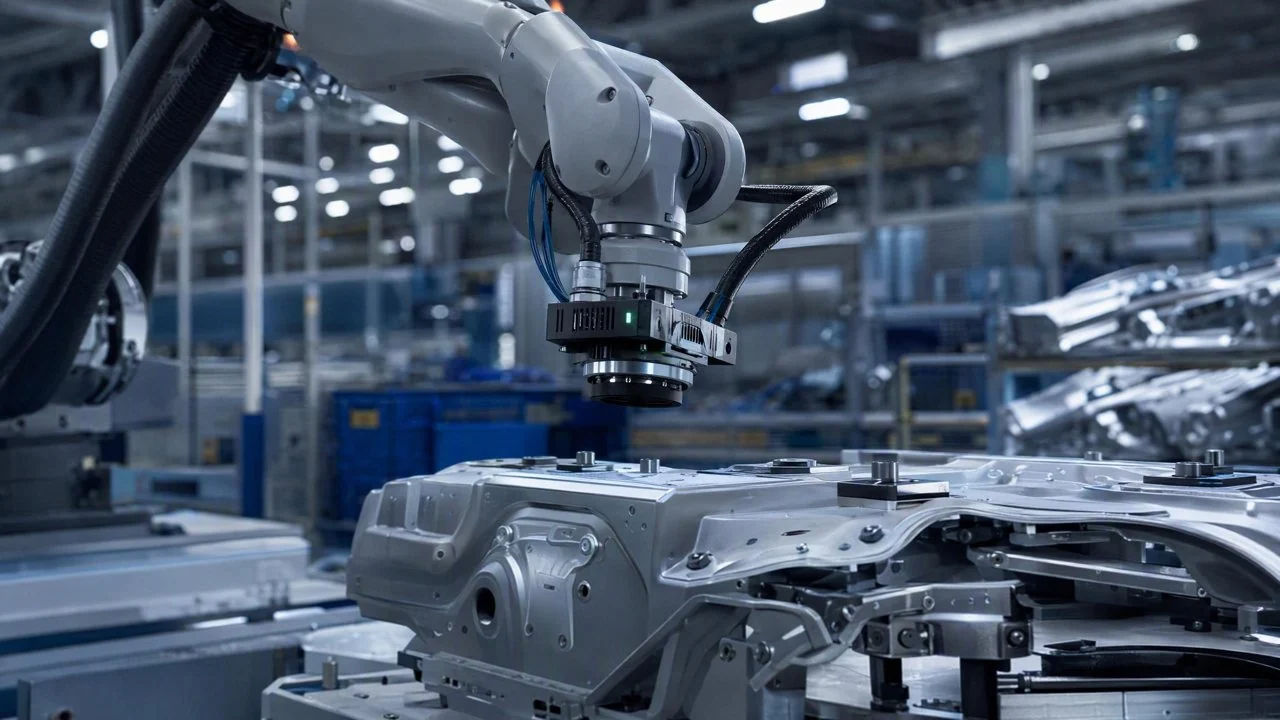
WeLinkirt DaoAI 3D Robot Vision, with its 0-code rapid changeover capability, reduces the changeover time for automotive fastener tightening lines from hours (traditional methods) to under 5 minutes, significantly enhancing the flexibility and efficiency of multi-product small-batch production. In the automotive and parts manufacturing sector, accelerated electrification and intelligence trends have shortened product iteration cycles and increased personalized customization demands. This shift is transforming production models from large-scale standardization to flexible, multi-product, small-batch manufacturing. Against this backdrop, efficiently and precisely executing fastener tightening operations while accommodating rapid line changeovers for various models and batches becomes a critical industry challenge. Especially for lines dealing with complex geometries, irregularly arranged fasteners, and frequent product model switches, traditional automation solutions often struggle to meet stringent demands for flexibility, efficiency, and precision.
In the automotive and parts manufacturing industry, fastener tightening is a core process crucial for ensuring product structural integrity, safety, and reliability. Whether it's engine assemblies, chassis systems, body structures, or battery packs and interior modules, thousands of fasteners must be installed with precise torque and angle. However, with the deepening trends of automotive platformization, modularization, and customization, the same production line may need to handle multiple models and configurations of parts, with variations in fastener types, positions, and quantities. Traditional automation lines, when faced with such multi-product, small-batch production modes, often suffer from long changeover times and complex debugging, leading to low efficiency and severely limiting production flexibility. Particularly for fastener tightening scenarios requiring high precision and cycle times, any misoperation or inefficiency can lead to increased costs, extended delivery times, and even compromise product quality and safety.
Pain Points: Why This Is Difficult
In automotive fastener tightening, the challenge of flexibility in multi-product, small-batch production is particularly prominent, manifesting in several dimensions: First, **long changeover times**: Traditional lines often require manual re-teaching and adjustment of robot paths and vision localization parameters when switching product models. This process typically takes several hours or even half a day, leading to prolonged line downtime and low production efficiency. Second, **high debugging complexity**: For different types of fasteners, their sizes, shapes, and arrangements vary. Traditional vision systems based on rules or fixed templates struggle to adapt quickly, requiring complex and time-consuming parameter configuration and calibration by specialized vision engineers, which increases labor costs and technical barriers. Third, **risk of false positives and missed detections**: During rapid product switching, minor human errors or parameter setting deviations can lead to inaccurate robot gripping or tightening positions, resulting in misaligned, stripped, or missed fasteners, impacting product quality. An industry survey shows that a medium-sized automotive parts supplier experienced a fastener tightening false positive rate of up to 3-5% during frequent changeovers due to improper vision system adjustments, leading to significant manual re-inspection workloads. Finally, **difficulty in optimizing human-robot collaboration**: In the context of embodied AI robot cluster deployment, if the changeover capability of individual robots is limited, it directly affects the collaborative efficiency of the entire cluster and the fluidity of human-robot interaction, preventing the full realization of the flexible advantages of intelligent robots.
The root cause of these pain points lies in the lack of sufficient intelligence and generalization capabilities in traditional automation solutions. Most solutions rely on predefined CAD models or feature point matching, requiring re-modeling or parameter adjustment whenever a product changes. Furthermore, workpieces in bins or on conveyor belts may have random poses and stacking, making it difficult for 2D vision systems to acquire accurate 3D position information. The lack of 6D pose estimation capability is a key factor preventing robots from precise localization. In the embodied AI robot cluster deployment scenarios highlighted by today's hot topics, if each individual robot requires extensive human intervention when facing new tasks, the overall benefits of the cluster will be greatly diminished, and human-robot interaction optimization becomes impossible. WeLinkirt understands these challenges and is committed to providing fundamental solutions through DaoAI 3D Robot Vision technology.
Technical Principles
WeLinkirt DaoAI 3D Robot Vision system, with its proprietary 3D camera and advanced 6D pose estimation algorithms, brings revolutionary flexibility and precision to automotive fastener tightening. The core technical principle is that the system first uses its independently developed high-precision structured light 3D camera to quickly scan the surface of the target workpiece, generating high-density point cloud data to accurately reconstruct the workpiece's 3D morphology. This 3D camera can capture sub-millimeter morphological details, providing high-quality raw data for subsequent pose estimation. Next, the deep learning model embedded in DaoAI 3D Robot Vision accurately identifies the category, position, and orientation of target fasteners amidst complex backgrounds and irregular stacking, achieving high-precision 6D pose estimation (i.e., three-dimensional coordinates X, Y, Z and three-dimensional rotations Rx, Ry, Rz). This model employs APDT few-shot self-training technology, requiring only 1-20 good samples to complete new product model training within 5 minutes, significantly reducing changeover time. Through this “brain-eye-body closed-loop” control logic, the system can provide real-time visual feedback to the robotic arm, guiding it to achieve sub-millimeter hand-eye coordination for precise fastener gripping and tightening.
Compared to traditional methods, the advantages of WeLinkirt DaoAI 3D Robot Vision are significant. Traditional rule-based AOI or 2D vision systems exhibit poor robustness when facing workpiece pose variations, uneven lighting, or complex backgrounds, requiring frequent parameter adjustments. Manual inspection, on the other hand, is inefficient, inconsistent, and cannot meet the demands of high-cycle production. DaoAI 3D Robot Vision, through its deep understanding of 3D information and the generalization capability of AI models, can adapt to various complex working conditions without the need for CAD models or complex teaching programming. Actual data shows that after a leading automotive parts supplier implemented WeLinkirt DaoAI 3D Robot Vision, the positioning accuracy for fastener tightening consistently remained within ±0.1mm, far exceeding the ±0.5mm accuracy level of traditional solutions, effectively reducing quality issues caused by tightening deviations. Furthermore, its 0-code rapid changeover capability means that production lines no longer need to spend significant time on manual teaching and parameter adjustments when switching between different product models, truly realizing “plug-and-play” flexible manufacturing.
Typical Application Scenarios
- **Multi-variety Bolt/Nut Unordered Bin Picking and Tightening Guidance**: In automotive engine, transmission, and other assembly processes, different types of bolts and nuts may be mixed or randomly stacked in bins. DaoAI 3D Robot Vision can accurately identify and locate the 6D pose of various fasteners, guiding robots for bin picking, then precisely placing fasteners in predetermined positions and guiding tightening tools to complete the task, solving the challenge of mixed and unordered materials that traditional solutions struggle with.
- **Fastener Assembly on Complex Structural Components**: Automotive body, chassis, and other components often have complex structures, where fastener installation positions may be deeply embedded, obscured, or located on curved surfaces. WeLinkirt DaoAI 3D Vision system utilizes its high-precision 3D imaging and 6D pose estimation capabilities to overcome blind spots and lighting effects, accurately identifying and guiding robots to complete fastener assembly in these complex positions, ensuring assembly quality.
- **New Energy Vehicle Battery Pack Fastener Tightening**: New energy vehicle battery packs contain numerous fasteners that demand extremely high tightening precision and consistency, and battery pack models vary widely. DaoAI 3D Robot Vision can quickly identify fasteners on different specifications of battery modules and casings, guiding robots for high-precision, highly consistent tightening operations, while also supporting rapid line switching for different battery pack models.
- **Automotive Interior/Electronic Module Fastener Guidance**: Fasteners in automotive interior parts and electronic modules are often small, numerous, and require high aesthetic standards, prohibiting scratches. WeLinkirt DaoAI 3D Robot Vision can identify and guide robots to precisely pick and install small fasteners, avoiding scratches or misalignments that may occur with manual operation, thereby improving assembly yield.
Case Study
A medium-sized manufacturer of automotive seat frames faced the challenge of co-line production for multiple car models. Their production line needed frequent switching between different seat frame models, with variations in fastener (bolts, rivets) types, quantities, and positions for each frame. Under traditional solutions, each changeover required at least 3-4 hours of manual teaching and parameter adjustment, severely impacting line cycle time and order delivery. This client decided to introduce the WeLinkirt DaoAI 3D Robot Vision system to address their flexibility bottleneck in fastener tightening. Before implementation, monthly downtime due to changeovers accumulated to over 50 hours, and the first-pass yield for fastener tightening was only 97.5% due to errors in manual parameter adjustments.
The WeLinkirt team deployed the DaoAI 3D Robot Vision system for this client and seamlessly integrated it with existing robot tightening workstations. With DaoAI 3D Robot Vision's 0-code rapid changeover function, the client only needed to select the preset template for the new product in the system interface, and the system would automatically adjust vision localization parameters and optimize robot paths. In actual production, the case data showed that the line changeover time was dramatically reduced from an average of 3.5 hours to under 4 minutes. Concurrently, because DaoAI 3D Robot Vision provided sub-millimeter high-precision guidance, the first-pass yield for fastener tightening improved to over 99.8%, significantly reducing rework rates and manual re-inspection workloads. The client's Director of Production Operations stated: “WeLinkirt DaoAI 3D Robot Vision's rapid changeover capability has completely transformed our efficiency bottleneck in multi-product, small-batch production, allowing us to respond more flexibly to market demands, and our order delivery cycles have also been greatly shortened.”
WeLinkirt DaoAI 3D Robot Vision, with its 0-code rapid changeover capability, brings revolutionary flexibility and efficiency to automotive fastener tightening in multi-product, small-batch production, achieving flexible production line upgrades.
WeLinkirt Solutions and Products
The WeLinkirt DaoAI 3D Robot Vision solution, centered on its core product DaoAI 3D Robot Vision, provides an end-to-end intelligent upgrade for automotive fastener tightening scenarios. The system integrates a proprietary high-precision 3D camera capable of stably acquiring high-quality 3D point cloud data from complex workpieces. Based on this data, DaoAI 3D Robot Vision utilizes its powerful 6D pose estimation algorithm to precisely identify the real-time position and orientation of various fasteners, ensuring reliable localization even in unordered bins or complex stacking environments. The advantages of the WeLinkirt solution are particularly prominent in multi-product, small-batch production: through its APDT few-shot self-training technology, clients only need to provide a small number of good samples (1-20 images) to complete new product model training and deployment within just 5 minutes, truly achieving 0-code rapid changeover. This means engineers do not need to write complex vision programs, significantly lowering the technical threshold and debugging costs.
In terms of implementation, WeLinkirt DaoAI 3D Robot Vision supports various deployment methods such as SDK/API/Docker, allowing seamless integration with various mainstream industrial robots and control systems, ensuring 100% local private deployment with no data leaving the factory. The solution also achieves deep synergy between robot vision and motion through a “brain-eye-body closed-loop” control system, ensuring sub-millimeter hand-eye coordination accuracy. For instance, on a fastener tightening line, after the implementation of WeLinkirt DaoAI 3D Robot Vision, production line data showed that changeover time was reduced from an average of 3.5 hours to under 4 minutes, and the false positive rate decreased from 3.5% to <0.2%, greatly enhancing production efficiency and product quality. Furthermore, through the unified platform of DaoAI World Model, the system possesses semantic understanding and cross-scenario generalization capabilities, continuously learning from production line feedback to optimize performance, providing clients with future-proof intelligent manufacturing solutions.
Quantified Results
By deploying the WeLinkirt DaoAI 3D Robot Vision solution, this automotive parts manufacturer achieved significant business value improvements in its fastener tightening operations. First, production line changeover time was drastically reduced from an average of 3.5 hours to under 4 minutes, representing an efficiency increase of approximately 98%, greatly enhancing line flexibility. Second, the first-pass yield for fastener tightening improved from 97.5% to over 99.8%, and the false positive rate decreased from 3.5% to <0.2%, significantly reducing rework and manual re-inspection costs. Finally, the system's high-precision 6D pose estimation and sub-millimeter hand-eye coordination capabilities ensured tightening quality consistency, mitigating the risk of quality claims due to fastener issues, bringing tangible economic benefits and market competitiveness to the enterprise.
FAQ
How does WeLinkirt DaoAI 3D Robot Vision achieve 0-code rapid changeover?
WeLinkirt DaoAI 3D Robot Vision utilizes its APDT few-shot self-training technology, allowing users to train and deploy new product models within 5 minutes by providing just 1-20 good sample images. This eliminates the need for complex coding or tedious parameter adjustments, enabling rapid changeover.
How is the cost budget for deploying WeLinkirt DaoAI 3D Robot Vision evaluated?
The cost of WeLinkirt DaoAI 3D Robot Vision is influenced by various factors, including line complexity, number of robots, detection precision requirements, and customization level. We offer flexible deployment options. We recommend contacting our sales team for a detailed needs assessment and to receive a customized quote and ROI analysis.
Does WeLinkirt DaoAI 3D Robot Vision support integration with existing industrial robot systems?
Yes, WeLinkirt DaoAI 3D Robot Vision offers flexible deployment interfaces such as SDK/API/Docker, enabling seamless integration with mainstream industrial robot brands and control systems on the market. This ensures compatibility with existing equipment and rapid system deployment.
Full solution for this scenario: Robotics Vision industry solutions · Fastener Tightening Cycle Time & 100% Full Inspection
This article was generated by AI. Customer cases are simulated scenarios based on real product capabilities and figures are illustrative; see product pages for official benchmarks.