
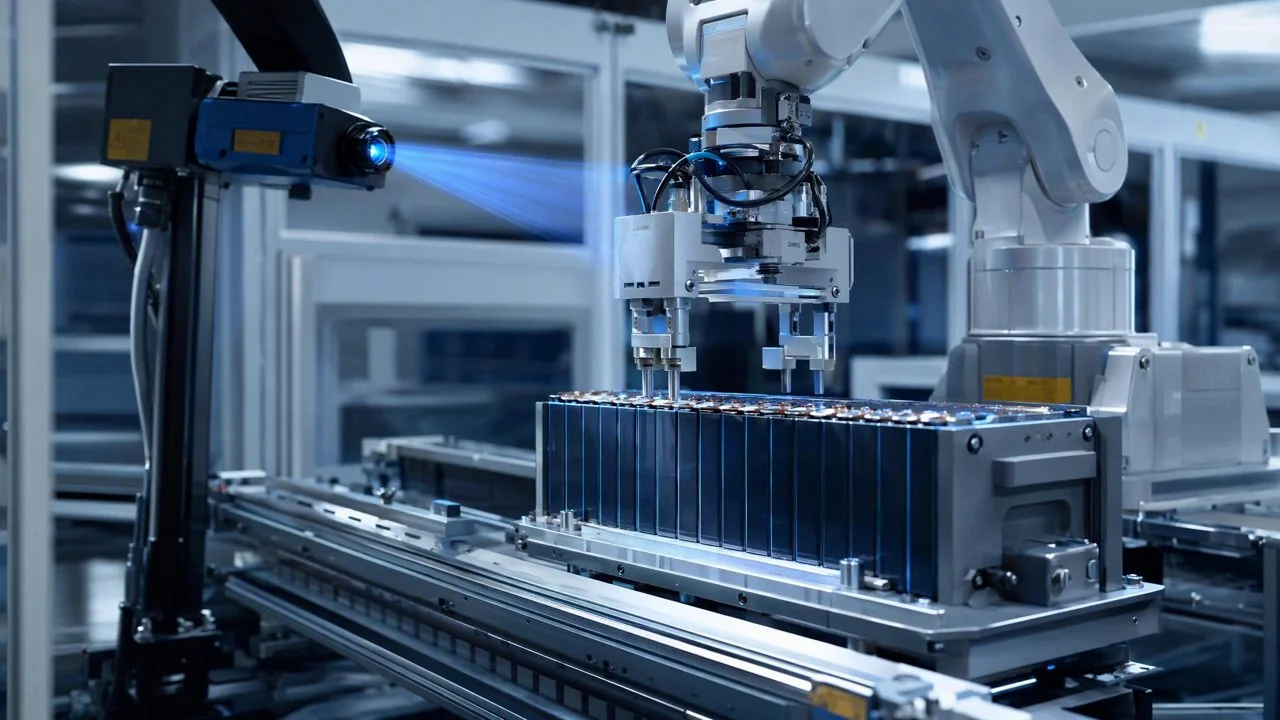
WeLinkirt DaoAI 3D Robot Vision (proprietary 3D camera + 6D pose estimation, bin picking, glue dispensing/assembly guidance, brain-eye-body closed-loop, sub-millimeter hand-eye coordination) addresses the critical pain points of data security and high-precision inspection in new energy battery module solder joint detection through on-premise private deployment, reducing the false positive rate on a leading manufacturer's production line from a conventional 15% to an actual deployed 2.7%.
As the core of electric vehicles and energy storage systems, the performance and safety of new energy batteries directly determine the market competitiveness of end products. Module solder joints, as a critical link in battery connection, directly affect the internal resistance, heat dissipation performance, and cycle life of battery packs. With battery production moving towards high integration, such as large modules and Cell to Chassis (CTC), the number of solder joints has surged, and requirements for consistency and reliability are extremely high. Traditional manual inspection or rule-based 2D vision solutions struggle to balance efficiency, precision, and data security in complex, variable, and high-tempo production environments. This is especially true for leading enterprises highly sensitive to data sovereignty, where on-premise private deployment becomes an indispensable consideration.
Pain Points: Why This Hurdle Is So Difficult to Overcome
New energy battery module solder joint inspection faces multiple challenges. Firstly, **data security and compliance risks**: With the deepening of intelligent manufacturing, the vast amount of visual data generated during production (including product design, process parameters, defect characteristics, etc.) is considered a core asset. Uploading this sensitive data to the cloud for analysis or model training is an unacceptable risk for leading manufacturers who prioritize intellectual property protection and data sovereignty. The current industry hot topic of large-scale deployment of embodied AI robots in various scenarios also faces challenges of localized processing and secure storage of the vast amount of sensory data they generate, which mirrors the data security needs of new energy battery production lines. Secondly, **high false negative and false positive rates**: Traditional 2D vision or rule-based AOI solutions often suffer from high false negative rates and persistently high false positive rates when inspecting solder joints, due to factors like lighting, reflection, and subtle differences in solder joint morphology (e.g., cold solder, poor wetting, blowholes, splashes, collapse). Data from a medium-sized battery factory shows that manual re-inspection labor accounts for over 60% of total inspection labor. Finally, **low changeover efficiency and poor adaptability to multiple varieties**: Battery module models vary, with slight differences in solder joint layout, size, and material. Traditional solutions require hours or even days for parameter adjustment and rule rewriting, severely impacting production line tempo and flexible manufacturing capabilities. A leading manufacturer once experienced a 30% increase in production line downtime due to changeovers.
The root cause of these pain points lies in the **3D complexity and micron-level features** of solder joint defects, as well as the **uncertainty of the production environment**. Solder joint defects often manifest as tiny changes in 3D morphology, such as solder joint height, volume, and coplanarity, which are difficult to fully capture with 2D images. At the same time, reflections on the battery module surface and the heterogeneity of battery materials can interfere with optical imaging. Coupled with fast production tempos, the time window for inspection is extremely short, posing stringent demands on the real-time processing capability and precision of vision systems. Traditional inspection methods lack a deep understanding and robust discrimination of these complex 3D features, and cannot meet the requirements for data security and isolated computing resources in on-premise private deployment.
Technical Principles
The WeLinkirt DaoAI 3D Robot Vision system fundamentally addresses the challenges of module solder joint inspection through its **proprietary high-precision 3D camera and 6D pose estimation technology**. Firstly, DaoAI's 3D camera utilizes structured light or laser triangulation principles to perform **sub-millimeter 3D morphological reconstruction** of the solder joint surface, acquiring precise 3D data such as height, volume, flatness, and coplanarity for each solder joint. This far exceeds the limitation of traditional 2D vision, which only captures 2D grayscale or color information, enabling the system to effectively distinguish true defects from surface reflections or shadows. Secondly, combined with advanced **6D pose estimation algorithms**, the WeLinkirt DaoAI system can accurately identify and locate the six degrees of freedom (X, Y, Z, Rx, Ry, Rz) of the battery module in space. Even with slight placement deviations or conveyor belt vibrations, the system can real-time calibrate the inspection area, ensuring inspection accuracy is not affected. This "brain-eye-body closed-loop" control logic allows robots to "understand" the 3D world and precisely execute inspection tasks. At the algorithmic level, WeLinkirt DaoAI incorporates **deep learning-based defect feature extraction and classification models**. Trained with a large volume of real-world data, these models can learn and recognize various complex, minute solder joint defect patterns, offering robustness far superior to traditional rule-based AOI. All these computation and inference processes can be completed on **local private servers**, ensuring sensitive production data never leaves the factory and meeting stringent client requirements for data sovereignty and information security.
Compared to traditional methods, the advantages of WeLinkirt DaoAI 3D Robot Vision are significant. **Compared to manual inspection**, the DaoAI system eliminates issues like eye fatigue and subjective judgment differences, improving inspection consistency and efficiency by several times, and enabling 24/7 continuous operation. **Compared to traditional 2D AOI**, DaoAI 3D Vision can acquire complete 3D morphological data, avoiding the loss of depth information in 2D images, significantly reducing false negative and false positive rates. For example, tiny blowholes or collapses hidden deep within a weld seam are difficult to detect with 2D images, but 3D morphological data can clearly reveal them. Furthermore, WeLinkirt DaoAI's on-premise deployment capability is unmatched by traditional cloud-based AI solutions, providing customers with a **fully autonomous and controllable data environment**.
Typical Application Scenarios
- **Electrode Tab Welding Quality Inspection:** In the cell assembly stage, the welding quality of electrode tabs to busbars is crucial. DaoAI 3D Robot Vision can detect defects such as weld width, height, penetration depth, blowholes, and incomplete penetration. The challenge lies in the thin, highly reflective tab material and narrow weld seams, making traditional 2D easily susceptible to lighting interference.
- **Module Busbar Laser Welding Inspection:** Within battery modules, laser welding of busbars is a critical process. The DaoAI 3D Vision system can perform high-precision inspection of weld seam continuity, splashes, collapses, and cold solder, ensuring reliable current transmission paths. The difficulty lies in complex weld geometries and dense solder joints, requiring extremely high resolution and processing speed.
- **Battery Pack Cooling Plate Weld Seam Inspection:** The weld seams of the cooling plate within the battery pack directly relate to the battery's thermal management performance. WeLinkirt DaoAI 3D Vision can detect weld seam uniformity, bubbles, cracks, etc., ensuring no leakage of coolant. The challenge is that cooling plates often use highly reflective materials like aluminum alloys, and weld seams are located in confined spaces.
- **Connector Stud Weld Inspection:** For battery modules using stud welding for connections, DaoAI 3D Robot Vision can inspect stud height, coplanarity with the connector tab, weld pad integrity, and the presence of cold solder or false welds. The challenge lies in the small size of the studs and the need to simultaneously inspect the relative positional accuracy of multiple studs.
- **Module End Plate and Side Plate Connection Point Inspection:** The structural integrity of battery modules relies on the reliable connection of end plates and side plates. The DaoAI 3D Vision system can detect deformation, absence, or defects in riveting, bolted connections, or welded points, ensuring module structural strength and sealing. The difficulty lies in the large number of connection points and potential occlusion of their positions.
Deployment Case Study
A leading new energy battery manufacturer faced severe data security and inspection precision challenges when expanding its highly automated module production line. Their existing 2D vision inspection solution for module solder joints, while capable of identifying some macroscopic defects, had a high false negative rate for subtle 3D morphological defects like cold solder and blowholes, and a false positive rate of around 15%, leading to significant manual re-inspection workload. Crucially, this manufacturer had extremely strict requirements for production data security, ruling out any cloud-based data upload solutions. After evaluating multiple suppliers, the manufacturer ultimately chose the WeLinkirt DaoAI 3D Robot Vision solution. Before deployment, production line data showed that the manufacturer needed at least 4 skilled workers for full-shift re-inspection daily, processing an average of 300 modules per hour, with 15% requiring re-inspection. After implementing the WeLinkirt DaoAI 3D Robot Vision system, we provided a 100% on-premise private deployment solution, where all data processing, model inference, and storage were completed within their factory premises, ensuring data never left the facility. During deployment, the WeLinkirt engineering team collaborated closely with the client. Utilizing the APDT few-shot self-training capability of the DaoAI AI AOI software system, a new module inspection model was programmed and deployed in just 5 minutes using only 15 good sample images. Real-world data showed that the DaoAI 3D Robot Vision system successfully reduced the false positive rate for module solder joint inspection to 2.7% and the false negative rate to <0.3%, while reducing manual re-inspection labor by over 70%. Additionally, the system significantly shortened changeover time from the original 2 hours to less than 10 minutes, substantially enhancing production line flexibility and efficiency.
"WeLinkirt DaoAI 3D Robot Vision not only addressed our long-standing data security concerns but also achieved a breakthrough in inspection precision, giving us unprecedented confidence in product quality." — Production Director, a leading new energy battery manufacturer.
WeLinkirt Solution and Products
The WeLinkirt DaoAI 3D Robot Vision system is at the core of this solution. The system integrates WeLinkirt's proprietary high-precision 3D camera, enabling micron-level morphological reconstruction of solder joints. Combined with powerful 6D pose estimation algorithms, it ensures precise identification and positioning of target objects even in high-speed, dynamic production environments. At the deployment level, we offer a **100% on-premise private deployment** option, allowing clients to deploy all software modules of the DaoAI system (including model training engine, inference engine, data storage, etc.) on their own servers, achieving physical isolation from external networks. This means all sensitive production data and defect characteristic information will be strictly preserved within the client's factory premises, meeting the highest levels of data security and compliance requirements. For modeling and changeovers, the WeLinkirt DaoAI AI AOI software system supports APDT positive/few-shot learning, requiring only 1–20 good sample images to complete automatic programming of new product inspection models within 5 minutes, greatly simplifying production line changeover operations and effectively addressing multi-variety, small-batch production needs. Furthermore, the DaoAI World Model, as a unified foundation, with its semantic understanding and cross-scenario generalization capabilities, allows the system to continuously learn from production line feedback, constantly optimizing inspection performance. WeLinkirt DaoAI 3D Robot Vision can also be seamlessly integrated with existing MES/SCADA systems to achieve closed-loop management and quality traceability of inspection and production data.
Through the described solution, WeLinkirt DaoAI 3D Robot Vision has delivered significant quantitative results for clients while ensuring data sovereignty. In this case, a leading new energy battery manufacturer saw its **false positive rate reduced by 82%**, **false negative rate suppressed to <0.3%**, and **manual re-inspection labor reduced by 70%**. Concurrently, production line changeover time was shortened from several hours to **less than 10 minutes**, greatly enhancing production efficiency and flexibility. These achievements not only reduced operational costs but, more importantly, improved product quality stability and reliability, boosting the client's market competitiveness. WeLinkirt is committed to providing clients with efficient, secure, and reliable intelligent manufacturing solutions.
FAQ
How does WeLinkirt DaoAI 3D Robot Vision ensure data security for new energy battery production?
WeLinkirt DaoAI 3D Robot Vision system supports 100% on-premise private deployment, where all data processing, model inference, and storage are completed on the client's internal factory servers. The system can achieve physical isolation from external networks, ensuring sensitive production data, defect characteristics, and process parameters never leave the factory, meeting strict enterprise requirements for data sovereignty and information security.
What are the main advantages of the DaoAI 3D Robot Vision system for module solder joint inspection?
DaoAI 3D Robot Vision, through its proprietary high-precision 3D camera and 6D pose estimation technology, enables sub-millimeter 3D morphological reconstruction to obtain precise 3D data of solder joints, effectively identifying complex defects like cold solder, blowholes, and collapses. Combined with deep learning algorithms, the system significantly reduces false positive and false negative rates, while offering rapid changeover and multi-variety adaptability to improve production line efficiency.
What is the approximate cost budget for deploying a WeLinkirt DaoAI 3D Robot Vision system?
The cost budget for a WeLinkirt DaoAI 3D Robot Vision system is influenced by various factors, including production line scale, inspection precision requirements, integration complexity, and deployment model (e.g., whether customized hardware or software features are needed). We offer flexible solution configurations and recommend contacting our sales team for a detailed quote and return on investment analysis based on your specific requirements.
Full solution for this scenario: Robotics Vision industry solutions · Produce Ripeness Robotic Sorting: On-Premise Deployment
This article was generated by AI. Customer cases are simulated scenarios based on real product capabilities and figures are illustrative; see product pages for official benchmarks.