
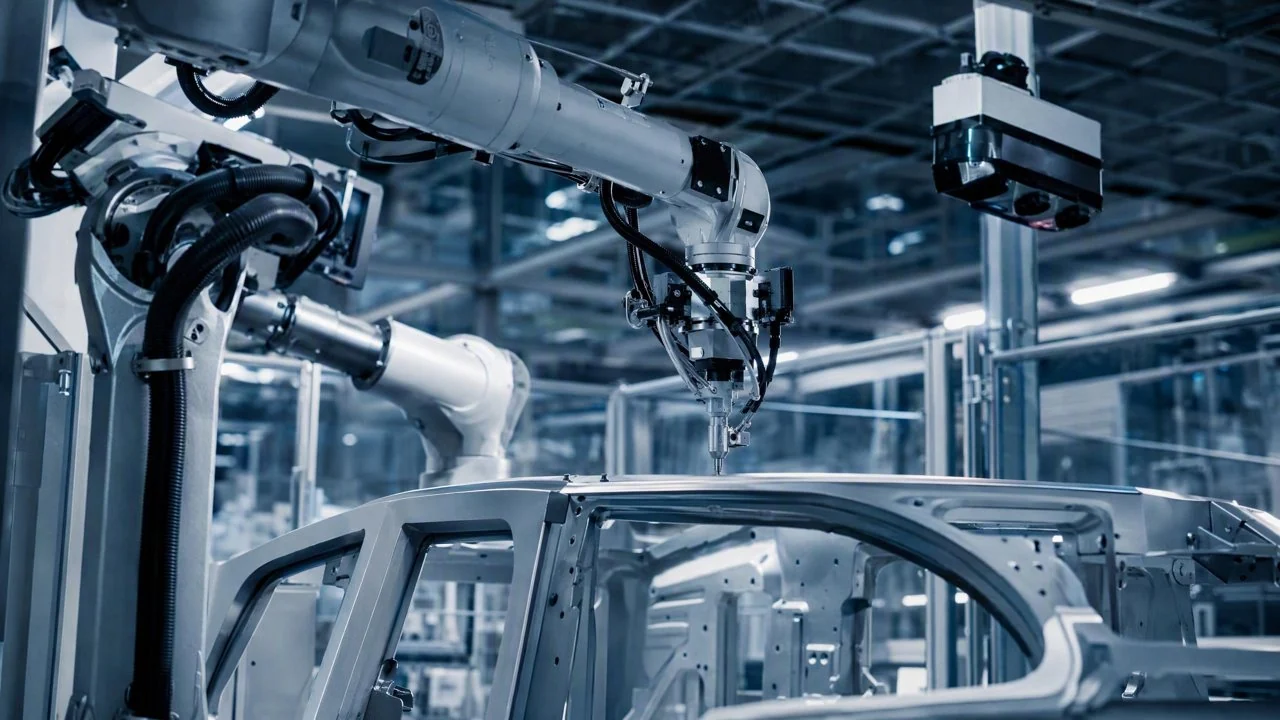
In automotive parts manufacturing, dispensing/sealing is a critical process for ensuring product performance and safety. DaoAI 3D Robot Vision (proprietary 3D camera + 6D pose estimation, bin picking, dispensing/assembly/loading/unloading guidance, brain-eye-body closed-loop, sub-millimeter hand-eye coordination) achieves 100% online 3D inspection and real-time path correction for dispensing paths. By binding all inspection data to production batches, it enables full lifecycle quality traceability and data closure, reducing the leak detection rate from the typical 3% caused by traditional manual inspection to <0.2% in actual production lines.
The stringent quality requirements of the automotive industry make the precision and consistency of dispensing processes paramount. Whether it's engine component sealing, body structure bonding, or interior part fastening, dispensing quality directly impacts a vehicle's reliability, durability, and riding comfort. Traditional sampling or manual visual inspection methods are no longer sufficient to meet the high-beat and high-standard demands of modern automotive production, especially in scenarios involving complex curved surfaces, confined spaces, or multiple adhesive types. A Tier-1 automotive parts supplier, for instance, processes tens of thousands of various parts for dispensing operations daily, covering multiple car models and components, with sub-millimeter precision requirements for dispense width, height, continuity, and the absence of defects such as breaks, overflows, or bubbles.
Pain Points: Why This Hurdle Is So Challenging
This Tier-1 supplier faced multiple challenges in the dispensing inspection process. Firstly, the leak detection rate for dispensing defects was high; traditional manual visual inspection or 2D vision-based sampling, according to production line data, often resulted in a leak detection rate exceeding 3% for subtle defects like breaks, overflows, or uneven bead height, leading to defective products entering downstream processes, increasing rework costs and quality risks. Secondly, significant manual re-inspection hours were required; once a suspected defect was found, extensive manual effort was needed for secondary confirmation and repair. Production line data indicated this accounted for approximately 40% of total inspection hours, severely impacting production efficiency. Thirdly, there was a lack of effective data closure and quality traceability mechanisms; even when defects were found, it was difficult to quickly pinpoint the specific production batch, equipment parameters, or operator actions, hindering root cause analysis and process optimization. Finally, in response to the automotive industry's trend of rapid product iteration and increasing customization demands, traditional solutions required several hours or even days of downtime for adjustments during line changeovers, affecting flexible production capabilities. These pain points collectively constituted a major obstacle for the supplier in dispensing quality management.
The root cause of these difficulties lies in the inherent complexity of the dispensing process and the limitations of traditional inspection methods. Dispensing materials vary widely (e.g., polyurethane, silicone, epoxy), with different colors and reflective properties, and are often applied on 3D curved surfaces, making it difficult for 2D vision to acquire complete morphological information. Furthermore, minute deviations in the dispensing path, such as robot motion jitter, part positioning errors, or nozzle wear, can lead to dispensing defects. In the current trend of embodied AI technology integrating with industrial robotic arms, while the precision of robotic arm movements continues to improve, true “brain-eye-body” closed-loop — where the vision system can perceive, judge precisely, and directly guide the robotic arm for sub-millimeter correction in real-time — remains a core challenge. Traditional solutions often separate the “eye” and “body,” where vision inspection results cannot be fed back to the robotic arm in real-time for path adjustment, let alone achieving full lifecycle quality data and production data correlation and traceability.
Technical Principles
DaoAI 3D Robot Vision solution from WeLinkirt fundamentally addresses dispensing inspection challenges through its proprietary high-precision 3D camera and advanced 6D pose estimation technology. Our 3D camera utilizes structured light or laser triangulation principles to reconstruct the 3D morphology of the dispensed surface with high accuracy, acquiring geometric information such as bead width, height, and volume, with precision up to micrometers. Combined with DaoAI's powerful 6D pose estimation algorithms, the system can precisely identify the workpiece's position and orientation in space, enabling accurate matching of the dispensing path and real-time deviation calculation. Compared to traditional rule-based AOI or manual visual inspection, DaoAI 3D Robot Vision offers several advantages: First, it acquires complete depth information, overcoming the limitations of 2D vision under complex conditions like reflections, shadows, and color variations, providing more accurate judgments of bead height and cross-sectional shape. Second, driven by deep learning defect detection models, DaoAI ACI OS operating system can learn normal dispensing features from a small number of good samples (APDT positive/few-shot learning) and identify various subtle defects such as breaks, overflows, bubbles, uneven width, etc., with a detection rate far exceeding traditional methods. Furthermore, DaoAI 3D Robot Vision achieves deep integration of “brain-eye-body,” where inspection results can be directly fed back to the robotic arm, guiding it for sub-millimeter path correction, forming an efficient closed-loop control system.
This engineering depth is reflected in DaoAI 3D Robot Vision's ability not only to “see” defects but also to “understand” their nature and location, and then “command” the robot for precise adjustments. For example, when a bead width exceeding tolerance is detected, the system calculates the deviation amount and direction, and adjusts the robot's motion trajectory in real-time via 6D pose to ensure the next bead segment meets standards. This contrasts sharply with traditional methods that merely perform a “good/bad” judgment and require manual intervention for adjustment. At the data level, DaoAI 3D Robot Vision system binds each inspection's 3D point cloud data, defect type, location, size, and correction records with the product's unique identifier (e.g., QR code or RFID), storing it in a locally privatized database, providing a solid foundation for subsequent quality traceability and big data analysis.
Typical Application Scenarios
- **Engine Block/Cylinder Head Sealant Inspection**: Used to inspect the sealant bead on engine block and cylinder head mating surfaces, ensuring its width, height, and continuity meet requirements to prevent oil or air leaks. Challenges include high-temperature environments, oil residue, and complex curved surface bead morphology detection.
- **Car Door/Window Seal Strip Dispensing Inspection**: Online inspection of sealant bead application quality on car door and window frames, ensuring no breaks, no overflows, uniform adhesion, to guarantee cabin sound insulation and waterproofing. Challenges include similar color of sealant to background, uneven reflections, and rapid inspection under high beat.
- **Automotive Interior Panel Bonding Adhesive Inspection**: Inspection of adhesive beads on interior parts like dashboards and door panels, ensuring bonding strength and aesthetic quality. Challenges include hidden beads, diverse colors, and sensitive detection of micro-bubbles and impurities.
- **Battery Pack Sealing Dispensing Inspection**: The sealing integrity of new energy vehicle battery packs directly impacts battery safety and lifespan. DaoAI 3D Robot Vision can precisely inspect the completeness and uniformity of battery pack housing sealant, ensuring IP rating. Challenges include large-sized workpieces, multiple bead segments, and high reliability inspection under high protection level requirements.
- **Electronic Component Potting Compound Inspection**: For automotive electronic modules (e.g., ECUs, sensors) potting compound, inspecting whether the potting is full, the surface is flat, and if there are bubbles or cracks, ensuring moisture-proof, dust-proof, and shock-resistant performance of electronic components. Challenges include transparent or translucent compounds, precise identification of micro-defects, and high-density arrangement.
Deployment Case Study
A Tier-1 automotive parts supplier, whose core business is the production and supply of automotive body structural components, had long faced challenges with unstable dispensing quality, inefficient manual re-inspection, and difficulty in tracing quality issues during the sealing and dispensing process for body structural components. Traditional 2D vision systems could only detect bead width and position on flat surfaces, rendering them helpless for bead height and cross-sectional shape, leading to a high leak detection rate. After introducing the DaoAI 3D Robot Vision system from WeLinkirt, we provided an integrated solution comprising our proprietary 3D camera, 6D pose estimation software, and integration with their existing robotic arms. In the initial deployment phase, leveraging DaoAI ACI OS's APDT few-shot learning capability, we completed rapid model training and deployment in just 5 minutes using only 15 good samples. After the system went live, it achieved 100% online detection of dispensing defects, including breaks, overflows, bubbles, uneven width, and abnormal height. Production line data showed that this system reduced the leak detection rate for dispensing defects from 3.2% before deployment to <0.2%.
The DaoAI 3D Robot Vision system not only enhanced inspection accuracy but also established a comprehensive quality data closed-loop, making every dispensing mark traceable and providing robust assurance for product quality.
In terms of quality traceability, the DaoAI 3D Robot Vision system stores and links 3D inspection data, defect images, location information, production batch, and timestamps for each product, forming a complete quality archive. When quality issues are reported downstream, the client can quickly trace back to the dispensing inspection records of that product batch through the system, view specific defect details, and even retrieve the 3D morphological data from that time, thereby accurately pinpointing the root cause. In this case, manual re-inspection hours were reduced by over 90% after deployment, significantly saving labor costs. Concurrently, due to the system's sub-millimeter hand-eye coordination capability, detected dispensing deviations can be fed back to the robotic arm in real-time, enabling dynamic correction of the dispensing path, effectively improving dispensing consistency and reducing rework rates. The successful implementation of the DaoAI 3D Robot Vision solution not only resolved the client's current quality pain points but also laid the foundation for their future intelligent manufacturing upgrade, making them more competitive in the increasingly complex automotive parts manufacturing challenges.
WeLinkirt Solution and Products
The DaoAI 3D Robot Vision solution from WeLinkirt, with its proprietary 3D camera at its core, combined with advanced 6D pose estimation algorithms, provides end-to-end intelligent inspection and guidance capabilities for automotive parts dispensing processes. In practice, we first acquire point cloud data of the dispensed surface using high-precision 3D cameras, and then utilize the DaoAI World universal model for semantic understanding and feature extraction. Next, the DaoAI ACI OS operating system comes into play; its APDT few-shot learning function allows customers to complete defect model training in a very short time (e.g., using 1-20 good samples), enabling rapid changeovers and multi-variety, small-batch production. The system calculates the deviation between the dispensing path and the standard model in real-time, sending precise 6D pose correction commands to the industrial robotic arm, achieving a “brain-eye-body” closed-loop control and sub-millimeter hand-eye coordination during the dispensing process. DaoAI 3D Robot Vision solution supports 100% local private deployment, ensuring data security and preventing data from leaving the factory, meeting the strict requirements of the automotive industry for data privacy and security.
The core capability of this solution lies in its powerful data closed-loop management. Each inspection result, correction record, product ID, and other data are stored and linked in real-time, forming a complete quality archive. Customers can integrate this data into their MES/QMS systems through DaoAI's provided SDK/API interfaces, building a full lifecycle quality traceability system from raw materials to finished products. This not only significantly improves the stability and consistency of dispensing quality, reducing leak detection rates and rework costs, but also provides valuable data support for process optimization. Production line data shows that after the solution's deployment, the overall dispensing defect rate was reduced by over 85%, and the product first-pass yield significantly increased. Furthermore, due to its efficient automatic programming and rapid changeover capabilities, the system's downtime for changeovers when introducing new products was reduced from several hours to within 5min, significantly enhancing production line flexibility and utilization. The deployment of DaoAI 3D Robot Vision brings tangible business value to automotive parts manufacturers, helping them maintain a leading position in fierce market competition.
FAQ
How does WeLinkirt's DaoAI 3D Robot Vision achieve full lifecycle traceability for dispensing quality?
WeLinkirt's DaoAI 3D Robot Vision system binds each dispensing's 3D inspection data (including defect type, location, size, and correction records) to the product's unique identifier (e.g., QR code, RFID) and stores it in a local private database. This data can be integrated into the customer's MES/QMS system, thereby building a complete quality archive from production to use, enabling precise defect localization and traceability.
What are the advantages of DaoAI 3D Robot Vision over traditional 2D vision for dispensing inspection?
Compared to traditional 2D vision, WeLinkirt's DaoAI 3D Robot Vision utilizes a proprietary high-precision 3D camera to acquire complete three-dimensional morphological information of the dispensed surface, accurately measuring bead width, height, volume, and cross-sectional shape. This allows it to effectively overcome the limitations of 2D vision under complex conditions like reflections, shadows, and color variations, significantly improving the detection capability and accuracy for subtle defects such as breaks, overflows, and bubbles, and enabling real-time path correction.
What is the cost structure and ROI period for deploying WeLinkirt's DaoAI 3D Robot Vision solution?
The cost of WeLinkirt's DaoAI 3D Robot Vision solution primarily includes 3D camera hardware, vision software licenses, system integration services, and potential custom development. Specific quotes vary based on line complexity, inspection cycle time, precision requirements, and deployment scale. Typically, by significantly reducing leak detection rates, rework costs, manual re-inspection hours, and improving line utilization and product quality, the solution can achieve ROI within 6-18 months. We recommend scheduling an expert consultation for a customized solution and detailed quotation.
Full solution for this scenario: the full inspection solution for Robotics Vision · 100% Inline 3D Inspection & Path Correction for Automotive Glue Dispensing
This article was generated by AI. Customer cases are simulated scenarios based on real product capabilities and figures are illustrative; see product pages for official benchmarks.