
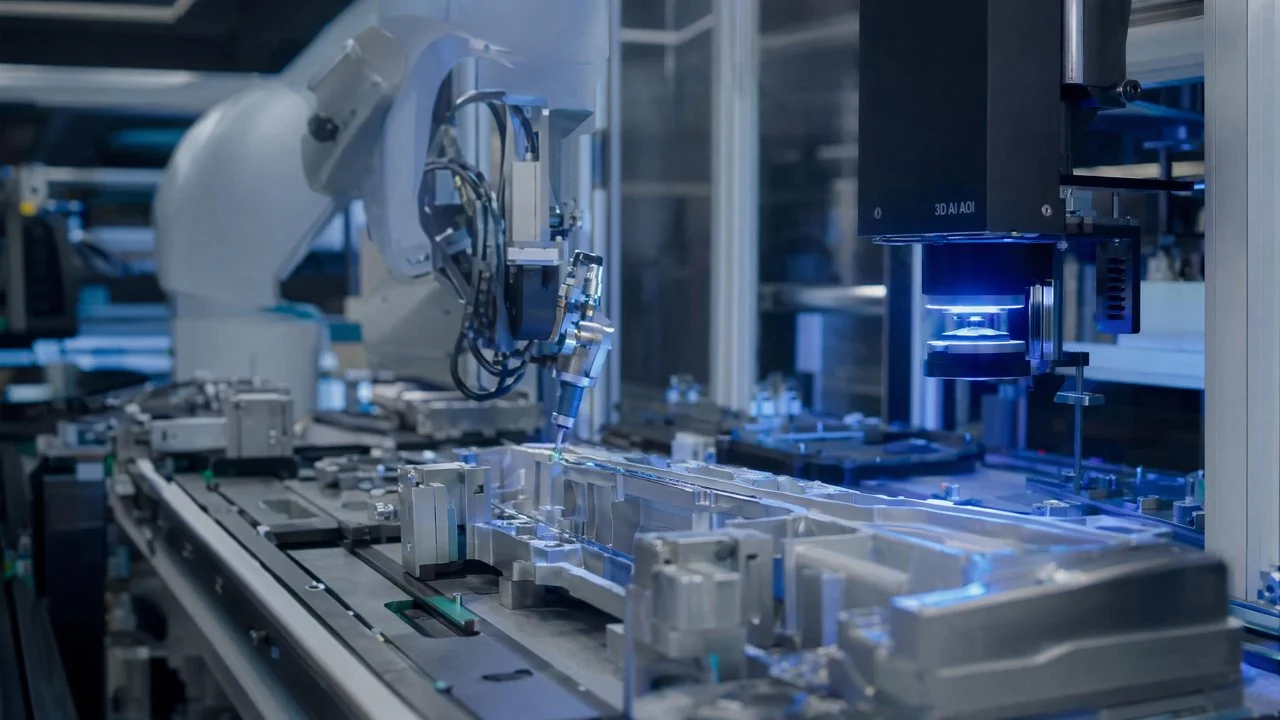
As industrial mother machines move towards the 'computational era', the field of industrial vision quality inspection is undergoing an upgrade from traditional methods to large-model applications. In the automotive and parts manufacturing industry, the glue sealing inspection process is facing new challenges and opportunities. WeLinkirt's 3D ACI equipment brings a brand-new solution to this field with its advanced technology.
Against the backdrop of the 'computational era' of industrial mother machines, industrial production is rapidly developing towards the direction of intelligence and automation. As a key link in ensuring product quality, industrial vision quality inspection is also constantly being upgraded to large-model applications. In the automotive and parts manufacturing industry, the glue sealing process is crucial as it directly affects the safety, sealing performance, and durability of automobiles. A leading automotive parts supplier has a glue-sealing process for various automotive parts in its production line. The main objects of inspection are the sealing conditions of the parts after glue application, covering multiple aspects such as the thickness, width, continuity of the glue layer, and the accuracy of the sealing path. Accurate detection of these parameters is crucial for ensuring product quality and performance.
Pain Points: Why Is It Difficult?
Traditional industrial vision quality inspection methods are struggling to keep up with the upgrade of automation equipment to large-model applications. The supplier faces many quantitative dilemmas in the glue-sealing inspection process. Firstly, there is the issue of the missed-detection rate. The missed-detection rate of traditional inspection methods reaches 3%, which means that some products with sealing defects will flow into subsequent processes. These defective products may cause problems during subsequent assembly or use, resulting in a significant increase in rework costs. Secondly, the false-alarm rate is as high as 20%. Frequent false alarms cause the production line to stop frequently. Each stop requires manual investigation, which not only wastes a lot of time but also reduces production efficiency. Moreover, manual inspection is inefficient and has high labor costs. Manual inspection requires professional inspectors who need to concentrate for long periods, which makes them prone to fatigue and mistakes. In addition, the model-changing time is as long as 30 minutes, which cannot meet the production requirements of rapid model changes in today's rapidly changing market. Furthermore, industry compliance requirements for the accuracy and comprehensiveness of sealing inspection are constantly increasing. Traditional inspection methods, due to their technical limitations, are difficult to meet the new standards.
The root cause of the difficulty for traditional methods to address these challenges lies in their technical limitations. Most traditional industrial vision quality inspections are based on 2D imaging technology, which can only obtain two-dimensional information on the object's surface. For some defects in 2D optical blind spots, such as hidden solder joints, coplanarity, and micron-level morphology, it is impossible to detect them accurately. Moreover, traditional methods lack effective data analysis and model-learning capabilities, making it difficult to adapt to complex and changeable production environments and continuously increasing inspection requirements.
Technical Principle
WeLinkirt's 3D ACI equipment uses a self-developed 3D camera for image acquisition. The 3D camera uses the structured-light principle to project a specific structured-light pattern onto the surface of the measured object and captures the deformed light pattern reflected from the object's surface through the camera. Since the height change of the object's surface will cause the deformation of the light pattern, the three-dimensional coordinates of each point on the object's surface can be calculated according to the degree of deformation, thus realizing the three-dimensional morphology reconstruction. The point-cloud data after 3D reconstruction can provide more abundant information, especially for defects in 2D optical blind spots, such as hidden solder joints, coplanarity, and micron-level morphology. For example, for hidden solder joints, the existence and welding quality of the solder joints can be judged by analyzing the three-dimensional morphology characteristics around the solder joints.
In terms of 2D-3D fusion, the equipment combines the texture information of 2D images with the geometric information of 3D point clouds. 2D images can provide information such as the color and texture of the object's surface, while 3D point clouds provide the three-dimensional shape information of the object. After the fusion of the two, the detection object can be analyzed and judged more comprehensively and accurately. In glue-sealing inspection, by reconstructing and analyzing the three-dimensional morphology of the glued area, parameters such as the thickness, width, and continuity of the glue layer can be accurately measured. At the same time, by comparing the actual glue-application path with the preset sealing-path model, path correction can be realized. Compared with traditional 2D detection methods, this 3D AI technology can provide more comprehensive and accurate detection results, effectively solving the limitations of 2D detection.
Typical Application Scenarios
- Glue-layer thickness detection: The thickness of each point of the glue layer is accurately measured through 3D reconstruction technology. The difficulty lies in the fact that the surface of the glue layer may be uneven, and precise data processing and analysis are required.
- Glue-layer width detection: The boundary of the glue layer is determined using 3D point-cloud data to measure the width. The difficulty is to accurately identify the boundary between the glue layer and surrounding components to avoid misjudgment.
- Glue-layer continuity detection: The continuity of the glue layer is judged by analyzing the 3D - reconstructed image. The difficulty lies in detecting tiny breakpoints or discontinuous areas, which requires high-resolution images and precise algorithms.
- Hidden solder-joint detection: The existence and welding quality of solder joints are judged by analyzing the three-dimensional morphology characteristics around the solder joints. The difficulty is that the solder joints may be blocked by other components, and effective information needs to be extracted from complex three-dimensional data.
- Coplanarity detection: The coplanarity of the component surface is calculated using 3D point-cloud data. The difficulty lies in accurately measuring tiny height differences to ensure detection accuracy.
Implementation Case
A leading automotive parts supplier has a large-scale automotive parts production line. The supplier has been facing many problems caused by traditional inspection methods in the glue-sealing inspection process. During the process of introducing WeLinkirt's 3D ACI equipment, WeLinkirt's technical team first conducted a comprehensive investigation and analysis of the supplier's production line to understand its specific needs and pain points. Then, the equipment was installed and debugged according to the actual situation of the production line. In the initial stage of going online, operators were provided with professional training to ensure that they could use the equipment and supporting software proficiently.
After introducing WeLinkirt's 3D ACI equipment, the glue-sealing inspection effect of the supplier has been significantly improved.
WeLinkirt's Solution and Products
Centered around the 3D ACI equipment, which has high-precision 3D imaging and analysis capabilities, it can perform 100% online 3D detection of the glue-sealing conditions of automotive parts. During the detection process, the equipment can collect the three-dimensional data of the glued area in real-time and compare it with the preset standard model. WeLinkirt's 3D ACI equipment provides a more comprehensive and accurate solution for automotive glue-sealing inspection through 2D-3D fusion technology. The supporting DaoAI ACI OS can achieve rapid programming. Automatic programming without code can be completed in 5 minutes for a single good product. Combined with APDT positive-sample/few-sample learning (only 1-20 good samples are required) and semantic false-alarm filtering functions, the detection efficiency and accuracy are further improved. At the same time, the system can generate correction instructions in real-time based on the detection results to guide the glue-application equipment for path correction.
Quantitative results: After introducing WeLinkirt's 3D ACI equipment, the detection rate of the supplier's glue-sealing inspection has increased to 99%, the missed-detection rate has decreased to <1%, effectively preventing defective products from flowing into subsequent processes; the false-alarm rate has decreased by 60%, reducing the number of production-line stops caused by false alarms and improving production efficiency; the model-changing time has been shortened from 30 minutes to 5 minutes, meeting the production requirements of rapid model changes.
FAQ
What glue-sealing defects can the 3D ACI equipment detect?
The 3D ACI equipment can detect various glue-sealing defects, such as uneven glue-layer thickness, inconsistent width, and poor continuity. It can also detect defects in 2D optical blind spots, such as hidden solder joints. Using 3D reconstruction and 2D-3D fusion technology, it conducts a comprehensive inspection of the object, obtains more abundant information, and accurately identifies various defects.
Is the programming of the supporting software system complex?
No, it isn't. The DaoAI ACI OS features rapid programming. Automatic programming without code can be completed in 5 minutes for a single good product. Combined with APDT positive-sample/few-sample learning, only 1-20 good samples are required, which makes the detection programming more efficient and reduces the complexity and difficulty of programming.
How does the equipment achieve path correction?
During the detection process, the equipment collects the three-dimensional data of the glued area in real-time and compares it with the preset sealing-path model. When a deviation between the actual glue-application path and the standard path is found, the supporting software system generates correction instructions in real-time based on the detection results to guide the glue-application equipment to adjust the path, thus achieving path correction.
Full solution for this scenario: the full inspection solution for Automotive / parts · 100% Inline 3D Inspection & Path Correction for Automotive Glue Dispensing
This article was generated by AI. Customer cases are simulated scenarios based on real product capabilities and figures are illustrative; see product pages for official benchmarks.