
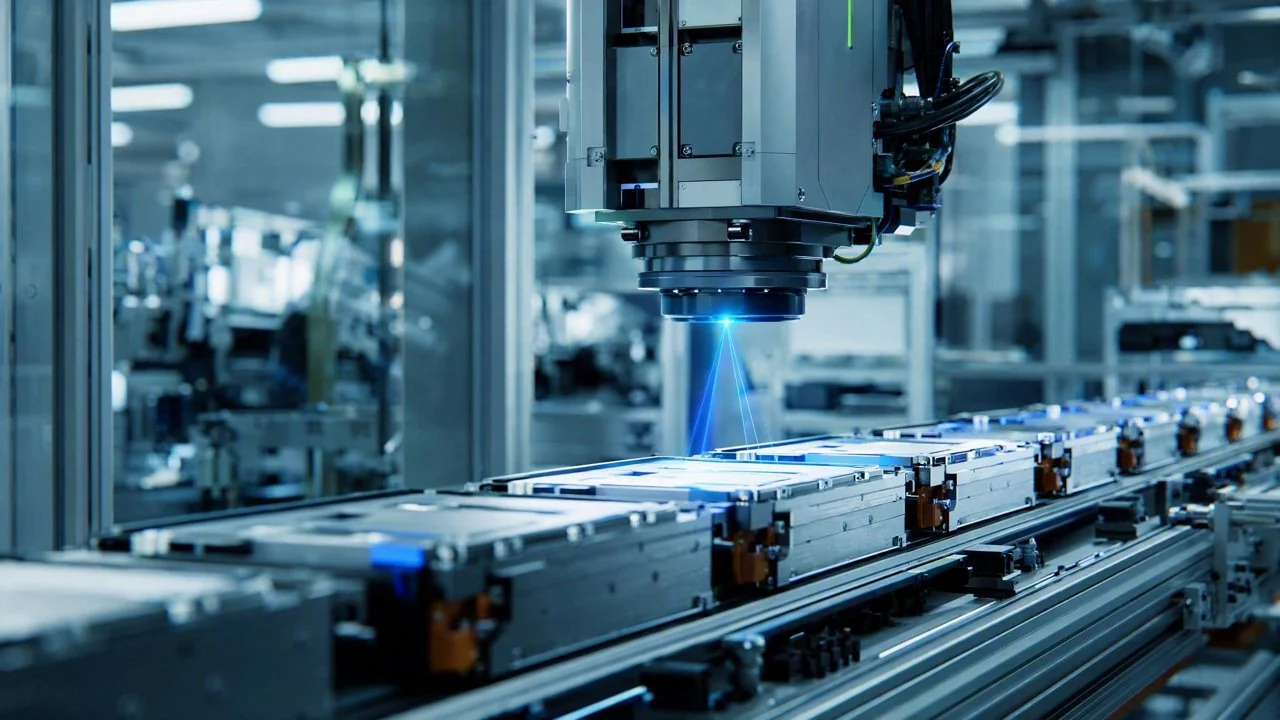
DaoAI 3D AI AOI equipment (proprietary 3D camera + 3D morphology reconstruction/point cloud, detecting hidden solder joints/coplanarity/micron-level morphology/pores and other 2D optical blind spot defects, 2D-3D fusion) significantly enhances flexibility and efficiency for multi-variety, small-batch production lines by offering zero-code rapid changeover capability, reducing downtime for new energy battery winding/stacking anode-cathode alignment inspection from hours to under 5 minutes.
New energy batteries, as a vital force driving global energy transformation, have their performance, safety, and cost directly determined by the sophistication and intelligence of their manufacturing processes. In the winding or stacking processes of power batteries, precise alignment of anode and cathode materials is crucial for battery performance consistency and internal resistance control. Any minute misalignment can lead to battery capacity degradation, localized overheating, or even safety hazards. Traditional inspection methods often struggle to meet the flexible demands of high-precision, high-throughput, and multi-variety, small-batch production. Especially for emerging battery technologies and customized products, the programming and debugging costs associated with frequent line changeovers become a bottleneck hindering efficiency improvements. DaoAI, deeply rooted in industrial AI vision, addresses this pain point by introducing 3D AI AOI equipment integrating proprietary 3D cameras and advanced 3D morphology reconstruction algorithms, aiming to provide an efficient, precise, and highly flexible online inspection solution for the new energy battery industry.
Pain Points: Why This Hurdle Is Difficult to Overcome
Anode and cathode alignment inspection in new energy battery winding/stacking processes faces multiple challenges. Firstly, the trend towards product diversification and customization leads to frequent line changeovers. Traditional rule-based or manually taught AOI systems require hours, or even half a day, for parameter adjustment and program writing with each changeover, severely impacting production rhythm and resulting in changeover downtime accounting for over 20%. Secondly, the micron-level alignment precision required for electrode sheets is extremely high. 2D vision has blind spots when detecting 3D features such as edge morphology, subtle warpage, and slight misalignment, often leading to missed detections and ultimately poor product consistency. Thirdly, the reflective and uneven textural optical properties of electrode materials themselves, as well as potential interference from dust and scratches during production, greatly increase the false alarm rate of traditional vision algorithms, leading to high manual re-inspection hours and significantly increased labor costs.
The root cause of these difficulties is the lack of precise 3D morphological perception in traditional inspection solutions and their rigid programming logic, which struggles to adapt to rapidly changing production demands. For small and medium-sized enterprises (SMEs), the high development costs and long deployment cycles of introducing traditional AI quality inspection solutions are particularly prohibitive. Even for leading enterprises, facing the flexible manufacturing demands of multi-variety, small-batch production, there is an urgent need for an intelligent inspection tool capable of “zero-code” rapid adaptation to new products and processes to reduce operating costs and enhance market competitiveness.
Technical Principles
The core of DaoAI 3D AI AOI equipment lies in its proprietary high-precision 3D camera and innovative 3D morphology reconstruction technology. This equipment acquires complete point cloud data of the inspected object in real-time through structured light projection and multi-view image acquisition, combined with high-precision calibration algorithms, reconstructing 3D morphology with micron-level accuracy. Unlike traditional 2D vision, which only obtains planar grayscale or color information, DaoAI 3D AI AOI can directly quantify 3D geometric features such as electrode sheet thickness, height difference, edge morphology, and coplanarity, thereby precisely identifying minute misalignments, warpage, and wrinkles in anode and cathode sheets that are 2D optical blind spot defects. At the algorithmic level, DaoAI employs advanced deep learning models, particularly APDT positive/few-shot learning technology optimized for industrial scenarios. This means users only need to provide 1–20 images of good products as “learning samples,” and the system can automatically complete model training and detection rule generation within 5 minutes, achieving “zero-code” rapid changeover and significantly lowering the technical threshold and deployment costs.
Compared to traditional rule-based AOI systems, the advantage of DaoAI 3D AI AOI lies in its powerful generalization capability and self-learning characteristics. Rule-based AOI requires manual setting of numerous thresholds and parameters, which need readjustment when products change, being time-consuming, labor-intensive, and prone to missing unknown defects. In contrast, DaoAI 3D AI AOI intelligently identifies “anomalies” by learning the characteristics of “good products,” possessing a certain ability to recognize newly emerging defect types. Concurrently, 2D-3D fusion inspection technology enables the equipment to both quickly screen surface defects using 2D images and conduct high-precision morphological measurements using 3D data. This complementarity reduces the missed detection rate to <0.5%, ensuring comprehensive and reliable inspection.
Typical Application Scenarios
- **Anode and Cathode Sheet Winding/Stacking Alignment Inspection**: During battery winding or stacking, DaoAI 3D AI AOI equipment is used to detect the relative position, misalignment distance, and edge neatness of anode and cathode sheets in real-time, ensuring alignment accuracy within micron-level to prevent localized short circuits or capacity loss due to misalignment. The challenge lies in real-time high-precision 3D measurement and capturing subtle morphological changes at high speeds.
- **Tab Welding Quality Inspection**: Conduct 3D morphology analysis of the weld points between the tab and current collector, detecting defects such as weld point height, width, collapse, pores, cold solder, or false welds. Traditional 2D struggles to effectively assess the 3D quality of weld points, while DaoAI 3D AI AOI provides complete weld point morphology data to identify hidden defects.
- **Separator Wrinkle, Damage, and Foreign Object Detection**: Perform comprehensive inspection of the separator surface before battery assembly, utilizing 3D morphological data to identify minute wrinkles, damage, holes, or attached foreign objects. These defects might be overlooked in 2D images due to insufficient contrast but are critical for battery safety.
- **Cell Encapsulation Sealing Morphology Inspection**: Conduct 3D morphology inspection of the sealing edges of pouch cells and the joint between the cover plate and casing of hard-shell batteries, assessing the flatness and width consistency of the sealing edge, and checking for micro-cracks or overflowing glue, ensuring cell sealing to prevent electrolyte leakage.
- **Coating Thickness Uniformity and Defect Detection**: While primarily focused on alignment, the morphology reconstruction capability of DaoAI 3D AI AOI equipment can also be extended to the coating process. By measuring changes in the coating surface height, it can evaluate coating uniformity and identify defects such as particles, bubbles, and scratches within the coating.
Case Study
A leading new energy battery manufacturer, when launching multiple customized high-energy-density cell products, faced challenges with frequent line changeovers and excessively long programming times for traditional AOI. Their existing rule-based 2D AOI system required senior engineers to spend 4-6 hours on image acquisition, feature extraction, parameter adjustment, and rule writing for each new product launch or specification change. This resulted in prolonged line downtime, affecting the delivery efficiency of multi-variety, small-batch orders. After introducing DaoAI 3D AI AOI equipment, the client's production model underwent a significant transformation. With the DaoAI AI AOI software system, engineers only needed to upload 10-15 images of good cells, and the system could automatically learn and generate new inspection models within 5 minutes, achieving “zero-code” rapid changeover. Before implementation, the production line averaged 8-10 changeovers per month, with high downtime costs for each; after implementation, changeover downtime was reduced by 90%, greatly enhancing the line's flexibility and utilization rate. Furthermore, DaoAI 3D AI AOI equipment reduced the missed detection rate for minute misalignments in anode-cathode alignment from the original 1.2% to <0.4%, significantly improving product consistency and safety.
DaoAI 3D AI AOI equipment has truly enabled our production line to achieve 'plug-and-play' flexible manufacturing. New product launches are no longer a nightmare.
DaoAI Solution and Products
DaoAI’s 3D AI AOI solution for the new energy battery industry is built around its core product, the DaoAI 3D AI AOI equipment, integrating proprietary 3D camera hardware, high-performance 3D morphology reconstruction algorithms, and the DaoAI AI AOI software system. This system, through deep learning foundation models, achieves precise recognition and classification of micron-level morphological features of electrode sheets. In practice, DaoAI provides a complete set of services from equipment integration, model training, to production line deployment. Customers only need to upload a small number of good product images in the DaoAI AI AOI software interface to quickly train detection models for specific products and defects using APDT positive/few-shot learning technology. The entire process requires no programming knowledge, achieving true “zero-code” operation. Furthermore, DaoAI 3D AI AOI equipment supports 100% local private deployment, ensuring customer data security and compliance with stringent industry data regulations. Through 2D-3D fusion inspection, DaoAI can cover traditional 2D optical blind spot defects, such as hidden solder joints, micron-level morphological defects, pores, and coplanarity anomalies, comprehensively improving inspection quality.
DaoAI 3D AI AOI not only solves the precision and speed issues of anode and cathode alignment inspection in new energy battery manufacturing but also, through its unique advantage of “zero-code rapid changeover,” lowers the barrier for enterprises, especially SMEs, to introduce AI quality inspection in multi-variety, small-batch production models. This enables enterprises to respond to market changes with lower costs and faster speeds, enhancing overall competitiveness. DaoAI is committed to transforming advanced AI vision technology into easy-to-use, efficient industrial tools, aiding in the transformation and upgrading of intelligent manufacturing.
FAQ
How does DaoAI 3D AI AOI equipment achieve 'zero-code rapid changeover'?
DaoAI 3D AI AOI equipment, through its core DaoAI AI AOI software system, integrates APDT positive/few-shot learning technology. Users only need to provide 1–20 images of good products as learning samples, and the system intelligently identifies product features and automatically generates inspection models and rules, eliminating the need for any manual coding. This reduces traditional changeover times from hours to under 5 minutes.
What are the fundamental differences between 3D AI AOI and traditional 2D AOI in new energy battery inspection?
Traditional 2D AOI primarily detects defects based on planar images, struggling to obtain 3D morphological information of products. DaoAI 3D AI AOI, however, utilizes proprietary 3D cameras and 3D morphology reconstruction technology to acquire micron-level 3D data such as electrode sheet thickness, height differences, and coplanarity. This enables precise detection of 2D optical blind spot defects like minute warpage, hidden solder joints, and pores, significantly enhancing inspection accuracy and comprehensiveness.
How does this solution help SMEs introduce AI quality inspection?
The 'zero-code rapid changeover' and few-shot learning capabilities of DaoAI 3D AI AOI equipment significantly lower the deployment and maintenance barriers for AI quality inspection. SMEs do not need to invest heavily in R&D resources and specialized AI engineers. They can quickly implement and flexibly adapt to multi-variety, small-batch production demands, effectively reducing manual re-inspection costs and enhancing product quality and market competitiveness.
Full solution for this scenario: the full inspection solution for New-energy batteries
This article was generated by AI. Customer cases are simulated scenarios based on real product capabilities and figures are illustrative; see product pages for official benchmarks.