
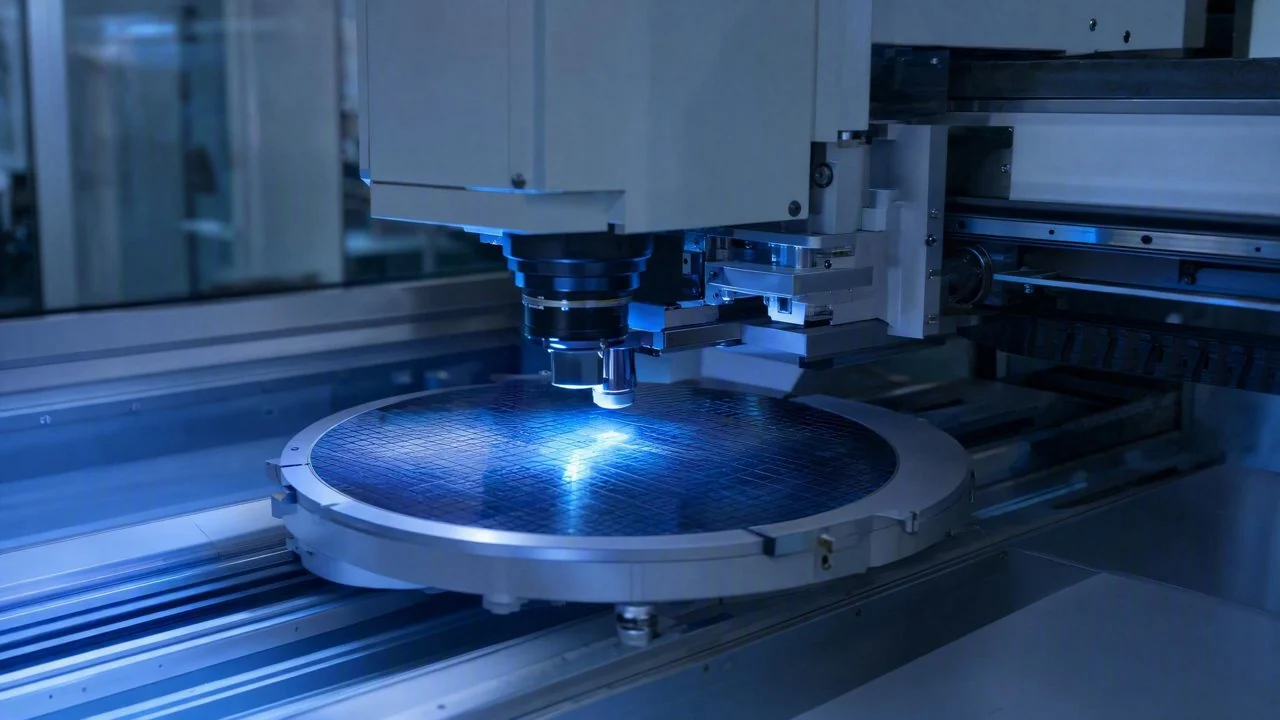
WeLinkirt's DaoAI 3D AI AOI equipment (featuring self-developed 3D cameras + 3D morphology reconstruction/point cloud, detecting hidden solder joints/coplanarity/micron-level morphology/pores, and other 2D optical blind spot defects, with 2D-3D fusion), through its unique local private deployment capability and high-precision 3D morphology reconstruction technology, has successfully reduced the escape rate of semiconductor micro-bump missing and bridging defects from a common 2% to <0.4%, significantly improving quality control and data security in chip packaging.
In the advanced packaging segment of semiconductor manufacturing, micro-bumps serve as critical structures connecting chips to substrates, with their quality directly determining the performance and reliability of the final product. As chip integration continues to increase, micro-bump sizes are shrinking, posing unprecedented challenges to detection accuracy and efficiency. Particularly in scenarios where clients demand extremely high levels of data security and localized deployment, traditional cloud-based AI solutions or those relying on external services often fail to meet compliance and security requirements. WeLinkirt's DaoAI 3D AI AOI equipment was developed to address this core pain point. It offers 100% local private deployment capability, combined with self-developed 3D cameras and 3D morphology reconstruction technology, enabling high-precision detection of micron-level defects such as micro-bump missing and bridging, all while ensuring critical data remains on-site. This significantly elevates the quality control standards in semiconductor packaging.
Pain Points: Why This Hurdle Is So Difficult to Overcome
In semiconductor micro-bump detection, clients face challenges across multiple dimensions. Firstly, **data security and compliance risks**: for leading semiconductor manufacturers, core process data and product defect information are the lifeblood of the enterprise. Any data leakage could lead to severe economic losses and competitive disadvantages. Therefore, uploading detection data to third-party cloud platforms is unacceptable, requiring all AI inference and data storage to be deployed privately on-premises. Secondly, **high escape and false positive rates**: traditional 2D AOI struggles to effectively identify 3D morphological defects such as micro-bump bridging at the bottom, tiny omissions, or height inconsistencies, leading to escape rates often fluctuating between 1.5%–2.5%. Concurrently, due to surface reflections, shadows, and other interferences, false positive rates are also high, increasing the burden of manual re-inspection, resulting in a **40% increase in manual re-inspection hours**. Thirdly, **production cycle time and changeover efficiency**: on high-speed production lines, each changeover requires reprogramming and debugging, which is time-consuming and affects overall OEE. Traditional programming methods are complex and demand high operator skill, running counter to the current trend of AI smart cameras simplifying operations to improve detection efficiency and accuracy for small and medium-sized manufacturers.
The root cause of these difficulties lies in the physical characteristics of micro-bumps and the complexity of the detection environment. Micro-bumps are typically tens of microns in size, often made of metallic materials with high gloss, prone to specular reflection and scattering, making it difficult for 2D images to capture their true morphology clearly. For instance, tiny bridges might only exist at the bottom of the bump, obscured in 2D images, creating “optical blind spots.” Furthermore, semiconductor production environments demand extremely high levels of cleanliness and stability, where any external interference can affect detection results. Against this backdrop, finding a solution that meets both data security requirements and offers high-precision, high-efficiency detection capabilities has become an urgent need for the semiconductor industry.
Technical Principles
The core advantage of WeLinkirt's DaoAI 3D AI AOI equipment lies in its self-developed 3D camera and advanced 3D morphology reconstruction algorithms. This equipment employs multi-view structured light projection and synchronized high-speed camera array acquisition technology, enabling it to capture multiple high-precision 2D images of the object under test in a very short time. These images are then fed into WeLinkirt's independently developed 3D morphology reconstruction engine, which uses computational geometry and deep learning fusion algorithms to precisely reconstruct the complete 3D point cloud data of the micro-bump. This method overcomes the sensitivity of traditional 2D AOI to surface reflections and shadows, enabling comprehensive capture of micron-level morphological features such as true height, volume, coplanarity, and bottom connections of micro-bumps. For example, for micro-bump bridging defects, 2D AOI might miss them due to occlusion, but WeLinkirt's DaoAI 3D AI AOI equipment can directly measure the actual height and width of the bridged part from the point cloud data, allowing for precise defect identification.
Compared to traditional rule-based AOI and manual inspection, WeLinkirt's DaoAI 3D AI AOI equipment offers significant advantages. Traditional rule-based AOI relies on engineers manually setting thresholds and geometric rules, which limits its ability to recognize complex defect patterns and makes it susceptible to lighting variations, often leading to false positives or escapes. Manual inspection, on the other hand, is limited by human eye fatigue, subjective judgment, and inefficiency, making it unsuitable for large-scale, high-precision production demands. WeLinkirt's DaoAI 3D AI AOI, powered by the DaoAI AI AOI software system, utilizes visual foundation models for feature recognition and supports APDT positive/few-shot learning (requiring only 1–20 good samples), greatly simplifying programming and changeover processes, achieving 5-minute 0-code automatic programming. This not only enhances detection robustness but also allows the equipment to continuously optimize detection models through ongoing learning, stabilizing the detection accuracy for micro-bump missing and bridging at over 99.6%, far exceeding the capabilities of traditional methods.
Typical Application Scenarios
- **Micro-bump Missing and Bridging Detection**: This is the most crucial application. The equipment precisely measures the presence, height, and volume of each micro-bump using 3D point cloud data, and identifies abnormal connections (bridging) between adjacent bumps. The challenge lies in the small size and large number of micro-bumps, and bridging potentially occurring in difficult-to-observe bottom areas.
- **Micro-bump Coplanarity Detection**: Ensuring all micro-bump tops are on the same plane is vital for subsequent packaging processes. WeLinkirt's DaoAI 3D AI AOI equipment generates high-precision height maps, calculates the overall coplanarity of the bump array, and identifies individual bumps with abnormal height deviations. The difficulty lies in the extremely high precision required for micron-level height differences.
- **Solder Pad/Ball Morphology Detection**: In Flip Chip packaging, the volume, sphericity, and positional offset of solder pads or balls directly impact soldering quality. The equipment performs comprehensive 3D morphological analysis of these tiny structures, detecting defects such as irregular shapes, undersized or oversized features. The challenge is severe solder ball surface reflections and potential tiny internal pores.
- **Underfill Overflow/Void Detection**: Underfill adhesive is used to enhance the connection between the chip and the substrate, and its uniformity and integrity are crucial. WeLinkirt's DaoAI 3D AI AOI equipment analyzes the surface morphology of the filled area to detect defects such as adhesive overflow, insufficient filling, or internal voids. The challenge is that the adhesive can be transparent or translucent, and voids may be internal.
Case Study
A leading domestic semiconductor packaging and testing manufacturer encountered a bottleneck in micro-bump detection on their high-end chip packaging line. Their existing 2D AOI equipment had a high escape rate for micro-bump missing and bottom bridging defects, particularly for some intricate bridge defects, with the escape rate once reaching 2.1%. Simultaneously, due to strict data security policies, they were unable to use any cloud-based AI solutions, requiring all detection systems to be 100% privately deployed on-premises. This forced them to invest significant human resources in manual re-inspection, accumulating **up to 3000 hours of manual re-inspection per month**, severely slowing down production cycles and increasing operational costs. To address this pain point, the manufacturer introduced WeLinkirt's DaoAI 3D AI AOI equipment.
The WeLinkirt team provided a complete local private deployment solution for the client, integrating the DaoAI AI AOI software system with their self-developed 3D camera hardware into the client's production line. During the commissioning process, leveraging the APDT few-shot learning capability of the DaoAI AI AOI software system, model training and optimization were completed within 3 days using only 15 good samples. After deployment, WeLinkirt's DaoAI 3D AI AOI equipment quickly demonstrated exceptional performance: the **escape rate for micro-bump missing and bridging was successfully reduced to <0.4%**, and the false positive rate was also significantly reduced by 85%. More importantly, all detection data was processed and stored on local servers, fully complying with the client's stringent data security requirements. This resulted in a **70% reduction in the client's manual re-inspection workload**, significantly boosting production line efficiency and effectively mitigating the risks of rework and customer complaints due to outgoing defects.
“The local deployment capability of WeLinkirt's DaoAI 3D AI AOI completely resolved our data security concerns, while its high-precision 3D detection capability pushed our most troublesome micro-bump escape rate to an industry-leading level. This is not just a technological breakthrough, but also protection for our core assets.” — Quality Director, a leading semiconductor manufacturer
WeLinkirt Solution and Products
WeLinkirt's 3D AI AOI solution for the semiconductor industry centers around its core product—the WeLinkirt DaoAI 3D AI AOI equipment, complemented by the powerful DaoAI AI AOI software system. This equipment integrates WeLinkirt's self-developed high-speed, high-precision 3D camera, enabling micron-level 3D morphology reconstruction to accurately capture the complete geometric information of tiny structures like micro-bumps and solder pads. For deployment, WeLinkirt offers 100% local private deployment options, where all AI inference models, training data, and production detection data run and are stored on the client's local servers, ensuring core data never leaves the facility and meeting the semiconductor industry's most stringent data security and compliance requirements. For model building and changeovers, the APDT few-shot self-training feature of the DaoAI AI AOI software system allows engineers to complete 0-code automatic programming in 5 minutes, quickly training high-performance detection models with a small number of good samples (1-20 images). This significantly shortens the time for new product introduction and production line changeovers, effectively addressing the complexity and time consumption of traditional AOI programming, and aligns perfectly with the current trend of AI smart cameras simplifying operational procedures.
Furthermore, WeLinkirt's DaoAI 3D AI AOI equipment supports 2D-3D fusion detection. While leveraging 3D morphological data to address optical blind spot defects, it also combines 2D image texture and color information to achieve more comprehensive defect coverage. This fusion capability allows WeLinkirt's DaoAI 3D AI AOI equipment to detect not only traditional 3D defects such as micro-bump missing, bridging, and coplanarity, but also 2D defects like surface scratches and foreign objects, providing a one-stop quality inspection solution. WeLinkirt ensures smooth integration with existing MES/SCADA systems through various deployment forms like SDK / API / Docker, enabling real-time interaction and closed-loop management of production data. For example, detection results can be transmitted in real-time to the MES system for traceability and analysis, further optimizing production processes and achieving a comprehensive upgrade to smart manufacturing. Through WeLinkirt's DaoAI 3D AI AOI equipment, clients not only gain superior detection accuracy and efficiency but, more importantly, achieve continuous productivity improvement while strictly adhering to data security.
FAQ
Why does the semiconductor industry particularly emphasize local private deployment?
The semiconductor industry is technology-intensive and intellectual property-intensive, with core process data, product designs, and defect information considered top secrets. Any data breach could lead to significant economic losses and competitive disadvantages. Local private deployment ensures that all sensitive data and AI inference processes are completed within the enterprise's firewall, with data remaining on-premises, thereby maximizing information security and compliance.
How does WeLinkirt's DaoAI 3D AI AOI equipment address 2D optical blind spot defects?
WeLinkirt's DaoAI 3D AI AOI equipment captures multi-view images with its self-developed 3D camera and uses 3D morphology reconstruction algorithms to generate high-precision point cloud data. This method obtains true 3D geometric information of objects, overcoming “optical blind spots” caused by occlusion, reflection, or shadows in 2D images. This enables effective detection of defects such as micro-bump bottom bridging, micron-level morphological defects, and internal pores that are difficult to find with 2D methods.
What is the typical implementation period for WeLinkirt's 3D AI AOI solution, and what initial investment is required?
The implementation period for WeLinkirt's 3D AI AOI solution is generally short, thanks to the APDT few-shot learning capability of the DaoAI AI AOI software system, allowing model training and debugging to be completed within a few days. The initial investment primarily includes equipment procurement and integration costs, with specific costs varying based on the client's production line scale, customization needs, and detection complexity. We encourage clients to consult us for customized solutions and detailed quotes to ensure maximized return on investment.
Full solution for this scenario: Semiconductor / chips industry solutions
This article was generated by AI. Customer cases are simulated scenarios based on real product capabilities and figures are illustrative; see product pages for official benchmarks.