
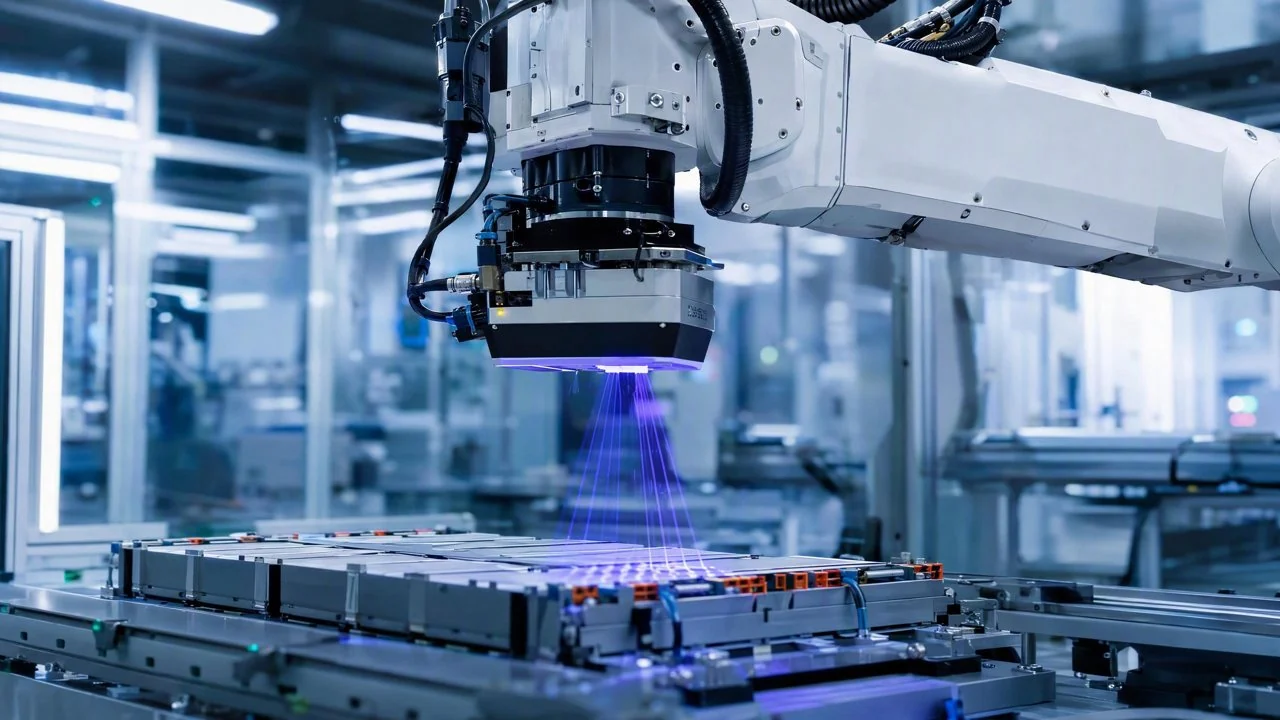
WeLinkirt DaoAI 3D robot vision (proprietary 3D camera + 6D pose estimation, bin picking, dispensing/assembly/loading guidance, brain-eye-body closed-loop, sub-millimeter hand-eye coordination) addresses the rapid changeover challenge in new energy battery module solder joint inspection for multi-variety, small-batch production. By integrating advanced 3D imaging and AI models, it dramatically reduces changeover downtime from an average of 30 minutes to under 5 minutes, which was previously caused by traditional manual teaching or rule-based programming.
The new energy battery industry is undergoing rapid iteration and diversification, especially in segmented markets like energy storage and electric vehicles. Customer demand for customized battery modules is growing, leading to production lines facing multi-variety, small-batch production models. In this context, the quality of solder joints in battery modules directly impacts battery performance and safety, making it a critical inspection step. However, traditional solder joint inspection solutions often suffer from low efficiency when facing frequent product changes, becoming a bottleneck restricting capacity improvement. WeLinkirt DaoAI 3D robot vision solution is designed to address this challenge. It ensures the quality of solder joint inspection through high-precision 3D vision technology and intelligent AI algorithms, while significantly enhancing production line flexibility and changeover efficiency.
Pain Points: Why This Hurdle Is Difficult to Overcome
In new energy battery module solder joint inspection, the pain points of traditional solutions primarily focus on several aspects: Firstly, **long changeover downtime**: For multi-variety, small-batch production, each product switch requires re-teaching the robot or adjusting inspection parameters, with average downtime reaching 30 minutes, severely impacting production line takt time. Secondly, **complex manual teaching and limited precision**: Solder joint positions, shapes, heights, and other information are complex, making traditional manual teaching time-consuming and labor-intensive, and difficult to achieve sub-millimeter inspection precision. Thirdly, **high rates of missed detections and false positives**: Due to complex conditions such as reflections, shadows, and micro-deformations on battery module solder joints, traditional 2D vision or rule-based AOI struggles to accurately identify defects, leading to a potential missed detection rate of up to 1.5% and a false positive rate of around 5%, increasing the burden of manual re-inspection. Finally, **data silos and traceability difficulties**: The lack of a unified vision platform and closed-loop data makes defect data difficult to trace and analyze effectively, hindering process optimization.
The root cause of these difficulties lies in the fact that new energy battery module solder joints typically use laser welding, and the solder joint surfaces may exhibit visual challenges such as uneven height, inconsistent color, and slight oxidation. Traditional 2D imaging is highly susceptible to lighting and angle, making it difficult to obtain true 3D topographical information of solder joints. Rule-based AOI systems require engineers to manually write a large number of rules, are insensitive to minor process fluctuations, and incur extremely high maintenance costs for rule bases when facing new defects or changeovers, failing to meet the demands of rapid iteration. Combined with the current trend of humanoid robot general motion control systems (“cerebellums”) requiring rapid learning and generalization for complex tasks, it is clear that traditional rigid programming models can no longer meet the higher demands for flexibility and intelligence in future industrial automation.
Technical Principles
WeLinkirt DaoAI 3D robot vision effectively overcomes the aforementioned challenges through its core technology. This solution employs a proprietary high-precision 3D camera to rapidly acquire complete 3D point cloud data of solder joints, reconstructing their true sub-millimeter topography. Combined with advanced 6D pose estimation algorithms, the system can precisely perceive the position and orientation of battery modules in space, guiding the robotic arm for accurate inspection. Its core advantage lies in the “brain-eye-body closed-loop” control system, which endows the robot not only with the perception capabilities of “eyes” but also the decision-making intelligence of a “brain” and the precise execution of a “body.” For different types of battery modules, the WeLinkirt DaoAI 3D robot vision system only needs to learn from a small number of good samples to establish a new product inspection model, achieving 0-code rapid changeover. Actual test data shows that this system can reduce the missed detection rate to <0.4% when dealing with complex reflective solder joints, significantly outperforming traditional solutions.
Compared to traditional manual visual inspection or rule-based AOI, the advantage of WeLinkirt DaoAI 3D robot vision lies in its deep utilization of 3D information and the generalization capability of AI models. Manual visual inspection is limited by human eye fatigue and subjective judgment, resulting in low efficiency and poor consistency; rule-based AOI relies on preset rules, is insensitive to unknown defects or morphological changes, and each changeover requires significant time to adjust parameters. In contrast, DaoAI 3D vision, through deep learning and 3D point cloud analysis, can adaptively identify various solder joint defects, such as cold solder joints, cracks, collapse, short circuits, and splashes, without the need for manual writing of complex rules. Its “5-minute 0-code automatic programming with one good sample” capability, along with APDT positive/few-shot learning (1–20 good samples), greatly simplifies deployment and maintenance processes, significantly improving production line flexibility and efficiency.
Typical Application Scenarios
- **Module Cell Connector Solder Joint Inspection**: Detects defects such as cold solder joints, false soldering, cracks, oxidation, and short circuits between battery cells and connectors. The challenge lies in dense, tiny, and potentially reflective solder joints; DaoAI 3D vision accurately identifies these through multi-angle 3D reconstruction and defect feature extraction.
- **Busbar Solder Joint Morphology and Coplanarity Inspection**: Checks the integrity of busbar solder joint morphology with battery electrodes, consistency of height, presence of collapse or protrusion, and compliance with coplanarity standards. The 3D camera acquires precise height information, and algorithms evaluate coplanarity.
- **Protection Board Solder Joint Defect Inspection**: Inspects the quality of component solder joints on battery protection boards, including missing solder, excess solder, insufficient/excessive solder paste, and bridging. DaoAI 3D vision can penetrate slight obstructions to identify hidden defects.
- **Module Connector Pin Soldering Quality Inspection**: Detects the soldering quality of connector pins, including pin bending, misalignment, and solder joint fullness. 6D pose estimation precisely guides the inspection, ensuring every pin is covered and micro-level morphology is analyzed.
- **Dispensing Quality Guidance and Inspection**: Provides real-time guidance and inspection of sealant dispensing path, width, and height before module encapsulation, ensuring uniform, continuous, and non-overflowing adhesive application. DaoAI 3D robot vision offers high-precision 3D guidance and online inspection of dispensing quality.
Deployment Case Study
A mid-sized new energy battery module manufacturer, primarily producing various customized energy storage battery modules, faced frequent product changeovers on its production line. Traditional manual teaching and rule-based AOI equipment resulted in changeover downtime of up to 30 minutes, severely impacting production efficiency. To enhance production line flexibility and reduce manufacturing costs, the manufacturer introduced the WeLinkirt DaoAI 3D robot vision solution. Before deployment, the production line's annual changeover downtime totaled approximately 1500 hours; manual re-inspection consumed significant labor and had a missed detection rate of around 1.5%. By deploying the WeLinkirt DaoAI 3D robot vision system, leveraging its 0-code rapid changeover capability, the production line achieved switching for multi-variety module solder joint inspection. Post-deployment, production line data showed that changeover downtime was significantly reduced to under 5 minutes, the overall detection rate for module solder joints increased to 99.4%, and the false positive rate decreased by approximately 80%, substantially reducing the workload of manual re-inspection and effectively improving the overall OEE of the production line.
WeLinkirt DaoAI 3D robot vision enables new energy battery module production lines to achieve efficient, precise solder joint quality control and rapid changeover even when facing multi-variety, small-batch challenges.
WeLinkirt Solution and Products
The WeLinkirt DaoAI 3D robot vision solution, with its proprietary 3D camera as the sensing core, combined with powerful AI vision foundation models, provides unprecedented flexibility and efficiency for new energy battery module solder joint inspection. The core of this solution lies in its “0-code rapid changeover” capability. Through the APDT positive/few-shot learning technology in the DaoAI ACI OS operating system, engineers only need to provide 1–20 good sample images, and the system can automatically generate a new inspection model within 5 minutes, without complex robot teaching or rule writing. This enables production lines to easily adapt to multi-variety, small-batch production modes, significantly reducing changeover downtime. Furthermore, the DaoAI World world model, as a unified foundation, ensures semantic understanding and cross-scenario generalization capabilities, with continuous learning from production line feedback data to further improve model accuracy. WeLinkirt offers various deployment methods such as SDK/API/Docker, supporting 100% local private deployment to ensure customer data security.
Through the deployment of the WeLinkirt DaoAI 3D robot vision solution, the client's production line changeover downtime in this case was reduced from 30 minutes to 5 minutes, an 83% efficiency improvement. Simultaneously, the detection rate for solder joints stabilized above 99.4%, with the missed detection rate falling below <0.6%, greatly enhancing product quality. The false positive rate decreased by approximately 80%, significantly reducing the burden of manual re-inspection, saving an estimated ¥694 per hour in manual re-inspection labor costs. These quantified achievements not only brought direct cost savings but also enhanced the client's market competitiveness and accelerated their innovation pace in the new energy sector.
FAQ
How does WeLinkirt DaoAI 3D Robot Vision achieve 0-code rapid changeover?
WeLinkirt DaoAI 3D Robot Vision achieves 0-code rapid changeover through its APDT positive/few-shot learning technology within the DaoAI ACI OS operating system. Users only need to provide 1-20 good sample images, and the system can automatically generate a new inspection model within 5 minutes, eliminating the need for complex manual coding or tedious robot teaching, significantly streamlining new product introduction processes.
How can I estimate the cost budget for deploying WeLinkirt DaoAI 3D Robot Vision solution?
The cost of deploying WeLinkirt DaoAI 3D Robot Vision solution depends on several factors, including production line scale, number of inspection stations, required camera and robotic arm configurations, and customized integration needs. We offer flexible software and hardware packages. We recommend contacting our sales team to get a detailed quote and return on investment analysis based on your specific requirements to ensure an optimized solution.
What types of defects can WeLinkirt DaoAI 3D Robot Vision identify in new energy battery module solder joint inspection?
WeLinkirt DaoAI 3D Robot Vision can identify a wide range of defects on new energy battery module solder joints, including cold solder joints, false soldering, cracks, oxidation, short circuits, collapse, protrusion, insufficient or excessive solder, bridging, splashes, as well as pin bending, misalignment, etc. With its high-precision 3D imaging and AI algorithms, it can penetrate complex lighting and morphological interferences, providing comprehensive defect detection capabilities.
Full solution for this scenario: Robotics Vision industry solutions · Battery Module Weld Spot Inspection
This article was generated by AI. Customer cases are simulated scenarios based on real product capabilities and figures are illustrative; see product pages for official benchmarks.