
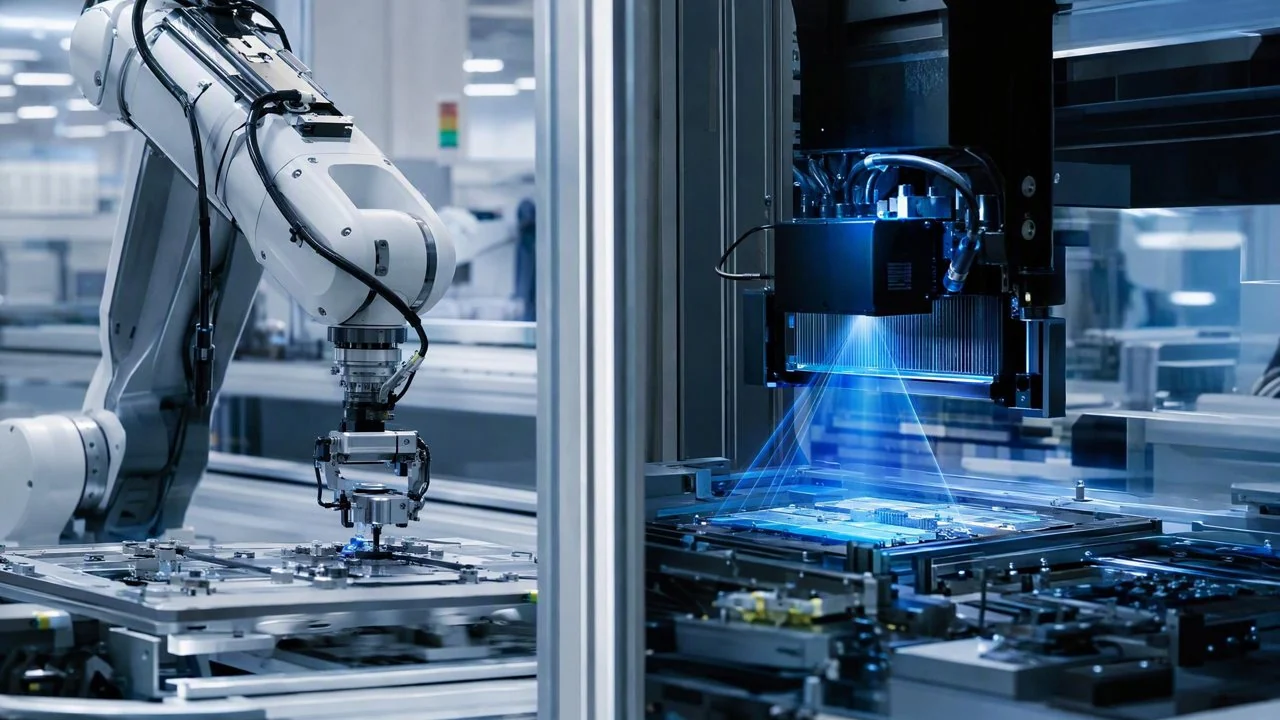
WeLinkirt DaoAI 3D Robot Vision (proprietary 3D camera + 6D pose estimation, bin picking, dispensing/assembly/loading guidance, brain-eye-body closed-loop, sub-millimeter hand-eye coordination) utilizes high-precision 3D inspection and intelligent decision-making to reduce missing/misplaced component and incorrect assembly false negatives on consumer goods high-speed assembly lines from a traditional 1.5% to <0.05%, while ensuring 100% full inspection capacity in sync with production line throughput.
The consumer goods manufacturing industry, particularly in areas like electronics and small appliances, typically operates at extremely high production speeds and demands exceptional consistency in assembly quality. On high-speed assembly lines, even minor missing components or misassemblies can lead to product malfunction, damage brand reputation, or even necessitate recalls. Traditional manual inspection or 2D vision-based solutions often struggle to balance detection accuracy with line speed when dealing with complex structures, reflective materials, or high-throughput scenarios. This challenge is further exacerbated in high-mix, low-volume production, where frequent changeovers and debugging significantly impede production efficiency. WeLinkirt DaoAI 3D Robot Vision system is specifically designed to address these core pain points. It ensures 100% full inspection of assembly quality on high-speed lines through high-precision 3D detection and intelligent decision-making, synchronizing with production line throughput.
Pain Points: Why This Hurdle Is So Difficult to Overcome
Detecting missing or misplaced components and incorrect assemblies on high-speed consumer goods lines presents multiple challenges. Firstly, traditional 2D vision solutions are limited by viewing angles and lighting, making it difficult to accurately identify tiny defects in complex three-dimensional structures or missing parts in hidden areas, leading to high false negative rates. Data from a consumer electronics factory indicates that manual inspection's false negative rate averages between 0.8% and 1.5%. Secondly, the extremely high throughput requirements of high-speed lines, with hundreds of units per minute, make it challenging for traditional inspection solutions to complete high-precision detection within the limited time, causing inspection capacity to become a bottleneck that impacts overall line throughput. Thirdly, rapid product iteration and high-mix, low-volume production necessitate significant manual effort for reprogramming and debugging vision systems during each changeover. According to statistics, traditional rule-based AOI systems can incur 30-60 minutes of downtime for each changeover, severely impacting production efficiency. Finally, prolonged high-intensity manual work leads to eye fatigue, resulting in inconsistent detection, while labor costs continue to rise. A mid-sized home appliance manufacturer reported that manual re-inspection accounted for over 20% of peak-period labor hours, creating immense operational pressure.
The root cause of these difficulties lies in the inability of traditional solutions to effectively acquire and interpret complex 3D information, or to quickly adapt to diverse product types. For instance, when product structures are intricate, involve occlusion, or have components with similar colors, 2D images struggle to differentiate them; when component surfaces are highly reflective, traditional vision systems are prone to misjudgments. Furthermore, with the development of embodied AI robot open platform ecosystems, the industry is accelerating towards more intelligent and flexible automated production. Traditional rigid inspection solutions can no longer meet the future demands of production lines for integrated “brain-eye-body” closed-loop control. WeLinkirt DaoAI 3D Robot Vision offers a new solution specifically addressing these deep-seated pain points.
Technical Principles
The WeLinkirt DaoAI 3D Robot Vision system utilizes its proprietary high-precision 3D camera to acquire real-time, complete 3D point cloud data of the inspected object. Unlike traditional 2D vision which only captures planar images, our 3D camera employs structured light or laser triangulation principles to reconstruct the precise 3D morphology of the inspected object, including height, depth, and volume information. This effectively solves problems related to complex structures, occlusion, and reflectivity. Building on this, the core algorithm of DaoAI Robot Vision—6D pose estimation technology—can precisely calculate the object's position and orientation (X, Y, Z, Rx, Ry, Rz) in three-dimensional space, achieving sub-millimeter accuracy. This allows the system not only to determine “if it's there” but also “where it is” and “how it's placed,” providing precise gripping, assembly, and guidance instructions for robots.
Compared to traditional rule-based AOI, the advantages of WeLinkirt DaoAI 3D Robot Vision are manifold: Firstly, it overcomes the sensitivity of 2D vision to lighting and surface reflections by directly identifying defects using 3D information, significantly reducing false positives. Secondly, the deep learning-based 6D pose estimation model, utilizing APDT positive/few-shot learning (requiring only 1-20 good samples), can automatically program and change over for new products within 5 minutes, whereas traditional rule-based AOI typically takes hours or even days. Thirdly, DaoAI 3D Robot Vision integrates “brain-eye-body” closed-loop control capabilities. The vision system not only provides inspection results but also directly guides robots for correction or subsequent operations, achieving integration from detection to execution, effectively reducing the false negative rate for assembly defects to <0.05%, significantly outperforming traditional solutions.
Typical Application Scenarios
- **Missing/Misplaced Connector Insertion Detection in Electronic Products**: In the assembly of consumer electronics like mobile phones and tablets, whether connectors are properly seated, or if pins are bent or missing, are common defects. DaoAI 3D Robot Vision, through high-precision 3D scanning, can accurately detect the insertion depth, flatness of connectors, and integrity of pins. Even tiny defects hidden in confined spaces can be precisely identified.
- **Misalignment/Disconnection of Internal Wiring Harnesses in Small Appliances**: Internal wiring harnesses in small appliances like hair dryers and vacuum cleaners are complex, and manual assembly is prone to misalignment or disconnection. WeLinkirt DaoAI 3D Vision system can inspect the 3D path and fixing points of wiring harnesses, determining if they are correctly routed according to the design, preventing product short circuits or functional abnormalities due to wiring issues.
- **Toy Component Assembly Integrity and Orientation Detection**: In the automated production of children's toys, the integrity and orientation of various small components such as gears, buttons, and stickers are crucial. DaoAI 3D Robot Vision utilizes its 6D pose estimation capability to not only confirm the presence of components but also determine if their installation direction is correct, preventing product functional defects due to reversed or missing parts.
- **Cosmetic Packaging Bottle Cap Tightness Detection**: For cosmetic and daily chemical product packaging lines, whether bottle caps are tightened correctly directly affects product sealing and shelf life. WeLinkirt DaoAI 3D Robot Vision detects tiny gaps or height differences at the junction of the cap and bottle, determining if the tightening torque meets standards and ensuring product quality.
- **Missing Rivet/Screw Assembly Detection in General Hardware Parts**: In the automated production of various general hardware parts, whether rivets and screws are completely assembled, or if there is floating height or stripped threads, are common issues. DaoAI 3D Robot Vision can perform 3D inspection of riveting points and screw holes, accurately identifying missing components and poor assemblies, ensuring product structural strength and reliability.
Case Study
A leading consumer electronics manufacturer, operating a high-speed production line for smart wearables, frequently encountered issues with missing connector insertions and misassembled micro-components. Their traditional 2D AOI solution, due to reflections and occlusions, had a false negative rate as high as 1.2%, leading to a significant number of defective products flowing into subsequent processes and incurring high rework costs. To enhance line throughput and full inspection capacity, the manufacturer adopted the WeLinkirt DaoAI 3D Robot Vision solution. Before implementation, the line's effective inspection cycle time was 300ms/piece, requiring 2 operators for random re-inspection; changeover time averaged 45 minutes. After the WeLinkirt DaoAI 3D Robot Vision system was deployed, the line achieved 100% full inspection, with inspection cycle time improved to 195ms/piece. This resulted in an overall capacity increase of over 35%. Concurrently, the manual re-inspection step was completely eliminated, saving approximately 400,000 RMB in labor costs annually. In actual operation, the system reduced the false negative rate for missing connector insertions to <0.05%, and the false positive rate was also significantly reduced by 85%.
The WeLinkirt DaoAI 3D Robot Vision system has not only greatly improved our inspection efficiency and accuracy but, more importantly, it has enabled our high-speed production line to truly achieve 100% full inspection, ensuring product quality and delivering significant economic benefits.
WeLinkirt Solution and Products
The WeLinkirt DaoAI 3D Robot Vision solution, based on its core proprietary 3D camera and advanced 6D pose estimation algorithms, provides the consumer goods industry with efficient and precise assembly quality inspection capabilities. Our offerings include the DaoAI 3D ACI device, which integrates high-resolution 3D cameras and high-performance computing units to rapidly acquire and process 3D data. Through the DaoAI ACI OS operating system, users can leverage its vision foundation model's feature recognition capabilities to perform APDT positive/few-shot learning with just 1-20 good samples, completing automatic programming of new product inspection models in 5 minutes, achieving 0-code changeovers. Furthermore, the semantic false positive filtering function further enhances detection robustness. The WeLinkirt DaoAI 3D Robot Vision system supports 100% local private deployment, ensuring all data remains on-site, guaranteeing customer data security and privacy. Through various deployment methods such as SDK / API / Docker, the solution can be integrated with existing production line equipment and robotic systems, achieving “brain-eye-body” closed-loop control to optimize the entire production process.
By deploying the WeLinkirt DaoAI 3D Robot Vision system, customers can significantly improve production line throughput and full inspection capacity. The system not only keeps the false negative rate for assembly defects at an extremely low level but also substantially cuts manual re-inspection costs. According to data from this case, manual re-inspection hours were reduced by 100%. Concurrently, rapid changeover capabilities enable high-mix, low-volume production, enhancing line flexibility. These quantifiable achievements collectively constitute significant business value, helping customers maintain a leading edge in fierce market competition. The WeLinkirt DaoAI 3D Robot Vision system represents the future direction of intelligent manufacturing in the consumer goods sector for inspection and guidance.
FAQ
How does WeLinkirt DaoAI 3D Robot Vision achieve 100% full inspection on high-speed production lines?
WeLinkirt DaoAI 3D Robot Vision utilizes its proprietary high-precision 3D cameras to acquire 3D point cloud data, combined with advanced 6D pose estimation algorithms, to quickly and accurately identify tiny defects in complex structures. Its deep learning models optimize processing speed, ensuring inspection cycle times synchronize with high-speed lines, enabling defect-free inspection of every product and effectively boosting full inspection capacity.
What are the deployment costs and ROI period for WeLinkirt DaoAI 3D Robot Vision?
The deployment cost of WeLinkirt DaoAI 3D Robot Vision is influenced by specific configurations, integration complexity, and production line scale. We offer flexible SDK/API/Docker deployment options, supporting 100% local private deployment. The return on investment period is typically short, realized primarily through reduced false negative rates, decreased rework costs, savings in manual re-inspection expenses, and enhanced overall line efficiency. For specific quotes and detailed ROI analysis, we recommend contacting us for a customized solution.
How does WeLinkirt DaoAI 3D Robot Vision adapt to frequent changeovers in high-mix, low-volume production?
WeLinkirt DaoAI 3D Robot Vision, powered by the DaoAI ACI OS operating system, supports APDT positive/few-shot learning. Users only need to provide 1-20 good sample images, and the system can automatically generate a new inspection model within 5 minutes, enabling 0-code rapid changeovers. This significantly reduces downtime and greatly enhances the flexibility and efficiency of high-mix, low-volume production.
Full solution for this scenario: the full inspection solution for Robotics Vision · Assembly Missing-Part & Misassembly Detection
This article was generated by AI. Customer cases are simulated scenarios based on real product capabilities and figures are illustrative; see product pages for official benchmarks.