
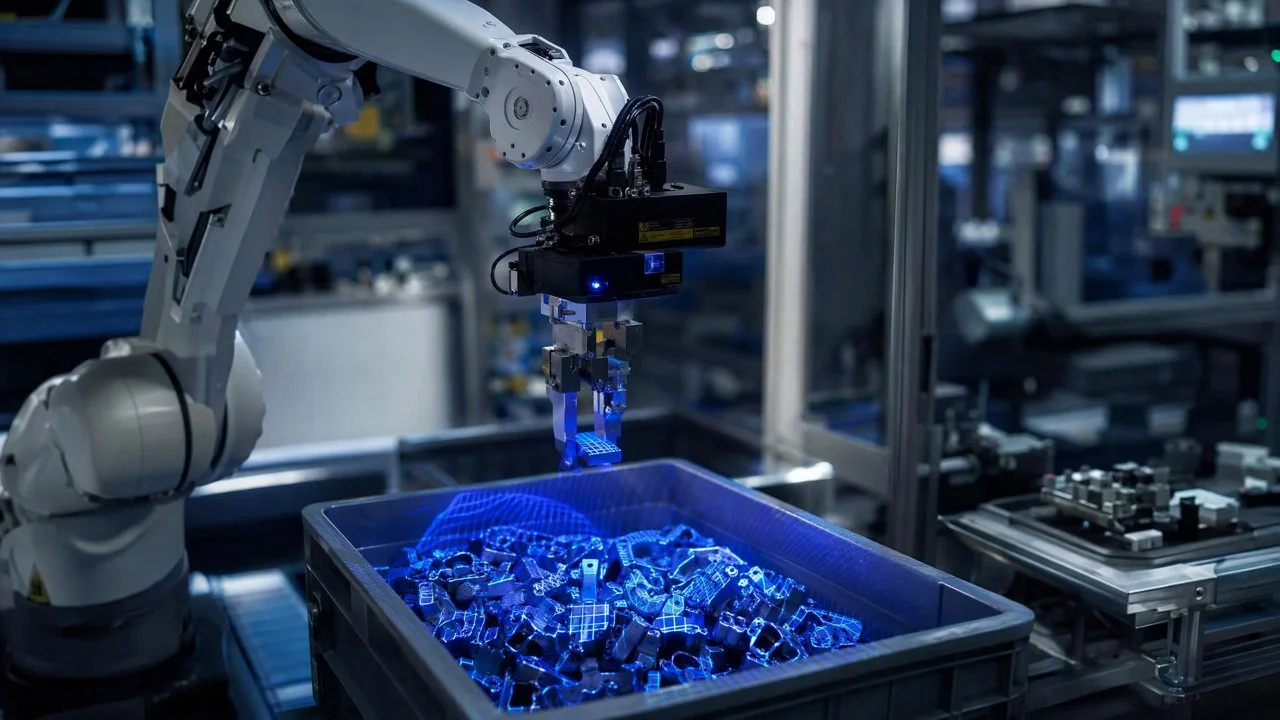
WeLinkirt's DaoAI 3D Robotic Vision (featuring proprietary 3D cameras + 6D pose estimation, bin picking, guidance for dispensing/assembly/loading/unloading, brain-eye-body closed-loop control, and sub-millimeter hand-eye coordination) employs high-precision 3D topographical reconstruction and real-time intelligent decision-making to reduce misassembly/missing part defect rates in automotive final assembly from an industry average of 1.2% to below 0.05%, ensuring 100% comprehensive quality inspection under stringent production takt times.
In the automotive/parts industry, final assembly is a critical link determining product quality and performance. As vehicle electrification and intelligence accelerate, assembly structures are becoming increasingly complex, demanding higher precision and quality control. For instance, on power train, chassis, or interior assembly lines, it's crucial to ensure hundreds of components are correctly installed, without omission, or misalignment. Traditional manual inspection or rule-based 2D AOI solutions often struggle to balance comprehensive detection with efficiency on high-takt production lines, leading to increased risk of missed defects, impacting downstream processes and even overall vehicle quality.
Pain Points: Why This Hurdle Is So Difficult to Overcome
Automotive final assembly lines face multiple challenges. First is the conflict between high takt time and 100% full inspection: A typical automotive final assembly line can have a takt time as high as 60-90 seconds per vehicle, meaning very limited time for the vision system at each inspection station. Achieving comprehensive inspection of multiple critical points on a complex assembly within such a short timeframe is often beyond traditional solutions. According to statistics, with manual visual inspection, the missed defect rate for critical component misassembly/missing parts can reach 1.2% or even higher at a medium-sized assembly plant. Second, the complexity of inspection objects: Assembly components are often made of metal or composite materials, with reflective surfaces, irregular shapes, and issues like occlusion or similar colors. Examples include missing fasteners, misaligned wiring harnesses, or deformed/missing seals—subtle defects that are difficult to identify in 2D images. Third, frequent product changeovers: Rapid vehicle model updates require frequent line changeovers, often necessitating re-programming and re-teaching for traditional vision systems, which is time-consuming and impacts overall equipment effectiveness (OEE).
The root cause of these difficulties is that traditional 2D vision primarily relies on grayscale or color information, struggling to acquire accurate depth and 3D topographical data. It is ineffective for defects involving height differences or coplanarity, which are 3D features. Manual inspection, on the other hand, is prone to human eye fatigue, subjective judgment, and distraction under high takt times. Furthermore, while the high-precision motion control of BLDC motors in robotic arms and mobile robots has improved assembly accuracy, real-time, sub-millimeter precision inspection of the assembled results still requires highly coordinated visual feedback. Traditional solutions fail to provide a "brain-eye-body" closed-loop feedback, creating an information gap between inspection results and robot execution, preventing real-time correction or predictive maintenance.
Technical Principles
WeLinkirt's DaoAI 3D Robotic Vision system fundamentally solves these challenges through its proprietary high-precision 3D cameras and advanced deep learning algorithms. Its core technologies include: First, high-precision 3D topographical reconstruction: The DaoAI 3D camera utilizes structured light or laser triangulation principles, capable of acquiring complete 3D point cloud data of workpieces within extremely short times (e.g., in one case, data acquisition for a single inspection area took only 200ms) with micron-level accuracy. This enables the system to accurately identify 3D features such as height differences, coplanarity, and deformation, rather than relying solely on 2D planar information. Second, 6D pose estimation and sub-millimeter hand-eye coordination: The system's built-in 6D pose estimation algorithm can calculate the precise position and orientation of the inspected component in 3D space in real-time. Combined with WeLinkirt's proprietary sub-millimeter hand-eye coordination technology, it achieves tight integration between the vision system and robotic arms. For instance, in a fastener inspection, DaoAI 3D Robotic Vision can control the detection accuracy of missing or misaligned bolts within a range of ±0.1mm.
Compared to traditional methods, WeLinkirt's DaoAI 3D Robotic Vision offers significant advantages. Traditional rule-based AOI relies on engineers manually setting numerous rules and thresholds, making it sensitive to lighting and angle variations, and struggling with complex and diverse defect types. In contrast, DaoAI 3D Robotic Vision is based on deep learning visual foundation models, possessing powerful feature recognition and generalization capabilities. Through APDT positive-sample/few-shot learning (requiring only 1–20 good sample images), high-precision models can be quickly trained, significantly shortening deployment cycles and changeover times. For example, during a product changeover on a production line, the WeLinkirt DaoAI 3D Robotic Vision solution can complete new product detection model configuration in just 5 minutes, significantly faster than traditional solutions which take hours or even days. Furthermore, its "brain-eye-body" closed-loop capability allows inspection results to directly feedback to robots for action adjustment or correction, achieving intelligent optimization of the production process, which is unparalleled by traditional independent inspection solutions.
Typical Application Scenarios
- **Powertrain Critical Component Assembly Inspection**: Detecting missing, misplaced, tilted, or damaged critical components such as bolts, gaskets, and sensors in engine blocks, transmission housings, and other assemblies. Challenges include a large number of components, hidden installation locations, confined inspection spaces, and the impact of metal component reflections on imaging. DaoAI 3D Robotic Vision effectively overcomes these challenges through multi-angle 3D scanning and point cloud analysis.
- **Chassis Assembly Connector Quality Inspection**: Checking the proper tightening of bolts, correct installation of circlips, and interference-free routing of pipelines in suspension systems, braking systems, and other connection points. Such defects often involve height differences and spatial relationships, which are difficult for traditional 2D vision to accurately determine. DaoAI 3D Vision's 6D pose estimation capability excels in these scenarios.
- **Interior Assembly Wiring Harness Routing and Clip Inspection**: Ensuring correct routing of in-car wiring harnesses, standardized bundling with cable ties, and proper installation of clips. Wiring harnesses vary in color, have complex routings, and are easily obscured by other components. DaoAI 3D Robotic Vision can identify the 3D path of harnesses and the integrity of clips, preventing abnormal noises or functional failures caused by loose harnesses or detached clips.
- **Seal and O-ring Assembly Integrity Inspection**: After installing seals or O-rings on parts like engine covers, car doors, and sunroofs, detecting whether they are fully compressed, twisted, broken, or missing. These defects typically manifest as subtle deformations or height differences, which the DaoAI 3D camera can detect with micron-level precision.
Implementation Case Study
A leading Tier-1 automotive component supplier faced persistent challenges in detecting misassembly and missing critical sensors and fasteners on one of its core powertrain assembly lines, operating at a high takt time. The line's takt time was 75 seconds per unit, and the traditional manual visual inspection combined with limited 2D AOI solutions resulted in a monthly missed defect rate of 1.2%. These defects would flow downstream, leading to high rework costs and customer complaint risks. The manufacturer had previously attempted to introduce other 3D vision solutions, but they failed due to slow imaging speeds, poor algorithm generalization, and complex changeovers. Upon adopting WeLinkirt's DaoAI 3D Robotic Vision system, the situation changed significantly. By deploying multiple DaoAI 3D Robotic Vision inspection stations at critical inspection points on the final assembly line, the system performed 100% comprehensive inspection of key assembly points on every unit.
WeLinkirt's DaoAI 3D Robotic Vision enables "zero" missed defects on automotive final assembly lines at high takt times, laying a solid foundation for intelligent manufacturing.
After implementation, production line data in this case showed that the missed defect rate for critical component misassembly/missing parts rapidly decreased from 1.2% to below 0.05%, achieving near-zero missed defects. Concurrently, due to the high-speed imaging and parallel processing capabilities of DaoAI 3D Robotic Vision, the inspection time perfectly matched the line's 75-second takt time, causing no production bottlenecks. Furthermore, during product changeovers, the system, leveraging APDT few-shot learning, allowed new product model training and deployment in just minutes, greatly enhancing production line flexibility. According to the manufacturer's feedback, the application of WeLinkirt's DaoAI 3D Robotic Vision saved them millions in rework and quality damage costs annually and significantly enhanced their brand reputation.
WeLinkirt Solutions and Products
WeLinkirt's core offering for automotive final assembly misassembly/missing parts detection is the DaoAI 3D Robotic Vision solution. This solution is centered around proprietary high-performance 3D cameras, combined with the DaoAI ACI OS operating system, achieving full-chain automation from data acquisition, feature extraction, intelligent judgment, to robot guidance. Specific implementation practices include: First, customized 3D camera deployment strategies, selecting structured light or laser line scan cameras based on inspection station space and field-of-view requirements, and configuring optimal installation angles and heights to ensure comprehensive coverage of all critical inspection points without blind spots. Second, leveraging DaoAI ACI OS's "one good part, 5 minutes, 0 code automatic programming" capability, models for good parts can be quickly established through simple teaching. For subsequent anomalies, the system can rapidly iterate and identify new defects through APDT positive-sample/few-shot learning. The WeLinkirt DaoAI 3D Robotic Vision system supports multiple deployment methods such as SDK/API/Docker and can achieve 100% local private deployment, ensuring customer data security and independent operation of the production line. Furthermore, integrated with the DaoAI World foundation model, the system possesses powerful semantic understanding and cross-scenario generalization capabilities, continuously learning from production line feedback to improve detection accuracy and efficiency.
Through the deployment of WeLinkirt's DaoAI 3D Robotic Vision, customers have realized significant business value. This solution not only reduced the missed defect rate for final assembly misassembly/missing parts to <0.05%, but more importantly, it achieved 100% full inspection capacity at high takt times, eliminating quality risks and improving overall line OEE. The system also significantly reduced the need for manual re-inspection, lowering labor costs, and shortened product changeover times from several hours to within 5 minutes. WeLinkirt's DaoAI 3D Robotic Vision provides a solid guarantee for high-precision, high-efficiency, and flexible intelligent manufacturing in the automotive industry.
FAQ
How does WeLinkirt's DaoAI 3D Robotic Vision ensure 100% full inspection capacity on high-takt production lines?
WeLinkirt's DaoAI 3D Robotic Vision utilizes proprietary high-speed 3D cameras for rapid 3D data acquisition, combined with optimized deep learning algorithms for real-time analysis. This enables the system to complete complex inspection tasks within extremely short production takt times, such as performing comprehensive inspection of multiple critical points on an assembly within a 75-second takt time in this case, ensuring no missed defects without affecting production efficiency.
How is the deployment cost for WeLinkirt's DaoAI 3D Robotic Vision in automotive assembly inspection estimated?
The deployment cost of WeLinkirt's DaoAI 3D Robotic Vision depends on various factors, including the number of inspection stations, the model and quantity of 3D cameras required, integration complexity, and whether custom development is needed. We encourage clients to schedule a professional consultation. We will provide a detailed, customized solution and accurate cost estimate based on your specific production line conditions and inspection requirements, along with an evaluation of the return on investment period.
How does WeLinkirt's DaoAI 3D Robotic Vision's few-shot learning feature help automotive production lines cope with frequent changeovers?
WeLinkirt's DaoAI 3D Robotic Vision's APDT few-shot learning capability allows the system to quickly train detection models for new products using only 1-20 good sample images. This significantly reduces the time required for product changeovers, from hours or even days with traditional solutions to just minutes, greatly enhancing the flexibility and overall equipment effectiveness (OEE) of automotive production lines and reducing downtime costs.
Full solution for this scenario: the full inspection solution for Robotics Vision
This article was generated by AI. Customer cases are simulated scenarios based on real product capabilities and figures are illustrative; see product pages for official benchmarks.