
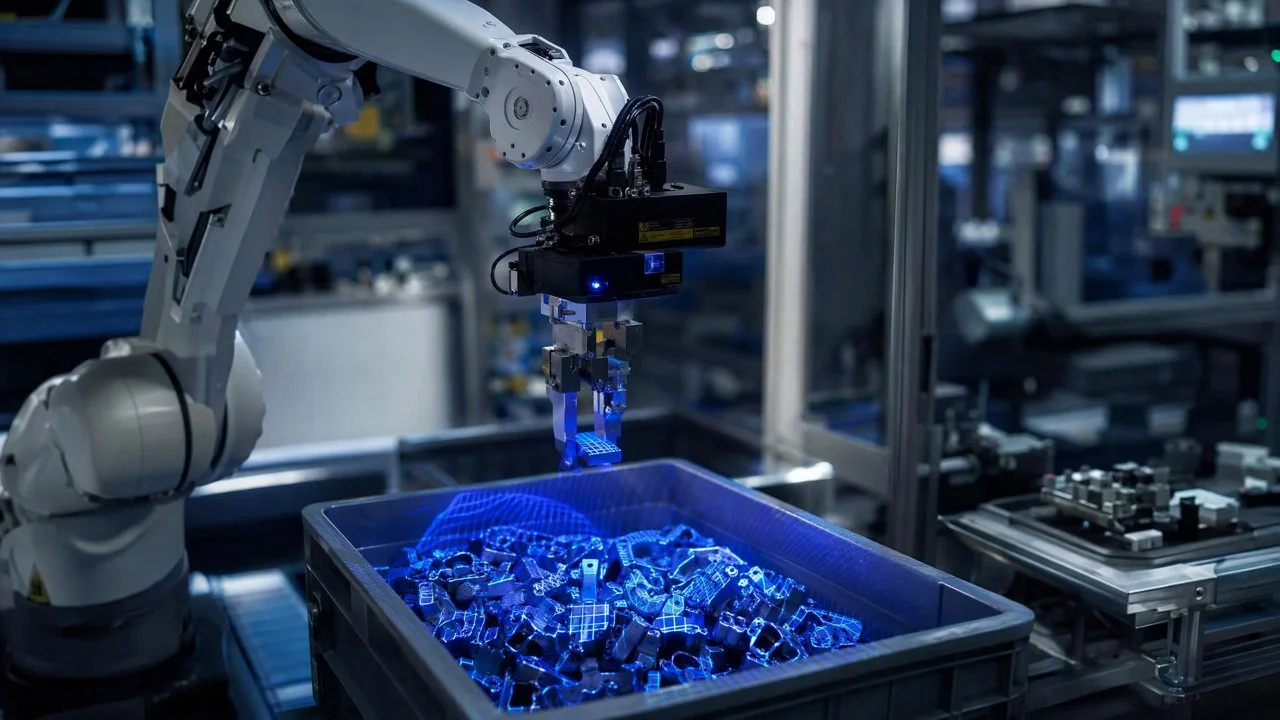
WeLinkirt DaoAI 3D Robot Vision (proprietary 3D camera + 6D pose estimation, chaotic bin picking, dispensing/assembly/loading guidance, brain-eye-body closed-loop, sub-millimeter hand-eye coordination) precisely identifies produce ripeness and defects, reducing omission rates for agricultural product ripeness sorting from an industry average of 3.5% to <0.4%, enabling full-chain quality traceability and data closed-loop, bringing a new upgrade to the agricultural processing industry. In the food/agriculture sector, produce ripeness is a critical factor determining commodity value, shelf life, and taste. Traditional sorting methods heavily rely on human experience, which is inefficient and struggles to ensure consistent quality across batches, especially when dealing with large volumes and diverse varieties of produce. WeLinkirt DaoAI 3D Robot Vision technology is becoming the core solution to this challenge.
In the food/agriculture industry, produce ripeness is a critical factor determining its commodity value, shelf life, and taste. Traditional sorting methods heavily rely on human experience, which is inefficient and struggles to ensure consistent quality across batches, especially when dealing with large volumes and diverse varieties of produce. WeLinkirt DaoAI 3D Robot Vision technology is becoming the core solution to this challenge. A large agricultural processing plant, as a leading fresh produce supplier in China, has as one of its core businesses the fine sorting of various fruits and vegetables to ensure market products meet uniform standards. This factory processes tens of thousands of tons of agricultural products daily, with ripeness sorting being a key link in determining product grade and economic benefits. In the past, this process primarily relied on manual visual inspection, where workers judged fruit color, luster, shape, and other characteristics based on experience, and manually sorted them. However, with surging order volumes and increasing consumer demands for produce quality, the shortcomings of traditional manual sorting have become increasingly prominent.
Pain Points: Why This Hurdle Is So Difficult to Overcome
Produce ripeness sorting faces multiple challenges. First, it's **highly subjective**, as manual visual inspection results are influenced by individual experience, fatigue, and mood, leading to inconsistent judgment standards across different batches and shifts. This results in significant fluctuations in produce pass rates; production line data shows that traditional manual sorting has an **omission rate as high as 3.5%**, with a false positive rate maintaining around 2%. Second, it's **inefficient and costly**, as large-scale manual sorting requires substantial labor. In one case, the factory invested millions in labor costs annually for this purpose, facing recruitment difficulties during peak seasons and high manual re-inspection hours, severely limiting capacity expansion. Third, **quality traceability is difficult**, as traditional sorting lacks standardized data recording. Once a consumer complaint arises, it's challenging to quickly trace back to specific batches or even individual fruits, posing risks to brand reputation and increasing compliance risks. Finally, **diversity and complexity** are fundamental challenges. Agricultural products are diverse, and the ripeness of the same variety can vary greatly at different growth stages and under different lighting conditions. For example, the ripeness of some fruits might manifest as subtle changes in skin color, localized depressions, or varying firmness, characteristics that are difficult for traditional 2D vision or simple color sensors to accurately capture.
The fundamental reason traditional solutions struggle to overcome these hurdles lies in their **lack of perception of 3D information and subtle features**. While manual visual inspection can perceive some 3D information, its efficiency and consistency cannot be scaled. Traditional 2D vision systems only capture planar images, unable to effectively identify 3D morphological features such as fruit depressions or localized softening, nor can they accurately distinguish subtle differences in color shades. Furthermore, issues like surface reflections, irregular shapes, and chaotic stacking of agricultural products all pose severe challenges to the imaging stability and feature extraction capabilities of traditional vision solutions. The current industrial exploration of humanoid robots for general task execution also highlights the importance of 'brain-eye-body closed-loop,' meaning robots require stronger environmental perception, decision-making, and operational capabilities, and produce sorting is a practical test of this general capability.
Technical Principles
The core of WeLinkirt DaoAI 3D Robot Vision solution lies in its **proprietary high-precision 3D cameras and advanced 6D pose estimation algorithms**, achieving sub-millimeter precision in perceiving the 3D morphology and surface features of agricultural products. Unlike traditional 2D vision, which only captures planar information, the DaoAI 3D vision camera, using the structured light principle, can reconstruct complete 3D point cloud data of agricultural products, thus capturing key ripeness features such as fruit depressions, disease spots, and color shades. Combined with the WeLinkirt DaoAI ACI OS operating system, the system can perform **APDT few-shot self-training**, requiring only 1–20 good samples to quickly learn and identify agricultural products of different ripeness levels. In practical applications, the DaoAI 3D vision system can accurately estimate the 6D pose of chaotically stacked agricultural products, guiding robotic arms for **bin picking**, achieving precise and efficient individual sorting. Its 'brain-eye-body closed-loop' capability means a real-time feedback loop between the vision system, AI decision unit, and robotic arm. The robotic arm adjusts its gripping strategy based on visual feedback, ensuring stable operation even in complex and changing environments, achieving **sub-millimeter hand-eye coordination**.
Compared to traditional manual visual inspection, the WeLinkirt DaoAI 3D Robot Vision solution offers significant advantages. The subjectivity and inefficiency of manual visual inspection are replaced by high-precision, consistent machine vision, with the **omission rate reduced from 3.5% to <0.4%**. Compared to traditional rule-based AOI (Automated Optical Inspection), the DaoAI solution's AI vision foundation model possesses stronger generalization capabilities and feature recognition, able to cope with the complex and varied natural forms of agricultural products, enabling **0-code automatic programming and semantic false positive filtering**, significantly reducing false positives and changeover times. Furthermore, its 3D imaging capability compensates for the shortcomings of 2D vision in 3D morphological recognition, able to identify subtle lesions or unripe areas hidden in fruit depressions, which is unattainable by traditional methods. In this case, WeLinkirt DaoAI 3D Robot Vision significantly outperforms traditional methods in both detection accuracy and efficiency.
Typical Application Scenarios
- **Fine-grained Fruit Ripeness Grading:** The DaoAI 3D vision system analyzes fruit surface color, texture, gloss, and 3D morphology (e.g., plumpness, localized depressions), combined with a preset ripeness model, to precisely classify fruits into multiple grades (e.g., unripe, ripe, overripe). The challenge lies in the significant differences in ripeness characteristics across various fruit varieties and the difficulty in quantifying color gradients. DaoAI's vision foundation model can quickly adapt to new fruit types through few-shot learning.
- **Pest, Disease, and Mechanical Damage Detection:** For surface defects such as mold spots, insect bites, scratches, and bruises on fruits, the DaoAI 3D camera can reconstruct high-precision 3D surfaces, identifying morphological anomalies at the micron level. For example, minor abrasions that might be indistinct in 2D images can clearly show depth changes in 3D point clouds, achieving high-precision detection.
- **Irregular and Deformed Fruit Rejection:** Agricultural products often exhibit irregular shapes (deformed fruits) during growth, affecting product appearance and packaging efficiency. DaoAI 3D vision analyzes the overall 3D contour of the fruit to accurately identify and reject fruits that do not meet standard shapes, ensuring product appearance consistency.
- **Data-driven Agricultural Product Quality Management:** Integrated with the DaoAI ACI OS operating system, the system can record real-time data for each fruit, including ripeness, defect type, size, weight, and associate it with batch information. This provides data support for agricultural product quality traceability, enhancing supply chain transparency.
- **Chaotic Bin Picking and Packing Guidance:** In the post-sorting packing stage, DaoAI 3D Robot Vision can estimate the 6D pose of chaotically stacked agricultural products in bins, guiding robotic arms for precise picking and placement into packaging boxes according to preset rules, improving packing efficiency and aesthetics.
Case Study
A large agricultural processing plant, a leading fresh produce supplier in the country, previously relied heavily on manual labor for its critical ripeness sorting process. During peak seasons, over 200 workers were needed daily for sorting, yet the plant still faced high omission rates, low sorting efficiency, and escalating labor costs. Production line data indicated that before the implementation of the DaoAI 3D Robot Vision system, the omission rate for agricultural product ripeness sorting reached 3.5%, with a false positive rate around 2%, and single-fruit level quality traceability was difficult to achieve. To enhance competitiveness, the factory introduced the WeLinkirt DaoAI 3D Robot Vision solution. In the initial phase, the DaoAI 3D vision system was deployed on a pilot production line. This involved integrating WeLinkirt's proprietary 3D cameras with high-performance computing units and training models based on the factory's specific ripeness standards for agricultural products. With the assistance of WeLinkirt engineers, the system completed debugging and optimization in just a few days, successfully achieving precise identification and sorting of various fruits (e.g., apples, pears, peaches) by ripeness. After going live, production line data showed that the system consistently controlled the **omission rate for agricultural product ripeness sorting to <0.4%**, and the **false positive rate was reduced by 80%**. More importantly, the WeLinkirt DaoAI 3D Robot Vision system generates a unique quality ID for each sorted agricultural product, recording key data such as ripeness, defect information, sorting time, and production batch. This achieves full-chain quality traceability from farm to table, bringing immense commercial value to the factory. In this case, the WeLinkirt DaoAI 3D Robot Vision system not only solved the pain points of manual sorting but also established a data-driven quality management system.
“DaoAI 3D Robot Vision not only improved our sorting efficiency, but more crucially, it built an unprecedented quality traceability system for us. Now we clearly know where every single fruit comes from and what its quality is.”
WeLinkirt Solutions and Products
WeLinkirt's core solution for agricultural product ripeness sorting is based on the **DaoAI 3D Robot Vision** product line, which integrates WeLinkirt's proprietary **high-precision structured light 3D cameras**, capable of acquiring 3D morphological data of agricultural products from centimeter to micron level. Combined with the **DaoAI ACI OS operating system**, the system can leverage its built-in vision foundation models for **APDT few-shot learning**, requiring only a very small number (1–20) of good samples to quickly train high-precision ripeness recognition models, significantly shortening model development and deployment cycles. For deployment, WeLinkirt supports **100% on-premise private deployment**, ensuring all data remains within the client's premises, safeguarding data security and privacy. The system is flexibly integrated into existing production lines via SDK / API / Docker, collaborating with various robotic arms (e.g., 6-axis robots, collaborative robots) to achieve 'brain-eye-body closed-loop' intelligent sorting. Furthermore, the WeLinkirt DaoAI World world model, as a unified foundation, continuously learns from production line feedback, constantly optimizing recognition accuracy and generalization capabilities to adapt to the diversity and seasonality of agricultural products. This solution not only focuses on sorting itself but also emphasizes building a **quality traceability and data closed-loop** system, providing clients with full lifecycle management capabilities from production to sales.
By introducing WeLinkirt DaoAI 3D Robot Vision, the large agricultural processing plant achieved significant quantitative results. In this case, the **omission rate for agricultural product ripeness sorting was reduced to <0.4%**, and the **false positive rate decreased by 80%**, greatly improving product qualification rates and brand reputation. Simultaneously, due to the increased efficiency of automated sorting, **single-line production capacity improved by 30%**, saving millions in labor costs annually. More importantly, the WeLinkirt DaoAI 3D Robot Vision system achieved **full-chain quality data traceability**, making quality information for every agricultural product from source to consumer clearly verifiable, effectively mitigating compliance risks, and providing precise data support for product optimization and market feedback. The introduction of the WeLinkirt DaoAI 3D Robot Vision solution is not just a technological upgrade but also an innovation in business models, assisting agricultural processing enterprises in moving towards a new stage of intelligent and refined management.
FAQ
How does WeLinkirt DaoAI 3D Robot Vision achieve quality traceability in produce ripeness sorting?
The WeLinkirt DaoAI 3D Robot Vision system identifies the ripeness, size, and surface defects of each agricultural product with high-precision 3D vision, generating a unique digital identity for each fruit. This data is linked with production batches, sorting times, and other information, uploaded in real-time to a management platform, thereby achieving full-chain, single-fruit level quality traceability from harvesting and sorting to packaging and sales. In case of any issue, the batch and cause can be quickly located.
What are the core advantages of DaoAI 3D Robot Vision compared to traditional 2D vision? What is the budget for it?
The core advantage of WeLinkirt DaoAI 3D Robot Vision lies in its proprietary 3D camera, which can acquire 3D morphological data of agricultural products, identifying subtle features like depressions and localized softening that are difficult for 2D vision to capture, combined with 6D pose estimation for chaotic bin picking. In terms of cost, while the initial investment is slightly higher than traditional 2D vision, its benefits in reducing omission rates, improving efficiency, enabling quality traceability, and long-term operational cost savings typically lead to a short-term return on investment. Specific budgets need to be customized based on production line scale, agricultural product types, and functional requirements. We recommend contacting a WeLinkirt expert for a detailed quote.
What is the typical deployment time for the WeLinkirt DaoAI 3D Robot Vision system?
The deployment cycle for the WeLinkirt DaoAI 3D Robot Vision system is usually short, with the exact time depending on the complexity of the production line and client-specific customization needs. Leveraging the APDT few-shot learning capability provided by the DaoAI ACI OS operating system, model training can be completed within hours. Overall integration, debugging, and go-live typically take days to weeks, enabling rapid production rollout. For instance, in a case study at an agricultural processing plant, the pilot production line's debugging and optimization only took a few days.
Full solution for this scenario: the full inspection solution for Robotics Vision · Produce Ripeness Grading & Sorting
This article was generated by AI. Customer cases are simulated scenarios based on real product capabilities and figures are illustrative; see product pages for official benchmarks.