
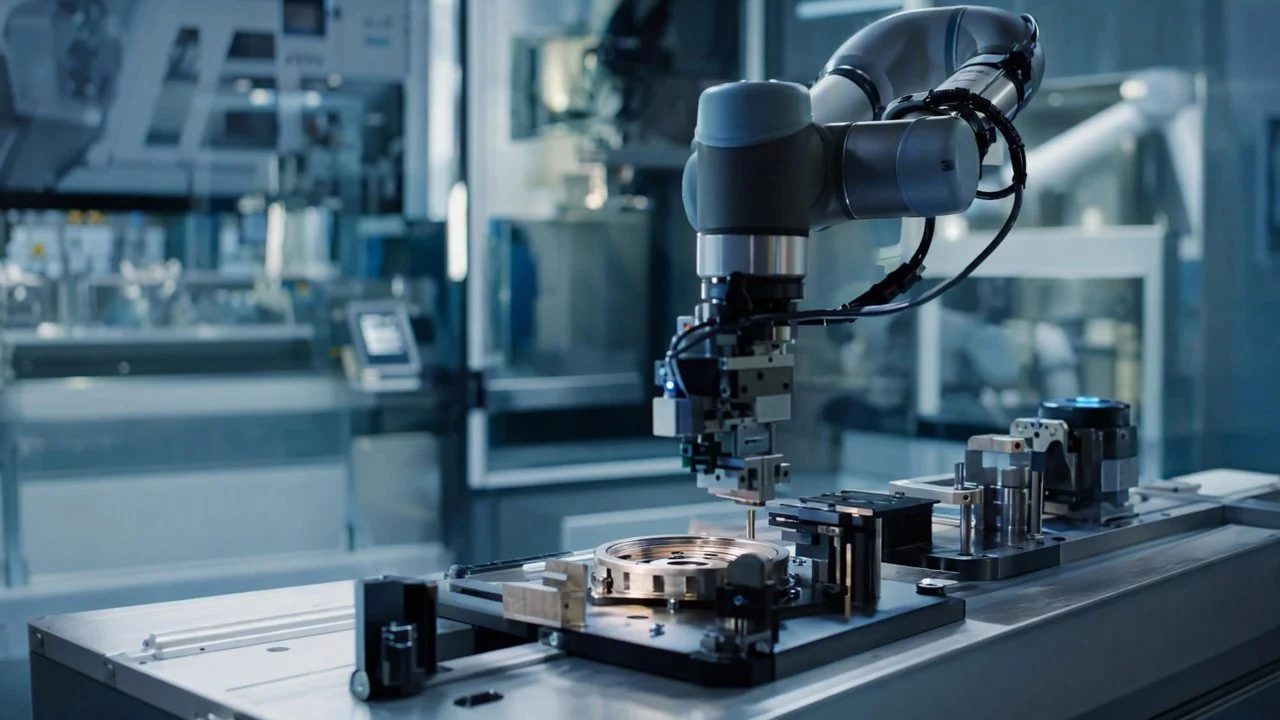
DaoAI 3D Robot Vision (proprietary 3D camera + 6D pose estimation, bin picking, guiding for dispensing/assembly/loading/unloading, brain-eye-body closed loop, sub-millimeter hand-eye coordination) from WeLinkirt leverages high-precision 3D reconstruction and intelligent recognition to reduce foreign object omission rates in agricultural product processing lines from the traditional 3% to <0.5%, while cutting labor costs for quality grading by over 60%.
In the agricultural product processing industry, especially in the primary processing of bulk grains, fruits, vegetables, and dried goods, foreign object removal and quality grading are critical steps to ensure food safety and product quality. For a long time, this process has heavily relied on manual visual inspection. However, human visual inspection suffers from low efficiency, fatigue, and inconsistent accuracy, struggling to cope with high-speed production lines and complex, varied types of foreign objects (such as stones, glass fragments, metal, insects, spoiled produce). Particularly for small to medium-sized agricultural processing plants, due to scale limitations and regional recruitment difficulties, high labor costs and unstable inspection quality have become bottlenecks restricting their development. WeLinkirt's DaoAI 3D Robot Vision system was developed to address these pain points, aiming to significantly improve detection efficiency and accuracy while drastically reducing labor costs through intelligent automation solutions.
Pain Points: Why This Hurdle Is Difficult to Overcome
The challenges of manual visual inspection in agricultural product processing lines are multi-dimensional. Firstly, there are **high labor costs and recruitment difficulties**. For a medium-sized agricultural processing plant, typically dozens or even hundreds of inspectors are required to work in shifts, with annual labor costs potentially reaching millions of yuan. Against the backdrop of an increasingly scarce workforce, recruiting and retaining qualified inspectors has become more challenging, leading to high personnel turnover, high training costs, and frequent risks of production capacity fluctuations. Secondly, there are **bottlenecks in detection efficiency and accuracy**. Human eyes are prone to fatigue during long periods of high-intensity work, leading to a persistently high **foreign object omission rate, commonly exceeding 3% in traditional methods**. For foreign objects similar in color and shape to the product, the false positive rate is also high. This not only affects product quality but can also lead to food safety incidents, damaging corporate reputation. Furthermore, **quality grading lacks objective standards**. Manual grading relies on subjective experience, with different workers having varying criteria for “good products,” leading to inconsistent quality between batches and impacting market competitiveness. Finally, **poor environmental adaptability**. Agricultural processing environments are often dusty, humid, and noisy, posing potential health threats to workers and further exacerbating recruitment difficulties. Aligning with current trends in warehouse bin picking automation, the complexity and precision requirements for picking foreign objects from varied, unstructured agricultural products far exceed those for standard parts, making automation an urgent need.
The root cause of these pain points lies in the inherent complexity of agricultural products. For instance, small stones in grains are similar in size and color to grain kernels, and spoiled fruits only have subtle color or shape differences compared to normal ones; on high-speed conveyor belts, these subtle features flash by, making them difficult for the human eye to catch. Moreover, agricultural products are often scattered randomly on the conveyor belt, with stacking and occlusion, making 2D vision ineffective for reliable identification. Traditional rule-based AOI solutions also struggle due to their rigid feature requirements, failing to adapt to the natural variability of agricultural products and the diversity of foreign objects, leading to high false positive or omission rates.
Technical Principles
WeLinkirt's DaoAI 3D Robot Vision system addresses these challenges by employing a **proprietary high-precision 3D camera** and advanced **6D pose estimation algorithms**. Our 3D camera can perform fast, high-precision 3D surface reconstruction of agricultural products scattered on the conveyor belt, obtaining precise depth, volume, and surface texture information for each object. This resolves the problem of missing information in traditional 2D vision when objects are stacked, occluded, or have height variations. With 3D data, the DaoAI system can accurately distinguish foreign objects that differ significantly from the agricultural product in height, volume, and shape. For example, even stones of similar color, their 3D morphology is vastly different from grain kernels. Furthermore, for spoiled fruits, the system can achieve precise identification by analyzing microscopic surface deformations and texture changes.
At the algorithmic level, the core of WeLinkirt's DaoAI Robot Vision is its **brain-eye-body closed-loop collaboration** capability. The system is equipped with a deep learning-based vision foundation model that can quickly learn the normal characteristics of agricultural products from a small number of positive samples (APDT few-shot learning, 1-20 good samples). For foreign object identification, we use **semantic false positive filtering** technology, combined with 6D pose estimation, not only to identify “anomalies” but also to accurately determine the type of anomaly (e.g., whether it's a stone, metal, or insect), and provide its precise position and orientation information in 3D space. This 6D pose data directly guides collaborative robots for **sub-millimeter hand-eye coordinated** precise grasping. Compared to traditional manual visual inspection, WeLinkirt's DaoAI 3D Robot Vision system eliminates errors and fatigue caused by subjective human judgment, reducing the omission rate to <0.5%. Moreover, with its high-speed processing capability, it can easily handle production line cycles of hundreds or even thousands of items per minute, far exceeding the efficiency limit of manual inspection. Compared to traditional rule-based AOI, the DaoAI system's adaptive capabilities through deep learning allow it to better cope with the natural variability of agricultural products and the diversity of foreign objects, eliminating the need for complex rule programming, and offering short changeover times, completing new product model adaptation in just 5 minutes.
Typical Application Scenarios
- **Removal of sand, stones, and metals from grains**: Before processing bulk grains like rice, wheat, or beans, WeLinkirt's DaoAI 3D Robot Vision scans the grains on the conveyor belt to precisely identify and locate mixed-in foreign objects such as sand, stone, and metal fragments, guiding robotic arms for accurate picking. The challenge lies in the foreign objects potentially being highly similar to grains in color and size, along with stacking and occlusion; 3D vision effectively distinguishes them by morphological differences.
- **Surface defect detection and grading for fruits and vegetables**: For fruits and vegetables like apples, oranges, and potatoes, WeLinkirt's DaoAI 3D Robot Vision can detect surface defects such as mold spots, insect holes, bruises, and deformities, and perform quality grading based on defect area, depth, position, combined with fruit size and shape. Challenges include reflective surfaces, uneven colors, and the small, diverse nature of defects.
- **Removal of biological foreign objects like insects and hairs from dried goods**: Before packaging dried goods such as goji berries, mushrooms, and tea leaves, WeLinkirt's DaoAI 3D Robot Vision can identify mixed-in biological foreign objects like insects, hairs, and plant residues. The difficulty lies in biological foreign objects often being small, close in color to the product, and irregularly shaped, making them hard for traditional 2D vision to capture.
- **Removal of bones and impurities in preliminary aquatic product processing**: In the preliminary processing of aquatic products like fish fillets and shrimp, WeLinkirt's DaoAI 3D Robot Vision can be used to detect and remove small residual bones, scales, and sediment. Challenges include the slippery, reflective surfaces of aquatic products, and foreign objects like bones being embedded within the product, requiring high penetration and fine recognition capabilities.
Case Study
A medium-sized agricultural product processing plant, specializing in dehydrated vegetables and dried fruits for export, previously relied heavily on manual labor for foreign object removal and quality grading. During peak seasons, nearly 80 workers were required to operate in three shifts. However, with rising labor costs and increasing recruitment difficulties, labor expenses constituted a significant portion of the total production cost. Moreover, the foreign object omission rate from manual visual inspection was measured at 3.5%, leading to frequent customer complaints and impacting international order fulfillment. To address this predicament, the factory introduced WeLinkirt's DaoAI 3D Robot Vision system. During deployment, the WeLinkirt engineering team utilized the system's APDT few-shot learning capability, training the visual model for various dehydrated vegetables and dried fruits with just 15 good samples within 3 hours, and integrating it with existing conveyor belts and collaborative robots. In this case, the WeLinkirt DaoAI 3D Robot Vision system, once online, successfully replaced 75% of the manual inspection positions.
“The WeLinkirt DaoAI 3D Robot Vision system not only solved our urgent problems of recruitment difficulties and high costs but, more importantly, it reduced our foreign object omission rate to a historic low, significantly enhancing the competitiveness of our products in the international market.” — Production Director of the factory
WeLinkirt Solution and Products
WeLinkirt provided this agricultural processing plant with an intelligent detection and grasping solution centered on DaoAI 3D Robot Vision. We deployed multiple detection units equipped with proprietary 3D cameras, paired with high-speed collaborative robots. The DaoAI 3D Robot Vision system first performs panoramic scans of agricultural products on the high-speed conveyor belt using the 3D camera to acquire high-precision point cloud data. Next, DaoAI's vision foundation model conducts real-time analysis of the point cloud data, identifying and locating various foreign objects (such as stones, glass, metal, insects) and defective products. Using 6D pose estimation algorithms, the system can precisely calculate the spatial position and orientation of each foreign object. Subsequently, this 6D pose data is communicated in a “brain-eye-body” closed loop with the collaborative robot via the WeLinkirt DaoAI ACI OS operating system, guiding the robot's end effector to perform sub-millimeter precision bin picking-style grasping to accurately remove foreign objects from the product stream. For quality grading, the DaoAI system guides qualified products and different grades of sub-products to different collection areas according to preset quality standards. The entire system supports 100% on-premise private deployment, ensuring data security and preventing data from leaving the factory. Through the DaoAI World model, the system continuously learns from production line feedback, constantly optimizing recognition accuracy and efficiency. The WeLinkirt DaoAI 3D Robot Vision system requires only 5 minutes to load a new product model during changeovers, greatly enhancing production flexibility.
In this case, after the WeLinkirt DaoAI 3D Robot Vision system went online, production line data showed that the foreign object **omission rate was successfully reduced to <0.5%**, significantly lower than the 3.5% level of manual inspection. Concurrently, by replacing most manual inspection positions, the factory **saved approximately ¥1.2 million in annual labor costs**. Furthermore, the consistency of quality grading significantly improved, product qualification rate increased by 8%, and customer complaint rate decreased by over 90%. These quantified achievements not only brought direct economic benefits to the enterprise but also enhanced its brand image and market competitiveness, gaining more advantages in an increasingly stringent food safety market environment.
FAQ
How does WeLinkirt's DaoAI 3D Robot Vision system cope with the diversity of foreign objects in agricultural products?
WeLinkirt's DaoAI 3D Robot Vision system acquires 3D morphological data of objects using its proprietary high-precision 3D camera, combined with an intelligent recognition visual foundation model based on deep learning. This model features APDT few-shot learning capabilities, allowing it to quickly learn from a small number of good samples and adapt to various foreign object shapes, colors, and materials through semantic false positive filtering, effectively handling the diversity of foreign objects in agricultural products.
What is the upfront investment and budget required to deploy WeLinkirt's DaoAI 3D Robot Vision solution?
The budget for WeLinkirt's DaoAI 3D Robot Vision solution varies depending on the production line scale, detection precision requirements, number of robots, and integration complexity. We offer flexible hardware and software configuration options and support 100% on-premise private deployment. Typically, customers can recoup their initial investment within 1-2 years through saved labor costs, improved yield rates, and reduced customer complaint risks. We recommend scheduling an expert consultation for a customized solution assessment and detailed quotation.
How does WeLinkirt's DaoAI 3D Robot Vision ensure sub-millimeter hand-eye coordination accuracy?
WeLinkirt's DaoAI 3D Robot Vision system achieves precise 6D pose data acquisition through its high-precision 3D camera, combined with advanced calibration algorithms and a 'brain-eye-body' closed-loop control, ensuring tight coordination between the vision system and the robotic arm. This mechanism enables the robot's end effector to locate and grasp target foreign objects with sub-millimeter accuracy, maintaining a high success rate even for small or irregularly shaped foreign objects.
Full solution for this scenario: Robotics Vision industry solutions · Fresh Food Foreign-Object Removal & Grading
This article was generated by AI. Customer cases are simulated scenarios based on real product capabilities and figures are illustrative; see product pages for official benchmarks.