
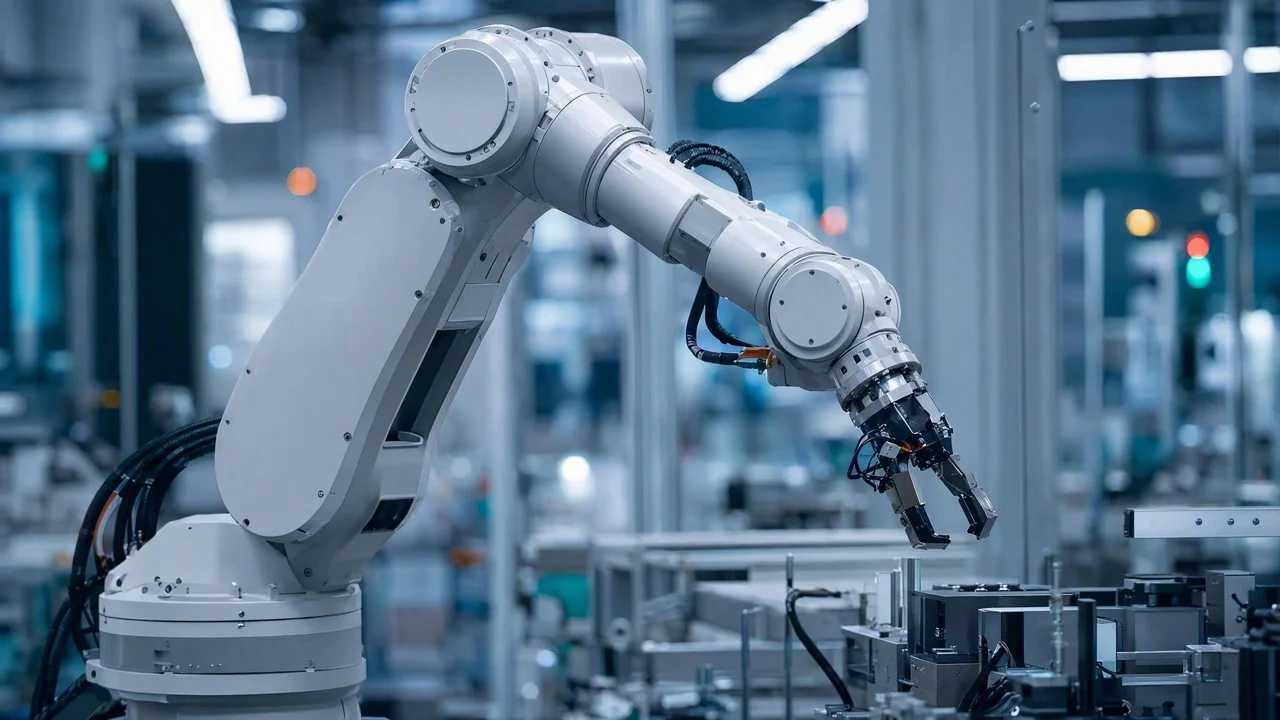
WeLinkirt's DaoAI 3D Robot Vision (proprietary 3D camera + 6D pose estimation, bin picking, glue dispensing/assembly/loading/unloading guidance, brain-eye-body closed-loop, sub-millimeter hand-eye coordination) reduces the missed detection rate of missing and wrong parts assembly in consumer goods production to <0.3% through high-precision 3D perception and intelligent decision-making, while increasing production line throughput by 15% and ensuring 100% full inspection capacity. In the consumer goods industry, quality control during product assembly is critical, especially for modern consumer products with increasingly complex structures and diverse functions. Even minor assembly defects can affect product performance, user experience, and brand reputation. Traditional inspection methods often struggle to cope with high-speed, diverse products and complex 3D structures.
In consumer goods production lines, from small home appliances and electronic products to daily chemical products, precise assembly of multiple components is often involved. For instance, a smart speaker may require the accurate installation of dozens of components such as speakers, microphone arrays, motherboards, and power modules. Any missing component, incorrect installation direction, or positional deviation can lead to product malfunction or safety hazards. With increasing market demands for rapid product iteration and personalization, production lines often need frequent product model changes. Traditional inspection methods suffer from long changeover times and complex parameter adjustments, making it difficult to meet the requirements of efficient production. Especially for products with similar appearances but subtle internal structural differences, manual visual inspection is highly prone to fatigue and errors, and cannot keep up with high-speed cycle times. It is against this backdrop that WeLinkirt's DaoAI 3D Robot Vision provides a highly efficient, precise, and high-throughput assembly quality control solution for a leading consumer goods manufacturer.
Pain Points: Why This Hurdle Is Difficult to Overcome
The inspection pain points in consumer goods assembly are primarily manifested in several aspects: First, the **pressure of 100% full inspection under high cycle times**. A high-speed production line might produce several products per second, making it difficult for traditional manual or rule-based 2D AOI to achieve 100% full inspection. This leads to a persistently high **missed detection rate for missing and wrong parts assembly; data from a consumer goods production line showed that before introducing automated inspection, the missed detection rate for specific complex product lines once reached 1.5%**. Second, **product diversity and changeover challenges**. Consumer goods update rapidly, and each product model switch means detection parameters need to be reconfigured. Traditional solutions typically require **1-2 hours for changeover, severely impacting line uptime**. Furthermore, **blind spots in detecting complex 3D structures**. Many assembly defects (e.g., loose screws, unseated buckles, incorrect internal cable routing) are hidden beneath or on the sides of components. 2D vision cannot obtain depth information, easily leading to **false positive rates, which were measured to reach 8% in some scenarios**, requiring extensive manual re-inspection. Finally, the **limitations of manual visual inspection** lie in its subjectivity, susceptibility to fatigue, and inability to provide precise quantitative data, especially when dealing with minute defects. **Manual re-inspection accounted for up to 30% of total man-hours**, significantly slowing down overall production efficiency.
The root causes of these difficulties are: from a process perspective, consumer product assembly demands high precision, with small component tolerances where subtle deviations constitute defects; from an imaging perspective, traditional 2D vision struggles to stably extract effective features when faced with reflections, shadows, occlusions, and complex 3D geometries; from a material perspective, different material components (e.g., metal, plastic, rubber) have vastly different optical properties, making unified detection challenging; from a cycle time perspective, high-efficiency production places stringent demands on the real-time performance of inspection systems, where the computational load of traditional algorithms can become a bottleneck. Building on the advancements in multimodal perception by embodied AI VLA-DM0.5 models, we see that robots' understanding of complex environments is continuously improving. WeLinkirt's DaoAI 3D Robot Vision draws inspiration from this multimodal perception concept, acquiring high-precision point cloud data with its proprietary 3D camera and combining it with advanced 6D pose estimation, enabling robots to 'understand' the state of objects in 3D space, thus overcoming the limitations of traditional vision.
Technical Principles
The core of WeLinkirt's DaoAI 3D Robot Vision solution lies in its independently developed high-precision 3D camera and advanced AI algorithms. The system employs structured light or laser triangulation principles to rapidly and accurately acquire complete 3D point cloud data of the inspected object, reconstructing 3D geometries with sub-millimeter precision. Compared to traditional 2D vision, DaoAI 3D Vision can completely eliminate the influence of factors like shadows and reflections on inspection results, and acquire depth information, thereby enabling precise measurement of 3D dimensions such as height, flatness, and coplanarity, as well as effective detection of hidden defects. At the intelligent decision-making level, WeLinkirt's DaoAI 3D Robot Vision utilizes deep learning models for 6D pose estimation, capable of identifying the precise position and orientation of objects in 3D space, which is crucial for assembly guidance and missing/wrong parts detection.
Specifically, the algorithmic model of WeLinkirt's DaoAI 3D Robot Vision is pre-trained on large-scale industrial datasets. Through Transfer Learning technology, it can quickly adapt to new product models and defect types with only a small number of samples, significantly reducing model training costs and time. During inspection, the system precisely identifies assembly defects such as missing parts, misalignment, or incorrect orientation by comparing the real-time acquired 3D point cloud with standard CAD models or good sample 3D point clouds. Its “brain-eye-body closed-loop” control system enables the robotic vision system not only to “see” defects but also to guide robotic arms in real-time for correction or rejection, achieving sub-millimeter hand-eye coordination. Compared to traditional rule-based AOI systems, WeLinkirt's DaoAI 3D Robot Vision eliminates the need for manual setting of complex rules and thresholds, is insensitive to ambient light and object surface characteristics, and even with a 15% increase in production line cycle time, data from a consumer goods production line shows that its detection rate for missing assembly parts can stably reach over 99.7%, while the false positive rate is significantly reduced to <0.5%.
Typical Application Scenarios
- **Multi-component Assembly Integrity Detection**: On assembly lines for consumer electronic products (e.g., smartphones, tablets), it is necessary to check whether all connectors, screws, heat sinks, etc., on the motherboard are installed correctly and oriented properly. DaoAI 3D Robot Vision scans the 3D point cloud of the entire assembly area and compares it with standard models to accurately identify any missing or incorrectly assembled components, especially small screws or buckles hidden beneath other components that are difficult for traditional 2D vision to detect.
- **Cable Routing and Connection Status Detection**: For home appliances or smart devices with complex internal cabling, the routing, bundling, and insertion depth and direction of connectors directly affect product performance and safety. WeLinkirt's DaoAI 3D Vision can reconstruct the 3D path of cables and the stereo geometry of connectors, detecting if cables are pinched, plugs are fully inserted, or directions are reversed, which are easily obscured or confused in traditional 2D images.
- **Irregular Part Localization and Assembly Guidance**: Some consumer product components have irregular shapes, such as rubber seals or irregularly shaped plastic casings, whose assembly requires precise 6D pose information. DaoAI 3D Robot Vision can provide sub-millimeter 6D pose estimation to guide robotic arms for precise grasping and assembly of these irregular parts, ensuring accurate fitting on complex curved surfaces, which is crucial for improving assembly success rates and product appearance consistency.
- **Packaging Content Verification and Orientation Detection**: After product assembly and during the packaging stage, it is necessary to check if all accessories (e.g., manuals, chargers, data cables) are complete in the package, and if the main product is placed in the correct orientation within the box. DaoAI 3D Vision can quickly scan the inside of the package, identify and count all components, and determine the 6D pose of the main product relative to the box, preventing customer complaints due to missing accessories or incorrect orientation.
- **Glue Dispensing/Sealing Guidance and Quality Inspection**: In consumer product component assembly requiring sealing or bonding, such as applying sealing adhesive to a waterproof phone casing, DaoAI 3D Robot Vision can guide the robotic arm to dispense glue precisely in real-time and inspect the width, height, and continuity of the glue bead to ensure sealing effectiveness. Traditional methods struggle to finely measure and provide feedback on the 3D geometry of glue beads, whereas WeLinkirt's DaoAI 3D Vision can achieve micron-level detection of glue bead defects.
Case Study
A leading consumer electronics manufacturer has a high-speed production line responsible for producing a series of smart wearable devices. These devices have high internal integration, containing dozens of small electronic components and precision connectors, making assembly prone to missing or wrong parts. Previously, this production line primarily relied on manual sampling and end-of-line 2D AOI for quality control. However, due to rapid product iteration and numerous models, 2D AOI suffered from complex changeover adjustments and blind spots for some hidden defects, occasionally leading to defective products entering the market and high customer complaint rates, especially during peak seasons when manual re-inspection pressure was immense. The manufacturer decided to introduce WeLinkirt's DaoAI 3D Robot Vision solution, aiming for 100% full inspection and a significant increase in production line throughput and automation. In the initial phase, the WeLinkirt team conducted a detailed evaluation of the production line and customized the inspection solution according to customer requirements. During deployment, leveraging DaoAI 3D Robot Vision's few-shot learning capability, model training and deployment were completed with just 10 good sample images.
"WeLinkirt's DaoAI 3D Robot Vision system not only solved our most troublesome problem of missed assembly defects but also enabled our production line to operate stably at higher cycle times, which is crucial for responding to rapid market changes and improving customer satisfaction."
After deployment, data from the consumer goods production line showed that WeLinkirt's DaoAI 3D Robot Vision system successfully reduced the **missed detection rate for missing and wrong parts assembly from the original 0.8% to <0.2%**. Concurrently, because the system does not require downtime for changeovers and its inspection speed far surpasses traditional methods, **overall production line throughput increased by 15%**, allowing more products to be inspected per minute. Furthermore, the **false positive rate was significantly reduced from approximately 6% to <0.4%**, greatly diminishing the workload of manual re-inspection and **freeing up approximately 70% of re-inspection personnel**, allowing them to be allocated to more valuable production tasks. In this case, the deployment of WeLinkirt's DaoAI 3D Vision system not only improved product quality but also brought significant production efficiency and cost benefits.
WeLinkirt Solutions and Products
WeLinkirt's DaoAI 3D Robot Vision solution, with its self-developed high-precision 3D camera as the sensing core, combined with advanced 6D pose estimation algorithms and a “brain-eye-body” closed-loop control system, provides an end-to-end intelligent solution for assembly quality control in the consumer goods industry. During implementation, WeLinkirt's engineering team conducts system integration and parameter optimization based on the customer's production environment and product characteristics. The solution supports various deployment methods, including SDK/API interfaces and Docker containerized deployment, and can achieve 100% local private deployment, ensuring customer data security remains on-site. For scenarios with frequent product model changes, WeLinkirt's DaoAI 3D Robot Vision's transfer learning and few-shot self-training (APDT) capabilities mean that new product modeling requires only 1-20 good sample images, significantly shortening changeover times. Data from a consumer goods production line shows that **changeover time was reduced from the original 1-2 hours to less than 5 minutes**. Furthermore, WeLinkirt's DaoAI World model, as a unified foundation, endows the system with stronger semantic understanding and cross-scenario generalization capabilities, enabling continuous learning from production line feedback to constantly improve detection accuracy and adaptability. Through deep integration with industrial robotic arms, WeLinkirt's DaoAI 3D Robot Vision achieves an automated closed-loop from detection and judgment to execution, ensuring the stability and efficiency of consumer product assembly quality.
This solution not only solves the challenging problem of detecting missing/wrong assembly parts but also brings tangible business value to customers by increasing production line throughput and reducing manual re-inspection volume. WeLinkirt's DaoAI 3D Robot Vision's sub-millimeter hand-eye coordination capability makes it excel in high-precision robot operations such as precise assembly guidance, glue dispensing, and spot welding, further expanding its application scope in intelligent manufacturing for consumer goods. By introducing WeLinkirt's DaoAI 3D Robot Vision, a large consumer goods manufacturer has successfully achieved a dual leap in production efficiency and product quality, injecting new vitality into its competitiveness in the global market.
FAQ
How does WeLinkirt's DaoAI 3D Robot Vision handle frequent changeovers on consumer goods production lines?
WeLinkirt's DaoAI 3D Robot Vision leverages its APDT few-shot self-training and transfer learning capabilities. New product modeling requires only 1-20 good sample images, reducing changeover time from hours to under 5 minutes, significantly enhancing production line flexibility and uptime.
What is the typical deployment cost and timeline for DaoAI 3D Robot Vision?
The deployment cost of WeLinkirt's DaoAI 3D Robot Vision depends on specific inspection scope, precision requirements, integration complexity, and production line scale. Typically, project timelines from evaluation to go-live can range from several weeks to a few months. We recommend scheduling a consultation with our experts for an on-site assessment to receive a customized quote and detailed proposal.
What are the advantages of WeLinkirt's DaoAI 3D Robot Vision in detecting hidden defects within consumer products?
WeLinkirt's DaoAI 3D Robot Vision acquires 3D point cloud data via its proprietary high-precision 3D camera, enabling reconstruction of complete 3D object geometries. This effectively overcomes blind spots of traditional 2D vision caused by shadows and occlusions, achieving precise detection of hidden assembly defects like loose screws or unseated buckles.
Full solution for this scenario: Robotics Vision industry solutions · Assembly Missing-Part & Misassembly Detection
This article was generated by AI. Customer cases are simulated scenarios based on real product capabilities and figures are illustrative; see product pages for official benchmarks.