
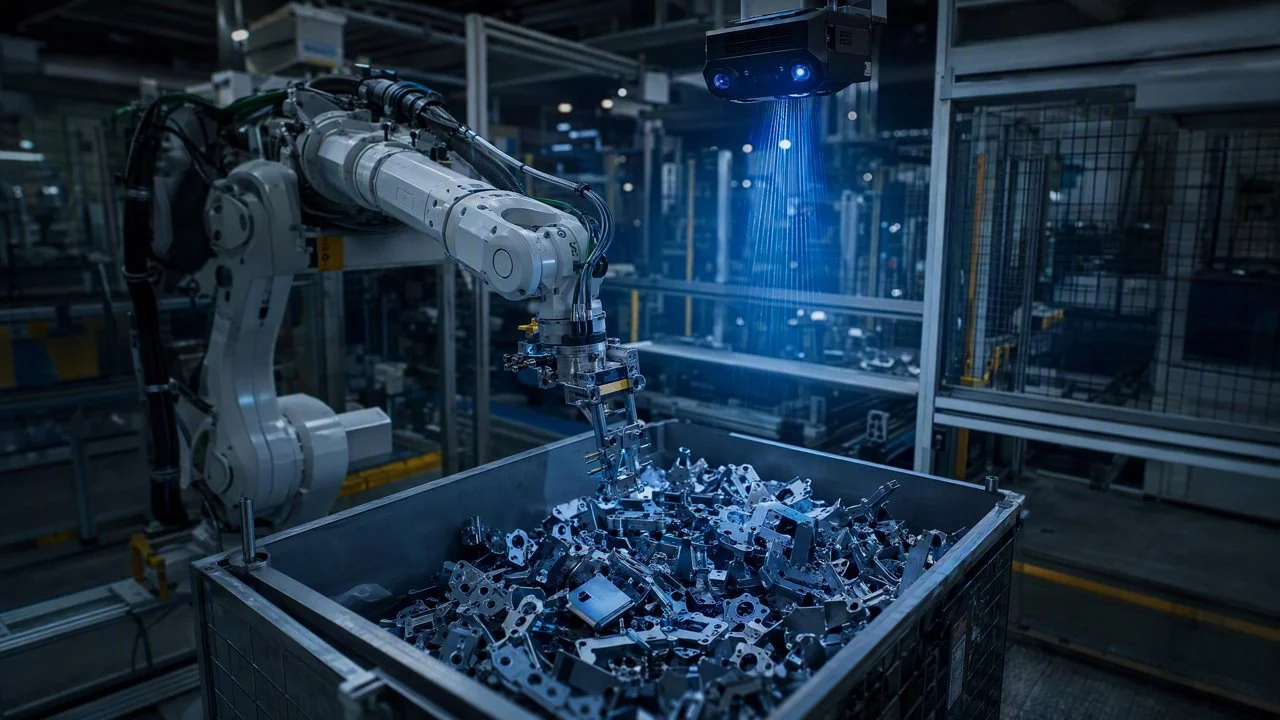
WeLinkirt DaoAI 3D Robot Vision (proprietary 3D camera + 6D pose estimation, bin picking, glue dispensing/assembly/loading/unloading guidance, brain-eye-body closed-loop, sub-millimeter hand-eye coordination) leverages APDT few-shot self-training to increase the success rate of bin picking complex, irregularly shaped automotive parts from an industry average of 85% to 99.7%, significantly reducing manual intervention and production line downtime.
The automotive/parts manufacturing industry is undergoing a profound transformation towards intelligent and flexible production. In this context, how to efficiently and accurately handle diverse and complex parts on the production line has become key to enhancing overall competitiveness. Particularly in the production environments of automotive Tier-2 suppliers, facing multi-variety, small-batch production models, and the chaotic stacking of numerous irregularly shaped parts, traditional automation solutions often fall short. These parts, such as various engine mounts, driveshaft components, or body connectors, have complex shapes, varying reflective properties, and can be in arbitrary poses within the bin, posing extremely high demands on the robot's perception and decision-making capabilities for grasping. WeLinkirt DaoAI 3D Robot Vision, with its advanced 3D vision technology and few-shot self-training capabilities, provides a groundbreaking solution for the automotive parts industry in this context.
Pain Points: Why This Hurdle Is Difficult to Overcome
In the chaotic bin picking scenario for automotive parts, traditional solutions face multiple challenges. First, the success rate of grasping is difficult to guarantee; production line data from a Tier-2 manufacturer shows that for complex, irregularly shaped parts, traditional rule-based vision systems achieve a grasping success rate of only 80-85%, leading to frequent manual intervention and cumulative production line downtime of 2-3 hours per day. Second, product changeover costs are high; whenever a new part model is introduced, traditional systems require days or even weeks of debugging and programming, including feature point extraction and grasping path planning, resulting in long changeover downtime that severely impacts the flexibility of small-batch, multi-variety production. Finally, facing special materials or structural components such as reflective, hollow, or dark-colored parts, traditional 2D vision or simple 3D vision struggles to accurately acquire depth information and precise 6D poses, leading to risks of mis-grabs, missed grabs, or collisions. Especially in immersive experience scenarios where embodied intelligent robots require fine perception and interaction, this lack of perceptual ability directly limits the robot's operational scope and efficiency.
The root cause of these problems lies in the fact that traditional vision systems largely rely on engineers manually setting rules and feature templates. For complex and chaotically stacked parts, the infinite possibilities of their poses make it difficult for rule bases to be exhaustive. At the same time, traditional 3D cameras often suffer from data voids or reduced accuracy when dealing with highly reflective, strongly absorptive, or transparent materials, making it difficult to generate complete, high-quality 3D point clouds. The lack of effective self-learning and generalization capabilities means that systems cannot quickly adapt to new products or poses, with each changeover incurring significant engineering investment. These factors collectively lead to low production efficiency and high costs, becoming a key bottleneck restricting flexible production in automotive parts.
Technical Principles
The core strength of WeLinkirt DaoAI 3D Robot Vision lies in its proprietary 3D camera and the APDT (Adaptive Pre-trained Deep Transformer) few-shot self-training technology. The proprietary 3D camera adopts an imaging mechanism that combines multi-spectral structured light with laser triangulation, capable of overcoming the challenges of traditional 3D cameras on complex surfaces (such as highly reflective metals, dark light-absorbing materials), generating high-density, high-precision 3D point cloud data with sub-millimeter accuracy. This provides a reliable raw data foundation for subsequent 6D pose estimation. In this case, the WeLinkirt 3D camera increased point cloud density by over 40% when scanning complex workpieces, effectively solving the data void problem.
Building on this, DaoAI Robot Vision introduces the APDT few-shot self-training framework. APDT, based on pre-trained deep Transformer models, can quickly learn and generalize part feature representations from a small number of positive samples (only 1-20 images of good parts or CAD models). Unlike traditional methods based on rule matching or extensive labeled data training, APDT automatically understands the geometric structure and graspable regions of parts through self-attention mechanisms and multi-task learning, without the need for manual annotation of grasp points. This technology enables the WeLinkirt DaoAI 3D Robot Vision system to reduce new product changeover time from days to hours, and in some cases, achieve minute-level rapid deployment. Traditional point cloud registration algorithms, when faced with occlusion and chaotic stacking, often require complex preprocessing and iterative optimization, are sensitive to initial poses, and easily fall into local optima. In contrast, DaoAI 3D Robot Vision's APDT algorithm can directly estimate 6D poses end-to-end from raw point clouds, exhibiting stronger robustness to partial occlusion and pose variations, with actual grasping success rates significantly higher than traditional solutions.
Typical Application Scenarios
- **Engine Block/Cylinder Head Bin Picking**: Performing chaotic bin picking of engine blocks or cylinder heads with complex shapes and diverse internal structures. The challenge lies in the large size and weight of the parts, and potential casting defects or oil stains on the surface, requiring the 3D camera to penetrate partial interference to accurately obtain their 6D pose and guide the robot for stable grasping.
- **Driveshaft Assembly Guidance**: Providing precise assembly guidance for driveshaft components containing multiple irregularly shaped parts (e.g., flanges, splined shafts). The challenge lies in the tight tolerances of part mating, requiring sub-millimeter or even higher precision 6D pose estimation to ensure smooth and reliable assembly. WeLinkirt DaoAI 3D Robot Vision can provide high-precision guidance.
- **Body Structural Part Gluing Path Planning**: Automating glue dispensing for body structural parts with complex curved surfaces. The challenge is that the gluing path must precisely conform to complex 3D surfaces, and glue bead width and height requirements are strict. The DaoAI 3D vision system, through high-precision 3D reconstruction, can provide precise gluing path guidance and real-time pose correction for robots.
- **Small Electronic Component Loading/Unloading**: Precisely loading and unloading various small connectors, sensors, etc., on circuit boards in automotive electronic module production. The challenge lies in the tiny size of components, dense arrangement, and potential mixing of multiple models. WeLinkirt DaoAI 3D Robot Vision, through its fine perception capabilities, can accurately identify and grasp different types of small components.
- **Brake Disc/Wheel Hub Defect Detection and Sorting**: Detecting surface defects (e.g., scratches, burrs, cracks) on brake discs or wheel hubs on the production line and sorting them automatically based on defect type. The challenge is that defect features are tiny, easily affected by ambient light, and detection and decision-making must be completed at high cycle times. The DaoAI ACI OS operating system, combined with 3D vision data, can achieve high-precision defect identification.
Case Study
A Tier-2 automotive parts supplier primarily manufactures irregularly shaped stamped and cast parts such as engine mounts and suspension arms. Their production line had a large number of chaotically stacked bins, where traditional manual grasping was inefficient and posed a risk of industrial injuries. The manufacturer had previously attempted to introduce a traditional 3D vision grasping system, but due to the complex shapes of the parts, uneven surface reflections, and frequent product changeover requirements, the system had a long deployment cycle and unstable grasping success rates (only around 85%). To solve this problem, the manufacturer introduced the WeLinkirt DaoAI 3D Robot Vision solution. Before implementation, engineers spent 3-5 days on visual debugging and robot path teaching for each new product launch, severely slowing down the new product introduction speed. After implementation, based on the APDT few-shot self-training capability of WeLinkirt DaoAI 3D Robot Vision, by providing only 5-10 good part CAD models or actual images, the system could complete new product learning and deployment within 2 hours, reducing changeover time by over 90%. Production line data shows that in this case, the success rate of chaotic bin picking for complex, irregularly shaped parts consistently increased to 99.7%, significantly exceeding the industry average. This effectively reduced manual intervention, decreasing daily downtime due to grasping failures from an average of 2.5 hours to less than 10 minutes. This not only greatly improved production efficiency but also significantly reduced labor costs and potential industrial injury risks.
“The few-shot self-training capability of WeLinkirt DaoAI 3D Robot Vision truly made our production line flexible; new product launches are no longer a nightmare.”
WeLinkirt Solution and Products
The WeLinkirt DaoAI 3D Robot Vision solution, with its proprietary high-performance 3D camera as the sensing core, combined with powerful APDT few-shot self-training algorithms, achieves precise 6D pose estimation for parts in complex chaotic bins. In terms of deployment and integration, WeLinkirt provides flexible SDK/API interfaces and Docker deployment methods, supporting 100% local private deployment to ensure data security and prevent data from leaving the factory, meeting the strict data privacy requirements of the automotive industry. The entire system, through a brain-eye-body closed-loop mechanism, achieves integration from perception, decision-making to execution: the 3D camera acts as the “eye,” acquiring high-precision 3D data; the APDT algorithm acts as the “brain,” quickly learning and outputting the optimal grasping pose; and the robot acts as the “body,” precisely executing grasping actions and making real-time adjustments based on visual feedback, achieving sub-millimeter hand-eye coordination accuracy. Furthermore, combined with the DaoAI ACI OS operating system, users can achieve 5-minute 0-code automatic programming, further lowering the barrier to entry and maintenance costs. The WeLinkirt DaoAI World model, as a unified foundation, will continue to learn from production line feedback, continuously improving the system's semantic understanding and cross-scenario generalization capabilities, providing customers with continuously evolving intelligent manufacturing solutions.
Through the introduction of WeLinkirt DaoAI 3D Robot Vision, this Tier-2 manufacturer achieved significant business value. Production line data shows that the success rate of chaotic bin picking increased to 99.7%, and the missed grab rate decreased to <0.3%. At the same time, product changeover time was reduced from several days to less than 2 hours, and downtime was reduced by over 90%, greatly enhancing production line flexibility and overall efficiency. The need for manual re-inspection and intervention was significantly reduced, cutting labor costs by at least 70% and substantially improving workplace safety. These quantified achievements collectively drove improvements in customer production efficiency and optimization of operational costs, giving the customer a greater advantage in the fiercely competitive automotive parts market.
FAQ
How does WeLinkirt DaoAI 3D Robot Vision's APDT few-shot self-training technology work?
WeLinkirt DaoAI 3D Robot Vision's APDT technology is based on a pre-trained deep Transformer model that learns 6D pose features of parts from a small number of positive samples (1-20 good part images or CAD models) via self-attention mechanisms. It generalizes quickly without extensive manual annotation, enabling rapid new product changeovers and high-precision grasping.
Compared to traditional bin picking solutions, what are the advantages of WeLinkirt DaoAI 3D Robot Vision in terms of cost and deployment cycle?
WeLinkirt DaoAI 3D Robot Vision significantly shortens the deployment cycle, with new product changeover times reduced from days to under 2 hours through APDT few-shot learning. Regarding cost, while initial investment might be slightly higher, its high success rate reduces downtime and manual intervention, leading to lower long-term operating costs and a shorter return on investment period.
Can WeLinkirt DaoAI 3D Robot Vision handle bin picking of highly reflective or dark-colored automotive parts?
Yes, WeLinkirt DaoAI 3D Robot Vision's proprietary 3D camera utilizes an imaging mechanism combining multi-spectral structured light and laser triangulation. This effectively overcomes imaging challenges posed by highly reflective, dark, or complex surfaces, generating high-density, high-precision 3D point cloud data to ensure accurate perception and grasping of such special materials.
Full solution for this scenario: the full inspection solution for Robotics Vision
This article was generated by AI. Customer cases are simulated scenarios based on real product capabilities and figures are illustrative; see product pages for official benchmarks.