
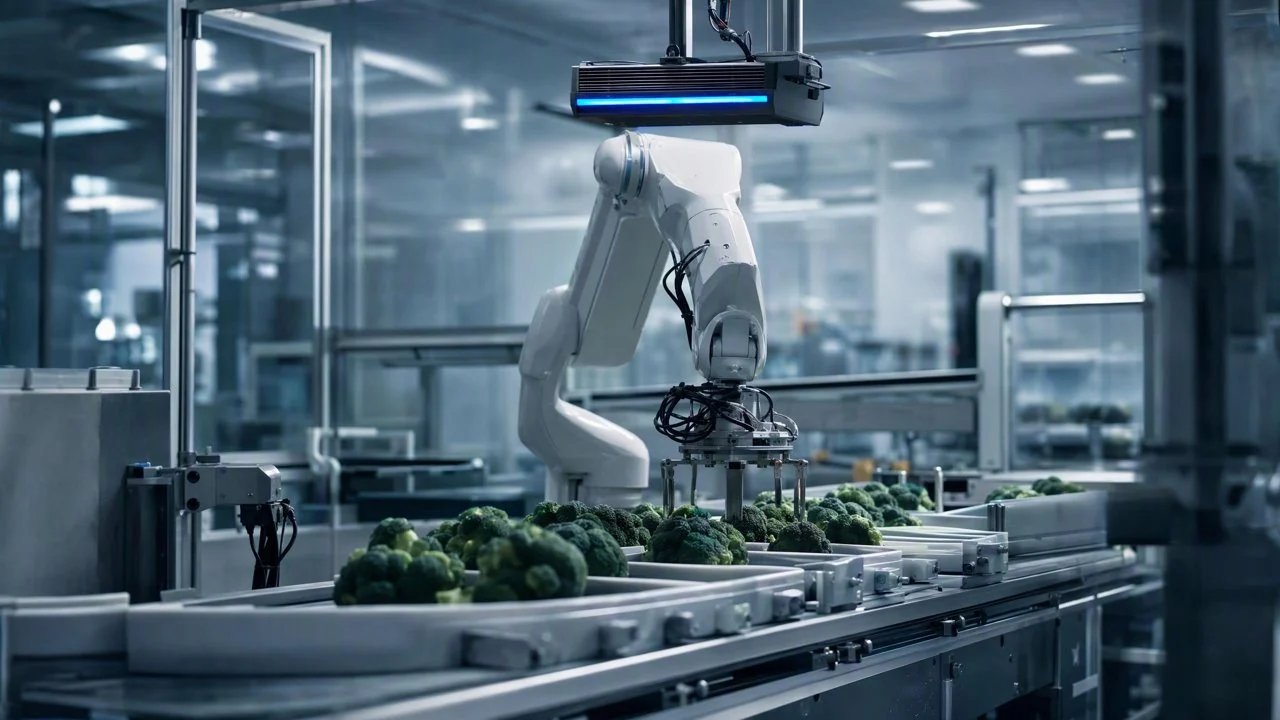
WeLinkirt DaoAI 3D Robotic Vision (proprietary 3D camera + 6D pose estimation, bin picking, glue dispensing/assembly/loading guidance, brain-eye-body closed loop, sub-millimeter hand-eye coordination) reduced batch rejection rates due to foreign objects from 2.5% to <0.3% at a specific agricultural processing plant through high-precision 3D reconstruction and intelligent grasping, while ensuring core production data remained on-premises.
In the current context of increasingly stringent global food safety and supply chain traceability requirements, the food and agricultural product processing industry faces unprecedented challenges. Consumer demands for product quality and safety are constantly rising, and any minor foreign object or quality defect can lead to brand reputation damage or even recalls. Particularly in the initial processing stages of agricultural products, such as grain screening and fruit/vegetable grading, traditional manual inspection is inefficient and susceptible to subjective factors, while 2D vision-based automation solutions struggle to effectively identify hidden, obscured, or color-similar foreign objects. More importantly, for many leading or mid-sized agricultural processing enterprises, production data—especially critical data related to raw material sources, processing techniques, and quality control—is the cornerstone of their core competitiveness and compliance. Uploading such sensitive data to the cloud for processing, whether for trade secret protection, compliance requirements, or cybersecurity considerations, poses significant risks. Therefore, WeLinkirt DaoAI 3D Robotic Vision, with its local private deployment capability, has become an ideal solution for addressing foreign object removal and quality grading challenges while ensuring data security.
Pain Points: Why This Hurdle Is Difficult to Overcome
Foreign object removal and quality grading in agricultural product processing face multiple challenges. Firstly, the “missed detection rate” remains high. Traditional 2D vision systems have limited capabilities in identifying irregularly shaped foreign objects that are similar in color to the product (e.g., soil clumps, stones, withered leaves, insects), leading to missed detection rates as high as 3-5% in certain specific scenarios. Secondly, “manual re-inspection hours” are immense. To compensate for automation shortcomings, significant human labor is invested in high-intensity, repetitive re-inspection tasks. For instance, a mid-sized agricultural processing plant still allocates 40% of its production line workforce for secondary visual inspection after fruit and vegetable grading, directly increasing the per-unit production cost. Thirdly, due to the lack of precise 3D information, traditional solutions struggle with fine-grained “quality grading,” such as distinguishing minor bruises, dents, or subtle disease spots on fruits and vegetables, resulting in a grading accuracy of only about 80%, which impacts product premium potential. Furthermore, “compliance risks” and “data security” are constant threats to enterprises. Any foreign object residue can trigger food safety incidents, and exposing sensitive production data to external network environments is a potential risk that companies cannot accept.
The root causes of these difficulties are: first, agricultural products inherently possess highly unstructured characteristics, with natural variations in shape, size, and color, making rule-based traditional vision algorithms difficult to generalize; second, foreign objects are diverse and varied in form, often highly integrated with or obscured by the product, and 2D images lack depth information, making it impossible to effectively distinguish between surface and internal features, foreground and background; third, high production line cycle time requirements, such as processing hundreds of particles per second in grain screening, mean traditional algorithms struggle to meet speed demands; fourth, in the development of embodied AI technology, while hardware bodies are maturing, the competitive focus in building software algorithms and environmental interaction capabilities lies in how to transform perceived information into precise physical operations and ensure data is securely closed-loop locally, which is precisely where traditional solutions fall short. WeLinkirt DaoAI 3D Robotic Vision addresses these pain points by combining proprietary 3D cameras with advanced AI algorithms to achieve precise identification and grasping of complex agricultural products and foreign objects.
Technical Principles
The core advantage of WeLinkirt DaoAI 3D Robotic Vision lies in its deeply integrated “brain-eye-body closed-loop” system. The “eye” component utilizes WeLinkirt's proprietary high-precision 3D camera, capable of real-time acquisition of dense 3D point cloud data of the detected objects, reconstructing sub-millimeter 3D surface morphology. Unlike traditional 2D vision which only captures planar grayscale or color information, the 3D camera provides spatial information such as object height, depth, and volume, enabling the system to effectively identify foreign objects embedded within products, partially obscured, or highly similar in color to the product. For example, for small stones mixed in grains, even if their color is similar to the grains, their unique protrusions or depressions in 3D morphology, as well as their different textures and densities compared to grains, can be precisely captured and distinguished by the DaoAI system. This capability of WeLinkirt DaoAI 3D Robotic Vision has reduced the foreign object missed detection rate at a specific grain processing plant to <0.4% in actual tests.
Its “brain” component is equipped with advanced 6D pose estimation algorithms and bin picking technology. Based on a deep learning framework, it analyzes 3D point cloud data not only to identify the presence of foreign objects but also to accurately estimate their 3D position and 6-degree-of-freedom (X, Y, Z, Rx, Ry, Rz) pose in space. This enables the “body”—i.e., the collaborative robot—to perform sub-millimeter hand-eye coordination, precisely grasping and removing foreign objects, or placing qualified products in a preset pose for grading. Compared to traditional rule-based AOI systems or manual inspection, the WeLinkirt DaoAI 3D Robotic Vision solution offers higher robustness and generalization capabilities, adapting to natural variations in the shape, size, color, and pose of agricultural products. It requires no complex parameter adjustments and can quickly adapt to new products or foreign object types through few-shot learning, reducing changeover time to less than 5 minutes. Crucially, all visual processing and AI inference are performed locally, ensuring data remains on-premises, fundamentally eliminating the risk of data leakage.
Typical Application Scenarios
- **Grain/Legume Foreign Object Removal:** Targeting foreign objects such as stones, soil clumps, metal fragments, withered leaves, and insects mixed in grains (e.g., rice, wheat, corn) and legumes (e.g., soybeans, red beans). WeLinkirt DaoAI 3D Robotic Vision, through 3D morphology reconstruction, can identify foreign objects even if partially covered or color-similar, by their unique geometric shapes and height information, guiding the robotic arm for precise grasping. The challenge lies in the small size of foreign objects, large quantities, and high-speed production line operations.
- **Fruit/Vegetable Surface Defect Detection and Grading:** Detecting surface defects (e.g., bruises, dents, insect damage, mold) on fruits and vegetables like apples, oranges, and tomatoes, and grading them based on defect severity, size, and shape. The DaoAI system can identify micron-level surface undulations, distinguishing minor bruises from normal physiological structures, achieving more refined grading. Challenges include uneven fruit/vegetable surface reflections, irregular shapes, and diverse defects.
- **Post-Wash Foreign Object Residue Detection for Root Vegetables:** Detecting residual soil, unwashed peel, or weeds on root vegetables such as potatoes, carrots, and sweet potatoes after washing. WeLinkirt DaoAI 3D Robotic Vision can effectively penetrate water film reflections to identify foreign objects adhering to depressions. Challenges include water film reflections and color similarity between foreign objects and vegetable surfaces.
- **Unordered Grasping and Sorting of Prepared Dish Ingredients:** In prepared dish processing, grasping and sorting randomly piled meat chunks or vegetable pieces. The bin picking function of DaoAI 3D Robotic Vision accurately identifies the 6D pose of each individual object, guiding the robot to efficiently and non-destructively grasp them, improving automation levels. Challenges include tightly stacked materials, irregular shapes, and complex reflections.
- **Bone/Scale Residue Detection in Aquatic Products (e.g., Shrimp, Fish Fillets):** Detecting bone or scale residue in deboned fish fillets or peeled shrimp. WeLinkirt DaoAI 3D Robotic Vision can identify these tiny, translucent, or color-similar foreign objects, ensuring product safety for consumption. Challenges include the small size and high transparency of bones, and slippery, reflective product surfaces.
Case Study
A mid-sized agricultural processing plant, primarily producing packaged grain and legume products, previously relied on traditional vibratory screens and limited manual inspection for grain screening. However, it still faced a high foreign object missed detection rate, especially for soil clumps and stones, leading to a batch rejection probability of up to 2.5% due to excessive foreign matter. Simultaneously, to ensure product quality, a significant amount of human labor was required for secondary re-inspection at the end of the production line, with a manual re-inspection rate as high as 20%, which not only increased operating costs but also limited capacity improvements. To address these pain points, and considering its high regard for production data security, the plant introduced the WeLinkirt DaoAI 3D Robotic Vision system. Before deployment, the client's primary concerns were the security of core production data (such as foreign object feature libraries, product 3D models) and the system's ability to identify complex foreign objects. WeLinkirt's team addressed the client's data security concerns by providing a 100% local private deployment solution.
During the deployment process, the WeLinkirt DaoAI 3D Robotic Vision system was installed and debugged on-site within one month. Utilizing APDT positive/few-shot learning technology, the system completed model programming for new product types in 5 minutes using only 15 good sample images. After going live, the system real-time captured the 3D morphology of the grains, precisely identifying and guiding robotic arms to remove foreign objects like soil clumps and stones. Production line data showed that in this case, the product batch rejection rate significantly decreased from 2.5% to <0.3%, and the foreign object missed detection rate was reduced to <0.5%. Concurrently, due to the substantial improvement in automated detection accuracy and efficiency, the manual re-inspection rate at the end of the production line dropped by 85%, from 20% to <3%. This improvement not only saved hundreds of thousands of yuan in labor costs annually but also significantly enhanced product quality and customer satisfaction. The plant's production manager stated that the local deployment of WeLinkirt DaoAI 3D Robotic Vision allowed them to enjoy the efficiency gains brought by advanced vision technology while completely eliminating data security concerns.
“The local private deployment of WeLinkirt DaoAI 3D Robotic Vision not only solved our most troublesome foreign object removal problem, but more importantly, it gave us 100% control over the security of our core production data. This was the decisive factor in our choice.” — Production Manager, Agricultural Processing Plant
WeLinkirt Solution and Products
WeLinkirt DaoAI 3D Robotic Vision is the core of this solution, integrating WeLinkirt's proprietary high-precision 3D camera and advanced AI vision algorithms. During implementation, we first select the appropriate 3D camera model based on the client's specific needs and production line environment, and perform precise calibration to ensure sub-millimeter accuracy in 3D reconstruction. Next, utilizing the 6D pose estimation algorithm of DaoAI Robotic Vision, the system performs real-time, high-precision pose recognition of target objects (whether foreign objects or qualified products). For randomly stacked materials, its bin picking function accurately identifies the independent 6D pose of each object, guiding the robotic arm for precise grasping. The WeLinkirt DaoAI 3D Robotic Vision system supports multiple deployment methods such as SDK/API/Docker, enabling 100% local private deployment to ensure all data is processed, stored, and analyzed within the client's internal network environment, completely eliminating the risk of data leakage. Furthermore, combined with the WeLinkirt ACI OS operating system, clients can achieve 0-code automatic programming for new product types or inspection tasks in 5 minutes using just one good sample, significantly lowering technical barriers and changeover costs.
This solution can also be integrated with the WeLinkirt DaoAI World model, leveraging its unified foundation for semantic understanding and cross-scenario generalization capabilities to continuously learn and optimize from production line feedback, further enhancing the ability to identify unknown foreign objects and complex defects. Through this deep “brain-eye-body” closed loop, WeLinkirt DaoAI 3D Robotic Vision not only improves production efficiency and product quality but also, with its local private deployment capability, builds a robust data security defense for clients, achieving a win-win situation of production automation and data autonomy in the food/agriculture industry.
FAQ
How does WeLinkirt DaoAI 3D Robotic Vision ensure data security in the food industry?
WeLinkirt DaoAI 3D Robotic Vision solutions support 100% local private deployment. This means all visual data acquisition, AI model training and inference, and critical production data analysis are performed within the client's internal servers and network environment. Data is not uploaded to the cloud, fundamentally eliminating data leakage risks and meeting the stringent compliance requirements of the food industry.
What is the difference between DaoAI 3D Robotic Vision and traditional 2D vision solutions for foreign object removal?
WeLinkirt DaoAI 3D Robotic Vision utilizes proprietary high-precision 3D cameras to acquire 3D point cloud data, enabling sub-millimeter 3D morphology reconstruction of objects. This allows for effective identification of obscured, embedded, or color-similar foreign objects, which is difficult for traditional 2D vision (relying solely on planar images). The DaoAI system provides depth information, leading to higher accuracy and robustness in identifying complex foreign objects.
How long does it take to deploy the WeLinkirt DaoAI 3D Robotic Vision system, and how is the budget estimated?
Deployment of the WeLinkirt DaoAI 3D Robotic Vision system typically takes less than a month, depending on production line complexity and integration requirements. Budget estimation involves factors such as camera model, number of robots, software functional modules, and customized development. We recommend contacting the WeLinkirt professional team for an on-site evaluation to obtain a detailed quotation and return on investment analysis.
Full solution for this scenario: the full inspection solution for Robotics Vision · Fresh Food Foreign-Object Removal & Grading
This article was generated by AI. Customer cases are simulated scenarios based on real product capabilities and figures are illustrative; see product pages for official benchmarks.