
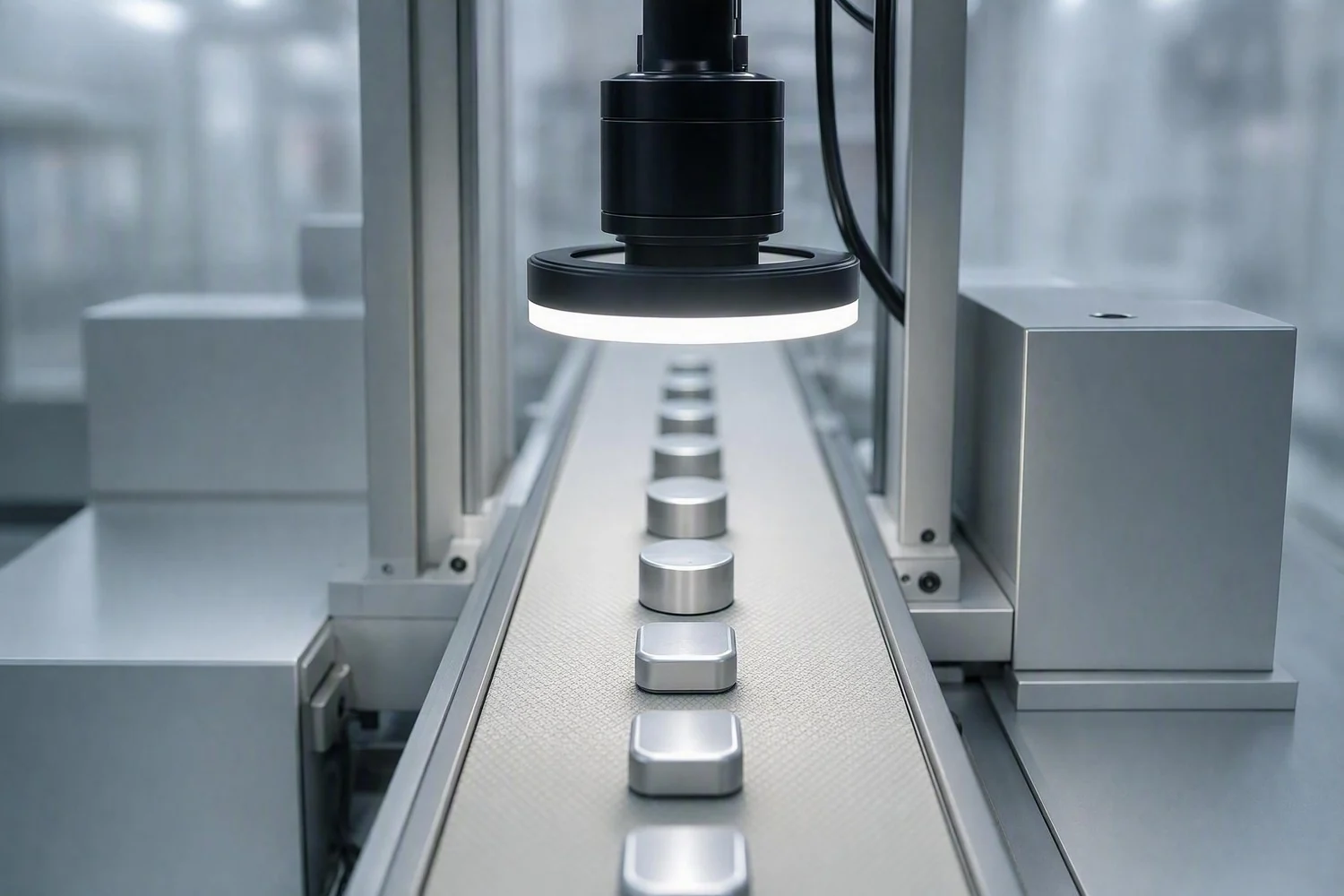
WeLinkirt DaoAI 3D Robot Vision (self-developed 3D camera + 6D pose estimation, bin picking, glue bead/assembly/loading guidance, brain-eye-body closed-loop, sub-millimeter hand-eye coordination) achieved 100% online 3D inspection and path correction for glue beads at an automotive parts manufacturer through on-premise deployment, reducing data transmission latency from an average of 50ms to less than 10ms, significantly improving production efficiency and data security.
In automotive and parts manufacturing, high-precision glue dispensing is a critical process for ensuring product sealing, structural integrity, and NVH (Noise, Vibration, Harshness) performance. As automotive designs become increasingly complex, with more irregular parts and lightweight materials, and as new energy vehicles demand stringent battery pack sealing, traditional glue dispensing processes face significant challenges. Particularly for key sealing components such as car doors, windows, engine covers, and battery pack housings, the uniformity, continuity, width, and height of the glue bead directly impact the final product's quality and safety. A certain automotive parts manufacturer deeply understood this, and its glue dispensing production line urgently required an advanced solution that could balance efficient online inspection with data security.
Pain Points: Why This Hurdle is Difficult to Overcome
This automotive parts manufacturer faced multiple challenges in the glue bead inspection process. Firstly, due to numerous product models and frequent changeovers, traditional rule-based 2D AOI solutions suffered from high false positive rates when dealing with irregular parts and complex curved surfaces. The measured average false positive rate exceeded 15%, leading to extensive manual re-inspection hours and severely slowing down the production rhythm. Secondly, glue bead defects were diverse, including discontinuous beads, overflow, bubbles, uneven width, and insufficient height. Subtle bubbles and height deviations, in particular, were difficult to accurately identify in 2D images, with the false negative rate consistently around 3%, directly impacting product sealing performance. More critically, the factory had extremely high requirements for production data security and real-time performance. Any solution involving uploading core production data to the cloud for processing was strictly restricted due to concerns about data leakage risks. Furthermore, the average 50ms data latency caused by cloud transmission could not meet its sub-millimeter real-time path correction requirements. These combined issues made both manual inspection and traditional 2D vision solutions inadequate for the quality and efficiency demands of the current production line.
Why are these challenges so difficult to overcome? From a process perspective, the rheology of the adhesive, curing speed, and environmental temperature and humidity during dispensing all affect the final shape of the glue bead, leading to unpredictable micro-deformations. From an imaging perspective, the complex reflective properties of the adhesive itself make it difficult for 2D vision to distinguish between surface reflections and true morphology, making it susceptible to ambient light interference. For this particular factory, the core pain points lay in its extreme pursuit of data security and stringent demands for real-time response. In the era of the Industrial Internet of Things, while cloud-based AI services offer powerful computing capabilities, uploading sensitive production process parameters, defect data, and even product design blueprints to external servers is an unacceptable risk for large manufacturing enterprises that prioritize intellectual property protection and national security. Concurrently, real-time path correction for glue dispensing requires the vision system to complete data acquisition, processing, decision-making, and feedback to the robot within an extremely short timeframe. Even a few tens of milliseconds of delay can lead to untimely correction, affecting dispensing accuracy. This is similar to how Nyobolt's fast-charging battery technology serves Agility Robotics' Digit 5 humanoid robot for efficient endurance, where core capabilities must be localized and highly real-time to support autonomous decision-making and rapid response for complex tasks.
Technical Principles
WeLinkirt's DaoAI 3D Robot Vision solution, through its self-developed high-precision 3D camera and advanced 6D pose estimation algorithms, offers a new breakthrough for automotive parts glue bead inspection. Its core lies in utilizing structured light or laser triangulation principles, combined with multi-view image fusion technology, to perform high-precision 3D morphology reconstruction of the glue bead, achieving micron-level Z-axis (height) measurement accuracy. Unlike traditional 2D vision, which only captures planar information, the DaoAI 3D camera can accurately capture all critical 3D geometric features of the glue bead, including width, height, cross-sectional shape, and continuity. Even subtle bubbles or insufficient height can be clearly rendered.
At the algorithmic level, WeLinkirt's DaoAI 3D Robot Vision employs deep learning-based 6D pose estimation algorithms to identify the precise position and orientation of workpieces in real-time. This is combined with the 3D morphology data of the glue bead for high-precision defect detection. The APDT few-shot self-training technology (1-20 good samples) greatly simplifies changeover programming, allowing for rapid training of highly generalized detection models with just a small number of good samples. More importantly, the DaoAI 3D Robot Vision achieves a “brain-eye-body closed-loop,” where the vision system (eye) perceives defects in real-time, the AI model (brain) determines correction strategies, and directly guides the robot (body) to adjust its path, achieving sub-millimeter hand-eye coordination. Compared to traditional rule-based AOI, its advantage lies in stronger adaptability to complex curved surfaces and irregular parts, significantly reducing false positive rates. Compared to manual inspection, WeLinkirt's DaoAI 3D Robot Vision not only improves detection consistency and efficiency, but crucially, the solution supports 100% on-premise private deployment. All data processing and model operations are completed on internal factory servers, ensuring absolute security of the customer's core production data. Furthermore, actual measurements show that data transmission latency can be reduced by over 80%, from an average of 50ms to less than 10ms, meeting the stringent requirements for real-time path correction.
Typical Application Scenarios
- **Automotive Interior Sealant Bead Inspection:** For sealant beads on interior components such as car doors, windows, and sunroofs, DaoAI 3D Robot Vision can precisely detect defects like bead width, height, continuity, breaks, and overflow. The challenge lies in beads often being located in confined areas and having similar colors to the background, which 3D morphology data effectively differentiates.
- **Battery Pack Housing Sealant Inspection:** New energy vehicle battery packs require extremely high sealing performance. DaoAI 3D Robot Vision can perform 100% full inspection of sealant at battery pack housing joints, detecting micron-level bubbles, cracks, and uneven height to ensure the battery pack's waterproof and dustproof capabilities. The difficulty is the large size of battery packs, extensive inspection range, and subtle defects.
- **Engine Block/Transmission Gasket Dispensing Guidance:** For dispensing gasket adhesive on precision components of engine blocks or transmissions, DaoAI 3D Robot Vision provides high-precision dispensing guidance, real-time correcting robot paths to ensure uniform bead placement and thickness, preventing oil leakage due to poor dispensing. The challenge is complex component surfaces and extremely high positioning accuracy requirements.
- **Car Body Weld Seam Sealant Inspection and Guidance:** Sealant must be applied to car body weld seams for rust prevention and sound insulation. DaoAI 3D Robot Vision can inspect the integrity and uniformity of the sealant and guide the robot to precisely dispense along complex weld seam paths. The difficulty lies in large variations in weld seam curvature and complex ambient lighting conditions.
- **Automotive Headlight Assembly Waterproof Seal Inspection:** Waterproof seals in headlight assemblies are crucial for vehicle lighting safety. DaoAI 3D Robot Vision can inspect the integrity, absence of damage, and proper seating of the seal, ensuring long-term waterproof performance of headlights. The challenge is that seal materials can be transparent or translucent and reflective, making 2D vision difficult to penetrate.
Case Study
A Tier-1 supplier specializing in automotive chassis and body structural parts had long faced quality and efficiency bottlenecks on its car body sealant dispensing production line for a specific vehicle model. Before implementation, the production line relied on manual sampling inspection and some 2D vision systems. However, due to product complexity and cycle time requirements, false negative and false positive rates remained high. Particularly for tiny bubbles and glue bead height deviations, the 2D vision solution's false negative rate averaged around 3%, leading to high rework rates and severely impacting overall production OEE. Concurrently, this customer had strict requirements for all production data to be stored and processed locally, rejecting any cloud-based solutions. After in-depth research, the WeLinkirt DaoAI 3D Robot Vision team provided a customized solution based on on-premise private deployment.
After a month of system integration and debugging, the DaoAI 3D Robot Vision system was successfully deployed on the customer's production line. The system integrated WeLinkirt's self-developed 3D camera, achieving 100% online inspection of glue bead morphology through high-precision 3D reconstruction technology. Post-implementation, production line data showed that the false negative rate for glue bead defects was successfully reduced to <0.4%, significantly below industry averages. Concurrently, due to the precision of 3D data, the false positive rate was also substantially reduced by −75%, greatly decreasing manual re-inspection workload. More importantly, the on-premise deployment of WeLinkirt's DaoAI 3D Robot Vision reduced data transmission latency from an average of 50ms before implementation to less than 10ms, providing a solid foundation for real-time robot path correction, thereby improving dispensing accuracy to sub-millimeter levels. In this case, the customer not only achieved a leap in quality but also completely resolved data security concerns, providing valuable experience for future intelligent upgrades of other production lines.
The on-premise private deployment of WeLinkirt's DaoAI 3D Robot Vision is not just a technological breakthrough, but a profound response to customer demands for data security and real-time performance.
WeLinkirt Solutions and Products
The core solution provided by WeLinkirt centers around DaoAI 3D Robot Vision, deeply customized for the pain points of automotive parts glue dispensing processes. The key advantage of this solution lies in its self-developed 3D camera, capable of high-precision, high-speed 3D point cloud acquisition, providing a solid data foundation for subsequent defect detection and robot guidance. Combined with the DaoAI ACI OS operating system, users can leverage APDT few-shot self-training technology to program models within 5 minutes using 1-20 good samples, achieving zero-code rapid changeovers. This significantly reduces production line downtime, especially suitable for multi-variety, small-batch production modes. The system also integrates advanced 6D pose estimation algorithms, ensuring robots can precisely identify workpiece positions and orientations, accurately performing dispensing tasks even with random workpiece deviations. WeLinkirt's DaoAI 3D Robot Vision supports various deployment methods such as SDK/API/Docker and enables 100% on-premise private deployment. All core algorithms and data processing are completed within the customer's factory premises, ensuring data never leaves the facility, meeting the highest data security requirements of this automotive parts manufacturer. Furthermore, WeLinkirt's DaoAI World model, as a unified foundation, continuously optimizes detection accuracy and correction strategies through semantic understanding and cross-scenario generalization capabilities, learning from production line feedback.
Through the localized deployment of WeLinkirt's DaoAI 3D Robot Vision, the customer not only resolved data security and real-time issues but also achieved significant improvements in production efficiency and quality. This solution reduced the false negative rate for glue bead defects to <0.4% and the false positive rate by −75%, greatly reducing manual re-inspection hours and saving millions of RMB in labor costs annually. Dispensing accuracy improved to sub-millimeter levels, reliably ensuring product sealing and reducing recall risks and brand damage due to quality issues. Concurrently, the zero-code rapid changeover capability shortened downtime by over 90%, significantly enhancing overall equipment effectiveness (OEE). These quantified achievements collectively generate immense business value, demonstrating the strong competitiveness of WeLinkirt's DaoAI 3D Robot Vision in the automotive parts manufacturing sector.
FAQ
How does WeLinkirt DaoAI 3D Robot Vision ensure data security with on-premise private deployment?
WeLinkirt's DaoAI 3D Robot Vision solution supports 100% on-premise private deployment. All data collection, processing, model training, and operation are completed on internal factory servers. Data never leaves the facility, fundamentally eliminating data leakage risks and meeting enterprises' highest security requirements for core production data and intellectual property.
What are the core advantages of WeLinkirt DaoAI 3D Robot Vision compared to traditional 2D vision in automotive glue dispensing scenarios?
The core advantage of WeLinkirt's DaoAI 3D Robot Vision lies in its self-developed 3D camera, which enables high-precision 3D morphology reconstruction. It can detect all three-dimensional features of the glue bead, such as width, height, and cross-section, effectively identifying subtle bubbles and insufficient height defects that traditional 2D vision struggles with. Combined with 6D pose estimation algorithms and brain-eye-body closed-loop, it achieves sub-millimeter real-time path correction, significantly improving dispensing accuracy and detection precision.
What factors primarily influence the cost budget for implementing WeLinkirt DaoAI 3D Robot Vision solutions?
The cost budget for WeLinkirt's DaoAI 3D Robot Vision solution is primarily influenced by factors such as deployment scale (number of inspection points, number of robots), required precision level, customized development needs, and whether additional integration with other automation equipment is required. We offer flexible solution configurations and licensing models. Specific quotes require detailed evaluation based on your actual needs; please feel free to schedule a consultation.
Full solution for this scenario: Robotics Vision industry solutions · 100% Inline 3D Inspection & Path Correction for Automotive Glue Dispensing
This article was generated by AI. Customer cases are simulated scenarios based on real product capabilities and figures are illustrative; see product pages for official benchmarks.