
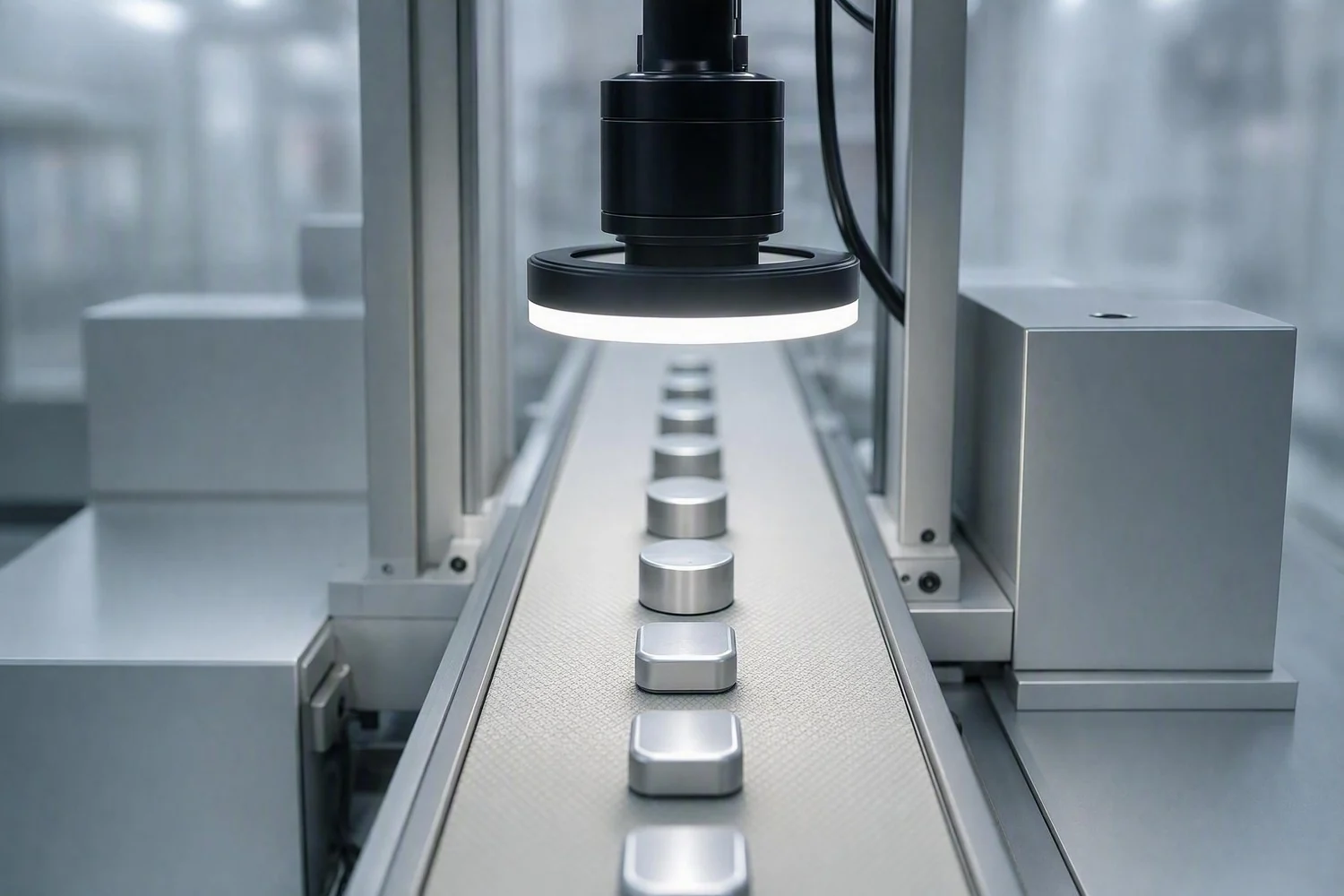
WeLinkirt's DaoAI 3D Robot Vision (featuring proprietary 3D cameras + 6D pose estimation, bin picking, guidance for gluing/assembly/loading/unloading, brain-eye-body closed loop, and sub-millimeter hand-eye coordination) integrates high-performance 3D visual perception with intelligent decision-making, reducing changeover time for automotive fastener tightening from over 30 minutes with traditional methods to under 5 minutes, significantly boosting flexibility and efficiency for high-mix, low-volume production lines.
In automotive parts manufacturing, fastener tightening is a critical assembly step directly impacting product performance and safety. As the automotive market demands more personalization and customization, and with the increasing penetration of new energy vehicles, automotive parts production exhibits characteristics of high-mix, low-volume, and rapid iteration. Traditional automated tightening solutions often rely on fixed fixtures and preset programs, leading to long changeover times and complex manual adjustments when faced with frequent model switches, severely restricting production line flexibility and efficiency. The challenge of integrating autonomous navigation, grasping, and decision-making for embodied AI service mobile robots in complex industrial scenarios also drives the industry to explore smarter, more flexible vision-guided tightening solutions.
Pain Points: Why This Hurdle Is Difficult to Overcome
In automotive fastener tightening, high-mix, low-volume production presents multi-dimensional challenges. Firstly, long changeover downtime is a core pain point. In traditional solutions, each product model switch requires readjusting fixtures, teaching robot paths, and modifying tightening parameters. Production line data from a certain automotive parts factory indicates this process typically takes 30 minutes or more, leading to low equipment utilization and significant capacity loss. Secondly, manual teaching and debugging are highly complex, requiring experienced engineers and involving inefficient repetitive labor, which becomes almost unmanageable when dealing with hundreds of part models. Thirdly, the wide variety of fasteners and their inconsistent positions—bolts, nuts, screws of various sizes and shapes, potentially with slight stacking or tilting—make it difficult for traditional vision systems to accurately identify and guide robots for grasping and tightening. Finally, for some critical fasteners, the tightening torque and angle require extremely high precision, which traditional solutions struggle to achieve with sub-millimeter guidance accuracy and force feedback, posing potential quality risks and compliance issues.
The root cause of these difficulties lies in the “rigidity” of traditional automation solutions—they rely on predefined geometric models and fixed programs, lacking the ability to perceive and adapt to environmental changes. For instance, in terms of imaging, traditional 2D vision struggles to acquire depth information, making it difficult to accurately handle 3D pose variations like fastener stacking or tilting. From a process perspective, each changeover means physical fixture replacement and robot trajectory re-planning, a time-consuming and error-prone process. In terms of decision-making, traditional robots lack the “brain-eye-body closed-loop” intelligence, unable to autonomously adjust tightening strategies based on real-time visual feedback, let alone achieve zero-code rapid changeover, severely hindering the flexible upgrade of production lines.
Technical Principles
WeLinkirt's DaoAI 3D Robot Vision solution fundamentally addresses these pain points through its proprietary 3D camera and core algorithms. Its core mechanism involves high-precision 3D perception, 6D pose estimation, and intelligent control via a “brain-eye-body closed loop.” First, the DaoAI proprietary 3D camera utilizes structured light or laser triangulation principles to acquire high-speed, high-precision 3D point cloud data of workpieces and fasteners. It can stably image even reflective or complex geometric surfaces, with reconstruction accuracy reaching sub-millimeter levels. Second, the system's built-in 6D pose estimation algorithm can calculate the precise position and orientation (X, Y, Z, Rx, Ry, Rz) of fasteners in space in real-time based on 3D point cloud data, eliminating the need for extensive pre-teaching of points and exhibiting strong robustness to minor stacking or tilting of fasteners. This high-precision 6D pose estimation capability is crucial for achieving sub-millimeter hand-eye coordination.
Compared to traditional rule-based 2D AOI or manual inspection, the advantages of WeLinkirt's DaoAI 3D Robot Vision are evident in several aspects: **3D Perception Capability**: Traditional 2D vision only captures planar information, struggling with depth and occlusion. In contrast, DaoAI 3D Vision can comprehensively perceive the 3D morphology of workpieces, accurately identifying the true pose of fasteners, avoiding misjudgments caused by viewpoint changes or uneven lighting. **Zero-Code Rapid Changeover**: Traditional solutions require engineers to re-teach robot paths for each changeover, which is time-consuming and complex. DaoAI 3D Robot Vision, relying on its powerful general vision foundation models and APDT few-shot learning capabilities, only needs to import CAD models of new product types or learn from a small number of good samples (1-20 images). The system can then automatically identify and generate tightening paths, achieving rapid changeover within 5 minutes. **“Brain-Eye-Body Closed Loop”**: The WeLinkirt DaoAI 3D Robot Vision system achieves integration of visual perception, intelligent decision-making, and robot motion control. The robot can adjust its tightening position and posture in real-time based on visual feedback and perform closed-loop control during tightening by incorporating force sensor data, ensuring tightening quality. This intelligent closed-loop control enables the system to maintain high precision and stability in complex and variable environments. In one case, the DaoAI system improved fastener tightening qualification rate to over 99.8%.
Typical Application Scenarios
- **Unordered Bin Picking and Positioning for Automotive Parts**: Before the tightening process, DaoAI 3D Robot Vision guides robots to accurately pick various fasteners (e.g., bolts, nuts, washers) or components to be assembled from unsorted bins. The challenge lies in the random poses of parts, mutual occlusion, and reflective materials. DaoAI 3D cameras, through high-precision point cloud reconstruction and 6D pose estimation algorithms, stably identify and guide robots for precise grasping.
- **Automated Tightening Guidance for Multi-Model Bolts/Nuts**: Different automotive parts have distinct fastener hole positions and tightening requirements. WeLinkirt's DaoAI 3D Robot Vision system can identify the current workpiece model in real-time and, combined with CAD data, automatically match the corresponding tightening strategy and robot path, guiding the tightening tool to precisely align with the holes, achieving flexible automated tightening for various bolt/nut models.
- **Quality Inspection of Fastener Tightening in Critical Areas**: After tightening, DaoAI 3D Vision can perform a secondary inspection of tightened fasteners to check for missing, stripped, undertightened, or over-tightened defects leading to deformation. The challenge is minute morphological changes and high-cycle time requirements. DaoAI 3D cameras, with their high-resolution imaging capabilities, can detect micron-level morphological anomalies, ensuring tightening quality.
- **Assembly Guidance for Complex Structural Parts**: Beyond tightening, DaoAI 3D Robot Vision can also be used for precise assembly guidance of complex structural parts, such as engine components and transmission housings. The system identifies the precise pose of components, guiding the robot to accurately insert or join parts, ensuring assembly precision and smoothness.
- **Adhesive Dispensing Path Guidance**: In automotive parts manufacturing, adhesive dispensing is a common sealing and bonding process. WeLinkirt's DaoAI 3D Robot Vision can acquire the 3D morphology of workpieces in real-time and automatically generate or correct adhesive dispensing paths based on CAD models, ensuring uniform, accurately positioned adhesive beads, preventing skips or overflows, and improving dispensing quality and efficiency.
Case Study
A leading Tier-1 automotive parts supplier needed to perform fastener tightening operations on various models of engine brackets. Due to increasing customized customer demands, product models were frequently switched. The traditional robot tightening solution required engineers to manually teach the robot for each changeover, resulting in an average changeover downtime of 30-45 minutes, severely impacting production rhythm. To improve line flexibility, the supplier introduced WeLinkirt's DaoAI 3D Robot Vision solution. Before implementation, the production line averaged 3-4 changeovers per shift (8 hours), totaling over 1.5 hours of downtime. Engineers spent significant time adjusting robot paths and setting parameters, often leading to human errors. After the DaoAI 3D Robot Vision system was deployed, the factory only needed to import CAD data for new product models, and the system automatically identified workpiece poses and generated tightening paths. The entire changeover process was compressed to under 5 minutes. Production line data shows that, with WeLinkirt's DaoAI 3D Robot Vision, the customer's changeover downtime was reduced by approximately 85%, leading to significant annual capacity increase.
The zero-code rapid changeover capability of WeLinkirt's DaoAI 3D Robot Vision has truly enabled our production line to achieve high-mix, low-volume mixed-line production, and we no longer worry about efficiency losses from frequent changeovers.
WeLinkirt Solutions and Products
WeLinkirt's solution for automotive fastener tightening is centered on DaoAI 3D Robot Vision, leveraging the powerful underlying capabilities of the Wemio engine. Our DaoAI 3D ACI equipment integrates proprietary high-precision 3D cameras, capable of stably acquiring 3D point cloud data of complex workpieces. Through the DaoAI ACI OS operating system, users can utilize the “zero-code automatic programming” feature. By simply importing CAD models or performing APDT positive/few-shot learning with 1-20 good samples, visual recognition models for new product types can be rapidly trained. For high-mix, low-volume production, this feature greatly simplifies the changeover process, reducing traditional model training and path teaching from hours or even days to minutes. The system supports various deployment methods like SDK / API / Docker and allows for 100% local private deployment, ensuring all templates and inspection images remain on-site, meeting the stringent data security and privacy requirements of the automotive industry.
Furthermore, WeLinkirt's DaoAI World model, serving as a unified foundation, endows the system with stronger semantic understanding and cross-scenario generalization capabilities. It continuously learns from production line feedback, constantly optimizing recognition accuracy and decision-making efficiency. In tightening operations, the system not only guides the robot for precise alignment but also integrates external data such as torque sensors for closed-loop control, achieving sub-millimeter hand-eye coordination accuracy to ensure tightening quality meets standards. Through the WeLinkirt DaoAI 3D Robot Vision solution, a certain automotive parts factory reduced its changeover downtime from 30-45 minutes to under 5 minutes, significantly enhancing production line flexibility and efficiency. Concurrently, it reduces reliance on engineers' specialized skills and minimizes manual debugging errors, enabling the production line to respond to market changes more quickly and economically.
FAQ
How does WeLinkirt's DaoAI 3D Robot Vision achieve zero-code rapid changeover?
WeLinkirt's DaoAI 3D Robot Vision, through its DaoAI ACI OS operating system, combined with proprietary vision foundation models and APDT few-shot learning technology, allows users to simply import CAD models of new products or provide 1-20 good sample images. The system then automatically learns and generates recognition models and robot paths, eliminating the need for manual programming or extensive teaching, thereby enabling rapid changeover within 5 minutes.
How does the deployment cost of WeLinkirt's DaoAI 3D Robot Vision compare to traditional solutions?
The initial deployment cost of WeLinkirt's DaoAI 3D Robot Vision might be slightly higher than traditional fixed fixture or 2D vision solutions. However, its zero-code rapid changeover capability significantly reduces long-term operating costs, especially in high-mix, low-volume production scenarios, saving substantial manual teaching, debugging time, and downtime losses, leading to a short return on investment period. Specific quotes are customized based on production line scale and complexity; please schedule a consultation.
What precision can WeLinkirt's DaoAI 3D Robot Vision achieve in automotive fastener tightening applications?
WeLinkirt's DaoAI 3D Robot Vision, with its proprietary high-precision 3D cameras and advanced 6D pose estimation algorithms, combined with a “brain-eye-body closed-loop” control, can achieve sub-millimeter hand-eye coordination accuracy. In automotive fastener tightening scenarios, the system ensures precise alignment of the tightening tool with the hole and integrates force sensor feedback for high-precision tightening operations, effectively improving product quality.
Full solution for this scenario: Robotics Vision industry solutions · Fastener Tightening Cycle Time & 100% Full Inspection
This article was generated by AI. Customer cases are simulated scenarios based on real product capabilities and figures are illustrative; see product pages for official benchmarks.