
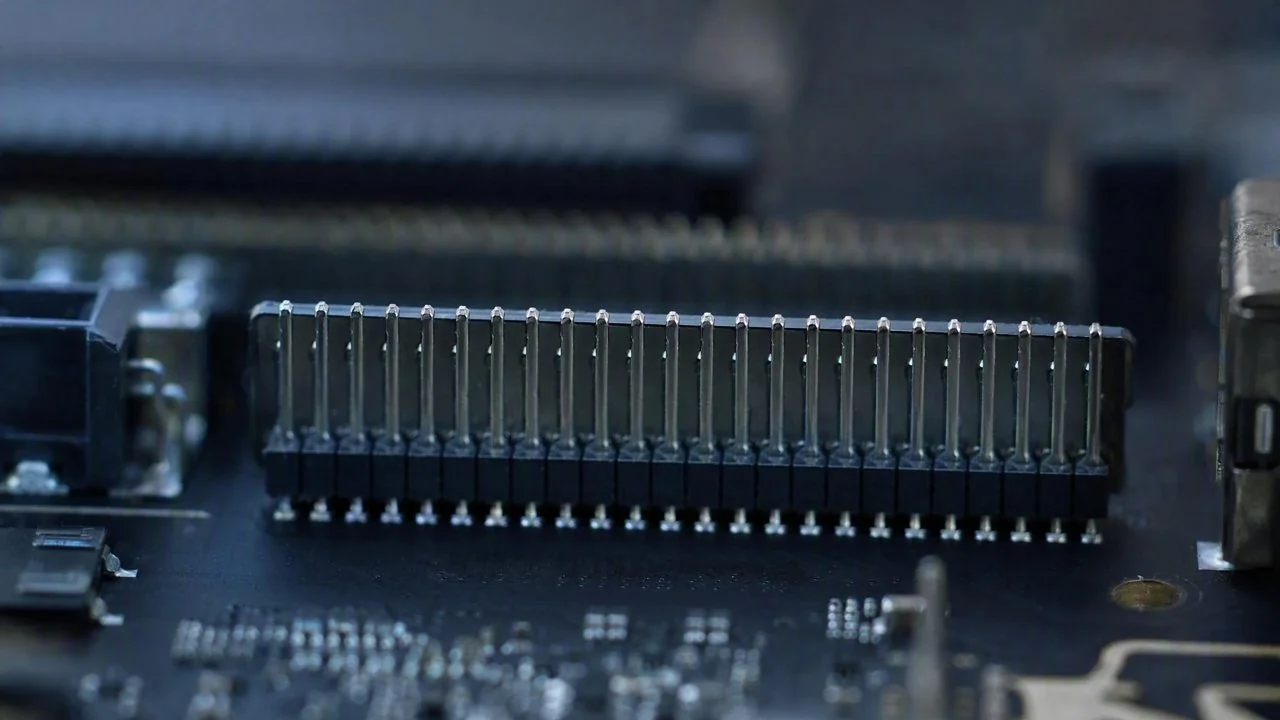
In the electronics production field, the coplanarity inspection of pin headers/connectors is of crucial importance. WeLinkirt brings a breakthrough solution to this inspection problem with its advanced AI vision technology.
Scene: The electronics industry is an important pillar of global technological development. The quality and stability of its products directly affect the development of the entire industrial chain. In the production process of electronic products, the PCBA (Printed Circuit Board Assembly) production line is one of the core links. On the PCBA production line of a leading electronics manufacturer, pin headers/connectors, as key components for signal transmission and power supply in electronic devices, their coplanarity inspection has become a crucial process. The coplanarity of pin headers/connectors is directly related to the performance and stability of the device. If the coplanarity does not meet the standards, it may lead to problems such as signal transmission interruption and unstable power supply, thus affecting the quality and service life of the entire electronic product.
Pain Points: Why is it Difficult?
The problem of missed detection is serious. In the traditional manual inspection method, due to the long-working-hour fatigue of inspectors, it is difficult to maintain a high level of concentration all the time. According to statistics, the missed-detection rate of manual inspection is about 0.6%. This means that out of every 1000 pin headers/connectors, about 6 unqualified products may be missed and flow into the market. Once these unqualified products enter the market, they will have a serious impact on product quality and brand reputation, possibly leading to a series of problems such as customer complaints and returns, bringing huge economic losses to the enterprise.
The false-alarm rate remains high. Although traditional machine vision inspection has improved the inspection efficiency to a certain extent, it also has a relatively high false-alarm rate of about 30%. This is because the algorithms of traditional machine vision inspection are relatively fixed, and their ability to handle complex features of pin headers/connectors and environmental interference factors is limited. A high false-alarm rate not only increases the workload of re-inspection, making inspectors spend a lot of time and energy re-inspecting falsely-alarmed products, but also reduces production efficiency, slowing down the operation speed of the production line.
The efficiency of model-changing production is low. In the electronics production process, it is often necessary to carry out model-changing production according to different product requirements. However, in the traditional inspection method, when changing the production model, the process of adjusting the inspection parameters is very cumbersome and time-consuming, taking about 30 minutes. This is because the traditional inspection system requires manual adjustment of a large number of parameters to adapt to the new type of pin headers/connectors and inspection requirements. The long model-changing adjustment time seriously affects the flexibility and efficiency of production, making it impossible for the enterprise to quickly respond to market demand changes.
Technical Principle
WeLinkirt uses advanced AI algorithms and self-developed imaging technology to solve the coplanarity inspection problem of pin headers/connectors. Its visual basic model has a powerful feature-recognition ability and can accurately identify various features of pin headers/connectors, such as the shape, size, and spacing of pins. Through the APDT positive-sample/few-sample learning algorithm, only 1-20 good samples are needed to quickly learn the normal features of the product. This few-sample learning algorithm greatly reduces the dependence on the number of samples, enabling the system to quickly adapt to new types of pin headers/connectors.
In terms of imaging, the self-developed 3D camera can obtain the three-dimensional morphology information of pin headers/connectors. Combined with the three-dimensional morphology reconstruction technology, it can accurately present their surface morphology. Compared with traditional 2D information, 3D information can better reflect the real shape of the object and can more comprehensively detect coplanarity problems. For example, 2D information can only provide a plane image of the object and cannot accurately reflect the three-dimensional features such as the height difference of pins, while 3D information can clearly show these features, thus improving the accuracy of detection. At the same time, the learning ability of the AI algorithm enables the system to automatically adjust the detection strategy according to different types of pin headers/connectors, improving the generality of detection.
Typical Application Scenarios
- Pin height deviation detection: The pin height of pin headers may deviate due to production processes and other reasons. WeLinkirt's 3D camera can accurately obtain the height information of pins and detect whether the height deviation is within the allowable range by comparing it with the standard height. The difficulty lies in the fact that the pin height deviation may be very small, which requires high-precision imaging and algorithms to accurately identify.
- Pin spacing detection: The accuracy of pin spacing is crucial for signal transmission. The system identifies the position of pins through the visual basic model and calculates the spacing between pins. The difficulty is that there are many pins in the pin header and the spacing is small, which is easily interfered with by image noise and other factors.
- Connector flatness detection: The flatness of the connector directly affects its connection effect with other components. Using the three-dimensional morphology reconstruction technology, the system can comprehensively detect the flatness of the connector surface. The difficulty is that there may be small undulations and defects on the connector surface, and the system needs to be able to accurately distinguish normal surface textures from defects.
- Hidden solder joint detection: In some pin headers/connectors, there are hidden solder joints. It is very difficult for traditional detection methods to detect the quality problems of these hidden solder joints. WeLinkirt's 3D camera can obtain the three-dimensional information of solder joints and detect whether the shape, size, and position of solder joints meet the requirements. The difficulty lies in the fact that the position of hidden solder joints is relatively hidden, and it is more difficult to image.
Implementation Case
A large-scale electronic manufacturing enterprise has multiple PCBA production lines and produces a large number of electronic products every day. Before introducing WeLinkirt's AI vision inspection solution, the enterprise had been using traditional inspection methods and faced problems such as high missed-detection rate, high false-alarm rate, and long model-changing time. During the implementation process, WeLinkirt's technical team first conducted a detailed investigation and analysis of the enterprise's production process and inspection requirements, and then carried out customized programming and debugging of the DaoAI ACI (AI-AOI) software system according to the actual situation. At the same time, the DaoAI 2D / 3D ACI equipment was installed and debugged to ensure that the equipment could be smoothly connected to the enterprise's production line.
After introducing WeLinkirt's solution, the detection rate of coplanarity of pin headers/connectors in this enterprise increased from about 99% to about 99.4%, the false-alarm rate decreased by about 63%, and the model-changing time was shortened from the original 30 minutes to 5 minutes. This not only greatly improved production efficiency and reduced production costs but also enhanced product quality and brand reputation.
WeLinkirt's Solution and Products
WeLinkirt provides a complete solution, including the DaoAI ACI OS and the DaoAI 2D / 3D ACI equipment. The DaoAI ACI OS utilizes the feature-recognition ability of the visual basic model and the APDT positive-sample/few-sample learning ability. It can complete zero-code automatic programming for a good product in 5 minutes and has a semantic false-alarm filtering function, which can effectively reduce the false-alarm rate. The self-developed 3D camera of the DaoAI 2D / 3D ACI equipment can perform three-dimensional morphology reconstruction and detect hidden solder joints, coplanarity, and micron-level morphology. During the implementation process, the software system is first used to quickly program and learn the product, and then high-precision inspection is carried out through the AOI equipment, realizing an efficient and accurate inspection process.
Quantitative results: By applying WeLinkirt's solution, the detection rate has increased to about 99.4%, greatly reducing the risk of missed-detected products flowing into the market. The false-alarm rate has decreased by about 63%, effectively reducing the re-inspection workload and improving production efficiency. The model-changing time has been shortened from the original 30 minutes to 5 minutes, significantly enhancing the flexibility and efficiency of production.
FAQ
What pain points in the coplanarity inspection of pin headers/connectors in the electronics industry can WeLinkirt solve?
WeLinkirt can solve many pain points of traditional inspection methods. For example, it can address the problem of the about 0.6% missed-detection rate in manual inspection, reducing the risk of missed-detected products flowing into the market. It can also solve the problem of the about 30% false-alarm rate in traditional machine vision inspection, reducing the re-inspection workload. Moreover, it can shorten the time for adjusting parameters during model-changing production from about 30 minutes to 5 minutes, improving production flexibility and efficiency.
What is the technical principle of WeLinkirt?
WeLinkirt uses advanced AI algorithms and self-developed imaging technology. The visual basic model can accurately identify the features of pin headers/connectors. The APDT algorithm reduces the dependence on samples through few-sample learning. The self-developed 3D camera obtains three-dimensional morphology, and combined with the reconstruction technology, it can more comprehensively reflect the object's shape compared with 2D information, improving the accuracy and generality of detection.
What results can WeLinkirt's solution achieve?
By applying WeLinkirt's solution, the detection rate of coplanarity of pin headers/connectors has increased to about 99.4%, effectively reducing the risk of missed detection. The false-alarm rate has decreased by about 63%, reducing the re-inspection workload. The model-changing time has been shortened from 30 minutes to 5 minutes, significantly enhancing production flexibility and efficiency.
Full solution for this scenario: Electronics / PCBA industry solutions
This article was generated by AI. Customer cases are simulated scenarios based on real product capabilities and figures are illustrative; see product pages for official benchmarks.