
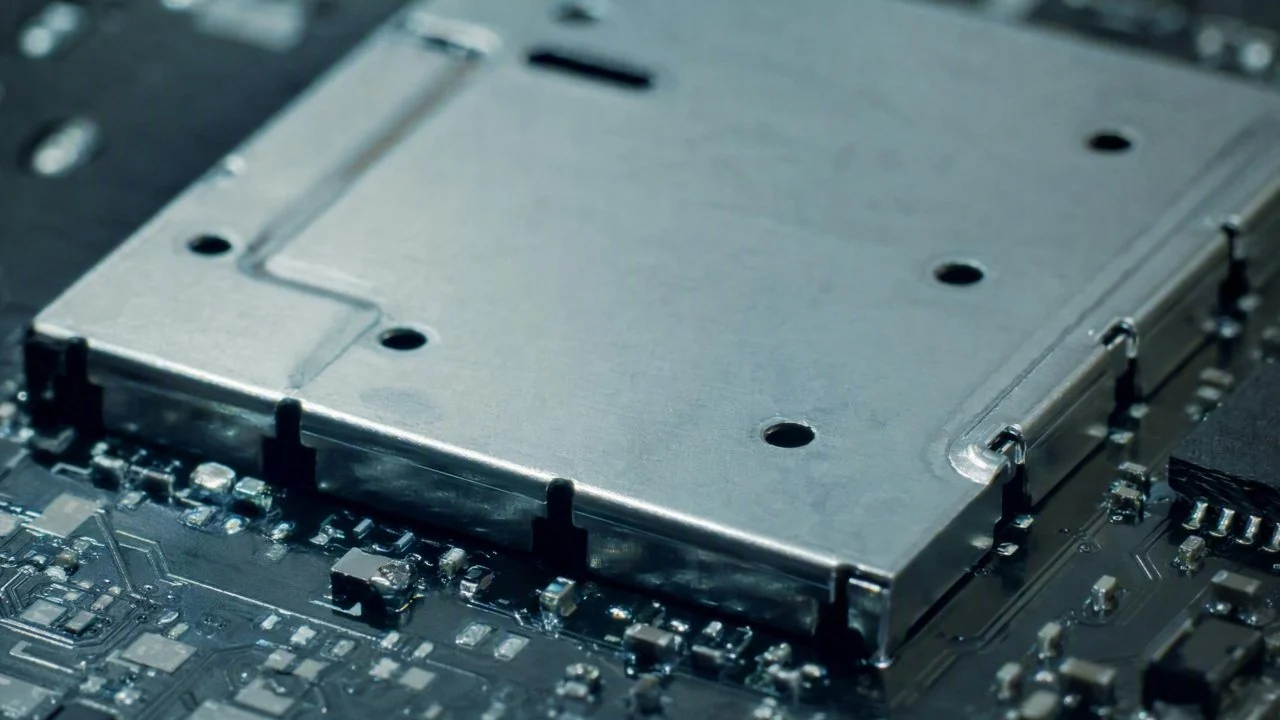
In the electronics industry, the quality inspection of shielding cover mounting is crucial. WeLinkirt provides an efficient inspection solution for a leading electronics manufacturer with advanced AI vision technology.
User Scenario: In the PCBA production line of a leading electronics manufacturer, the shielding cover mounting process is a critical step. The products are PCBA boards for various electronic devices, and the inspection object is the mounted shielding cover. It is necessary to ensure that the shielding cover is accurately positioned, well-attached, and free of obvious defects such as offset and edge warping to guarantee the electromagnetic shielding performance and overall quality of the electronic devices.
Pain Points: The traditional manual re-judgment method has many quantitative dilemmas. The miss-detection rate is relatively high. Due to factors such as fatigue during manual inspection, about 2.5% of defective products flow into subsequent processes. The false-alarm rate reaches about 30%, and a large number of false-alarm messages increase the workload of manual re-inspection. In terms of labor cost, each production line needs to be equipped with multiple inspectors, resulting in high labor input. The model-changing time is long. When the product model changes, it takes about 30 minutes to manually adjust the inspection standards and processes, seriously affecting production efficiency. In addition, in the case of insufficient samples, manual inspection is difficult to ensure high-precision defect classification, and it is easy to misjudge some minor defects.
Technical Principle
WeLinkirt's technology uses advanced AI algorithms and imaging techniques. In terms of algorithms, deep-learning algorithms are used to learn and analyze the image features of the shielding cover. Through a large amount of training data, the model learns the characteristic patterns of normal shielding covers and various defective shielding covers. For example, for offset defects, the model can learn the pixel difference features between the shielding cover and the standard position; for edge-warping defects, the model can recognize the irregular shape features of the edge. In terms of imaging, a self-developed 3D camera is used for image acquisition, which can obtain the three-dimensional morphology information of the shielding cover. The three-dimensional morphology reconstruction technology can convert the collected image data into an accurate three-dimensional model, so as to more accurately detect hidden solder joints, coplanarity, and micron-level morphological changes. This technology is effective because it combines the intelligent analysis ability of the AI algorithm with the high-precision data acquisition ability of 3D imaging, and can comprehensively and accurately identify various defects of the shielding cover.
- The deep-learning algorithm learns the image features to improve the accuracy of defect identification.
- The self-developed 3D camera acquires three-dimensional morphology information to detect hidden defects.
- The three-dimensional morphology reconstruction technology converts the image data into an accurate model for micron-level detection.
- Combining the AI algorithm and 3D imaging technology, comprehensively and accurately identify various types of defects.
WeLinkirt's Solution and Product Introduction
WeLinkirt provides the DaoAI ACI (AI-AOI) software system and the DaoAI 2D / 3D ACI equipment. The DaoAI ACI OS has a powerful feature recognition ability. Based on the visual basic model, a non-defective product can be automatically programmed without code in only 5 minutes. Using the APDT positive-sample/few-sample learning technology, only 1 - 20 non-defective products are needed as samples, and the model can learn the features of normal products, thus effectively identifying defective products. At the same time, the semantic false-alarm filtering function can greatly reduce the false-alarm rate. The DaoAI 2D / 3D ACI equipment is equipped with a self-developed 3D camera. Through the three-dimensional morphology reconstruction technology, it can detect hidden solder joints, coplanarity, and micron-level morphology. In actual implementation, the equipment is installed at the inspection station of the shielding cover mounting process to collect the image data of the shielding cover, and then the software system analyzes and makes judgments to achieve automated inspection.
WeLinkirt's AI vision solution brings an efficient and accurate new experience to the shielding cover mounting inspection in the electronics industry.
Quantitative Results: After introducing WeLinkirt's solution, remarkable results have been achieved. The detection rate has been increased to 99.2%, and the miss-detection rate has been reduced to <0.8%, greatly reducing the risk of defective products flowing into subsequent processes. The false-alarm rate has been reduced by 65%, effectively reducing the workload of manual re-inspection. The model-changing time has been shortened from the original 30 minutes to 5min, significantly improving production efficiency.
FAQ
What solutions does DaoAI provide for the inspection of shielding cover mounting in the electronics industry?
DaoAI provides the DaoAI ACI OS and DaoAI 2D / 3D ACI equipment. The former can perform automatic programming, identify defects and reduce false alarms, while the latter is equipped with a self-developed camera to detect hidden solder joints, etc.
What problems exist in the traditional manual re-judgment of shielding cover mounting?
Traditional manual re-judgment has a missed detection rate of about 2.5% and a false alarm rate of about 30%. It has high labor costs, long change-over time of about 30 minutes. It's difficult to ensure high-precision defect classification with insufficient samples and prone to misjudge minor defects.
What is the technical principle of DaoAI?
DaoAI uses advanced AI algorithms and imaging technology. Deep learning algorithms learn image features, a self-developed 3D camera obtains three-dimensional information, and 3D morphology reconstruction technology converts accurate models to comprehensively and accurately identify defects.
Full solution for this scenario: the full inspection solution for Electronics / PCBA
This article was generated by AI. Customer cases are simulated scenarios based on real product capabilities and figures are illustrative; see product pages for official benchmarks.