
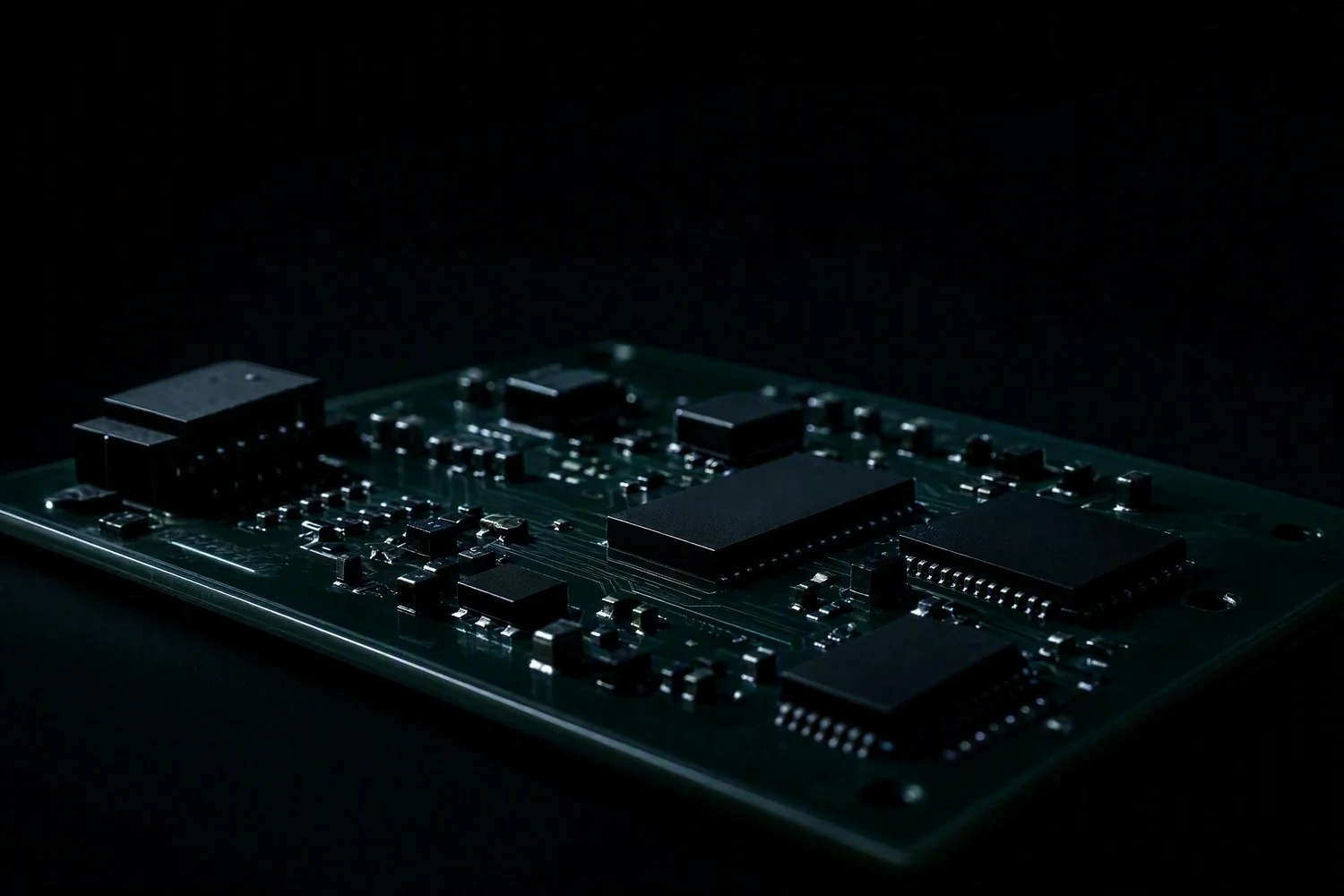
In the electronics PCBA industry, BGA void inspection is crucial. DaoAI provides an efficient and accurate inspection solution for this industry with advanced AI technology.
User scenario: In the high-speed production line of a leading electronics PCBA manufacturer, there is an X-ray inspection process for ball grid arrays (BGAs) on printed circuit board assemblies (PCBA). As an important packaging form, the internal voids of BGA directly affect the performance and reliability of the product. Therefore, the detection object is the void defects inside the BGA.
Pain points: Traditional inspection methods face many quantitative dilemmas on high-speed production lines. First, the missed detection rate is relatively high, about 4%, which means that a considerable number of products with void defects will enter the market, bringing potential quality risks. Second, the false alarm rate cannot be ignored, reaching 30%. This not only increases the subsequent manual re-inspection workload but also reduces the production efficiency of the production line. In addition, the labor cost is high, requiring a large number of manual inspections and re-inspections. Moreover, when the product is changed, the traditional method needs a long time to adjust the parameters, and the changeover time is as long as 30 minutes, seriously affecting the flexibility and production progress of the production line.
Technical Principle
DaoAI uses advanced AI algorithms and imaging technologies to solve these problems. In terms of algorithms, deep learning algorithms are used to learn and train a large number of BGA X-ray images, which can accurately identify void defects of different sizes, shapes, and positions. Through feature extraction and analysis of the images, the algorithm can distinguish real defects from normal image features, thereby effectively reducing the false alarm rate. In terms of imaging, a high-resolution X-ray imaging device is used to clearly capture the fine internal structure of the BGA, providing high-quality image data for the algorithm. At the same time, combined with 3D topography reconstruction technology, the BGA can be observed and analyzed from multiple angles, further improving the accuracy of detection. The reason why this technical principle is effective is that the deep learning algorithm has a powerful feature learning ability, which can continuously optimize and improve the detection model to adapt to different types of void defects. The high-resolution imaging device and 3D topography reconstruction technology provide richer and more accurate image information for the algorithm, making the detection results more reliable.
- The deep learning algorithm learns and analyzes image features to improve the defect recognition ability.
- The high-resolution X-ray imaging device provides clear image data for algorithm processing.
- The 3D topography reconstruction technology observes the BGA from multiple angles to enhance the detection accuracy.
- The algorithm is continuously optimized and improved to adapt to different types of void defects.
DaoAI Solution and Products
DaoAI provides the DaoAI ACI (AI-AOI) software system and the DaoAI 2D / 3D ACI device to solve the BGA void X-ray inspection problem. The DaoAI ACI OS has a powerful feature recognition ability. Based on the visual basic model, it can realize 0-code automatic programming in 5 minutes for a good product. Through APDT positive sample/few-sample learning (only 1 - 20 good products are needed), an accurate detection model can be quickly established. At the same time, the semantic false alarm filtering function can effectively reduce the false alarm rate. The DaoAI 2D / 3D ACI device has a self-developed 3D camera. Combined with 3D topography reconstruction technology, it can detect hidden solder joints, coplanarity, and micron-level topography, providing a more comprehensive and accurate solution for BGA void inspection. In terms of implementation, these two products are integrated into the production line and deployed through SDK / API / Docker, supporting 100% local privatization to ensure that the data does not leave the factory.
DaoAI's products and solutions have brought efficient and accurate changes to the BGA void inspection in the electronics PCBA industry.
Quantitative results: After adopting DaoAI's solution, significant results have been achieved. The detection rate has increased from the original 96% to 99.2%, and the missed detection rate has been reduced to <0.8%, greatly reducing the risk of defective products entering the market. The false alarm rate has been reduced by 70%, from 30% to 9%, effectively reducing the manual re-inspection workload and improving the production efficiency of the production line. The changeover time has been shortened from the original 30 minutes to 5 minutes, improving the flexibility and production progress of the production line.
FAQ
What solutions does DaoAI provide for BGA void X-ray detection in the electronic PCBA industry?
DaoAI offers an efficient and accurate solution for BGA void detection in the electronic PCBA industry, with a 99.2% detection rate, a 70% reduction in false-alarm rate, and a 5-minute change-over time. It includes the DaoAI ACI OS and DaoAI 2D / 3D ACI equipment.
What are the pain points of traditional BGA void detection methods?
Traditional methods face many difficulties on high-speed production lines. The missed-detection rate is about 4%, and the false-alarm rate reaches 30%, increasing the workload of manual re-inspection, reducing efficiency, and having high labor costs. A 30-minute change-over time affects flexibility and progress.
What is the technical principle of DaoAI's solution?
It uses advanced AI algorithms and imaging technologies. The deep-learning algorithm learns image features, the high-resolution X-ray imaging device provides data, combined with 3D topography reconstruction technology. The algorithm is continuously optimized to improve detection accuracy.
Full solution for this scenario: Electronics / PCBA industry solutions
This article was generated by AI. Customer cases are simulated scenarios based on real product capabilities and figures are illustrative; see product pages for official benchmarks.