
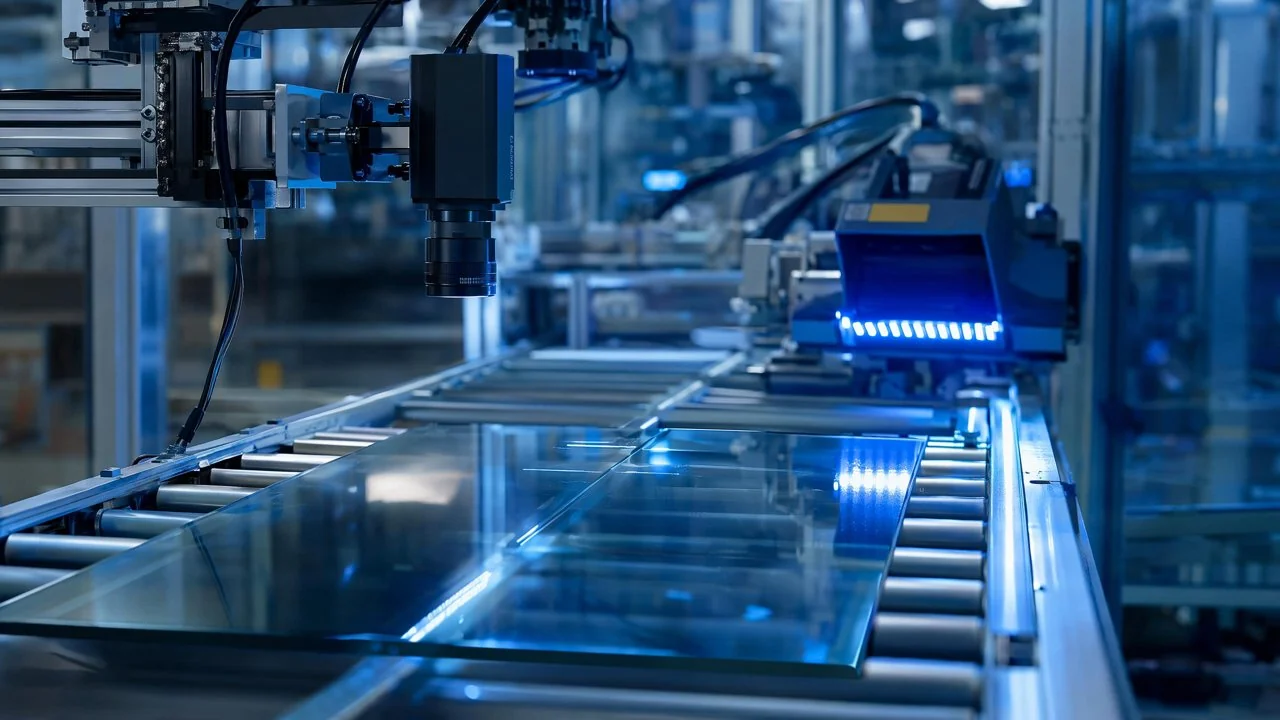
As an important product in the chemical materials industry, the surface quality of glass directly affects its performance and market acceptance. WeLinkirt's ACI OS brings new breakthroughs to glass surface defect detection with advanced technology.
In the chemical materials industry, glass is an important and widely used material. It is not only used in the construction field to provide lighting and decoration for buildings but also plays a crucial role in the optical field, such as manufacturing precision equipment like lenses and displays. However, the surface quality of glass is of great importance for its final performance. For example, small scratches on architectural glass may affect its aesthetics and safety, while bubbles or impurities on the surface of optical glass may seriously degrade its optical performance, leading to problems like blurred imaging and light scattering. A leading manufacturer in the chemical materials industry has a glass production line that mainly produces various types of optical glass and architectural glass. During the production process, it is necessary to detect defects such as small scratches, bubbles, and impurities on the glass surface to ensure that the product quality meets the standards.
Pain Points: Why Is It Difficult?
When using the traditional acoustic emission acquisition system combined with AI signal-processing technology for industrial visual quality inspection, the manufacturer faces many difficulties. In terms of quantitative indicators, in the case of few samples, the miss-detection rate of traditional algorithms is as high as 5%. This means that 5 out of every 100 products may be unqualified and flow into the market, increasing the after-sales cost and brand risk of the enterprise. The false-alarm rate reaches 10%. A large number of false alarms require manual re-inspection, consuming a lot of manpower and time. In addition, the model-changing time is as long as 30 minutes, which means that when switching to produce glass of different specifications, the production line needs to be shut down for a long time to wait for the detection system to be reprogrammed and debugged, seriously affecting the continuity and efficiency of production.
The root cause of these problems is that the number of glass defect samples is small, and traditional algorithms have difficulty accurately learning defect features. Traditional algorithms usually require a large number of defect samples for training to establish an accurate model. However, in actual production, the occurrence of glass defects is random and diverse, making it difficult to collect enough defect samples. Moreover, small defects on the glass surface are often very similar to normal textures, and traditional algorithms have difficulty distinguishing these subtle differences, resulting in a high miss-detection and false-alarm rate.
Technical Principle
The ACI OS from WeLinkirt uses an advanced visual foundation model for feature recognition. Based on deep-learning algorithms, this model can automatically extract feature information such as the texture and shape of the glass surface. Compared with traditional methods, which may simply perform threshold processing or edge detection on images without in-depth understanding of the glass surface features, the visual foundation model can perform high-precision recognition and analysis of the microscopic features of the glass surface, and even small defects can be accurately captured.
The system uses the APDT positive-sample/few-sample learning algorithm. With only 1-20 good glass samples, it can quickly learn the characteristic distribution of normal glass. This is because the algorithm can quickly establish a feature model of normal samples by learning from a small number of good products. When encountering a defect, it can accurately identify the anomaly by comparing it with the normal features. Traditional algorithms often cannot establish an effective model with few samples, while the APDT algorithm overcomes this problem. At the same time, the semantic false-alarm filtering technology can effectively filter false alarms according to the semantic information of defects, such as the size, location, and morphology of the defect. This filtering method combines deep learning and semantic analysis, can make judgments based on the actual situation of the defect, and avoid false alarms caused by factors such as noise. It not only reduces the workload of manual re-inspection but also improves the accuracy of detection. The model uses a combination of unsupervised learning and supervised learning, further improving the detection ability for unknown defects. Unsupervised learning can automatically discover patterns and rules in the data, while supervised learning can use known defect samples for training. The combination of the two enables the system to better adapt to various complex defect situations.
Typical Application Scenarios
- Small scratch detection: During the glass production process, small scratches may occur on the glass surface due to mechanical friction. These scratches are usually very fine and difficult to detect with the naked eye. The ACI OS from WeLinkirt analyzes the texture of the glass surface through the visual foundation model and can accurately identify the location and length of the scratches. The difficulty lies in that the features of scratches are similar to the normal texture of the glass surface, and the system needs to have high-precision feature extraction and analysis capabilities.
- Bubble detection: Bubbles in glass can affect its optical performance and strength. The system uses a self-developed 3D camera to achieve three-dimensional shape reconstruction and detect the size, location, and depth of bubbles. The difficulty is that bubbles inside the glass may present different shapes, and the contrast with the surrounding glass is low. The 3D camera needs to have high resolution and high sensitivity.
- Impurity detection: Impurities on or inside the glass surface may cause light scattering, affecting the imaging quality of optical glass. The system analyzes the color and grayscale information of the glass surface to identify the presence of impurities. The difficulty is that the color and shape of impurities may be similar to the color and texture of the glass itself, and the system needs to have strong image recognition and classification capabilities.
- Surface flatness detection: The surface flatness of glass is crucial for its optical performance and appearance quality. The system detects the micron-level shape changes on the glass surface through the 3D camera to determine whether the surface is flat. The difficulty lies in the need for high-precision 3D imaging technology and data-processing capabilities to detect small flatness deviations.
Implementation Case
A leading manufacturer in the chemical materials industry has a large-scale glass production line. Before introducing the ACI OS from WeLinkirt, the manufacturer faced problems such as high miss-detection rate, high false-alarm rate, and long model-changing time caused by traditional detection methods. During the implementation process, the WeLinkirt team first conducted a detailed investigation and analysis of the manufacturer's production process and detection requirements, and then customized the system according to the actual situation. After simple training, the operators can use the system proficiently for detection. After the system was launched, its performance was satisfactory.
WeLinkirt's ACI OS brings new changes to glass detection in the chemical materials industry with its efficient few-sample learning ability and accurate defect detection technology.
WeLinkirt's Solution and Products
Centered around the ACI OS, it has the ability of 0-code automatic programming in 5 minutes. Operators do not need to write complex codes. They can quickly complete programming with simple operations and achieve rapid model-changing of the system, which greatly improves the flexibility and adaptability of the production line. At the same time, the system supports 100% local private deployment of SDK/API/Docker, and the data does not leave the factory, ensuring the security of enterprise data. In practical applications, the system can cooperate with the DaoAI 2D/3D ACI equipment to conduct all-around detection on the glass surface. The self-developed 3D camera of the DaoAI 2D/3D ACI equipment can achieve three-dimensional shape reconstruction, detect hidden solder joints, coplanarity, micron-level morphology, etc., and provide more abundant detection data for the ACI OS.
Quantitative results: After introducing the ACI OS from WeLinkirt, the detection rate of glass surface defects of the manufacturer increased to 98%, the miss-detection rate decreased to <2%, and the false-alarm rate decreased by 60%. At the same time, the rapid model-changing ability of the system shortened the model-changing time to 5 minutes, greatly improving the production efficiency of the production line.
FAQ
What is the detection effect of the ACI OS in the case of few samples?
The system uses the APDT positive-sample/few-sample learning algorithm. It can learn the normal features with only 1-20 good glass samples. In this case, the detection rate of glass defects reaches 98%, and the miss-detection rate is <2%. It can effectively handle the situation of few samples and accurately identify defects, with a significant detection effect.
How long is the model-changing time of the system?
The ACI OS has the ability of 0-code automatic programming in 5 minutes. Operators can quickly complete programming with simple operations. This shortens the model-changing time of the system to 5 minutes, greatly improving the model-changing efficiency of the production line.
How is data security guaranteed?
The system supports 100% local private deployment of SDK/API/Docker, and the data does not leave the factory. This means that the enterprise's data will not be transmitted externally, avoiding the risk of data leakage and comprehensively ensuring the security of enterprise data.
Full solution for this scenario: the full inspection solution for Chemical / materials
This article was generated by AI. Customer cases are simulated scenarios based on real product capabilities and figures are illustrative; see product pages for official benchmarks.