
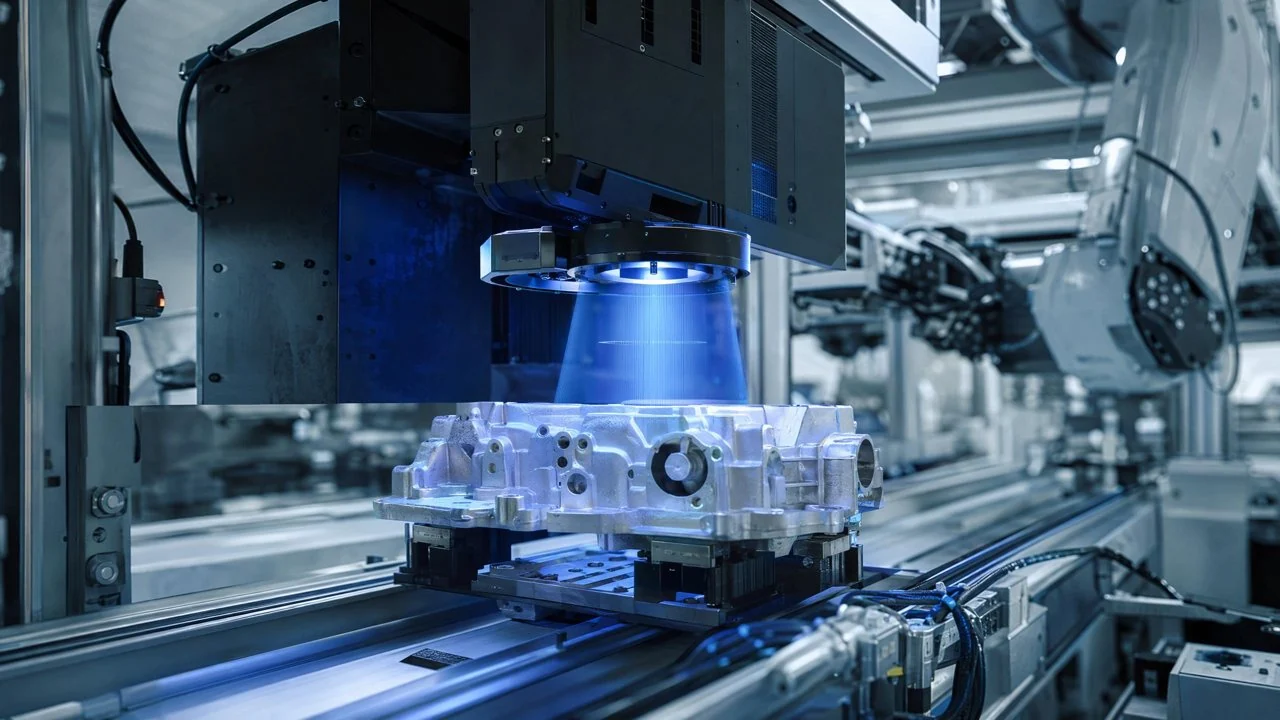
Driven by the wave of intelligent manufacturing, the combination of industrial vision inspection and world model technology has become an important way to improve the accuracy of defect detection. WeLinkirt's 3D ACI equipment plays a crucial role in the inspection of aluminum die-castings in the automotive/parts industry.
Industry Background and User Scenarios: In today's trend of intelligent manufacturing, industrial production has increasingly high requirements for product quality, especially in the automotive/parts industry. As the main means of modern transportation, the quality of automotive parts is directly related to the safety and reliability of the whole vehicle. A leading automotive parts supplier has an aluminum die-casting production line mainly producing aluminum die-castings for key parts such as automobile engines. X-ray porosity and inclusion defects inside these aluminum die-castings may seriously affect the strength and reliability of automotive parts, and thus pose potential threats to the performance and safety of the whole vehicle. Therefore, high-precision defect detection of aluminum die-castings is crucial.
Pain Points: Why is it Difficult?
Traditional inspection methods face many quantitative dilemmas in the inspection of aluminum die-castings. In terms of the missed-detection rate, the missed-detection rate of traditional methods is relatively high, about 4%. This means that some defective aluminum die-castings may flow into subsequent processes, bringing great risks to product quality. Once these defective parts are used in cars, they may cause malfunctions during driving and even endanger the lives of passengers.
In terms of the false-alarm rate, the false-alarm rate of traditional inspection methods is as high as 35%. Frequent false alarms not only require a large amount of manpower for re-inspection, increasing labor costs, but also reduce production efficiency. Every false alarm means that the production line may need to be suspended, and workers need to re-inspect and confirm the misjudged products, which will undoubtedly affect the smooth progress of the entire production process.
In addition, the model-changing time of traditional inspection equipment is long, about 30 minutes. In today's rapidly changing market environment, the production of automotive parts needs to continuously adapt to different vehicle models and design requirements. Rapid model-changing is the key to improving the flexibility and response speed of the production line. The overly long model-changing time of traditional equipment obviously cannot meet this demand, resulting in a large amount of time waste during the model-changing process.
The root cause of these problems is that traditional inspection methods have not fully utilized world model technology. World model technology can model and understand complex environments and scenarios, while traditional methods lack this ability, making it difficult to accurately identify and detect complex defects inside aluminum die-castings, resulting in limited inspection accuracy.
Technical Principle
WeLinkirt's 3D ACI equipment uses self-developed 3D cameras and advanced three-dimensional morphology reconstruction/point cloud technology. The self-developed 3D camera can capture the three-dimensional information of aluminum die-castings, providing a rich data basis for subsequent analysis. The three-dimensional morphology reconstruction algorithm accurately reconstructs the real morphology of aluminum die-castings based on this data. Point cloud technology represents the three-dimensional coordinate information of the object surface in the form of points. Through the analysis of these point cloud data, hidden solder joints, coplanarity, micron-level morphology, and porosity and other 2D optical blind-spot defects can be clearly identified.
Compared with the traditional 2D inspection method, 2D inspection can only obtain the planar information of the object, and it is difficult to detect internal defects such as porosity and inclusions. The 3D technology can observe the object from multiple dimensions, thus effectively detecting these hidden defects. At the same time, the equipment uses 2D-3D fusion technology, combining the texture information of 2D images and the depth information of 3D models to further improve the accuracy of defect detection.
Typical Application Scenarios
- Porosity detection of aluminum die-castings for automobile engines: Porosity is one of the common defects in aluminum die-castings. Traditional methods are difficult to accurately determine the size and location of porosity. The 3D ACI equipment can observe the casting from multiple angles through point cloud technology and 2D-3D fusion technology to accurately detect the size and location of porosity. The difficulty lies in that the irregular shape and distribution of porosity may affect the accuracy of detection.
- Inclusion defect detection of aluminum die-castings for automobile gearboxes: Inclusion defects may affect the performance and reliability of gearboxes. The equipment uses the self-developed 3D camera to obtain three-dimensional information and restores the real morphology of the casting through the three-dimensional morphology reconstruction algorithm to detect inclusion defects. The difficulty lies in that the material difference between inclusions and the casting body is small, making it difficult to distinguish.
- Hidden solder joint detection of aluminum die-castings for automobile braking systems: The detection of hidden solder joints is crucial for the safety of the braking system. The point cloud technology of the 3D ACI equipment can accurately identify the position and quality of hidden solder joints, while traditional 2D inspection methods may miss these solder joints. The difficulty lies in that the position of hidden solder joints is relatively hidden, requiring high-precision inspection technology.
- Coplanarity detection of aluminum die-castings for automobile suspension systems: Deviations in coplanarity may affect the stability of the suspension system. The equipment can accurately detect coplanarity through 3D technology to ensure that the casting meets the design requirements. The difficulty lies in that the detection of coplanarity requires high-precision three-dimensional measurement and analysis.
- Micron-level morphology detection of aluminum die-castings for automobile wheels: The surface quality of wheels has an important impact on the driving performance and safety of cars. The 3D ACI equipment has a micron-level detection accuracy and can detect tiny defects on the wheel surface. The difficulty lies in that micron-level defects are very small and require high-resolution imaging and accurate data analysis.
Implementation Case
A large-scale automotive parts supplier with multiple factories around the world produces a large number of automotive aluminum die-castings every year. The supplier previously used traditional inspection methods but faced problems such as high missed-detection rate, high false-alarm rate, and long model-changing time. After cooperating with WeLinkirt, it introduced the 3D ACI equipment. During the implementation process, WeLinkirt's technical team programmed using the DaoAI ACI OS according to the customer's specific needs and product characteristics, and completed the 0-code automatic programming in 5 minutes with only one good sample. Before the implementation, the supplier's missed-detection rate was 4%, the false-alarm rate was 35%, and the model-changing time was 30 minutes. After the implementation, the detection rate increased to 96%, the missed-detection rate decreased to < 4%, the false-alarm rate decreased by 70%, and the model-changing time was shortened to 5 minutes.
The 3D ACI equipment brings an efficient and accurate solution to the inspection of aluminum die-castings for automotive parts, significantly improving production quality and efficiency.
WeLinkirt's Solution and Products
Centered on the 3D ACI equipment, it has high-precision detection capabilities and can detect micron-level porosity and inclusion defects inside aluminum die-castings. In terms of implementation, first, according to the customer's specific needs and product characteristics, the DaoAI ACI OS is used for programming. This software system has the feature recognition ability of the visual basic model. It can complete 0-code automatic programming in 5 minutes with only one good sample, and uses APDT positive-sample/few-sample learning (1-20 good samples), greatly reducing programming time and cost. At the same time, combined with the DaoAI World model, semantic understanding, cross-scenario generalization, and continuous learning from production-line feedback are realized to further improve the detection accuracy and adaptability.
Quantitative Results: After practical application, the 3D ACI equipment has achieved remarkable results. The detection rate has increased to 96%, the missed-detection rate has decreased to < 4%, effectively reducing the risk of defective products flowing into subsequent processes. The false-alarm rate has decreased by 70%, greatly reducing the workload of manual re-inspection and improving production efficiency. The model-changing time has been shortened to 5 minutes, meeting the production demand for rapid model-changing and improving the flexibility of the production line.
FAQ
How small porosity defects can the 3D ACI equipment detect?
The 3D ACI equipment has a micron-level detection accuracy and can detect micron-level porosity and inclusion defects inside aluminum die-castings. This high-precision detection ability effectively guarantees product quality and avoids product quality problems caused by undetected minor defects.
How many samples are needed for programming when using this equipment?
Using the DaoAI ACI OS and APDT positive-sample/few-sample learning, only 1-20 good samples are required. One good sample can complete 0-code automatic programming in 5 minutes, greatly reducing programming time and cost and improving the equipment's usage efficiency.
What are the advantages of this equipment compared with traditional inspection methods?
Compared with traditional inspection methods, the 3D ACI equipment has significant improvements in the missed-detection rate, false-alarm rate, and model-changing time. Its detection rate has increased to 96%, the false-alarm rate has decreased by 70%, and the model-changing time has been shortened to 5 minutes. It can more accurately and efficiently detect various defects in aluminum die-castings.
Full solution for this scenario: the full inspection solution for Automotive / parts
This article was generated by AI. Customer cases are simulated scenarios based on real product capabilities and figures are illustrative; see product pages for official benchmarks.