
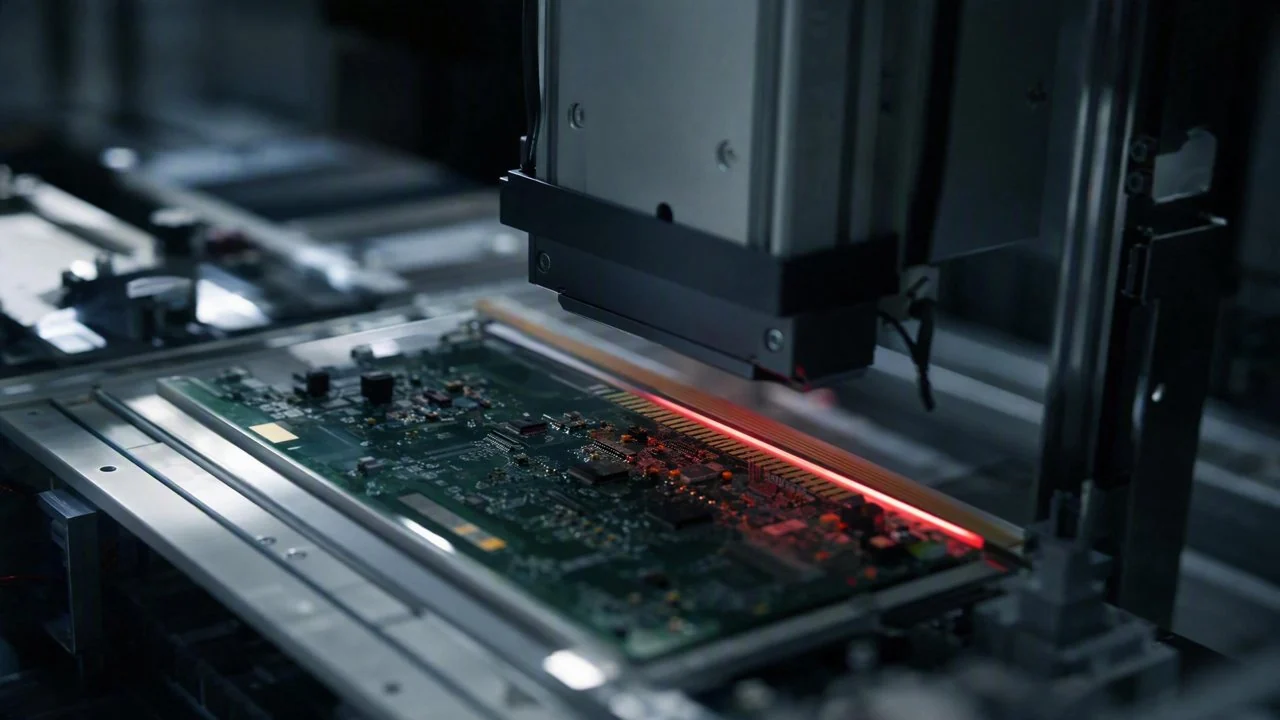
DaoAI's 2D AI AOI equipment (high-resolution 2D imaging + deep learning secondary judgment, targeting surface/print/OCR/assembly defects, high-speed inline full inspection, micron-level precision, semantic false alarm filtering) precisely identifies PCBA gold finger scratches and oxidation defects with intelligent data management, reducing false-alarm-induced manual re-inspection rates from a historical average of 25% to <3%. This establishes an efficient quality traceability and data closed-loop system for electronics manufacturers.
DaoAI's 2D AI AOI equipment (high-resolution 2D imaging + deep learning secondary judgment, targeting surface/print/OCR/assembly defects, high-speed inline full inspection, micron-level precision, semantic false alarm filtering) precisely identifies PCBA gold finger scratches and oxidation defects with intelligent data management, reducing false-alarm-induced manual re-inspection rates from a historical average of 25% to <3%. This establishes an efficient quality traceability and data closed-loop system for electronics manufacturers. In the electronics manufacturing industry, PCBA (Printed Circuit Board Assembly) is a core component, and its quality directly determines the performance and reliability of end products. Particularly in the connector area, such as gold fingers, their surface integrity is crucial. Scratches or oxidation on gold fingers not only affect conductivity but can also lead to poor contact, signal interruption, and even early product failure. A leading PCBA manufacturer, whose products are widely used in high-reliability fields like communications and automotive electronics, had extremely high requirements for the detection accuracy and traceability of gold finger defects. In traditional production processes, planar defects such as gold finger scratches and oxidation primarily relied on manual visual inspection or rule-based AOI equipment. However, with increasing product complexity and production line takt times, these methods gradually revealed problems of inefficiency, high false alarm rates, and inability to effectively trace defects, severely limiting the company's further development.
Pain Points: Why This Hurdle Was Difficult to Overcome
This PCBA manufacturer faced multiple quality inspection challenges. Firstly, gold fingers are critical interfaces for high-speed signal transmission, and even micron-level scratches or slight oxidation on their surface can degrade electrical performance or cause failure. These defects are often difficult to discern with the naked eye, and traditional threshold-based rule-based AOI is highly susceptible to environmental light, product batch variations, and even minor fluctuations in gold layer thickness. This resulted in high missed detection rates or persistently high false alarm rates, which at one point led to a manual re-inspection rate as high as 25%. Secondly, the accelerating production line takt times demanded high-speed inline full inspection capabilities from inspection equipment. Traditional inspection methods often struggled to keep pace, creating production bottlenecks or necessitating sampling strategies, which increased potential quality risks. Thirdly, for SMEs, programming and debugging traditional AOI equipment typically required professional engineers to spend significant time, leading to long downtime for new product changeovers, averaging 2-4 hours per changeover. This severely impacted production flexibility and efficiency. Finally, the lack of effective defect data recording and analysis mechanisms made it difficult to trace quality issues back to specific batches, workstations, or equipment. This meant that quality improvement efforts lacked data support and could not form a closed-loop management system, which was one of the client's biggest pain points.
The root cause of these difficulties lies in the complex and diverse nature of gold finger defects. For example, scratches vary in depth, length, and direction, while oxidation manifests as subtle changes in color and luster. These subtle and varied features make it challenging for traditional rule-based vision algorithms to accurately capture and differentiate between good and defective products. At the same time, the highly reflective surface of gold fingers places extremely high demands on the stability and anti-interference capabilities of the imaging system. Acquiring clear, stable, high-resolution images on a high-speed production line is itself a major challenge. Furthermore, prolonged, high-intensity manual inspection leads to human fatigue, resulting in poor consistency and high missed detection rates, and cannot meet the demands of high-takt production. These factors collectively constitute the 'difficult hurdle' in PCBA gold finger defect inspection.
Technical Principles
DaoAI's 2D AI AOI equipment fundamentally solves the challenges of gold finger scratch and oxidation detection by combining high-resolution 2D imaging technology with deep learning secondary judgment algorithms. Its core technology involves: Firstly, utilizing customized high-resolution industrial cameras and precision optical systems, complemented by multi-angle, programmable annular or linear light sources. This effectively suppresses high reflections on the gold finger surface, capturing micron-level scratch details and changes in color and texture of oxidized areas, ensuring high-quality raw image data input. Secondly, at the image processing level, the DaoAI AI AOI software system integrates a self-developed deep learning vision foundation model. This model, trained on massive industrial defect data, possesses powerful feature extraction and pattern recognition capabilities. It learns complex features of both normal and abnormal states of gold fingers and automatically differentiates various types of scratches (e.g., minor scratches, deep scratches) and oxidation (e.g., slight discoloration, large-area oxidation). Compared to traditional rule-based AOI, which relies on manually set thresholds and features, DaoAI's deep learning algorithm adaptively handles image noise, background variations, and product tolerances, significantly reducing false alarm rates and ensuring a stable detection rate of over 99.6% for true defects. Particularly, its semantic false alarm filtering function effectively identifies and eliminates false alarms caused by non-defect features (such as dust, fingerprints), further reducing the burden of manual re-inspection.
Compared to traditional inspection methods, DaoAI's 2D AI AOI equipment offers significant advantages. Traditional manual visual inspection is limited by human eye recognition capabilities and fatigue, leading to poor consistency and inability to meet high-takt production demands. Rule-based traditional AOI, while automated, has poor algorithm flexibility, weak adaptability to new defect types or process fluctuations, and is prone to generating a large number of false alarms, leading to frequent production line downtime for re-inspection. In contrast, DaoAI's 2D AI AOI, leveraging its deep learning capabilities, achieves 'zero-code rapid changeover' and 'few-shot learning' (APDT), requiring only 1-20 good product images to complete model training for new products. This reduces changeover time from several hours to less than 5 minutes, greatly enhancing production line flexibility and efficiency. Furthermore, its powerful data processing capabilities provide a solid foundation for quality traceability and a closed data loop, which is difficult to achieve with traditional methods.
Typical Application Scenarios
- **PCBA Gold Finger Surface Scratch Detection:** DaoAI's 2D AI AOI equipment accurately identifies various scratches on the gold finger surface. Whether micron-level minor scratches or deep scratches, they can be effectively distinguished through high-resolution imaging and deep learning algorithms. The challenge lies in the highly reflective nature of gold fingers and the diversity of scratch morphologies.
- **Gold Finger Oxidation Discoloration Detection:** The equipment analyzes changes in color and luster on the gold finger surface to accurately determine the presence of oxidation. Even early-stage oxidation imperceptible to the naked eye can be identified by the AI model. The challenge lies in subtle differences in oxidation levels and the influence of ambient light.
- **Solder Pad Surface Foreign Object and Contamination Detection:** Beyond gold fingers, DaoAI's 2D AI AOI can also detect foreign objects, solder balls, flux residue, and other contaminants on PCBA solder pads. Through multispectral imaging and deep learning, it differentiates foreign objects of various materials, preventing impacts on soldering quality. The challenge lies in the minute size of foreign objects and their low contrast with the background.
- **Character OCR and Missing/Misplaced Component Detection:** For silkscreen characters, component models, and other markings on PCBA, the equipment performs high-precision OCR to verify character content accuracy and clarity, and detects assembly defects such as misplaced, missing, or reversed components. The challenge lies in the diversity of character fonts, unstable print quality, and variations in component sizes.
- **BGA/QFN Package Bottom Defect Inspection:** While 2D AOI primarily targets planar defects, with specific lighting and imaging angles, DaoAI's 2D AI AOI can also assist in detecting planar visible defects such as solder ball overflow and bridging at the edges of BGA/QFN packages. The challenge lies in limited viewing angles and the concealed nature of defects.
Case Study
A medium-sized PCBA contract manufacturer, specializing in high-reliability products for industrial control. Before adopting DaoAI's 2D AI AOI equipment, their PCBA gold finger scratch and oxidation inspection primarily relied on manual visual inspection and an outdated rule-based AOI system. Due to a wide variety of products and frequent small-batch production, each new product launch or changeover required senior engineers to spend several hours adjusting parameters on the rule-based AOI, leading to long production line downtime for changeovers, averaging 2.5 hours per changeover. More critically, the rule-based AOI had a false alarm rate as high as 25%, meaning one-quarter of each product batch required secondary manual re-inspection, which heavily consumed human resources and made consistency difficult to guarantee. Furthermore, defect data was stored only as images, lacking structured information, preventing effective quality traceability and root cause analysis. The client urgently needed an intelligent solution that could improve inspection efficiency, reduce false alarms, and support quality traceability.
The DaoAI team addressed the client's pain points by deploying multiple 2D AI AOI devices and deeply integrating them with the client's MES system. During the implementation, DaoAI engineers guided the client in utilizing the APDT few-shot learning function, which enabled model training for new products within 5 minutes by collecting only 10-20 images of good gold fingers. After deployment, the results were immediate: the manual re-inspection rate significantly dropped from 25% to <3%, freeing up nearly 80% of re-inspection personnel; changeover time per line was reduced from an average of 2.5 hours to <5 minutes, significantly improving line utilization and production flexibility. More importantly, the DaoAI 2D AI AOI system recorded every detected defect with a timestamp, workstation information, defect type, and image data, uploading it in real-time to the client's MES system, thus establishing a complete quality traceability chain. When batch quality issues arose, the client could quickly use data analytics to pinpoint specific batches and production stages for precise root cause investigation and improvement. This closed-loop data management model greatly enhanced the client's quality management capabilities and market competitiveness.
"DaoAI's 2D AI AOI not only solved our gold finger inspection challenges but also built a complete quality traceability system, enabling truly data-driven and intelligent management of our production process. This represents a qualitative leap in our quality management."
DaoAI Solutions and Products
The core solution provided by DaoAI to this client was based on its powerful 2D AI AOI equipment. This equipment integrates a high-resolution vision module, an intelligent lighting system, and DaoAI's self-developed DaoAI AI AOI software system. For model building, the DaoAI AI AOI software system utilizes APDT (Anomaly Pattern Detection Technology) positive-sample/few-shot learning, which requires no large number of defect samples. It can quickly train high-precision models with just 1-20 good product images, greatly simplifying the model deployment and iteration process. For complex and varied defects like gold finger scratches and oxidation, its deep learning algorithm automatically extracts features, achieving micron-level defect identification. For changeovers, thanks to zero-code automatic programming and few-shot learning, the changeover time for new products or batches can be controlled to within 5 minutes, ensuring efficient production line operation.
Regarding deployment and integration, DaoAI's 2D AI AOI equipment supports 100% on-premise private deployment, ensuring customer data security and preventing production information leakage. Through standardized API interfaces, the equipment smoothly integrates with existing customer MES and ERP systems, enabling real-time upload, storage, and analysis of inspection data to build a comprehensive quality traceability system. Every detected defect, whether a gold finger scratch, oxidation, or other planar defect, is meticulously recorded with its location, type, severity, and corresponding image data, forming a traceable digital archive. This data is not only used for real-time alarms and product grading but, more importantly, provides valuable insights for subsequent process optimization, yield improvement, and quality enhancement, truly achieving a closed-loop quality data system from detection to analysis to improvement. Furthermore, the DaoAI World universal model, as a unified foundation, with its semantic understanding and cross-scenario generalization capabilities, allows the system to continuously learn from production line feedback, constantly improving detection accuracy and adaptability, providing ongoing intelligent support for the client's long-term development.
Through the DaoAI 2D AI AOI solution, the client achieved several quantifiable results. Firstly, the detection rate for gold finger scratches and oxidation defects increased to over 99.8%, and the missed detection rate decreased to <0.2%, ensuring product quality reliability. Secondly, thanks to deep learning's semantic false alarm filtering, manual re-inspection volume was reduced by 88%, significantly saving labor costs and time. Thirdly, production line changeover time decreased from an average of 2.5 hours/changeover to <5min/changeover, improving production efficiency by approximately 15%. These achievements not only brought direct economic benefits but, more importantly, by establishing a comprehensive quality traceability and data closed-loop system, the client gained fine-grained control over product quality, enhancing market competitiveness and laying a solid foundation for future smart manufacturing upgrades.
FAQ
How does DaoAI's 2D AI AOI equipment ensure the accuracy and stability of gold finger scratch and oxidation detection?
DaoAI's 2D AI AOI equipment uses a high-resolution 2D imaging system combined with multi-angle intelligent lighting to effectively capture micron-level defects. The core is the deep learning-based DaoAI AI AOI software system, which, by training on vast industrial data, adaptively identifies complex and varied scratch and oxidation features, and includes semantic false alarm filtering, significantly reducing false alarm rates and ensuring a stable detection rate of over 99.8%.
How does DaoAI's 2D AI AOI support quality traceability and data closed-loop for PCBA production?
The equipment supports 100% on-premise private deployment and integrates deeply with MES/ERP systems via standard API interfaces. For every detected defect, the system records detailed location, type, severity, and image data, uploading it in real-time. This structured data forms a complete digital archive, facilitating rapid identification of problem sources, root cause analysis, and continuous improvement, achieving a closed loop from detection to optimized management.
For SMEs, is the deployment and use of DaoAI's 2D AI AOI complex?
No. DaoAI's 2D AI AOI software system features 'zero-code rapid changeover' and APDT few-shot learning, enabling new product model training with just 1-20 good product images, reducing changeover time to under 5 minutes. The intuitive interface significantly lowers the reliance on specialized vision engineers, helping SMEs quickly improve inspection efficiency and production flexibility.
This article was generated by AI. Customer cases are simulated scenarios based on real product capabilities and figures are illustrative; see product pages for official benchmarks.