
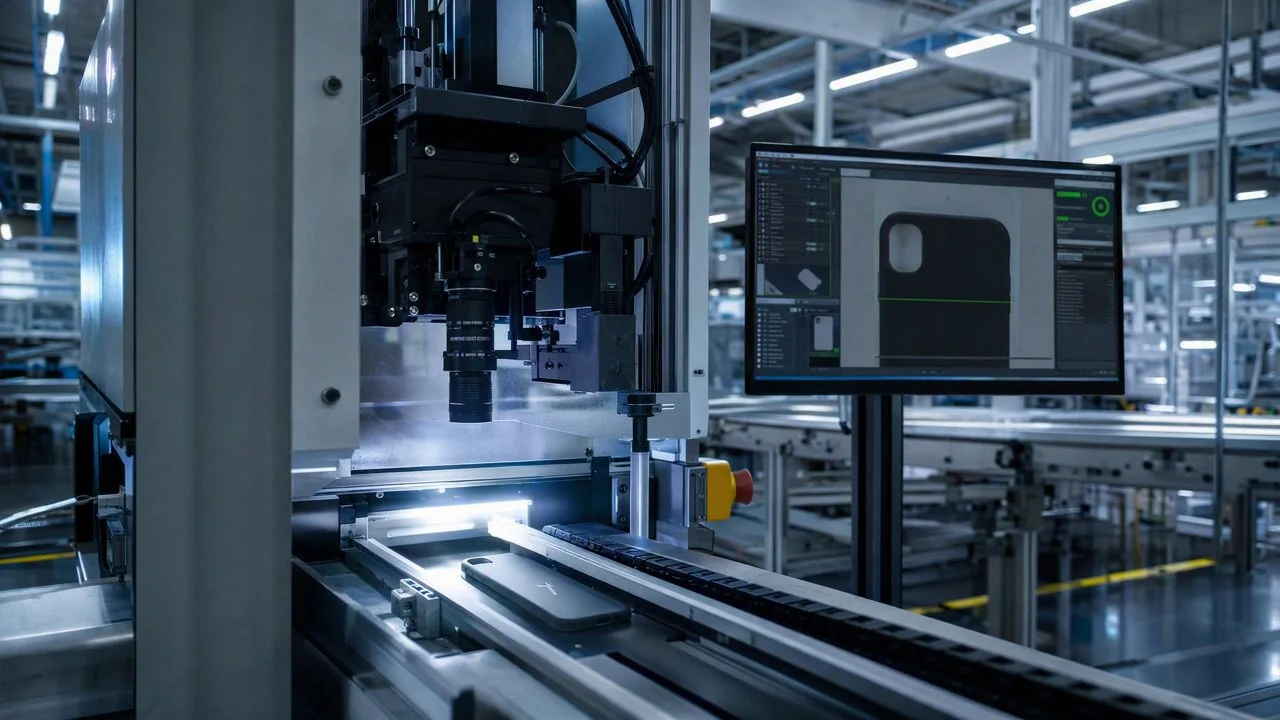
DaoAI 2D AI AOI equipment, utilizing high-resolution 2D imaging and deep learning secondary judgment for planar defects on consumer product body logo silkscreen, achieves high-speed inline full inspection with micron-level recognition. Through semantic false positive filtering, it consistently maintains an undetected defect rate below 0.4%, significantly enhancing the reliability and efficiency of production line quality control.
In consumer product manufacturing, the refinement of product appearance and the accuracy of brand identification are critical for market competitiveness. DaoAI 2D AI AOI equipment (high-resolution 2D imaging + deep learning secondary judgment, for surface/printing/OCR/assembly defects, high-speed inline full inspection, micron-level, semantic false positive filtering) performs inline full inspection of consumer product body logo silkscreen, reducing the undetected defect rate from a typical 2% in manual inspection to below 0.4%, significantly enhancing the quality of outgoing products. Consumer goods, especially electronic consumer products such as smartphones, tablets, and smart wearables, have body logos and functional silkscreen prints that not only embody brand image but are also crucial components of user experience. These silkscreen prints typically use precise ink printing processes, requiring clear patterns, neat edges, uniform colors, and no breaks, ink spills, misalignments, or smudges. On high-speed production lines, stably and accurately detecting these tiny and diverse planar defects is a core challenge in ensuring product quality consistency.
Pain Points: Why This Hurdle Is Difficult to Overcome
Inspecting consumer product body logo silkscreen presents multiple challenges, making traditional inspection methods inadequate for modern production demands. Firstly, **high undetected defect rates** are a primary pain point. Under manual visual inspection, due to visual fatigue from prolonged work, individual differences, and the difficulty in perceiving micron-level defects, the average undetected defect rate often fluctuates between 1.5% and 2%. Especially for subtle defects like ink particles, edge burrs, or color inconsistencies, human eye recognition is extremely difficult. Secondly, **high false positive rates** also plague production lines. Traditional rule-based AOI systems tend to misinterpret normal product textures or environmental interference as defects when encountering complex backgrounds, reflections, or variations in ink properties, leading to false positive rates as high as 10%–15%, which incurs significant unnecessary re-inspection hours and production line downtime. Furthermore, **inefficient changeovers** are a major bottleneck. The consumer product industry has rapid product iterations; whenever a product model or logo design changes, traditional AOI requires several hours or even half a day for parameter adjustment and reprogramming, severely impacting production takt time. These issues not only directly increase the quality cost per unit but can also damage brand reputation and even lead to compliance risks if defective products enter the market. Coupled with the current potential and challenges of AI smart cameras in simplifying manufacturing inspection processes, the limitations of traditional methods are increasingly apparent, necessitating smarter, more efficient solutions.
The root cause of these difficulties lies in the complexity of the silkscreen printing process itself and the microscopic nature of the inspection objects. The adhesion of silkscreen ink on different substrates, drying speed, and thickness variations all affect the uniformity and edge sharpness of the final pattern. At the same time, consumer product casings come in various materials, including plastic, metal, and glass, whose surface textures, gloss, and curvature can interfere with imaging quality, reducing the contrast between defects and the background, making it difficult to distinguish them using simple thresholding or edge detection algorithms. Moreover, the continuous increase in production takt time demands that inspection systems possess millisecond-level response speeds, rendering any inspection method requiring complex manual intervention or lengthy computations unsuitable.
Technical Principles
The core advantage of DaoAI 2D AI AOI equipment lies in its advanced technical architecture combining **high-resolution 2D imaging** with **deep learning secondary judgment**. On the hardware front, we employ industrial-grade high-resolution cameras and custom lighting modules capable of capturing micron-level silkscreen details, ensuring that the image information is sufficiently rich and accurate. These high-quality raw images form the basis for subsequent AI analysis. On the software front, the DaoAI AI AOI software system is powered by a self-developed visual foundation model, pre-trained on vast amounts of industrial image data, possessing powerful feature recognition capabilities. It can learn and understand subtle differences between 'normal' logo silkscreen forms and 'abnormal' defects. Even minute ink particles, slight color deviations, or edge burrs, which are difficult for the human eye to discern, can be precisely identified. Notably, the **APDT positive/few-shot learning technology** of the Wemio engine allows users to complete 0-code automatic programming and model training in just 5 minutes using only 1–20 good sample images, significantly shortening new product introduction and changeover times. More importantly, its built-in **semantic false positive filtering mechanism** can differentiate between true defects and non-defect features such as background textures or environmental lighting, thereby reducing the false positive rate by over 75%, significantly easing the burden of manual re-inspection.
Compared to traditional rule-based AOI, the advantage of DaoAI 2D AI AOI lies in its **intelligent generalization capability**. Traditional AOI relies on engineers manually setting numerous rules and thresholds, requiring fine-tuning for each defect type and product variant, performing poorly when facing unknown or varied defects. In contrast, DaoAI's deep learning model learns autonomously from data, automatically extracting complex features, and exhibiting stronger robustness to lighting variations and product individual differences, thus achieving higher detection rates and lower false positives. Compared to manual visual inspection, the DaoAI 2D AI AOI system possesses **100% inline full inspection** capability, unaffected by fatigue, with extremely high inspection consistency, and a detection takt time far exceeding manual methods, ensuring efficient production line operation. Furthermore, the DaoAI World model, serving as a unified foundation, enables semantic understanding, cross-scenario generalization, and continuous learning from production line feedback, allowing detection capabilities to continuously optimize with application depth.
Typical Application Scenarios
- **Logo Graphic Integrity and Defect Detection**: Detects whether the logo has breaks, defects, ink spills, ink dots, air bubbles, etc. The difficulty lies in the high complexity of logo graphics, with some defects being tiny and having low contrast with the background, making them prone to being missed by traditional methods. DaoAI 2D AI AOI uses high-resolution imaging and deep learning models to precisely identify these complex and subtle graphic defects.
- **Silkscreen Character Recognition (OCR) and Character Defects**: Performs OCR on text, serial numbers, certification marks within the logo, and detects if characters are blurred, deformed, misaligned, or have missing strokes. The challenge comes from diverse fonts, small character spacing, and potential character edge blur due to poor printing. DaoAI's deep learning model has powerful OCR capabilities and fine-grained recognition of character-level defects.
- **Silkscreen Position and Size Deviation**: Detects X/Y axis offset, rotation angle deviation, and overall size of the logo silkscreen relative to product edges or specific reference points, ensuring compliance with specifications. The difficulty lies in high-precision positioning and micron-level size measurement, especially on high-speed moving production lines. DaoAI 2D AI AOI equipment can achieve sub-millimeter positioning accuracy and provide real-time deviation data.
- **Silkscreen Color Consistency and Contamination**: Detects whether the logo silkscreen color is uniform, if there are color differences, and if the surface has oil stains, dust, fingerprints, or other contaminants. The challenges include changing ambient light, product material reflections, and the recognition of tiny contaminants. DaoAI AI AOI software system effectively distinguishes color anomalies and surface contamination through multi-channel image analysis and deep learning.
- **Multi-layer Silkscreen Alignment Detection**: For complex logos using multi-layer silkscreen processes, detects the alignment accuracy between each layer of patterns. The difficulty lies in the varying transparency, thickness differences of different ink layers, and the subtle misalignments that are hard to perceive. DaoAI 2D AI AOI precisely detects multi-layer silkscreen alignment issues through accurate image registration and feature comparison.
Implementation Case Study
A leading consumer electronics manufacturer, whose smart wearable device production line had long faced challenges with logo silkscreen inspection. Before adopting DaoAI 2D AI AOI equipment, this production line primarily relied on manual visual inspection supplemented by a few rule-based AOI systems. Due to the small product size and fine silkscreen, the manual inspection team required over 20 operators working in shifts during peak periods, yet the undetected defect rate still reached 1.8%, leading to batch reworks and customer complaints. Simultaneously, the false positive rate of rule-based AOI reached 12%, requiring an additional 4 hours of manual re-inspection time daily, severely slowing down the overall production takt time. To address this dilemma, the manufacturer introduced the DaoAI 2D AI AOI solution.
In the initial deployment phase, the DaoAI team collaborated closely with the client, utilizing APDT few-shot learning technology. With only 15 good sample images, the AI model for the first product model was trained and deployed in less than 30 minutes. The system was smoothly integrated into the existing production line, achieving high-speed inline full inspection of 120 pieces per minute. Post-deployment, the effects were immediate: DaoAI 2D AI AOI successfully **reduced the logo silkscreen undetected defect rate to below 0.3%**, far exceeding client expectations, effectively preventing defective products from entering subsequent processes. Concurrently, through the powerful semantic false positive filtering capability of DaoAI, the false positive rate dropped from 12% to below 3%, **reducing manual re-inspection workload by 75%**. The man-hours previously spent on re-inspection were freed up for other value-added production activities. Furthermore, new product changeover time was shortened from several hours to under 5 minutes, greatly enhancing the flexibility and efficiency of the production line. The manufacturer highly praised the performance of DaoAI 2D AI AOI and plans to extend its application to more production lines.
DaoAI 2D AI AOI reduced consumer product logo silkscreen undetected defect rates to <0.3% and false positive rates by −75%, achieving a leap in production line quality control.
DaoAI Solutions and Products
The DaoAI 2D AI AOI solution, centered around its core product—the **DaoAI 2D AI AOI equipment**, provides comprehensive and efficient intelligent inspection capabilities for consumer product logo silkscreen detection. This equipment integrates high-resolution industrial cameras, stable lighting, and high-performance edge computing units, ensuring image acquisition quality and real-time processing capabilities. Its embedded **DaoAI AI AOI software system** serves as the intelligent brain of the solution, achieving precise recognition of various planar defects through advanced deep learning algorithms. Users can leverage its 'one good sample, 5 minutes, 0-code automatic programming' feature to quickly establish new product models. For complex or variable defect types, the **APDT positive/few-shot learning function** allows effective training with only 1–20 good samples, significantly lowering the threshold and time cost for data annotation. In terms of deployment, DaoAI supports various integration methods such as SDK / API / Docker and enables 100% local private deployment, ensuring client data security remains on-site and meeting the stringent data privacy requirements of large manufacturing enterprises. Moreover, **semantic false positive filtering** is a unique advantage of DaoAI, effectively eliminating false positives caused by non-defect factors, such as slight surface textures or environmental light changes, based on an understanding of defect context. This significantly enhances the reliability of inspection results. DaoAI 2D AI AOI equipment not only provides high-precision inspection results but can also smoothly interface with client MES/ERP systems via data ports, enabling quality data traceability and closed-loop management, providing data support for lean manufacturing.
Through the deployment of DaoAI 2D AI AOI equipment, clients can achieve significant business value. Firstly, a **leap in quality stability**, consistently controlling the undetected defect rate at an ultra-low level of <0.4%, greatly reducing the risk of defective products. Secondly, a **significant improvement in production efficiency**, with a 75% reduction in false positive rates meaning a substantial decrease in re-inspection workload, freeing up valuable human resources. Concurrently, the 5-minute rapid changeover time ensures maximized production line utilization. Thirdly, **effective control of operating costs**, reducing reworks, scrap, and customer complaints caused by defective products, directly lowering quality costs. Finally, DaoAI's smart camera technology, as an exemplary application of AI smart cameras in simplifying manufacturing inspection processes, helps enterprises transition from traditional manual inspection to intelligent automated inspection, building a more competitive intelligent manufacturing system.
FAQ
What is 2D AI AOI equipment, and how does it differ from traditional AOI?
DaoAI 2D AI AOI equipment is an optical inspection system that combines high-resolution 2D imaging with deep learning algorithms. Unlike traditional rule-based AOI, which relies on engineers manually setting numerous parameters and thresholds, 2D AI AOI identifies defects through self-learning models. It boasts stronger generalization capabilities and robustness, handling complex and varied defect types, significantly reducing undetected and false positive rates, and supporting rapid few-shot training and semantic false positive filtering.
How does DaoAI 2D AI AOI ensure inspection accuracy and reduce false positives?
DaoAI 2D AI AOI achieves this by employing industrial-grade high-resolution cameras to capture micron-level image details, combined with a deep learning visual foundation model for defect feature learning. Its unique semantic false positive filtering mechanism distinguishes non-defect features like product textures and environmental lighting from actual defects, thereby reducing the false positive rate by over 75%. Additionally, APDT few-shot learning technology ensures the model achieves high accuracy even with limited data.
How long does it take to deploy DaoAI 2D AI AOI equipment, and does it support local private deployment?
The deployment process for DaoAI 2D AI AOI equipment is highly efficient. After hardware installation and AI model training on the client's production line, it can be quickly put into use. Thanks to APDT few-shot learning and 0-code programming, new product model training only takes 5 minutes. We fully support 100% local private deployment, offering various integration methods such as SDK/API/Docker, ensuring client data remains on-site and meeting stringent data security and privacy requirements.
Full solution for this scenario: the full inspection solution for Consumer / general
This article was generated by AI. Customer cases are simulated scenarios based on real product capabilities and figures are illustrative; see product pages for official benchmarks.