
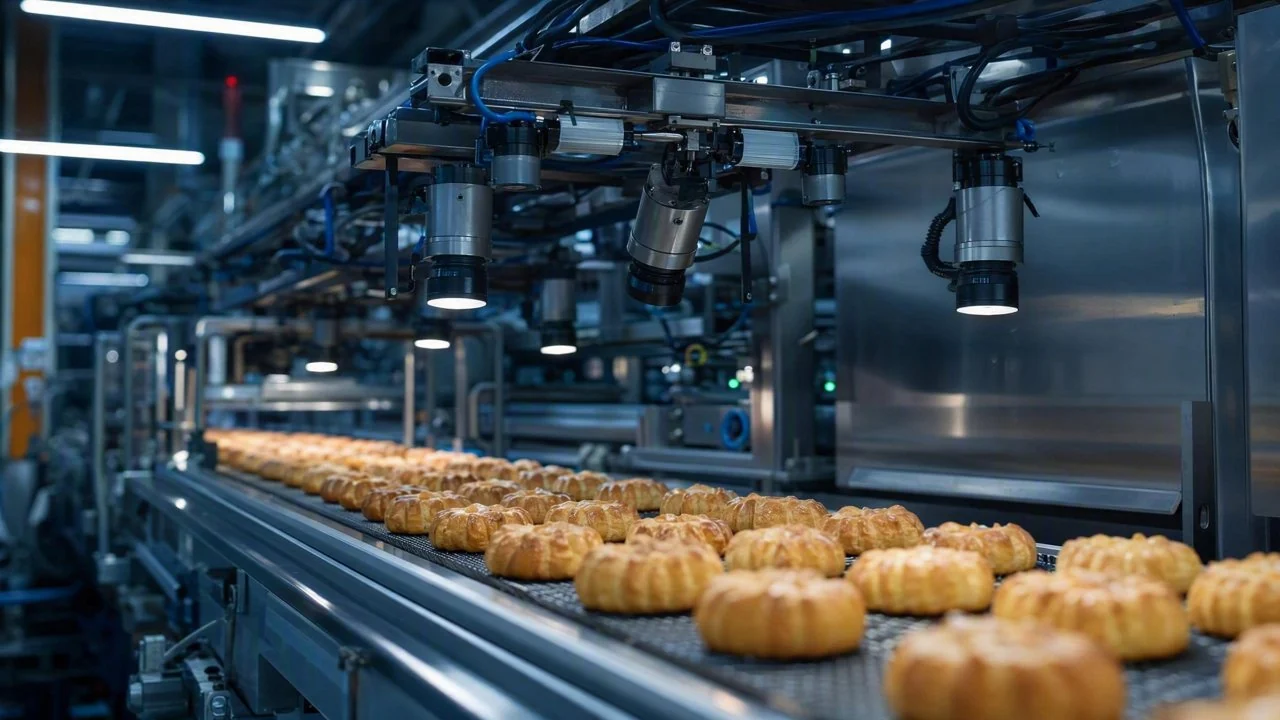
WeLinkirt's DaoAI 2D AI AOI equipment (high-resolution 2D imaging + deep learning secondary judgment, addressing surface, print, OCR, and assembly defects, high-speed inline full inspection, micron-level, semantic false positive filtering) utilizes APDT few-shot self-training to reduce model deployment time for new bakery product appearance defect detection from days to hours for a leading bakery manufacturer, simultaneously lowering the micro-crack false negative rate to <0.3%.
On high-speed bakery production lines, minor appearance defects, particularly micro-cracks on the surface, directly impact product quality perception and brand image. These cracks may arise from subtle fluctuations in baking processes, dough recipes, or cooling, and while not affecting food safety, they severely diminish consumer expectations of a 'perfect' product. For a leading manufacturer specializing in high-end bakery products, the challenge lies in accurately and efficiently identifying and rejecting products with micro-cracks while maintaining extremely high production line speeds. Traditional inspection methods are often inefficient, costly, and struggle to adapt to the diverse appearance characteristics and rapid product iterations in the bakery sector.
Pain Points: Why This Hurdle Was Difficult to Overcome
This leading bakery manufacturer faced multiple challenges in micro-crack detection: Firstly, manual inspection had a false negative rate of 3%-5%, especially during night shifts or extended working hours when employee fatigue significantly reduced inspection accuracy. Secondly, due to the wide variety of bakery products and frequent new product launches, each new product or mold required days, even up to a week, for manual sample collection, labeling, and traditional rule-based algorithm debugging. This resulted in excessive changeover downtime, severely impacting production efficiency, with annual losses from changeover downtime estimated at millions of RMB. Furthermore, micro-cracks vary widely in morphology and randomness, sometimes being difficult to distinguish from normal bakery textures. This led to high false positive rates of 10%-15% for traditional threshold or edge-detection AOI equipment, resulting in unnecessary waste from misidentified good products and additional labor costs for re-inspection. Finally, data security and on-premise deployment were core requirements, as cloud-based solutions could not meet their strict internal data governance policies.
From an engineering and imaging perspective, the complex color and texture of bakery product crusts, coupled with natural variations between batches, made micro-crack feature extraction exceptionally difficult. Cracks typically ranged from 50-200 micrometers in width with varying depths, and were easily confused with surface shadows under ordinary lighting. Traditional vision algorithms struggled to effectively differentiate between true defects and normal textures, while manual inspection was limited by human visual acuity and consistency. This made it challenging to improve both detection efficiency and accuracy simultaneously, especially on high-speed lines where hundreds of products per minute made 100% manual inspection almost impossible.
Technical Principles
WeLinkirt's DaoAI 2D AI AOI equipment completely solves these problems by combining a high-resolution 2D imaging system with its core APDT (Adaptive Pre-trained Deep Transfer) few-shot self-training technology. The equipment first uses industrial-grade high-resolution cameras to capture micron-level details of the bakery product surface, ensuring even subtle cracks are clearly presented. Its core lies in the APDT technology embedded in the DaoAI AI AOI software system, which, based on pre-trained vision foundation models, can rapidly learn the normal appearance characteristics of a product from a minimal number of good samples (1-20 images). When a new product is introduced or a minor process adjustment is made on the production line, only a few good product images are needed, and the system can complete adaptive model training and deployment within hours, without requiring a large number of defect samples. This few-shot learning capability allows WeLinkirt's DaoAI 2D AI AOI equipment to demonstrate unparalleled flexibility and efficiency when faced with the multi-variety, small-batch production model prevalent in the bakery industry.
Unlike traditional rule-based AOI that relies on engineers manually writing complex rule sets, the deep learning algorithms of WeLinkirt's DaoAI 2D AI AOI automatically extract high-level semantic features from images. This effectively distinguishes true micro-cracks from normal textures and lighting variations, thereby reducing the false positive rate by over 85%. Compared to manual inspection, WeLinkirt's DaoAI 2D AI AOI equipment not only achieves 100% inline full inspection, pushing the false negative rate below <0.3%, but also operates without fatigue, providing detection accuracy and consistency far superior to human operators. Furthermore, its “semantic false positive filtering” function further enhances detection robustness, ensuring that only defects genuinely impacting product quality are identified, avoiding misidentification of visually harmless 'blemishes' and significantly reducing re-inspection workload.
Typical Application Scenarios
- **Micro-Crack Detection on Bread/Pastry Crusts:** WeLinkirt's DaoAI 2D AI AOI equipment can accurately identify subtle surface cracks, fissures caused by temperature and humidity changes during baking, and microscopic cracks resulting from cooling shrinkage. The challenge lies in distinguishing cracks from normal baking textures; DaoAI learns the distribution patterns of normal textures through deep learning models to identify abnormal textures as defects.
- **Biscuit/Puff Pastry Surface Foreign Object and Damage Detection:** For fragile products like biscuits, WeLinkirt's DaoAI 2D AI AOI can efficiently detect baking residues, scorch marks, foreign object adhesion, as well as structural defects like broken edges or missing corners. The difficulty arises when foreign objects are similar in color to the product, and in accurately identifying irregular damage; DaoAI addresses this with high-resolution imaging and feature extraction capabilities.
- **Mooncake/Pastry Pattern Printing Defects and Character OCR:** For bakery products with embossed patterns or printed characters, WeLinkirt's DaoAI 2D AI AOI can detect blurred, misaligned, or broken patterns, as well as blurred, ghosted, or missing production dates and batch numbers. Challenges include uneven lighting or reflective printing materials affecting recognition; DaoAI's OCR module boasts strong anti-interference capabilities.
- **Bread/Toast Slice Assembly Defect Detection:** Before automated packaging, check multi-slice bread or toast for missing slices, incorrect counts, or uneven stacking. The difficulty lies in real-time counting and position judgment on high-speed production lines; DaoAI's visual positioning and counting modules ensure stable operation.
Implementation Case Study
A leading bakery manufacturer, with product lines covering various high-end breads, cakes, and pastries, launches dozens of new products annually. Previously, when introducing new products or changing molds, debugging and deploying appearance defect detection models required experienced engineers 3-5 days for extensive sample collection, labeling, and algorithm parameter adjustments. This not only resulted in production line downtime losses but also limited the speed of new product market entry. After implementing WeLinkirt's DaoAI 2D AI AOI equipment, the situation fundamentally changed. The manufacturer first piloted the solution on a high-end bread production line, focusing on detecting common surface micro-cracks and scorch marks. The WeLinkirt team, on-site, used only 10 good product images and, through the APDT function of the DaoAI AI AOI software system, completed model training and deployment for the new product within 4 hours. Post-deployment, WeLinkirt's DaoAI 2D AI AOI equipment achieved a detection rate of over 99.7%, while reducing the false positive rate from 12% to below 1.5%, saving approximately 8 hours of manual re-inspection time daily.
“The APDT few-shot self-training capability of WeLinkirt's DaoAI 2D AI AOI has revolutionized our new product launch efficiency, from days of waiting to hours of deployment – a qualitative leap in productivity.”
WeLinkirt Solution and Products
WeLinkirt's core offering to this leading bakery manufacturer was the DaoAI 2D AI AOI equipment, with its integrated DaoAI AI AOI software system being key to efficient detection. The system supports 100% local private deployment, ensuring customer data remains on-site, fully meeting their strict data security and compliance requirements. During implementation, WeLinkirt engineers first evaluated the existing production line, designing optimal camera mounting positions and lighting solutions to capture high-quality images of bakery product surfaces. Subsequently, using the APDT module of the DaoAI AI AOI software system, the customer only needed to provide 1-20 good product images, enabling the system to rapidly self-train and generate high-precision defect detection models. This 'one good sample, 5 minutes, 0 code automatic programming' capability greatly simplified the model creation and changeover process. Furthermore, WeLinkirt's DaoAI World universal model, as a unified foundation, ensures semantic understanding and cross-scenario generalization, allowing the system to continuously learn from production line feedback and optimize detection performance. Its flexible deployment options via SDK/API/Docker also facilitate smooth integration with existing MES/SCADA systems for closed-loop data management.
By deploying WeLinkirt's DaoAI 2D AI AOI equipment, the bakery manufacturer achieved significant quantified results. Firstly, new product launch or product changeover time was dramatically reduced from 3-5 days to under 4 hours, decreasing changeover downtime by over 90%, greatly enhancing production line flexibility and new product time-to-market. Secondly, the false negative rate for micro-cracks was reduced from the original 3%-5% to <0.3%, improving overall product qualification rate by over 2.5%. The false positive rate decreased from 12%-15% to below 1.5%, significantly reducing manual re-inspection workload, with manual re-inspection hours decreasing by over 80%. These improvements not only directly enhanced product quality and consumer satisfaction but also brought considerable economic benefits to the enterprise, including reduced scrap rates, optimized labor costs, increased production line utilization, and ultimately strengthened brand competitiveness in the high-end bakery market. WeLinkirt, with its engineering depth and practical value, has delivered a concrete application case of industrial AI in visual quality inspection for the food industry, along with quantifiable Return on Investment (ROI).
FAQ
Beyond baked goods, what other applications does WeLinkirt's DaoAI 2D AI AOI equipment have in the food industry?
In addition to baked goods appearance inspection, WeLinkirt's DaoAI 2D AI AOI equipment can be widely applied in various scenarios such as food packaging seal quality inspection, fruit and vegetable surface defect recognition, meat product foreign object detection, snack packaging print defects, and label character recognition, ensuring quality compliance and production efficiency across the entire food supply chain.
How does APDT few-shot self-training specifically help companies reduce costs?
APDT few-shot self-training significantly reduces model development and deployment time by minimizing reliance on large numbers of defect samples, thereby lowering manual annotation costs and production line downtime losses. Companies can launch new products faster, reduce production interruptions due to changeovers, and significantly decrease scrap rates and re-inspection labor costs caused by false positives.
How does WeLinkirt's DaoAI 2D AI AOI equipment ensure data security and on-premise deployment?
WeLinkirt's DaoAI 2D AI AOI equipment supports 100% local private deployment, with all data processing and model training completed within the customer's internal network, ensuring data never leaves the facility. Flexible deployment options via SDK/API/Docker allow smooth integration with existing production systems, guaranteeing data security and enterprise compliance requirements.
Full solution for this scenario: the full inspection solution for Food / agriculture
This article was generated by AI. Customer cases are simulated scenarios based on real product capabilities and figures are illustrative; see product pages for official benchmarks.