
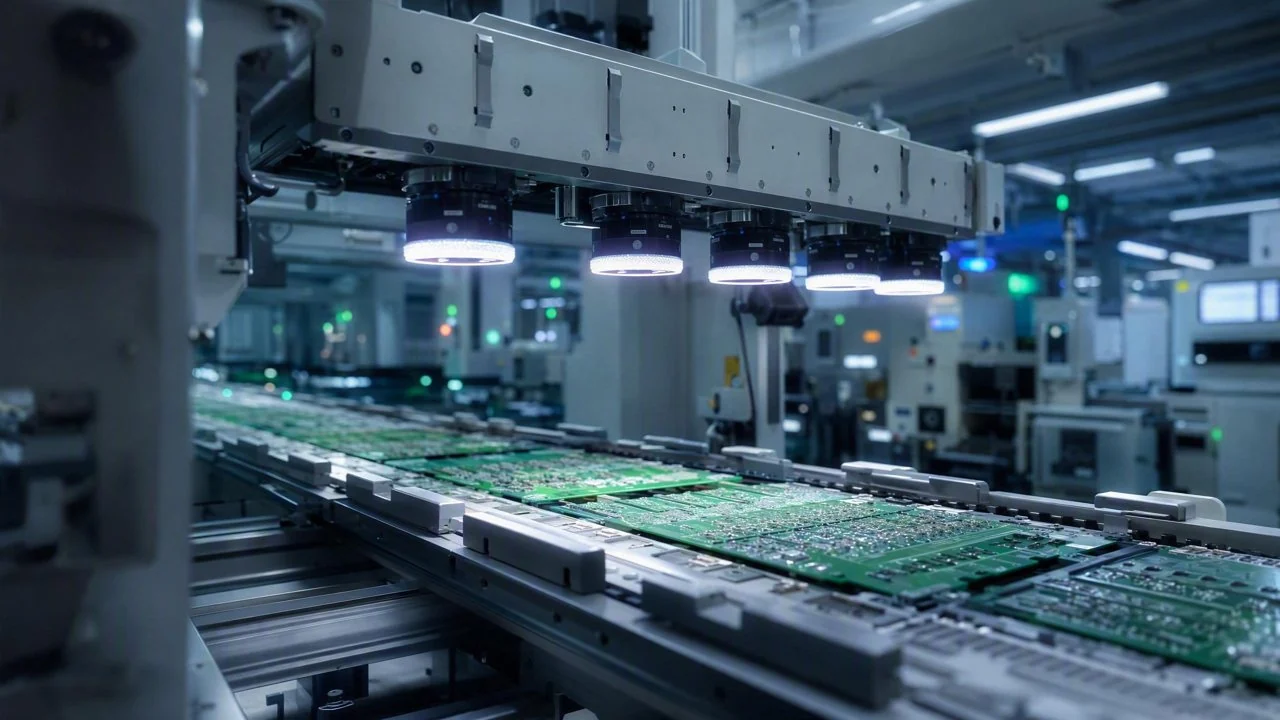
DaoAI 2D AI AOI equipment (high-resolution 2D imaging + deep learning secondary judgment, targeting surface/print/OCR/assembly defects, high-speed inline full inspection, micron-level, semantic false alarm filtering), through local private deployment, reduced the missed detection rate for critical defects like cold solder, bridging, and insufficient solder in SMT solder joints for a large electronics manufacturer from 2% with manual inspection to <0.4%, while ensuring all production data strictly remains within the factory, meeting the highest level of data security compliance.
In the electronics manufacturing sector, particularly in the Surface Mount Technology (SMT) stage of PCBA, solder joint quality directly determines product functionality and reliability. As electronic products trend towards miniaturization and higher integration, component density on PCBA boards has dramatically increased, making solder joints microscopic and defects diverse, such as cold solder, bridging, insufficient solder, tombstoning, and misalignment. Traditional manual visual inspection can no longer meet the demands of high-speed, high-precision production, and is prone to subjective influences, leading to low inspection efficiency and high missed detection rates. Automated Optical Inspection (AOI) equipment emerged to address this, but traditional rule-based AOI still has limitations in identifying complex defects and filtering false alarms. For leading electronics manufacturers, beyond inspection precision, the security and compliance of production data are paramount considerations, especially in scenarios involving core process parameters and intellectual property, where any risk of data leakage is unacceptable. DaoAI 2D AI AOI equipment is specifically designed to solve these challenges, with its local private deployment capability being a key factor in gaining trust from large clients.
Pain Points: Why This Hurdle Is Difficult to Overcome
A leading Tier-1 electronics supplier faced multiple challenges in SMT solder joint inspection. Firstly, the missed detection rate for manual visual inspection was as high as 2%, leading to costly rework and impacting product reliability. Secondly, traditional rule-based AOI equipment suffered from persistently high false alarm rates, reaching 15% or even higher, necessitating extensive manual secondary verification, consuming dozens of person-hours daily and significantly reducing production line efficiency. Thirdly, due to the wide variety of product models, each changeover required reprogramming rules, resulting in changeover downtime exceeding 30 minutes, severely affecting production rhythm. A more critical pain point was the enterprise's extremely stringent requirements for production data security; all inspection data and model training data had to be strictly kept on local servers, not allowed to be uploaded to cloud or third-party platforms. This meant that most market solutions relying on cloud-based AI computing power could not meet their compliance needs.
The root cause of these difficulties lies in the complexity and diversity of SMT solder joint defects. Defects like cold solder, bridging, and insufficient solder exhibit subtle grayscale variations and edge features in 2D images, easily confused with normal fluctuations. For instance, slight solder paste insufficiency and severe insufficient solder may only have subtle differences in image features, making it difficult for traditional AOI to distinguish. At the same time, PCBA surfaces contain numerous reflective areas, shadows, characters, and component numbers, which are easily misidentified as defects, leading to high false alarm rates. Furthermore, minor fluctuations in different batches of solder paste, PCB materials, and reflow soldering process parameters can affect solder joint appearance, causing defect characteristics to change non-linearly, making traditional fixed rules ineffective for generalization. In today's trend of AI smart cameras, simplifying deployment, improving inspection efficiency, and reducing false alarm rates are key, but data security and localized deployment are often overlooked, which are non-negotiable for large enterprises. DaoAI 2D AI AOI, through its innovative technical architecture, effectively addresses these profound issues.
Technical Principles
The core of DaoAI 2D AI AOI equipment lies in its tight integration of a high-resolution 2D imaging system and a deep learning secondary judgment engine. The equipment utilizes custom industrial-grade high-resolution cameras and multi-angle annular lighting to capture micron-level details of solder joint surfaces, effectively avoiding the impact of reflections and shadows on image quality, providing high-quality input for subsequent AI analysis. After image acquisition, raw data first undergoes preprocessing at edge computing nodes and is then fed into the embedded DaoAI AI AOI software system for deep learning inference. This system, based on advanced visual foundation models, can learn the normal feature distribution of solder joints from a small number of good samples and identify anomalies that significantly deviate from the 'normal' pattern, rather than simply matching preset defect templates. This means that DaoAI 2D AI AOI can perform more robust identification of complex defects such as cold solder, bridging, and insufficient solder.
Compared to traditional rule-based AOI, the advantage of DaoAI 2D AI AOI lies in its powerful generalization capability and semantic false alarm filtering mechanism. Traditional AOI relies on engineers manually setting numerous rules and thresholds, which need readjustment when solder joint appearance slightly changes, and has weak ability to identify subtle defects in complex backgrounds. In contrast, DaoAI 2D AI AOI uses deep learning models to autonomously learn defect features, enabling identification of even unexplicitly defined variant defects through its anomaly detection capability. More importantly, its semantic false alarm filtering function can understand 'non-defect' information in images (such as silkscreen characters, component numbers, board textures, etc.) and exclude them during inference, thereby reducing the false alarm rate by over 85%, significantly outperforming the generally high false alarm rates of traditional methods. Furthermore, DaoAI 2D AI AOI supports 100% local private deployment, with all model training, inference, and data storage completed on the client's local servers, ensuring that sensitive production data never leaves the factory, meeting the client's highest requirements for data security and compliance.
Typical Application Scenarios
- **SMT Cold Solder/Dry Joint Detection:** DaoAI 2D AI AOI can accurately identify cold solder caused by poor wetting between the solder joint and pad, insufficient solder, or internal voids within the solder joint. The challenge lies in that cold solder may not be obvious in surface features, only showing subtle changes in color, luster, or edge discontinuity. The AI model learns subtle variations in 2D projections of the 3D morphological features of many good solder joints to achieve high-precision judgment.
- **SMT Bridging/Short Circuit Detection:** The equipment effectively detects short circuits formed between adjacent solder joints or pads due to excessive solder. The difficulty lies in bridging possibly occurring in very narrow gaps, requiring extremely high image resolution and edge recognition accuracy. DaoAI 2D AI AOI's high-resolution imaging and precise edge extraction capabilities, combined with deep learning's generalized recognition of bridging features, can reduce the missed detection rate to <0.4%.
- **SMT Insufficient/Excess Solder Detection:** Detects cases where the solder joint has insufficient (insufficient solder) or excessive (excess solder) solder. Insufficient solder can lead to insufficient connection strength, while excess solder can cause bridging or affect component coplanarity. The AI model performs quantitative judgment by analyzing the geometric shape, volume estimation, and comparison with standard solder joints.
- **Component Misalignment/Tombstoning Detection:** Detects defects where surface-mount components are misaligned on the pad (misalignment) or one end lifts up (tombstoning). These defects directly affect the reliability of circuit connections. DaoAI 2D AI AOI utilizes its high-precision positioning and geometric analysis capabilities, combined with deep learning's recognition of the component body and its relative position to the pad, to ensure zero missed detection of such assembly defects.
- **Character OCR Defects and Assembly Omissions:** In addition to solder joints, DaoAI 2D AI AOI can also handle character printing defects on PCBAs (OCR recognition errors, blurring, missing) and component assembly omissions (missing components, wrong components). Through deep learning's OCR module and object detection models, it achieves comprehensive coverage of various planar defects.
Case Study
A globally leading automotive electronics Tier-1 supplier had extremely high requirements for quality and data security in their core PCBA production line. Previously, this manufacturer primarily relied on traditional rule-based AOI supplemented by extensive manual re-inspection for SMT solder joint detection. However, the traditional AOI had a false alarm rate as high as 18%, requiring 8 operators for 10 hours daily for re-inspection, severely slowing down the production rhythm. More critically, they had attempted to introduce other cloud-based AI AOI solutions but were forced to abandon them due to inability to meet local private deployment and data non-exfiltration compliance requirements. After learning about the local deployment capability of DaoAI 2D AI AOI equipment, the manufacturer decided to pilot it on one of their critical production lines.
The DaoAI team first deployed the 2D AI AOI equipment on this production line and utilized its APDT positive/few-shot learning technology, completing model training and line debugging within 5 minutes using only 15 good sample images. After commissioning, DaoAI 2D AI AOI demonstrated outstanding performance. Compared to before deployment, the missed detection rate for solder joint defects was reduced from 2% to <0.4%, far exceeding client expectations. Simultaneously, the false alarm rate significantly decreased by 87%, from 18% to 2.3%, greatly reducing the need for manual re-inspection, requiring only 1 operator for minimal spot checks. Most importantly, all image data, model parameters, and inference results were stored on the client's local servers, fully meeting their strict data security and privacy protection requirements. Through the deployment of DaoAI 2D AI AOI, the manufacturer not only improved product quality but also optimized production processes, achieving a win-win in data security and production efficiency.
“DaoAI 2D AI AOI not only solved our long-standing high false alarm and missed detection issues, but more importantly, it truly achieved localized deployment, ensuring the absolute security of our core production data. This was the decisive factor in our choice.”
DaoAI Solutions and Products
DaoAI provides a comprehensive solution for SMT solder joint inspection in the electronics/PCBA industry, centered around its 2D AI AOI equipment. This equipment integrates DaoAI's self-developed high-resolution 2D imaging module and the DaoAI AI AOI software system. During deployment, we support 100% local private deployment, offering various integration methods such as SDK/API/Docker, ensuring that client data never leaves the factory. For model building, using the APDT positive/few-shot learning function of the DaoAI AI AOI software system, clients only need to provide 1-20 good sample images to complete automatic model programming within 5 minutes, achieving zero-code rapid changeover. For complex and diverse defects, DaoAI 2D AI AOI's deep learning secondary judgment capability can accurately identify micron-level defects such as cold solder, bridging, and insufficient solder, and significantly reduce manual re-inspection workload through semantic false alarm filtering. Furthermore, our DaoAI World universal foundation ensures the AI model's cross-scenario generalization capability across different production lines and products, and continuously learns and optimizes from production line feedback, constantly improving inspection accuracy and efficiency. DaoAI is committed to providing secure, efficient, and intelligent industrial inspection solutions to clients through leading AI vision technology.
Through the deployment of DaoAI 2D AI AOI equipment, clients have realized significant business value. In terms of product quality, the missed detection rate for critical defects was reduced from 2% to <0.4%, effectively enhancing product reliability. In terms of production efficiency, the false alarm rate decreased by 87%, greatly reducing manual re-inspection workload, saving significant labor costs and time. Changeover time was shortened from over 30 minutes to 5 minutes, significantly improving line utilization. More importantly, local private deployment ensured the absolute security of all production data, eliminating client concerns about data leakage and meeting the industry's most stringent compliance requirements. DaoAI 2D AI AOI not only provides an advanced inspection tool but also offers a secure and reliable path for intelligent manufacturing upgrades.
FAQ
How does DaoAI 2D AI AOI ensure data security with local private deployment?
DaoAI 2D AI AOI solutions support 100% local private deployment, where all model training, inference computation, image data storage, and result logging are performed on the client's designated internal servers. We offer various integration methods such as SDK/API/Docker to ensure that data physically and logically remains within the client's factory network, fundamentally eliminating the risk of data exfiltration and meeting stringent enterprise requirements for data sovereignty and compliance.
What are the core advantages of DaoAI 2D AI AOI over traditional rule-based AOI for SMT solder joint inspection?
The core advantages of DaoAI 2D AI AOI lie in its deep learning secondary judgment capability and semantic false alarm filtering. Traditional AOI relies on fixed rules, struggling to adapt to complex and variable solder joint defects and background interference. Our AI model learns defect features from a small number of samples, achieving high-precision identification of micron-level defects like cold solder and bridging, and reducing the false alarm rate by over 85%, significantly cutting down manual re-inspection and improving inspection efficiency and accuracy.
Is the modeling and changeover process for DaoAI 2D AI AOI complex, requiring specialized AI engineers?
DaoAI 2D AI AOI utilizes APDT positive/few-shot learning technology, enabling zero-code rapid programming. Users only need to provide 1–20 good sample images to automatically complete model training in approximately 5 minutes. The entire process does not require the involvement of specialized AI engineers; production line operators can quickly learn after simple training, greatly simplifying deployment and changeover processes, making it particularly suitable for multi-variety, small-batch production scenarios.
Full solution for this scenario: Electronics / PCBA industry solutions
This article was generated by AI. Customer cases are simulated scenarios based on real product capabilities and figures are illustrative; see product pages for official benchmarks.