
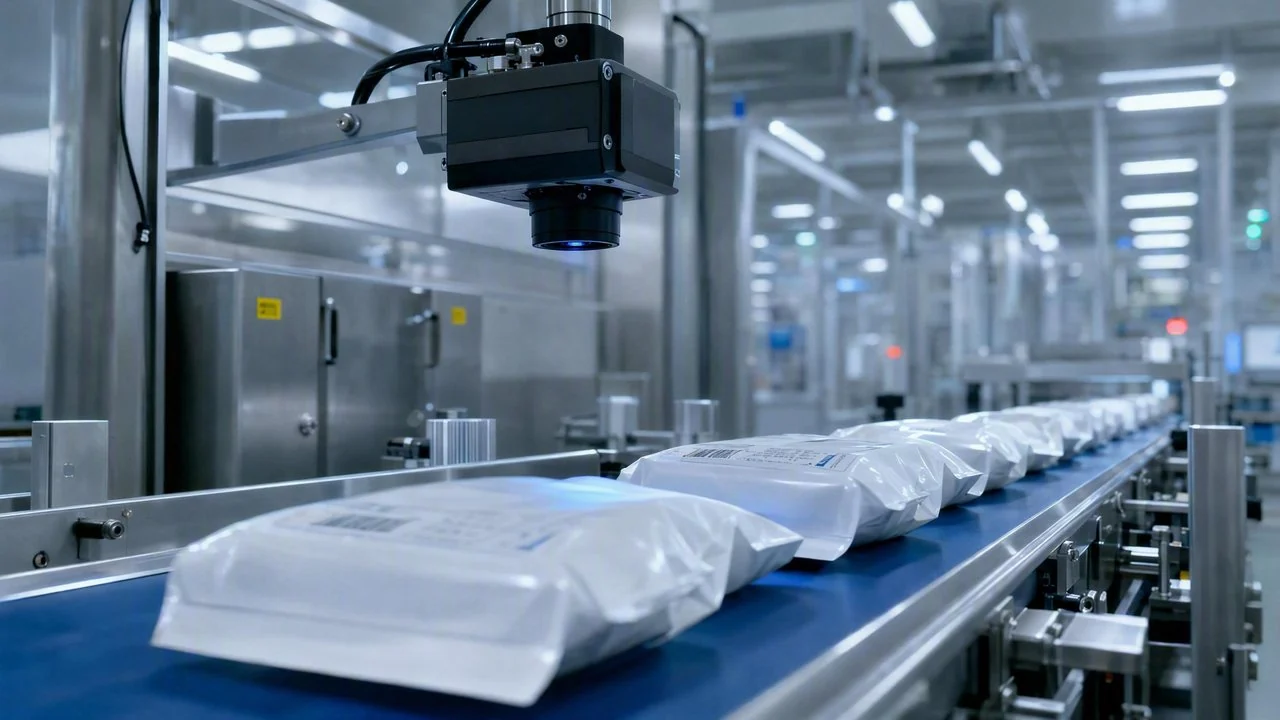
DaoAI's 2D AI AOI equipment, leveraging high-resolution 2D imaging and deep learning for secondary judgment, targets planar defects such as food packaging seal leaks, label misalignment, and blurred codes. It achieves high-speed inline full inspection, reducing a major food manufacturer's leak detection rate from 1.2% to <0.3% and decreasing manual reinspection man-hours by 75%.
In the food and agriculture industry, the integrity of product packaging directly impacts food safety, shelf life, and brand reputation. Particularly in packaging sealing, labeling, and coding, even minor defects can lead to product spoilage, misinformation, or even recalls. Traditionally, these critical quality control points relied heavily on manual inspection. In high-volume, multi-variety production lines, the inefficiency, inconsistency, and high labor costs of manual inspection have become a bottleneck limiting enterprise profitability. With increasingly stringent consumer demands for food safety standards and rising labor costs, finding an efficient, precise, and economical automated inspection solution to replace the growing pressure of manual inspection has become an urgent need for food processing enterprises.
Pain Points: Why This Hurdle Is Difficult to Overcome
Customers in food packaging sealing, labeling, and coding face multiple challenges. First, the high cost of manual inspection: a medium-sized food production line might require several, or even more than ten, quality inspectors for continuous patrolling and reinspection to ensure seal quality. This labor expenditure accumulates into a significant burden over time. Second, detection accuracy and consistency issues: manual inspection is limited by eye fatigue, subjective judgment, and attention lapses, making it difficult to effectively suppress the false negative rate. For micron-level tiny seal cracks or missing ink dots, the detection rate often falls below 90%. Meanwhile, differing judgment standards between shifts and individual inspectors lead to inconsistent detection results, complicating quality traceability. Third, the contradiction between production rhythm and changeover efficiency: modern food production lines pursue high efficiency and fast rhythms, with hundreds of packages per minute demanding extremely high performance from inspection systems. Manual inspection often becomes a production bottleneck, limiting overall capacity. Furthermore, when product varieties change frequently, manual operators spend considerable time familiarizing themselves with new packaging styles, label positions, and coding content, leading to excessive downtime and affecting production continuity. Finally, the food industry has extremely high regulatory compliance requirements, and any packaging defect can lead to serious legal and economic risks. These factors collectively result in significant disadvantages for traditional manual inspection solutions in terms of efficiency, cost, and reliability.
The root cause of these difficulties lies in the complexity and diversity of the inspection objects. Food packaging materials vary widely, such as soft plastic films, composite paper boxes, glass bottles, etc., with different surface textures, reflective properties, and transparency, making image acquisition inherently challenging. Defects at the sealing area, such as tiny bubbles, wrinkles, foreign matter, overflow, or adhesions caused by inadequate heat sealing, are often only tens of microns or even smaller in size, and may be hidden under patterns or textures, making them difficult for the human eye or traditional rule-based vision systems to accurately capture. Label printing defects like color differences, misalignment, warping, damage, and coding issues such as missing characters, blurriness, ghosting, or ink splatter are all non-standardized and varied defects. Traditional algorithms based on thresholds or feature matching struggle to effectively distinguish good products from defective ones, leading to high false positive rates or false negatives. Simultaneously, the high-speed operation of production lines requires inspection systems to complete image acquisition, processing, and judgment in extremely short periods, posing severe challenges to the computational power and algorithm robustness of traditional vision systems. DaoAI's 2D AI AOI equipment is designed to address these challenges.
Technical Principles
The core of DaoAI's 2D AI AOI equipment lies in its combination of high-resolution 2D imaging technology and advanced deep learning for secondary judgment. This equipment employs industrial-grade high-resolution cameras, equipped with a customized lighting system, capable of acquiring clear, high-contrast image data for different packaging materials and defect types, capturing micron-level subtle defect features. At the image processing level, the DaoAI AI AOI software system is powered by a self-developed visual foundation model with powerful feature recognition capabilities. Unlike traditional rule-based AOI systems, DaoAI's 2D AI AOI does not rely on engineers manually writing complex rule chains; instead, it automatically learns defect patterns from a large amount of image data through deep learning algorithms.
Specifically, the DaoAI 2D AI AOI system utilizes APDT positive/few-shot learning technology, requiring only 1–20 good product images to complete 0-code automatic programming in 5 minutes, rapidly establishing a detection model for specific products. For complex, ambiguous defects, the system performs “secondary judgment” through deep learning models, conducting deeper semantic understanding and analysis of suspicious areas identified initially. This effectively filters out semantic false positives caused by environment, lighting, or inherent product textures, reducing the false positive rate by 80%. For example, minor occasional wrinkles on packaging film might be misjudged as defects by traditional AOI, but DaoAI's 2D AI AOI can learn to differentiate between “normal wrinkles” and “defects affecting seal integrity,” thereby significantly improving detection accuracy and stability. Compared to manual inspection, DaoAI's 2D AI AOI equipment can operate 24/7 without interruption, avoiding fluctuations caused by eye fatigue and subjective judgment, ensuring stable and consistent detection results; compared to traditional rule-based AOI, its deep learning capability allows it to handle non-standardized, varied defect types, significantly reducing the false negative rate and improving the ability to identify defects against complex backgrounds.
Typical Application Scenarios
- **Packaging Seal Integrity Inspection:** DaoAI's 2D AI AOI equipment can inspect the integrity of various packaging seals, such as heat seals, cold seals, and ultrasonic seals. For example, it detects wrinkles, bubbles, foreign matter inclusion, small cracks or discontinuities due to insufficient heat sealing, and unclear seal impressions on soft plastic bag seals. The challenge lies in the minute size and diverse forms of these defects, which are difficult for traditional methods to precisely identify. The DaoAI system, however, learns from good product features to make high-precision judgments on abnormal areas.
- **Label Printing and Application Quality Inspection:** For labels on food packaging, DaoAI's 2D AI AOI can detect label printing quality (e.g., blurred patterns, color deviation, scratches, missing ink dots), application position (e.g., offset, tilt), label surface integrity (e.g., damage, bubbles, warping, wrinkles), and barcode/QR code readability. Especially on high-speed production lines, ensuring precise label application and error-free printing in a very short time is a significant challenge.
- **Coding and Batch Number Character Recognition (OCR):** DaoAI's 2D AI AOI equipment efficiently performs recognition and quality inspection of coded characters such as batch numbers, production dates, expiration dates, and serial numbers. It can identify missing, blurry, ghosted, or splattered ink characters, abnormal character spacing, and positional deviations, performing accurate OCR recognition and verification. Its deep learning model achieves high robustness in recognizing characters with different fonts and printing methods (e.g., inkjet, laser marking).
- **Packaging Assembly Deficiency Detection:** For food packaging with multiple layers or attached small items (e.g., seasoning packets, straws), DaoAI's 2D AI AOI can detect missing items, misplacement, or incomplete packaging structures. For example, it can check for missing straws in boxed milk or missing individual items in multi-packs. By semantically understanding the overall assembly structure, it effectively identifies assembly deficiencies.
Case Study
A large dairy product manufacturer in South China, operating multiple high-speed packaging lines, primarily produces Tetra Pak cartons and cup yogurts. Previously, their packaging sealing, labeling, and coding processes relied heavily on manual inspection, with 3-4 quality inspectors per line working three shifts, incurring millions of RMB annually in labor costs alone. Even so, due to high line speeds (up to 400 packages/minute), human fatigue led to an average false negative rate of around 1.2%, particularly for tiny heat seal defects in Tetra Pak cartons, where detection capability was insufficient. Meanwhile, inconsistent manual judgment standards resulted in a high false positive rate, leading to numerous good products being misjudged and increasing rework costs. The client urgently needed a solution that could effectively replace manual labor, reduce labor costs, and improve detection accuracy and consistency. DaoAI's 2D AI AOI equipment was introduced as a pilot solution on one of their core production lines.
With the assistance of the DaoAI team, the client deployed DaoAI's 2D AI AOI equipment on a Tetra Pak production line. Through customized lighting and high-resolution cameras, the system acquired real-time images of the seal, label, and coding areas of each package. Engineers utilized the APDT few-shot learning function of the DaoAI AI AOI software system, training the model with only 15 good product images in less than 10 minutes, enabling it to identify defects such as seal wrinkles, bubbles, label misalignment, and blurred codes. After deployment, DaoAI's 2D AI AOI equipment achieved 100% inline full inspection. Before deployment, the production line averaged about 5-8 customer complaints per month due to packaging defects; after deployment, the number of complaints dropped to 0-1 per month, significantly improving product quality stability. Most importantly, the manual inspection positions on this line were reduced from 3 to 1 (only responsible for anomaly review and equipment supervision), achieving a manual inspection replacement rate of 98% and directly saving over 60% in annual labor costs.
DaoAI's 2D AI AOI is not just a defect detection tool; it's a key engine for food production enterprises to reduce costs, increase efficiency, and enhance core competitiveness.
DaoAI Solutions and Products
The DaoAI 2D AI AOI equipment provided for the food/agriculture industry is a complete solution integrating high-resolution 2D imaging hardware and the DaoAI AI AOI software system. Its core capability lies in performing high-speed inline full inspection of various planar defects such as surface, printing, character OCR, and assembly deficiencies, achieving micron-level precision. For deployment and integration, DaoAI's 2D AI AOI equipment supports various forms like SDK/API/Docker, enabling 100% local private deployment to ensure customer data does not leave the factory, meeting the stringent requirements of the food industry for data security and privacy. Addressing rapid changeover demands, the DaoAI AI AOI software system offers 0-code automatic programming, combined with APDT few-shot learning, allowing non-professional personnel to establish new product inspection models in 5 minutes, greatly enhancing production line flexibility and changeover efficiency. Furthermore, its unique semantic false positive filtering technology, which performs secondary judgment on suspicious defects through deep learning, effectively distinguishes real defects from background noise, reducing the false positive rate to an industry-leading level, minimizing unnecessary downtime and manual reinspection, and further optimizing production efficiency.
By introducing DaoAI's 2D AI AOI equipment, food enterprises can achieve multiple business values. First, significantly reduced labor costs by replacing a large number of repetitive, fatigue-prone manual inspection positions, freeing up human resources from low-value-added labor. Second, a substantial improvement in product quality and compliance, as DaoAI's 2D AI AOI equipment can reduce the false negative rate to <0.3%, ensuring every product leaving the factory meets strict quality standards and effectively avoiding customer complaints and recall risks due to packaging defects. Third, optimized production efficiency, with high-speed inline full inspection capabilities ensuring that production line rhythm is unaffected, and 5-minute rapid changeover capabilities reducing downtime. Finally, through real-time feedback of inspection data and quality traceability, enterprises can continuously optimize production processes, achieving digital and intelligent transformation. The DaoAI AI AOI software system is not just an inspection tool; it is a powerful engine for enhancing food safety and production efficiency.
FAQ
How does DaoAI 2D AI AOI help food enterprises reduce labor costs?
DaoAI's 2D AI AOI equipment effectively replaces traditional manual inspection positions by achieving high-speed inline full inspection. Its deep learning algorithms can stably and accurately identify various packaging defects, reducing reliance on human experience. This allows enterprises to significantly cut down on the number of quality inspection personnel, reallocating human resources to higher-value production stages, thereby substantially reducing overall labor costs and management burden.
What level of precision can this equipment achieve in food packaging seal inspection?
DaoAI's 2D AI AOI equipment can achieve micron-level precision in food packaging seal inspection. Through its high-resolution 2D imaging system and deep learning for secondary judgment, it can identify subtle defects imperceptible to the naked eye, such as wrinkles, bubbles, or cracks caused by inadequate heat sealing, even down to tens of microns. This ensures an extremely low false negative rate (e.g., <0.3%) even on high-speed production lines, guaranteeing product quality.
How can food industry customers quickly deploy and use DaoAI 2D AI AOI equipment?
The deployment process for DaoAI's 2D AI AOI equipment is designed to be highly convenient. Its DaoAI AI AOI software system supports 0-code automatic programming and APDT few-shot learning, allowing customers to train a detection model in just 5 minutes with only 1-20 good product images. This means even non-professional production line operators can quickly set up and manage the equipment, significantly shortening the go-live cycle and changeover time, enhancing production line flexibility.
Full solution for this scenario: the full inspection solution for Food / agriculture · Food Package Missing-Item, Misload & Overfill Detection
This article was generated by AI. Customer cases are simulated scenarios based on real product capabilities and figures are illustrative; see product pages for official benchmarks.