
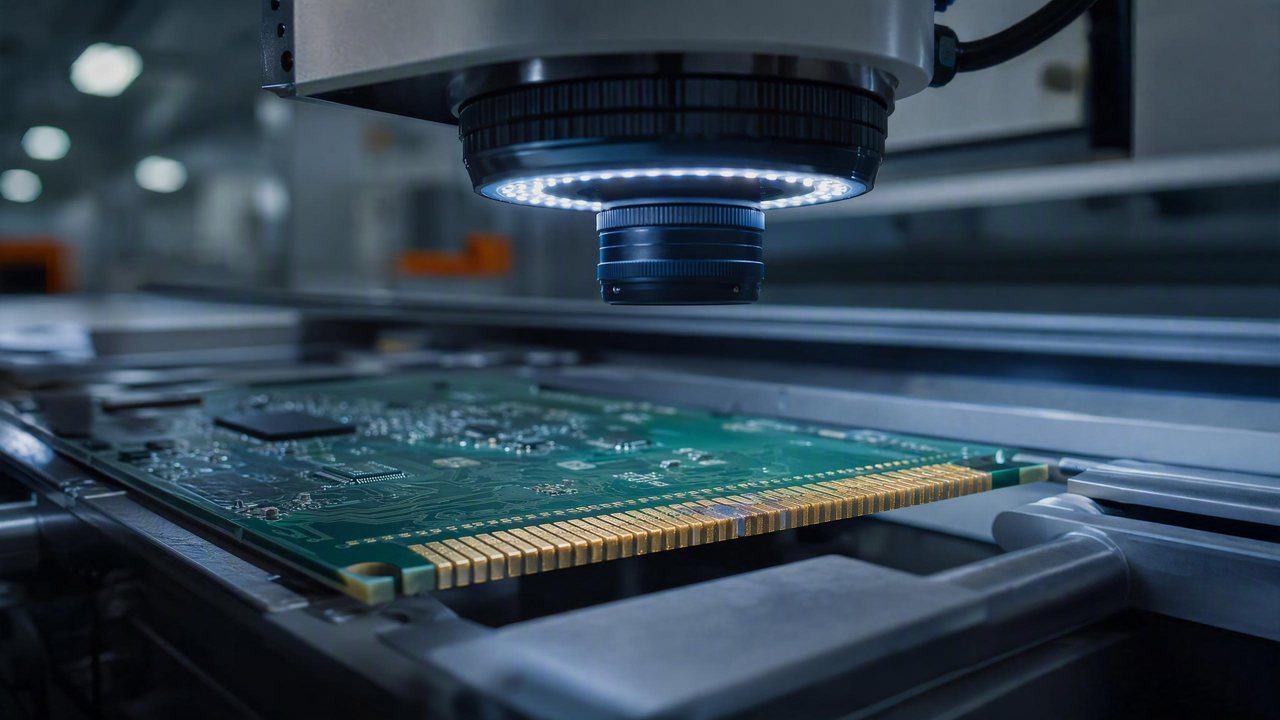
DaoAI's 2D AI AOI equipment (high-resolution 2D imaging + deep learning secondary judgment, targeting planar defects such as surface/printing/OCR/assembly omissions, high-speed online full inspection, micron-level, semantic false positive filtering), through on-premise private deployment, reduced a leading PCBA supplier's false positive rate for gold finger scratch and oxidation detection by −75%, while ensuring absolute security and compliance of production data. In the highly competitive field of electronics manufacturing, PCBA (Printed Circuit Board Assembly) is a core component, and its quality directly determines the performance and reliability of the final product. Particularly, the gold fingers on connectors, as critical interfaces for data transmission, require impeccable surface integrity. Any minute scratch, oxidation, or foreign matter can lead to poor contact, resulting in product functional failure or even batch-wide quality incidents. For top-tier suppliers producing high-performance, high-reliability electronic products, the demands for precision and efficiency in gold finger defect detection are extremely high. Concurrently, the security of sensitive data, such as process parameters and defect images generated during production, is paramount.
In an era of accelerated electronic product iteration and increasingly stringent market demands for quality, PCBA manufacturing processes are complex and precise. Particularly, the gold finger area, with its plating thickness, flatness, absence of scratches, oxidation, or foreign matter adhesion, directly impacts the electrical performance and lifespan of the product. A leading supplier specializing in high-end communication equipment PCBA manufacturing faces immense daily production volumes, requiring not only high precision but also high efficiency and extremely low false positive rates for gold finger inspection. Crucially, this supplier has almost draconian requirements for production data confidentiality. Any images or data related to product design, process flows, or defect characteristics must be processed and stored within the enterprise firewall, strictly prohibited from being uploaded to external cloud platforms, to prevent commercial secret leakage. Traditional inspection solutions could no longer meet its multifaceted demands for precision, efficiency, and data security.
Pain Points: Why This Hurdle Was Difficult to Overcome
This leading supplier faced multiple challenges in gold finger scratch and oxidation detection: First, **traditional AOI rule-based judgment had a high false positive rate**, especially for subtle color differences or reflections at the gold finger edges often misidentified as oxidation, leading to a massive workload for manual re-inspection, consuming at least 4 hours of manual re-inspection time daily and reducing inspection efficiency by approximately 30%. Second, **micron-level defects were difficult to stably detect**, with some gold finger scratches being only tens of microns wide, making it hard for traditional vision algorithms to stably capture and identify them on a high-speed production line. Third, **data security and privacy risks**, as core product processes and defect data were involved, the client could not accept uploading data to third-party cloud platforms for model training or inference, rendering many cloud-based AI solutions unfeasible. Fourth, **inefficient changeover**, when product models switched, traditional AOI required several hours or even half a day for parameter adjustment and rule reset, severely impacting line utilization. These pain points collectively posed significant obstacles to their quality control and production efficiency improvements.
The root cause of these difficulties lies in the special material properties of gold fingers and the complexity of defects. Gold finger surfaces are typically plated with a nickel-gold layer, which is highly reflective, generating complex reflections under different lighting angles, making it extremely prone to interfering with traditional image processing algorithm judgments. Scratch defects often appear as thin, irregular lines, while oxidation manifests as localized color changes with blurry boundaries. These factors make it challenging for traditional rule-based AOI, which relies on fixed thresholds or geometric features, to accurately distinguish between good and defective products. Simultaneously, in high-speed online inspection scenarios, the stability and consistency of image acquisition also pose challenges. Furthermore, the current industry hot topic direction, emphasizing how AI smart cameras like DeteX achieve real-time defect detection and classification in complex manufacturing environments through edge computing, directly addresses the client's needs for localization, real-time performance, and data security—specifically, how to ensure all sensitive data remains on-premise and enables rapid decision-making at the production line edge without sacrificing detection performance.
Technical Principles
DaoAI's 2D AI AOI equipment provides robust support for gold finger defect detection by combining high-resolution 2D imaging technology with advanced deep learning secondary judgment mechanisms. At the imaging level, the equipment utilizes customized high-resolution industrial cameras and a multi-angle annular/coaxial light source combination, effectively suppressing high reflections on the gold finger surface and capturing micron-level scratches and subtle oxidation color differences. This fine imaging capability is the foundation for subsequent AI judgment. At the judgment level, the DaoAI 2D AI AOI equipment is centrally powered by the DaoAI AI AOI software system, which, based on advanced visual foundation models, possesses powerful feature recognition capabilities. It first performs preliminary analysis on acquired images using pre-trained general defect detection models to identify suspicious regions. Subsequently, these suspicious regions enter a deep learning secondary judgment module, leveraging APDT few-shot learning technology (requiring only 1–20 good sample images for model training) to conduct refined learning and judgment specifically for client-specific gold finger scratches and oxidation defects. This “coarse screening + fine judgment” mechanism enables DaoAI's 2D AI AOI equipment to effectively distinguish between true defects and background noise or pseudo-defects, significantly reducing false positive rates.
Compared to traditional rule-based AOI, the core advantage of DaoAI's 2D AI AOI equipment lies in its powerful “semantic false positive filtering” capability. Traditional rule-based AOI often relies on fixed thresholds and geometric rules set by engineers, exhibiting poor robustness to lighting variations and material batch differences, leading to a large number of good products being falsely rejected. In contrast, DaoAI's 2D AI AOI equipment, through its deep learning model, can understand the “semantic” features of defects, such as the texture of a scratch or the gradient pattern of oxidation, thereby achieving more intelligent and accurate judgments. Even subtle oxidation spots with colors similar to the gold finger background, or extremely fine scratches, can be precisely identified based on the learned features. Compared to manual inspection, DaoAI's 2D AI AOI equipment achieves 100% online full inspection, with detection speeds far exceeding human capabilities, while avoiding omissions and misjudgments caused by human eye fatigue and subjectivity. Furthermore, the DaoAI AI AOI software system supports 100% on-premise private deployment, with all data processing and model training completed on the client's local servers, ensuring that data never leaves the facility. This completely addresses the client's concerns about data security and commercial secret leakage, an advantage unparalleled by traditional cloud-based AI solutions.
Typical Application Scenarios
- **Gold Finger Scratch Detection:** DaoAI's 2D AI AOI equipment can precisely identify minute scratches on the gold finger surface, whether horizontal, vertical, or irregularly shaped, stably detecting even scratches with widths of only tens of microns. The challenge lies in the high-reflectivity surface weakening scratch features and distinguishing scratches from normal textures.
- **Gold Finger Oxidation Detection:** The equipment analyzes comprehensive features of the gold finger surface, such as color, brightness, and texture, to effectively identify oxidized areas. Oxidation often appears as localized darkening or spots with indistinct boundaries. The challenge arises when oxidation is slight, and the color difference from normal plating is subtle, leading to potential misjudgment.
- **Gold Finger Foreign Object Detection:** For foreign objects like dust, fibers, or solder residue adhering to the gold finger surface, DaoAI's 2D AI AOI equipment can quickly identify them based on their distinct morphology and color features compared to the background. The challenge is that tiny foreign objects might be confused with background reflections or difficult to distinguish from burrs at the gold finger edges.
- **Gold Finger Plating Defect Detection:** This includes defects such as uneven plating, exposed copper, and bubbles. The equipment, through high-resolution imaging and deep learning models, can detect abnormal morphology and color changes on the plating surface. The difficulty lies in these defects sometimes being very small and potentially masked by other surface features.
- **Character OCR Recognition and Defect Detection:** Although this case primarily focuses on surface defects, DaoAI's 2D AI AOI equipment also possesses the capability to perform OCR on characters on gold fingers or PCB boards and detect character printing defects (e.g., blur, missing characters, misalignment). This is crucial for tracing and verifying product batch information, with challenges arising from diverse character fonts, inconsistent print quality, and background interference.
Implementation Case
A globally renowned Tier-1 Electronic Manufacturing Services (EMS) supplier, producing PCBAs for its high-end communication products, had long faced challenges in gold finger scratch and oxidation detection. Their production line originally relied on traditional rule-based AOI equipment combined with extensive manual re-inspection. The traditional AOI's false positive rate was over 15%, requiring at least 4 workers per shift for re-inspection, which was time-consuming and labor-intensive, and manual inspection carried a risk of omissions. More importantly, the client firmly opposed any practice of uploading product images or defect data to external servers. After learning that DaoAI's 2D AI AOI equipment supported 100% on-premise private deployment, the supplier decided to introduce the DaoAI solution. During the implementation, the DaoAI team first deployed the DaoAI AI AOI software system on the client's local servers and guided the client's engineers to collect a small number of good and defective gold finger samples. Utilizing APDT few-shot learning technology, an initial model was trained in just 5 minutes using only 15 good sample images. Subsequently, through annotation of a small number of defect images and iterative model optimization, the system was deployed and tested on-premise at the client's facility. After going live, DaoAI's 2D AI AOI equipment achieved 100% online full inspection for gold finger scratches and oxidation defects, successfully reducing the false positive rate from 15% to <4%.
DaoAI's 2D AI AOI equipment, through on-premise private deployment, not only ensured the absolute security of our production line data but also reduced the gold finger detection false positive rate by −75%, freeing up significant manual re-inspection resources and greatly enhancing production efficiency and quality control.
DaoAI Solutions and Products
The core solution provided by DaoAI to this leading PCBA supplier was the 2D AI AOI equipment, which integrates a high-resolution 2D imaging system and an industrial-grade edge computing platform powered by the DaoAI AI AOI software system. For deployment, we strictly adhered to the client's on-premise private deployment requirements, deploying all software systems, model training environments, and inference engines within the client's internal network, ensuring that all production data, images, and model parameters never leave the facility. The modeling process leverages the APDT few-shot self-training feature of the DaoAI AI AOI software system, allowing client engineers to automatically program a basic model in just 5 minutes by collecting only a small number of good samples (15 images in this case). For complex defects like gold finger scratches and oxidation, the system supports incremental learning through annotating a small number of defect samples, continuously optimizing model performance. Equipment changeover is also highly convenient; with the DaoAI AI AOI software system, introducing a new product model requires only 5 minutes of simple configuration and learning from a few good samples, significantly reducing downtime. Furthermore, the DaoAI World Model, serving as a unified foundation, ensures the system's semantic understanding capabilities and cross-scenario generalization potential, allowing for easy expansion to other PCB defect detection or assembly inspection tasks in the future.
By introducing DaoAI's 2D AI AOI equipment, the supplier achieved significant quantifiable results and business value. First, the false negative rate for gold finger scratches and oxidation defects was effectively controlled to <0.5%, ensuring stable product quality. Second, the false positive rate was reduced from 15% to <4%, a decrease of −75%, directly reducing a large amount of manual re-inspection work from 4 hours daily to less than 1 hour, significantly improving production line inspection efficiency. Third, 100% on-premise private deployment completely alleviated the client's data security concerns, safeguarding core commercial secrets. Fourth, changeover time was reduced from several hours to 5min, notably increasing line utilization and flexible manufacturing capabilities. These improvements not only lowered operating costs and enhanced product competitiveness but also solidified the supplier's leading position in the high-end electronics manufacturing sector.
FAQ
How does DaoAI's 2D AI AOI equipment ensure production data security?
DaoAI's 2D AI AOI equipment supports 100% on-premise private deployment. All image data, model training, and inference processes are completed within the client's internal network and servers. Data is never uploaded to external cloud platforms, thereby fundamentally eliminating data leakage risks and meeting stringent client requirements for data security and privacy protection.
What is the accuracy of this equipment in detecting gold finger scratches and oxidation?
DaoAI's 2D AI AOI equipment combines high-resolution 2D imaging with deep learning secondary judgment to achieve micron-level defect detection accuracy. Through APDT few-shot learning and semantic false positive filtering, the system can effectively distinguish subtle scratches, blurry oxidation, and normal surface features, keeping the gold finger defect false negative rate below <0.5%.
Is model training and product changeover complex and time-consuming?
No, it is not. DaoAI's AI AOI software system provides APDT few-shot self-training, allowing automatic model programming in just 5 minutes with only 1–20 good sample images. New product model changeovers also require only 5 minutes of simple configuration and learning from a few good samples, significantly lowering the technical barrier and production line downtime.
This article was generated by AI. Customer cases are simulated scenarios based on real product capabilities and figures are illustrative; see product pages for official benchmarks.