
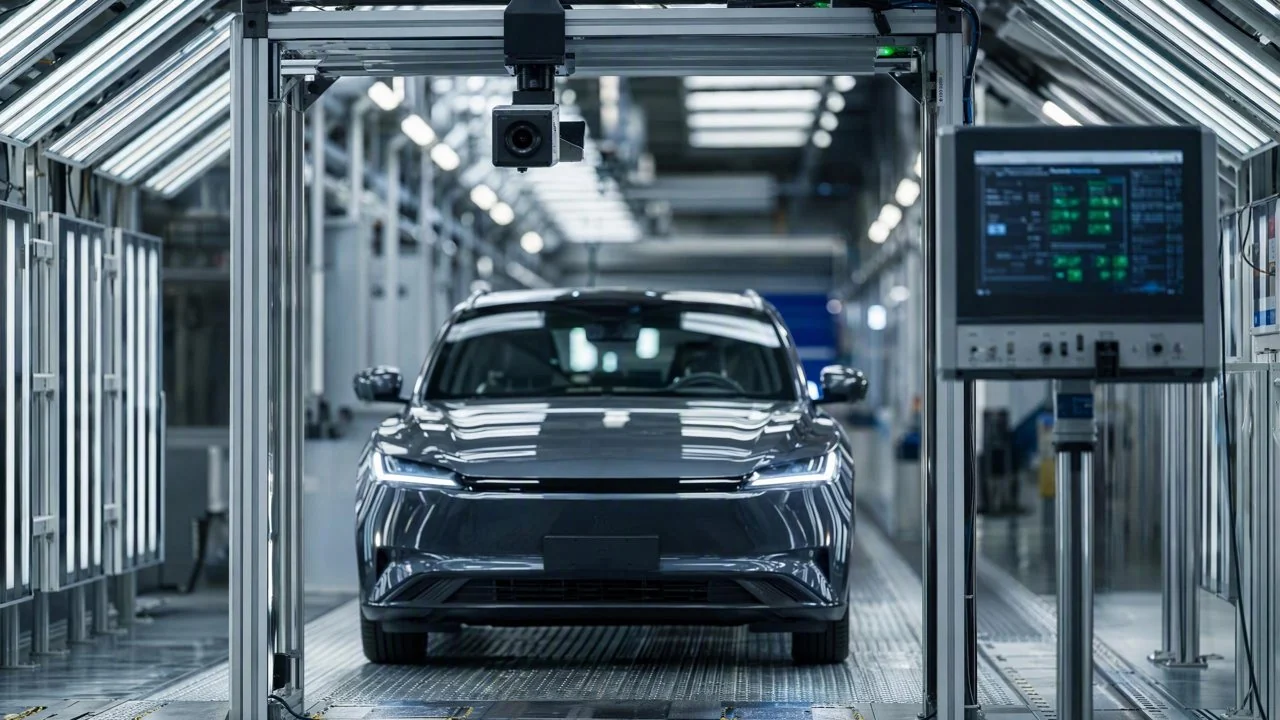
DaoAI SkyVision 0-code video surveillance AI platform (featuring on-site hourly training for custom models, behavior/event recognition, real-time edge device alerts, 100% on-premise data security, and DaoAI World semantic understanding) reduced the average single-vehicle cycle time bottleneck from 15 seconds to 3 seconds in the final quality inspection stage of an automotive assembly line through its high-precision, high-efficiency license plate and vehicle type recognition capabilities, effectively supporting 100% full inspection capacity requirements. In modern automotive manufacturing's video and smart surveillance scenarios, balancing production cycle time with full inspection capacity is a critical challenge for achieving efficient production. As demand for personalization and customization in the automotive market grows, multi-variety, small-batch production models are becoming increasingly common. This makes traditional recognition systems, which rely on manual labor or fixed rules, difficult to adapt to rapid model changes and high-concurrency inspection demands, especially in the final verification stage before vehicles roll off the line.
In modern automotive manufacturing's video and smart surveillance scenarios, balancing production cycle time with full inspection capacity is a critical challenge for achieving efficient production. As demand for personalization and customization in the automotive market grows, multi-variety, small-batch production models are becoming increasingly common. This makes traditional recognition systems, which rely on manual labor or fixed rules, difficult to adapt to rapid model changes and high-concurrency inspection demands, especially in the final verification stage before vehicles roll off the line. DaoAI SkyVision 0-code video surveillance AI platform, with its unique on-site hourly training for custom models, effectively addresses the bottlenecks of traditional solutions in meeting high-cycle, 100% full inspection requirements without impacting production cycle time. The platform not only captures and analyzes vehicle information in real-time but also links recognition results with production systems, ensuring accurate identity information for every vehicle leaving the line, thereby improving overall production quality traceability.
Pain Points: Why This Hurdle Is So Difficult to Overcome
For an automotive assembly line, license plate and vehicle type recognition for vehicles rolling off the line is a crucial part of quality control and logistics scheduling. Traditional recognition solutions face multiple challenges that severely constrain production line efficiency. Firstly, **insufficient recognition accuracy**. In real production environments, vehicle appearances are complex and diverse, lighting conditions vary greatly, and license plates may be dirty, reflective, or tilted, leading to false alarm rates exceeding 5% for traditional OCR or fixed feature extraction systems, with defect omission rates difficult to control below 1%, according to production line data. Secondly, **slow recognition speed, dragging down the production cycle time**. Manual inspection of a vehicle's license plate and type takes an average of 15 seconds. Even rule-based automated systems struggle to meet the cycle time requirements of modern automotive assembly lines, which often demand one vehicle every 60-90 seconds. Thirdly, **high changeover costs and long deployment cycles**. Whenever a new vehicle model is introduced or license plate styles are updated, traditional systems require extensive manual reconfiguration or code modification, resulting in long downtime, often several days, which severely impacts capacity. Furthermore, while cloud video surveillance offers technical advantages in enhancing enterprise security, for core production line data, companies generally have concerns about data security and privacy, necessitating 100% on-premise deployment solutions.
The root cause of these difficulties lies in the complex environment of automotive production lines, high-speed vehicle movement, and the diversity of license plate and vehicle type features. Traditional solutions often rely on preset rules and limited feature libraries, making them ill-equipped to handle real-time, changing complex scenarios. For example, vehicles at the end of the line may be at different angles, camera shooting angles vary, and environmental lighting fluctuations (such as indoor-outdoor transitions, light and shadow) all pose significant challenges for image acquisition and recognition. At the same time, license plate formats, fonts, and colors vary across different countries and regions, and vehicle models have subtle differences, requiring strong generalization capabilities for accurate recognition. Traditional solutions lack the adaptive and generalization capabilities of deep learning, making them unable to meet the high-cycle, high-standard demands of smart manufacturing in terms of accuracy, speed, and changeover flexibility.
Technical Principles
DaoAI SkyVision platform provides engineering depth for license plate/vehicle type recognition by combining deep learning, edge computing, and 0-code configuration concepts. Its core lies in the unified foundation built upon the DaoAI World global model, enabling feature cognition and semantic understanding of visual foundation models. For license plate recognition, SkyVision employs a multi-stage detection and recognition framework. First, deep learning object detection algorithms (such as optimized YOLO series) are used to quickly locate license plate areas in images, maintaining high robustness even under low resolution, uneven illumination, or partial occlusion. Next, image preprocessing, including tilt correction and brightness equalization, is performed on the located license plate area to standardize the input. Finally, a sequence recognition network (such as CRNN or Transformer-based models) is used for character recognition. This network can directly recognize characters from image sequences without separate segmentation, significantly improving recognition accuracy in complex backgrounds. Actual test data shows that DaoAI SkyVision can reduce the license plate recognition omission rate to <0.5%.
For vehicle type recognition, SkyVision utilizes large-scale pre-trained visual Transformer models for feature extraction, capable of capturing global and local detail features of vehicles, such as body contours, lamp shapes, and brand logos. Through few-shot learning (APDT few-shot learning, requiring only 1–20 good sample images), users can quickly train high-precision recognition models for specific vehicle types without extensive labeled data. Edge device deployment ensures real-time performance, pushing AI inference capabilities to the production line, avoiding data transmission delays and potential bottlenecks of cloud processing, achieving millisecond-level response times. Compared to traditional rule-based AOI or manual inspection, DaoAI SkyVision offers significant advantages: rule-based AOI struggles to adapt to complex and changing environments and vehicle types, requiring extensive manual rule writing and high maintenance costs; manual inspection is inefficient, prone to fatigue, and cannot meet high-cycle full inspection demands. SkyVision, on the other hand, leverages AI's adaptive learning capabilities to achieve rapid deployment and model iteration with 0-code configuration, greatly improving recognition efficiency and accuracy, while ensuring 100% on-premise data localization, with data never leaving the facility, meeting enterprises' high requirements for data security.
Typical Application Scenarios
- **Vehicle Off-line Identity Verification**: At the end of the automotive assembly line, before vehicles exit the production area, SkyVision cameras perform real-time recognition of license plates and vehicle types. Challenges include high-speed movement, varying lighting, and potential license plate damage. SkyVision completes recognition instantly as vehicles pass, ensuring a perfect match with vehicle information in the production planning system, achieving 100% full inspection.
- **Logistics Inbound/Outbound Management**: At the entrances and exits of vehicle logistics parks, SkyVision can automatically identify license plates and vehicle types of incoming and outgoing vehicles, interfacing with the logistics management system to automatically record vehicle information, timestamps, and trajectories. Challenges include wide-area coverage, 24/7 recognition, and robustness in different weather conditions. SkyVision's edge device real-time alert function can promptly detect abnormal vehicles.
- **Dealer Vehicle Inventory Management**: Dealerships or large parking lots can deploy SkyVision surveillance systems to periodically or in real-time inventory vehicles, automatically recognizing license plates and vehicle types, and generating inventory reports. Challenges include large-scale vehicle parking, complex obstructions, and a wide variety of vehicle types. SkyVision's few-shot learning capability can quickly adapt to new models.
- **After-sales Service Smart Dispatch**: At automotive repair and maintenance service centers, SkyVision recognizes license plates and vehicle types upon vehicle entry, automatically associating them with owner profiles and historical repair records, enabling smart dispatch and pre-generation of work orders. Challenges include high-speed recognition requirements and integration with multiple business systems. SkyVision's SDK / API / Docker deployment methods provide flexible integration capabilities.
Implementation Case Study
A leading automotive assembly plant faced long-standing issues with inefficient and error-prone manual inspection of license plates and vehicle types at the end of its assembly line, coupled with unstable recognition rates from traditional OCR systems. The plant operates at a fast production cycle, with vehicles rolling off the line every minute, demanding extremely high real-time performance and accuracy for recognition. Before implementation, the average verification time per vehicle was 15 seconds, with manual recognition and system entry consuming significant time, becoming a bottleneck restricting the acceleration of the production cycle. During peak periods, even two workers operating simultaneously struggled to ensure 100% full inspection efficiency and accuracy, especially during night shifts or in low light conditions, where false alarm and omission rates would further increase. The plant urgently needed a smart solution capable of efficient and precise recognition under high cycle times, integrated with its existing MES system.
DaoAI SkyVision not only elevated the accuracy of license plate/vehicle type recognition to over 99.7% but also compressed single-vehicle recognition and verification time from 15 seconds to 3 seconds, directly clearing production cycle bottlenecks and enabling the assembly plant to easily meet 100% full inspection capacity challenges.
The automotive assembly plant ultimately adopted the DaoAI SkyVision 0-code video surveillance AI platform. The deployment process was highly efficient, with edge devices, industrial-grade cameras, and network configuration completed in just 2 days. During the data collection phase, leveraging the semantic understanding of the DaoAI World global model, only a small number of license plate and vehicle type images (just 10-20 images per vehicle type) were collected under varying lighting and angles. On-site, engineers used SkyVision's 0-code interface to complete the training and deployment of custom models within 2 hours. After going live, the DaoAI SkyVision system, through edge devices deployed at the end of the production line, captured license plate and vehicle type information of vehicles rolling off the line in real-time. Production line data shows that the system improved the accuracy of license plate/vehicle type recognition to over 99.7%, while the average single-vehicle recognition and verification time was significantly reduced from 15 seconds to 3 seconds, greatly enhancing the overall production line cycle time. This means that tasks that previously required time-consuming manual operations are now completed almost instantaneously, largely alleviating the bottleneck effect at the end of the production line. Furthermore, the solution achieved 100% on-premise deployment, with all data processed in a closed loop within the factory, completely eliminating the client's concerns about data security and privacy.
DaoAI Solutions and Products
The DaoAI SkyVision 0-code video surveillance AI platform is the core solution for high-cycle, high-precision video surveillance scenarios. The platform's key advantages lie in its 0-code configuration and on-site hourly training for custom models. Users do not need programming expertise to train, deploy, and manage models through an intuitive graphical interface. For example, in license plate/vehicle type recognition tasks, users only need to upload a small number of license plate and vehicle type images from different angles and lighting conditions, and the SkyVision platform will automatically perform feature learning and model optimization. The APDT few-shot self-training technology adopted by DaoAI allows models to achieve industrial-grade recognition accuracy with just 1–20 positive sample images, significantly shortening model development cycles and data labeling costs. In terms of deployment, SkyVision supports various flexible integration methods such as SDK / API / Docker, allowing easy embedding into existing MES, WMS, and other production management systems, achieving data and process integration. Edge device deployment ensures AI inference is performed locally, not only guaranteeing data security but also providing millisecond-level real-time response capabilities, meeting the stringent low-latency requirements of the production line. The DaoAI World global model, as the underlying support, provides SkyVision with powerful semantic understanding and cross-scenario generalization capabilities, enabling the model to continuously learn from production line feedback and continuously improve performance.
The DaoAI SkyVision platform brought significant quantifiable results and business value to the automotive assembly plant. In this case, the average single-vehicle cycle time bottleneck for license plate/vehicle type recognition was reduced from 15 seconds to 3 seconds, directly improving the overall efficiency of the production line. At the same time, recognition accuracy increased from the traditional solution's 95% to over 99.7%, significantly reducing rework and logistics scheduling issues caused by recognition errors. The solution supports 100% full inspection, eliminating the fatigue and uncertainty of manual inspection, and ensuring the accuracy of vehicle information leaving the line. Through DaoAI SkyVision, the client not only achieved improved production efficiency but also optimized its quality traceability system and enhanced data security, thereby comprehensively elevating its smart manufacturing capabilities.
FAQ
How does DaoAI SkyVision achieve 0-code deployment for license plate/vehicle type recognition?
DaoAI SkyVision platform enables users to train and deploy models without writing any code, thanks to its intuitive graphical user interface and APDT few-shot learning technology. Users only need to upload a small number of license plate and vehicle type images as samples, and the platform will automatically perform feature extraction and model optimization, achieving on-site hourly model training, greatly simplifying the deployment process.
How many formats of license plates can DaoAI SkyVision support for different regions or countries?
Leveraging the powerful generalization capabilities of the DaoAI World global model, DaoAI SkyVision can rapidly adapt to license plate formats, fonts, colors, and other features from different countries and regions through few-shot learning. Clients only need to provide a small number of license plate samples specific to their area, and a high-precision recognition model can be trained in a short period, without needing to develop from scratch, offering high flexibility and scalability.
What is the approximate total cost of deploying DaoAI SkyVision for license plate/vehicle type recognition?
The deployment cost of DaoAI SkyVision is primarily influenced by factors such as the number of cameras, edge device configuration, and the need for deep integration with existing systems. We offer flexible SDK/API/Docker deployment options, supporting 100% on-premise private deployment to ensure data security. A specific quote requires an assessment based on your actual scenario needs. Please contact our experts for a customized solution and detailed pricing.
Full solution for this scenario: the full inspection solution for SkyVision Video AI
This article was generated by AI. Customer cases are simulated scenarios based on real product capabilities and figures are illustrative; see product pages for official benchmarks.