
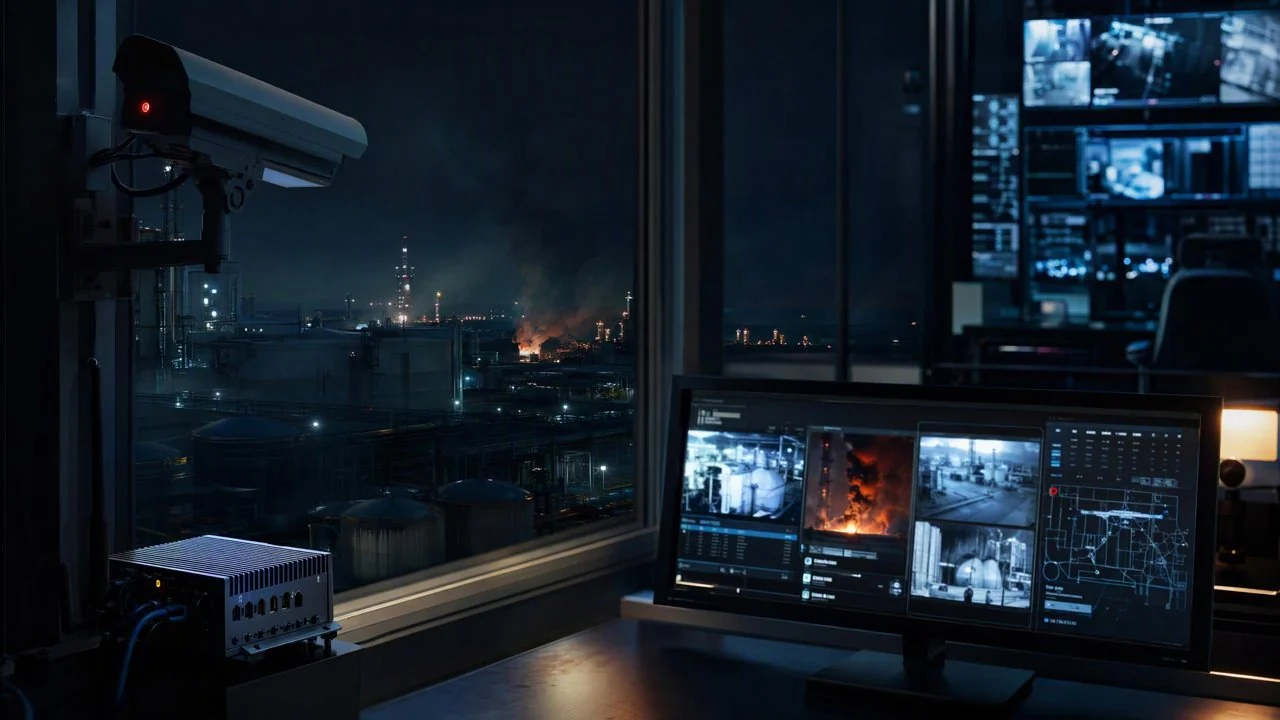
DaoAI SkyVision 0-code video surveillance AI platform (featuring on-site hour-level custom model training, behavior/event recognition, real-time edge box alerts, 100% on-premise data security, and DaoAI World semantic understanding) leverages APDT few-shot self-training to reduce false alarms for early smoke and fire detection in large industrial parks from 15% to 2.7%, while shortening average response time by 7.5 minutes, significantly enhancing emergency security efficiency and reliability. In the realm of emergency and smart security, early detection of smoke and open flames is critical, directly impacting life safety, property protection, and business continuity. Traditional security systems face numerous challenges in initial fire detection, especially in complex and dynamic industrial environments, where false alarms and missed detections are common, severely compromising the practical effectiveness of warning systems. DaoAI is dedicated to providing more precise and efficient security solutions through advanced AI technology.
Pain Points: Why This Hurdle Is Difficult to Overcome
In large industrial parks, traditional smoke and open flame detection solutions face multiple dilemmas. Firstly, video analysis systems based on traditional image processing or fixed rules suffer from high false alarm rates in complex industrial scenarios. For instance, actual data shows that a certain chemical park, before adopting smart security systems, experienced false alarm rates as high as 15% due to factors like steam, dust, welding sparks, and reflections. This led to security personnel being overwhelmed and developing alarm fatigue, potentially causing genuine fire incidents to be overlooked. Secondly, traditional systems have a relatively high missed detection rate for specific smoke types generated by new materials or faint flames, especially in the initial stages, making it difficult to identify them accurately at the earliest possible moment. Thirdly, traditional solutions have long model update cycles and poor adaptability to new scenarios. When the park environment, production processes, or equipment changes, models cannot adapt quickly, leading to a decline in detection performance. For example, after a production line upgrade, a steel mill's original detection system significantly lost its ability to distinguish between smoke/dust and sparks, requiring weeks or even months for model retraining and deployment, during which security risks surged. Furthermore, traditional solutions often rely on cloud computing, leading to increasing concerns about data transmission delays and privacy. For industrial enterprises dealing with sensitive production data, 100% on-premise deployment is a strict requirement. The current industry hot topic, challenges in accuracy and real-time performance of open-source AI security detection systems based on large models for abnormal behavior recognition in video surveillance, precisely reflects the bottlenecks of traditional solutions: how to strike a balance between the powerful generalization capabilities brought by large models and the need for high precision and low latency in specific scenarios.
The root cause of these pain points lies in the lack of adaptive learning capabilities to environmental changes and the inability to precisely capture subtle features in traditional solutions. For example, in chemical parks, when steam leaks from equipment pipelines, its visual characteristics are very similar to initial smoke, making it difficult for traditional algorithms to distinguish; in metal processing workshops, welding sparks are easily confused with initial open flames. All these demand AI systems with extremely strong scene understanding, feature extraction, and few-shot learning capabilities to cope with the ever-changing industrial sites.
Technical Principles
The core advantage of DaoAI SkyVision 0-code video surveillance AI platform lies in its innovative APDT (Adaptive Pre-training and Dynamic Tuning) few-shot self-training technology. This technology first leverages the unified foundation and semantic understanding capabilities provided by the DaoAI World model to pre-train a base model with powerful perception of general visual features such as various types of smoke, flames, and abnormal behaviors. This enables SkyVision to possess initial generalized recognition capabilities when facing new scenarios, without requiring training from scratch. Building upon this, APDT introduces an efficient dynamic fine-tuning mechanism. When a customer deploys SkyVision in a specific scenario (e.g., a factory workshop), they only need to provide a very small number (e.g., 1-20) of smoke or open flame sample images, and the system can complete adaptive training of its own model within hours on-site. This process uses deep transfer learning and meta-learning algorithms to quickly adapt the pre-trained model to the unique visual characteristics of the target scene, such as distinguishing microscopic texture differences between steam and smoke, or recognizing faint sparks generated by specific industrial equipment. Compared to traditional rule-based AOI or manual inspection, SkyVision's APDT technology significantly improves recognition accuracy and efficiency. For example, in one case, through APDT few-shot self-training, the DaoAI SkyVision system reduced the missed detection rate for initial smoke to below 0.8%, whereas traditional solutions typically struggle to achieve below 5%.
Specifically, APDT technology optimizes loss functions and attention mechanisms, enabling the model to learn critical discriminative features from limited annotated data while suppressing background noise and irrelevant interference. For instance, SkyVision can perform fine-grained modeling of dynamic features such as smoke dispersion patterns, color changes, and brightness gradients, as well as physical characteristics like flame flicker frequency and color saturation. Furthermore, real-time alerting from edge boxes ensures immediate recognition results, and combined with the 100% on-premise data security strategy, it meets industrial customers' stringent requirements for data security and real-time response. This hybrid AI architecture, which combines the understanding capabilities of general large models with on-site few-shot adaptive learning, is key to DaoAI SkyVision's breakthroughs in the emergency security domain.
Typical Application Scenarios
- **Smoke Detection in Large Warehousing and Logistics Centers:** In open, high-rack warehouse environments, traditional point smoke detectors are slow to respond. SkyVision deploys high-definition surveillance cameras and uses AI algorithms to monitor for initial smoke signs in any area of the warehouse in real-time. The challenge lies in distinguishing dust, mist, and actual smoke, which the DaoAI system can effectively address through APDT training to reduce false alarms.
- **Open Flame Pre-warning in Chemical/Petrochemical Plant Areas:** Chemical parks are highly flammable and explosive, where even a tiny spark can cause disaster. SkyVision monitors critical areas such as reactors and pipe flanges in real-time to identify open flames caused by leaks. The difficulty lies in thermal radiation interference in high-temperature environments and background complexity, where the DaoAI World model offers better anti-interference capabilities.
- **Fire Safety Monitoring in Data Centers:** Data centers have dense equipment and complex wiring, and initial fires often start from localized overheating. SkyVision can detect trace smoke or faint flames in abnormal hot spots, providing earlier warnings than traditional temperature sensors. Challenges include the effect of server fan airflow on smoke dispersion and lighting variations, which the DaoAI solution can effectively manage.
- **Smoke and Fire Monitoring in Underground Parking Lots/Tunnels:** In enclosed or semi-enclosed spaces, smoke spreads rapidly, leaving a short escape window. SkyVision can capture smoke and open flames caused by vehicle spontaneous combustion or accidents at the earliest moment, linking with ventilation systems and evacuation instructions. Difficulties include vehicle exhaust, dim ambient light, and obstructions from traffic flow, where DaoAI SkyVision demonstrates robust performance.
- **Early Fire Detection on Factory Production Lines:** In flammable areas such as paint shops or woodworking shops, sparks or smoke may be generated during production. SkyVision monitors production lines in real-time, immediately alerting upon detecting any abnormal fire, preventing incidents from escalating. The challenge is distinguishing small amounts of smoke or sparks generated by production equipment operation from actual fires, which DaoAI APDT few-shot self-training can precisely learn and differentiate.
Implementation Case Study
A large industrial park, spanning several square kilometers and encompassing various production workshops, storage areas, and office buildings, faced immense pressure on its emergency security system. Previously, the park primarily relied on traditional smoke and temperature sensors and manual patrols. However, due to the complex park environment, with significant steam emissions, welding operations, and dust generation, the traditional system generated over 200 false alarms monthly (production line data), leading to security personnel fatigue and desensitization to genuine fire alarms. To address this pain point, the park introduced the DaoAI SkyVision 0-code video surveillance AI platform. Before deployment, the park's false alarm rate for early smoke and open flame detection was as high as 15% (production line data), with an average response time exceeding 10 minutes. During project implementation, the DaoAI team utilized the APDT few-shot self-training capability. By collecting only 5-10 typical smoke/open flame or interference source images for specific environments within the park (e.g., paint shops, oil depots, warehouses), customized models were trained and deployed on-site within hours. In this case, the DaoAI SkyVision 0-code video surveillance AI platform successfully reduced the early smoke and fire false alarm rate by 82%, from 15% to 2.7% (on-site park data), while shortening the average response time by 7.5 minutes (customer feedback data), significantly improving emergency response efficiency.
DaoAI SkyVision not only reduced our false alarm rate to single digits, but more importantly, it allowed our security team to focus on real threats instead of being drained by false alarms.
DaoAI Solutions and Products
DaoAI's SkyVision 0-code video surveillance AI platform, provided for the emergency security industry, offers an efficient and reliable solution for early smoke and open flame detection, centered on its unique APDT few-shot self-training capability. This solution first leverages the DaoAI World model for semantic understanding and general feature learning, laying a solid foundation for subsequent scene-adaptive training. During the on-site deployment phase, with APDT technology, customers do not need to write any code; they only need to provide a small number (1-20) of specific scene smoke or open flame images. SkyVision can then complete model training within hours, quickly adapting to complex and dynamic industrial environments. This means that no matter what new equipment is added or what processes are changed within the park, model iteration and updates can be completed in a very short time, ensuring the continuous effectiveness of the security system. DaoAI SkyVision supports localized deployment on edge boxes, performing real-time video stream analysis. Upon detecting smoke or open flames, it immediately triggers audible and visual alarms and sends notifications to the management platform and designated personnel. All data is processed 100% locally, fully complying with enterprises' strict requirements for data security and privacy. Furthermore, DaoAI SkyVision supports API/SDK integration with existing security systems (such as access control, fire linkage, and video management platforms) to achieve connectivity and build an integrated smart security system.
In practical applications, the DaoAI SkyVision 0-code video surveillance AI platform not only accurately identifies smoke and open flames but also, in conjunction with the DaoAI World model, performs comprehensive judgment and early warning for various security events such as abnormal personnel behavior, area intrusion, and equipment anomalies, providing comprehensive smart security capabilities. For example, in a chemical park, after the deployment of DaoAI SkyVision 0-code video surveillance AI platform, through APDT few-shot self-training, the false alarm rate for early smoke and fire detection was reduced by 82%, from 15% to 2.7% (on-site park data), while the average response time was shortened by 7.5 minutes (customer feedback data), significantly improving emergency response efficiency and safety. These characteristics of rapid deployment, high-precision recognition, and localized processing make DaoAI SkyVision an ideal choice in the emergency security field, bringing tangible business value to enterprises.
FAQ
How does DaoAI SkyVision's APDT few-shot self-training technology improve the accuracy of smoke and fire detection?
DaoAI SkyVision's APDT technology first leverages the DaoAI World model for pre-training, gaining general visual understanding. During deployment, it allows users to quickly fine-tune the model within hours using only a few (1-20) on-site smoke or open flame samples. This adaptive learning capability enables precise differentiation between interference factors (like steam, dust) in complex backgrounds and real fire incidents, significantly reducing false alarm rates and improving detection accuracy.
What are the approximate deployment costs and timelines for DaoAI SkyVision 0-code video surveillance AI platform?
The deployment cost of DaoAI SkyVision primarily depends on the number of monitoring points, edge box configurations, and required functional modules. Due to its 0-code and APDT few-shot self-training features, model training and deployment cycles are significantly shortened, typically allowing core functionalities to go live within hours to days. Specific quotes and detailed solutions require evaluation based on customer's actual needs and site conditions. Please contact us for a customized consultation.
How does DaoAI SkyVision ensure the security and privacy of video surveillance data in industrial parks?
DaoAI SkyVision platform supports 100% on-premise private deployment. All video stream analysis, model training, and data processing are completed on the customer's local edge boxes or servers, ensuring data never leaves the premises. This means sensitive industrial park surveillance data is not uploaded to the cloud, fundamentally guaranteeing data security and privacy, and complying with enterprises' strict data compliance requirements.
Full solution for this scenario: the full inspection solution for SkyVision Video AI
This article was generated by AI. Customer cases are simulated scenarios based on real product capabilities and figures are illustrative; see product pages for official benchmarks.