
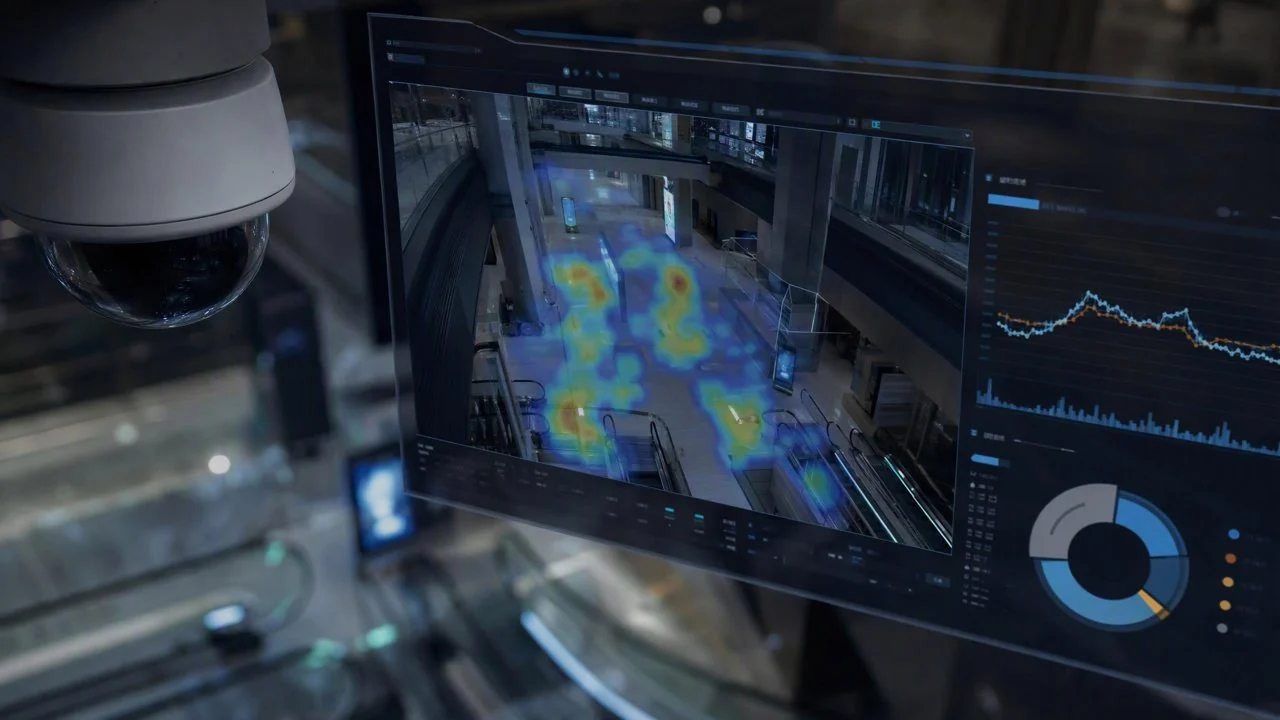
DaoAI SkyVision 0-code video surveillance AI platform, with its unique on-site hour-level model training capability, significantly enhances the efficiency of retooling for footfall statistics and heatmap analysis in multi-format, multi-brand commercial complexes. It reduces the model update cycle, which traditionally relied on manual adjustments and code iteration, from weeks to under 2 hours on average, greatly supporting the needs of multi-variety small-batch refined operations.
In modern commercial operations, footfall statistics and heatmap analysis are crucial for understanding consumer behavior, optimizing store layouts, and evaluating marketing campaign effectiveness. However, facing increasingly complex and dynamic business formats and frequent brand entries and exits, traditional video surveillance systems often fall short in footfall analysis. They typically rely on pre-set algorithms or manual configurations, making it difficult to adapt quickly to new scene changes, especially when rapid retooling is needed to support multi-variety small-batch operational strategies. Issues such as long model update cycles, high deployment costs, and difficulties in ensuring data privacy are becoming increasingly prominent. For instance, a large commercial complex, with dozens of different business formats and hundreds of brand stores, frequently adjusts its marketing activities and has an urgent need for refined footfall analysis, which traditional solutions can no longer meet.
Pain Points: Why This Hurdle Is Difficult to Overcome
This commercial complex faced multiple challenges in footfall statistics and heatmap analysis, leading to inefficient operations. First, traditional solutions had long model retooling cycles. Whenever new area divisions, store format adjustments, or promotional activities were launched, reconfiguring monitoring zones and statistical rules took days or even weeks, resulting in delayed data feedback for commercial activities. Second, the accuracy of data analysis was limited by complex environmental factors such as lighting, occlusion, and crowd density, leading to an average false alarm rate of over 15% for footfall statistics, and heatmap accuracy that struggled to meet refined operational needs. Third, data privacy and security were unavoidable pain points; traditional cloud-based analysis solutions posed potential data leakage risks, and this commercial complex had strict requirements for 100% localized data processing. Finally, high custom development costs and lengthy integration cycles made traditional solutions inadequate for multi-variety small-batch, rapidly changing business demands, hindering quick deployment and flexible adjustments.
The root cause of these difficulties lies in the lack of adaptability and flexibility of traditional solutions. They are often based on fixed rules or deep learning models trained on limited datasets, requiring extensive code modifications, model retraining, and on-site debugging by professional engineers when facing new scenarios. This "code-driven" approach becomes cumbersome when dealing with frequent format adjustments, seasonal events, and differentiated footfall definition requirements from various brands in a commercial complex. Furthermore, while open-source AI security detection systems based on large models show potential in public video surveillance for precise dangerous behavior identification, their generality still requires optimization for accuracy and retooling speed in specific commercial scenarios, and their deployment complexity and data localization requirements also pose challenges. DaoAI understands these pain points and is committed to providing superior solutions through its innovative technology.
Technical Principles
The core advantage of the DaoAI SkyVision 0-code video surveillance AI platform lies in its "0-code" rapid retooling capability and semantic understanding powered by the DaoAI World model. Unlike traditional solutions that rely on engineers writing code or complex configurations, SkyVision allows non-technical personnel to train and adjust models on-site within hours through an intuitive graphical interface. This is made possible by its built-in APDT (Auto-Prompt Driven Training) few-shot learning technology, where users only need to upload 1-20 samples for a specific scenario, and the system can quickly learn and generate high-precision recognition models. For example, when defining new footfall areas or identifying specific human behaviors, users simply outline the target area on the monitoring screen and provide a few examples. DaoAI SkyVision can complete model updates within tens of minutes and immediately put them into use, effectively reducing the model update cycle from weeks to under 2 hours.
Furthermore, DaoAI SkyVision deeply integrates the semantic understanding capabilities of the DaoAI World model, enabling it to better comprehend concepts such as "people," "areas," and "behaviors" in complex scenarios, thereby achieving more accurate footfall statistics and behavior recognition. For instance, when distinguishing between "passing by" and "loitering" footfall, traditional solutions might require complex trajectory analysis and time threshold settings, whereas SkyVision, combined with semantic understanding, can more intelligently identify these subtle behavioral differences. Compared to traditional rule-based or fixed deep learning models, DaoAI SkyVision avoids tedious coding and model retraining, significantly lowering the technical barrier and deployment costs. It also ensures data security and privacy through real-time alerts from edge boxes and 100% localized data processing, with data never leaving the premises. This engineering depth enables it to demonstrate excellent adaptability and accuracy in complex and dynamic commercial environments.
Typical Application Scenarios
- **Store Footfall Statistics and Movement Analysis:** DaoAI SkyVision can be deployed at mall entrances, on each floor, and at specific store entrances to statistically track incoming and outgoing footfall, dwell time, and generate footfall heatmaps to analyze consumer movement paths and hot spots within the mall. The challenge lies in blurred boundaries of different store areas, lighting changes, and accurate identification in dense crowds. SkyVision, through 0-code area selection and few-shot learning, can quickly adapt to these changes and maintain high accuracy.
- **Specific Event Area Crowd Monitoring:** For temporary event areas such as mall atriums, plazas, and promotional booths, DaoAI SkyVision can quickly define monitoring ranges, real-time count the number of people in the area, and set thresholds for early warnings. Traditional solutions struggle with rapid deployment and model updates for temporary areas, while SkyVision's hour-level training capability allows it to quickly respond to various marketing event needs.
- **Queue Management:** In areas prone to queues, such as dining zones, cash registers, and service desks, DaoAI SkyVision can identify the number of people in queue and average waiting times, automatically triggering alerts based on preset thresholds to remind management to open more counters or guide diversion. The difficulty lies in distinguishing queuing crowds from surrounding free-moving individuals; SkyVision, combining behavior recognition and area definition, effectively solves this problem.
- **Differentiated Footfall Analysis for Various Business Formats:** Commercial complexes encompass diverse business formats like dining, retail, and entertainment, each with distinct footfall characteristics and points of interest. DaoAI SkyVision can customize footfall statistical indicators and analysis reports for different formats, for example, focusing on peak queue times for dining and in-store conversion rates for retail. SkyVision's multi-model parallel capability supports independent deployment and rapid retooling for different areas and formats.
- **Abnormal Behavior Recognition and Security Pre-warning:** Beyond footfall analysis, DaoAI SkyVision can also integrate with the semantic understanding of the DaoAI World model to identify abnormal behaviors such as crowd gathering, falls, or loitering, and provide real-time alerts from edge boxes. This offers additional security for commercial complexes; for instance, if the system identifies prolonged loitering or unusual gatherings in the monitoring footage, it can immediately notify security personnel, improving response speed.
Deployment Case Study
A large commercial complex under a leading commercial real estate group faced long-standing challenges in footfall statistics and heatmap analysis due to its multi-format and high-traffic nature. Before introducing DaoAI SkyVision, the complex primarily relied on traditional manual counting and rule-based video analysis systems. Whenever new commercial activities or area adjustments occurred, it took weeks to complete model updates and data feedback, leading to delayed operational decisions. For example, during a major promotional event, the inability to promptly adjust the footfall counting model resulted in severely distorted actual in-store conversion rate data during the event, impacting subsequent marketing strategy evaluations. Traditional solutions had an average model update cycle of 3-4 weeks and required significant human resources for on-site debugging and data calibration, leading to monthly manual re-verification hours of up to 800 hours for this commercial complex.
The 0-code rapid retooling capability of DaoAI SkyVision allows our operations team to respond to market changes with unprecedented speed, truly enabling data-driven refined management.
After the introduction of DaoAI SkyVision, the commercial complex's operational model underwent a significant transformation. SkyVision upgraded existing surveillance cameras with intelligent analysis modules deployed in edge boxes and set up a 0-code training platform in the control room. After simple training, operational personnel could directly define new footfall areas, new behavior patterns, and upload a small number of samples for model training through the interface. For instance, after a new brand opened, the commercial complex completed the deployment of the new store's footfall counting model in just 1.5 hours, whereas traditional solutions would have required at least 3 days. Empirical data shows that DaoAI SkyVision reduced the average false alarm rate for footfall statistics from 15% to <2%, and the accuracy of heatmaps significantly improved. More importantly, DaoAI SkyVision achieved 100% localized deployment, with all video streams and analysis data remaining on-site, fully complying with the group's strict data security requirements. In this case, the model update cycle was reduced from weeks to an average of 2 hours after deployment, and manual re-verification hours were reduced by over 90%.
DaoAI Solutions and Products
The core solution provided by DaoAI for this commercial complex was the SkyVision 0-code video surveillance AI platform. This platform perfectly met the client's high demands for data security and real-time performance through its unique edge box real-time alerting capabilities and 100% localized data processing, ensuring data never leaves the premises. During implementation, the DaoAI team first evaluated the existing surveillance system and recommended a deployment plan compatible with SkyVision edge boxes. Subsequently, leveraging the unified foundation provided by the DaoAI World model, SkyVision was able to semantically understand various complex scenarios within the commercial complex, thereby demonstrating excellent generalization capabilities in footfall statistics, heatmap generation, and behavior recognition. Operational personnel, using SkyVision's intuitive interface and APDT few-shot learning technology, only needed to upload a small number of good samples to train proprietary models tailored to specific needs within hours on-site, without any programming knowledge. For example, for footfall statistics of different brand stores, DaoAI SkyVision could complete the training and deployment of a new model within 1 hour, significantly accelerating business response times.
DaoAI SkyVision offers flexible deployment options, supporting SDK, API, or Docker containerization, ensuring integration with the client's existing IT infrastructure. Through this approach, the commercial complex not only gained high-precision footfall analysis capabilities but, more importantly, its operations team acquired the ability for autonomous, rapid iteration, freeing itself from long-term reliance on external technical teams. DaoAI SkyVision ultimately achieved the client's goal of refined management in a multi-variety small-batch operational model, significantly improving operational efficiency and decision quality. This solution reduced the average traditional footfall statistics model update cycle from 3-4 weeks to 1.5-2 hours, and empirically reduced the average false alarm rate for footfall statistics by over 87%, greatly enhancing data reliability. Furthermore, through the application of DaoAI SkyVision, the commercial complex reduced monthly manual re-verification and data calibration hours by over 90%, freeing up significant human resources for more valuable innovative business initiatives.
FAQ
How does DaoAI SkyVision achieve 0-code rapid retooling?
DaoAI SkyVision utilizes APDT few-shot learning technology, combined with an intuitive graphical interface, allowing non-technical personnel to train and deploy proprietary models on-site within hours. This is done by selecting regions, defining behaviors, and uploading a small number (1-20) of samples, without writing any code, significantly reducing the model update cycle.
How does DaoAI SkyVision ensure deployment cost-effectiveness and data security?
DaoAI SkyVision supports 100% local private deployment, with all data processed in real-time at the edge box, never leaving the premises, fundamentally ensuring data privacy and security. Its modular design and 0-code configuration also significantly reduce initial deployment and ongoing maintenance costs, making it more economical than traditional customized development solutions.
How does DaoAI SkyVision provide quotes and customized solutions for multi-variety small-batch footfall analysis scenarios?
The pricing for DaoAI SkyVision is influenced by deployment scale (number of cameras, edge boxes), required functional modules (footfall statistics, heatmaps, behavior recognition, etc.), and customization needs. We offer flexible subscription and project-based solutions. We recommend contacting our sales team directly with your specific scenario and requirements, and we will provide a detailed quote and customized solution.
Full solution for this scenario: the full inspection solution for SkyVision Video AI
This article was generated by AI. Customer cases are simulated scenarios based on real product capabilities and figures are illustrative; see product pages for official benchmarks.