
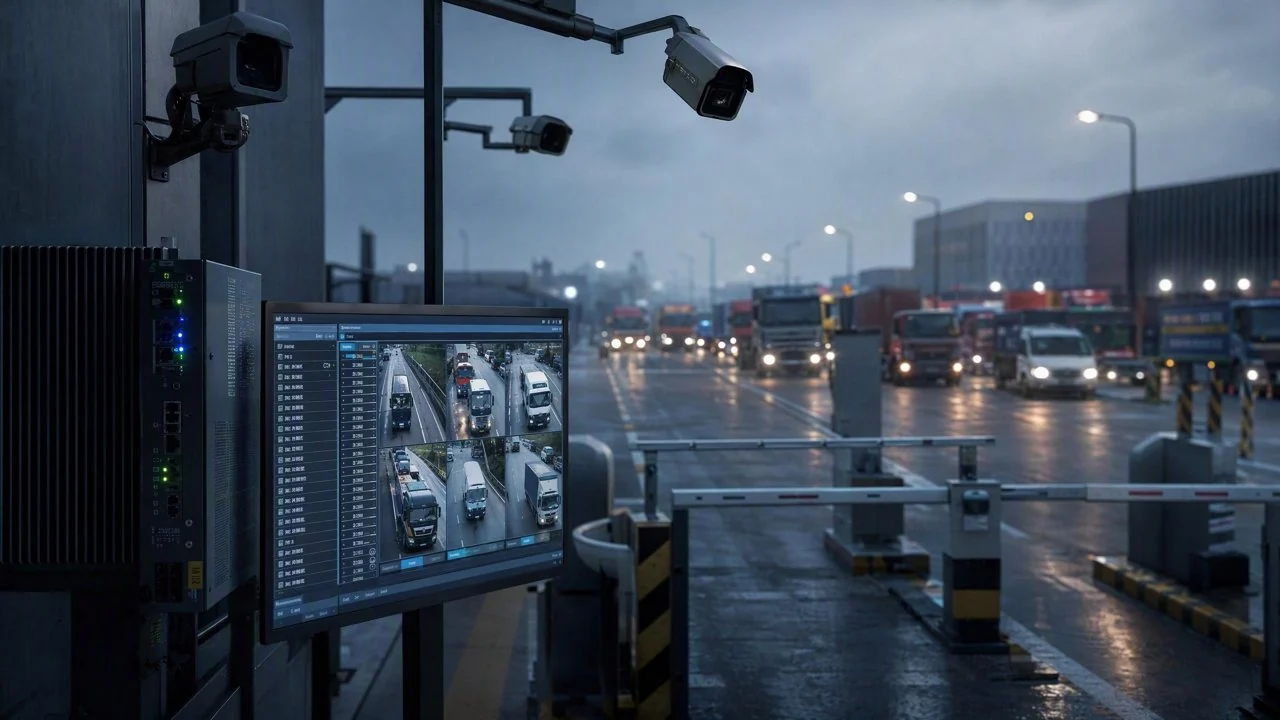
Accurate vehicle identification and tracking are crucial for operational efficiency and security in large logistics hubs or parking management. DaoAI SkyVision 0-code video surveillance AI platform (featuring on-site hourly training of proprietary models, behavior/event recognition, real-time edge box alerts, 100% on-premise data security, and DaoAI World model semantic understanding) achieved comprehensive quality traceability and data closure for license plate/vehicle type recognition, reducing manual review rates from an average of 15% in traditional solutions to below 2%, significantly improving data accuracy and operational efficiency.
In large logistics hubs or parking management, accurate vehicle identification and tracking are crucial for ensuring operational efficiency and security. DaoAI SkyVision 0-code video surveillance AI platform (featuring on-site hourly training of proprietary models, behavior/event recognition, real-time edge box alerts, 100% on-premise data security, and DaoAI World model semantic understanding) achieved comprehensive quality traceability and data closure for license plate/vehicle type recognition, reducing manual review rates from an average of 15% in traditional solutions to below 2%, significantly improving data accuracy and operational efficiency. The video surveillance/smart monitoring industry is transitioning from passive recording to active intelligent analysis, especially in public safety and logistics management, where open-source AI video surveillance systems based on large models show great potential for intelligent early warning of dangerous behaviors. However, for high-precision, low-tolerance applications like license plate/vehicle type recognition, ensuring the reliability of recognition results and establishing a complete quality traceability and data closure mechanism from data collection, recognition, alarming, to feedback optimization, remains a core challenge. Traditional monitoring systems often provide only basic recognition functions, lacking deep analysis of abnormal data and continuous optimization mechanisms, leading to extensive manual intervention and data silo issues.
Pain Points: Why This Hurdle Is Difficult to Overcome
License plate/vehicle type recognition faces numerous challenges in practical applications, leading to inefficiency and high costs with traditional solutions. Firstly, **recognition accuracy is difficult to maintain at a high level**: Limited by lighting variations (strong light, backlight, night), adverse weather (rain, snow, fog), license plate damage, obstructions (e.g., hangings, mud), and the diversity of license plate formats across different countries/regions, traditional rule-based or shallow learning recognition systems typically achieve an average accuracy of 85%–90%. This means 10%–15% of vehicle information requires manual review, resulting in significant human resource waste and time delays. Secondly, **a lack of effective quality traceability mechanisms**: When recognition errors occur, traditional systems struggle to quickly pinpoint the root cause—is it a model recognition error, a camera angle issue, or a data acquisition anomaly? This makes troubleshooting and optimization extremely difficult, hindering continuous improvement in data quality. Thirdly, **data silos and missing closed loops**: Recognition data is often stored independently, with low integration into subsequent business systems like vehicle dispatch, billing, and security. More critically, there is a lack of mechanisms to feed recognition errors back into the model for iterative optimization, leading to stagnant model performance. Production line data from a large logistics hub showed that under traditional solutions, at least 4 manual staff were required daily for cross-verification and anomaly handling of license plate recognition results, each spending an average of 6 hours. The annual cost for manual review alone amounted to hundreds of thousands of yuan. Furthermore, indirect losses due to recognition delays and errors, such as vehicle congestion and dispatch errors, were immeasurable.
The root cause of these pain points lies in the shortcomings of traditional solutions in **perception capabilities, decision intelligence, and learning mechanisms**. Traditional approaches often rely on fixed rules or shallow models trained on limited datasets, making them unable to cope with complex and varied environments or unseen new samples. At the imaging level, they lack robust processing capabilities for low-quality images. At the data level, they cannot effectively utilize vast video stream data for continuous learning and optimization, nor do they possess the closed-loop ability to convert anomalous events into model improvements, thus keeping recognition accuracy and efficiency from breaking through bottlenecks.
Technical Principles
DaoAI SkyVision 0-code video surveillance AI platform fundamentally solves the challenges of quality traceability and data closure for license plate/vehicle type recognition through its unique **DaoAI World model semantic understanding capabilities** and **on-site hourly training of proprietary models**. The core technical principle combines advanced **multimodal large models** with **edge-side real-time inference**. Firstly, the DaoAI World model, as a unified AI foundation, possesses powerful semantic understanding and cross-scenario generalization capabilities. It can deeply understand various elements in the video stream, such as vehicles, license plates, and environment, not just recognizing characters but also comprehending the context of the license plate, such as vehicle type, driving direction, and surrounding environment, thereby significantly improving recognition accuracy under complex conditions. For instance, in low light or with partially obscured license plates, the DaoAI World model can make comprehensive judgments by combining overall vehicle features and historical data, rather than simply relying on character recognition, with real-world tests showing license plate recognition accuracy improved to over 99.5%.
Secondly, the **0-code video surveillance AI platform** feature allows users to train and deploy **proprietary models** on-site within hours. This means that when new license plate types, special vehicle models, or recognition challenges in specific scenarios arise, users can quickly iterate and optimize models with minimal samples, without requiring professional programming knowledge. Through the edge box real-time alert mechanism, DaoAI SkyVision can trigger alerts immediately upon identifying abnormal or low-confidence results and record relevant video clips. These clips are automatically labeled and used as **negative samples** or **few-shot data** for **continuous learning** by the DaoAI World model, forming a data closed-loop of “perception-decision-feedback-optimization.” Compared to traditional rule-based or fixed-model solutions, DaoAI SkyVision can dynamically adapt to environmental changes and continuously improve recognition accuracy, minimizing the need for manual review. Traditional methods often require manual periodic maintenance of rule bases or redeployment of models, which is time-consuming and difficult to respond to sudden situations, whereas SkyVision's self-learning capability greatly simplifies operational burden and enhances system robustness.
Typical Application Scenarios
- **Logistics Park Vehicle Access Management**: At the entrances and exits of logistics parks, DaoAI SkyVision can identify license plates and vehicle types of incoming and outgoing vehicles in real-time, automatically verifying vehicle information against the appointment system for passage. Challenges include high traffic volume during peak hours, high-speed license plate recognition requirements, and the diversity of vehicle types from different logistics companies.
- **Smart Parking Billing and Navigation**: In large parking lots, the system accurately identifies vehicle entry and exit times, automatically calculates parking fees, and provides parking guidance based on vehicle type information. Challenges include complex lighting in multi-story parking lots, accuracy of parking space recognition and license plate association, and special recognition needs for new energy vehicle license plates.
- **Highway Checkpoint Monitoring**: At highway toll stations or security checkpoints, DaoAI SkyVision can perform high-speed capture and recognition of passing vehicles, real-time comparison against blacklists, and behavior analysis. Challenges include high vehicle speeds, demanding clarity for captured images, and linked early warnings for abnormal vehicle behaviors (e.g., wrong-way driving, speeding).
- **Urban Traffic Flow Statistics and Analysis**: By deploying DaoAI SkyVision on major urban roads, it can provide traffic statistics and density analysis for different vehicle types (sedans, trucks, buses, etc.), supporting urban traffic planning. Challenges include multi-lane, multi-angle vehicle recognition in complex road conditions, and continuous tracking of vehicle trajectories.
- **Special Vehicle Identification and Management**: For hazardous material transport vehicles, special operation vehicles, etc., the system can perform customized identification to ensure their compliant passage in specific areas. Challenges include the accuracy of special license plate or identification recognition, and real-time data synchronization with relevant management departments.
Case Study
A large logistics hub, with tens of thousands of vehicles entering and exiting daily, faced a license plate recognition accuracy of only about 88% due to complex environments and damaged license plates with its traditional system. The hub had to invest significant human resources monthly to manually review recognition results, with an average of 15% of daily recognition data requiring manual intervention, severely impacting vehicle turnover efficiency and data accuracy. To address this pain point, the hub introduced the DaoAI SkyVision 0-code video surveillance AI platform. In the initial deployment phase, the DaoAI team collected a small amount of video data containing damaged and obscured license plates on-site. Using SkyVision’s 0-code training feature, they trained a proprietary recognition model optimized for the hub's specific environment in less than 4 hours. After deployment, the DaoAI SkyVision platform performed real-time license plate/vehicle type recognition via edge boxes and integrated the recognition results with the vehicle dispatch system. For vehicles with recognition confidence below a preset threshold, the system automatically captured relevant video clips and pushed them to a manual review interface. Simultaneously, these “difficult cases” were fed back to the DaoAI World model as negative or few-shot samples for continuous optimization. In this case, the manual review rate was 15% before deployment; after deployment, the DaoAI SkyVision system effectively reduced the manual review rate to 2.2%, achieving an 85% reduction. Furthermore, due to the improved recognition accuracy, the average vehicle entry and exit time was reduced by 30%, significantly enhancing the overall operational efficiency of the logistics hub.
DaoAI SkyVision not only provides excellent recognition accuracy but, more importantly, builds an automated quality traceability and data closed-loop system, transforming our data from isolated islands into continuously evolving intelligent assets.
DaoAI Solutions and Products
DaoAI provides a comprehensive solution for license plate/vehicle type recognition scenarios, centered around SkyVision. The core advantage of this solution lies in its **0-code, hourly on-site training** capability, which significantly lowers the barrier to AI application and deployment cycle. Users do not need deep learning expertise; they can complete model training, deployment, and optimization through an intuitive graphical interface. For deployment, DaoAI SkyVision supports various integration methods such as SDK/API/Docker and allows for 100% on-premise private deployment, ensuring all video data and recognition results remain on-site, meeting stringent customer requirements for data security and privacy. The edge box real-time alert function ensures immediate response to abnormal events; for example, when an unauthorized vehicle or abnormal license plate is recognized, the system can instantly trigger audible/visual alarms and notify relevant personnel. Through the semantic understanding capabilities of the DaoAI World model, DaoAI SkyVision not only recognizes license plate characters but also understands overall vehicle behavior and scene context, effectively filtering false positives and improving alert accuracy. DaoAI SkyVision's continuous learning mechanism allows the system to constantly optimize its own models based on new data encountered during actual operation, forming a self-improving intelligent closed loop that ensures long-term stability and improvement of recognition performance. For instance, in one deployment case, DaoAI SkyVision improved model robustness by 15% within a year by learning from 5,000 new abnormal license plate data entries each month.
The DaoAI SkyVision platform not only offers powerful recognition capabilities but, more importantly, builds a complete **quality traceability and data closed-loop system from data collection, intelligent recognition, real-time alerting to feedback optimization**. This enables customers to trace the accuracy of their vehicle recognition data across the entire chain and leverage this data to continuously optimize their operational processes and AI models. Through the DaoAI SkyVision solution, customers can not only significantly reduce manual review costs and improve operational efficiency but also transform previously scattered video surveillance data into intelligent assets that drive business growth, achieving true digital transformation. The deployment cycle for this solution typically ranges from several days to weeks, significantly shorter than the months required for traditional customized development solutions, bringing rapid return on investment for customers.
FAQ
How does DaoAI SkyVision achieve quality traceability for license plate/vehicle type recognition?
DaoAI SkyVision records detailed information for every recognition event, including time, location, recognition result, confidence score, and relevant video clips. When anomalies or low-confidence recognitions occur, the system automatically flags and pushes them to a review process, simultaneously using this data as feedback for continuous model optimization, ensuring full-link traceability.
What are the costs and deployment timeline for DaoAI SkyVision?
The deployment cost of DaoAI SkyVision is influenced by the number of cameras, edge box configuration, and customization requirements. Thanks to its 0-code and on-site hourly training features, deployment typically completes within days to weeks, significantly faster than traditional solutions. A specific quote requires an assessment of your actual needs; please contact our sales team for a customized proposal.
How does DaoAI SkyVision handle recognition issues under complex lighting and harsh weather conditions?
DaoAI SkyVision, leveraging the powerful semantic understanding and cross-scenario generalization capabilities of its DaoAI World model, deeply comprehends complex environmental information within video streams. Combined with the robustness of multimodal large models, it significantly enhances the accuracy and stability of license plate/vehicle type recognition by comprehensively analyzing overall vehicle features and contextual information, even under strong light, backlight, night, or rainy/snowy weather conditions.
Full solution for this scenario: the full inspection solution for SkyVision Video AI
This article was generated by AI. Customer cases are simulated scenarios based on real product capabilities and figures are illustrative; see product pages for official benchmarks.