
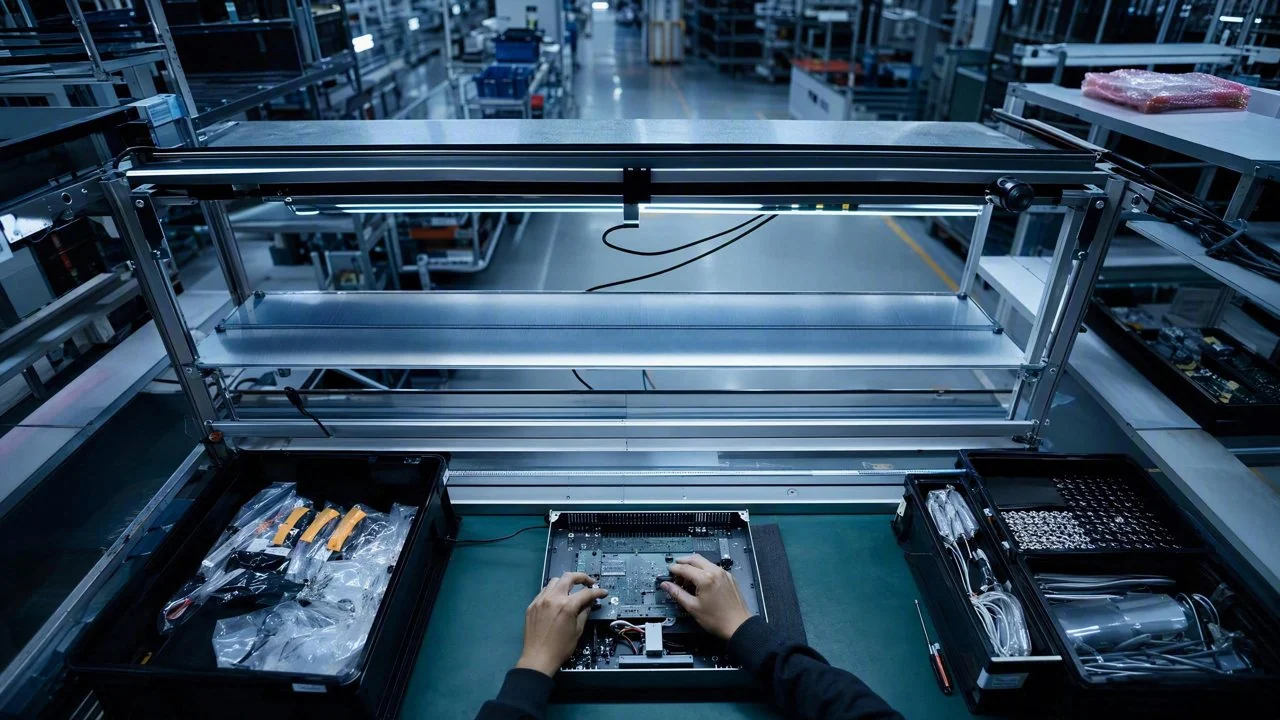
In industrial production, WeLinkirt's SkyVision 0-code video surveillance AI platform (on-site hourly proprietary model training, behavior/event recognition, edge box real-time alerting, 100% local data security, DaoAI World model semantic understanding) significantly enhances the detection accuracy of dual-hand operation SOP violations on large-scale electronics component manufacturing lines through its advanced APDT few-shot self-training technology, reducing the typical 5-8% missed detection rate of traditional manual patrols to <0.8% in practical applications. In today's landscape where lean manufacturing and safety compliance are increasingly critical, ensuring operators strictly adhere to Standard Operating Procedures (SOPs) is vital for product quality, production efficiency, and employee safety. Particularly in precision assembly, many operations require collaborative dual-hand movements, and any non-standard action can lead to product defects or safety incidents.
In the complex environment of industrial production, especially in high-precision electronics component manufacturing, adherence to dual-hand operation SOPs directly impacts the quality and reliability of final products. Traditionally, supervision of such procedures primarily relied on physical patrols and spot checks by on-site managers, or post-event review of surveillance footage. However, this approach is inefficient and prone to missed detections, particularly on fast-paced, densely populated production lines where managers struggle to cover all workstations in real-time. WeLinkirt's SkyVision platform addresses this pain point by leveraging its powerful AI visual analysis capabilities to achieve intelligent, real-time supervision of dual-hand operation SOPs.
Pain Points: Why This Hurdle Is Difficult to Overcome
Supervision of dual-hand operation SOPs faces multiple challenges with traditional solutions. Firstly, the missed detection rate of manual patrols remains high; statistics from a leading electronics component manufacturer show that during peak production hours, the missed detection rate for dual-hand SOP violations by manual patrols reached 5-8%. Secondly, post-event video review is extremely time-consuming, often requiring significant human effort for hours or even days of video analysis to uncover a few violations, leading to high manual re-inspection hours; this enterprise typically spent over 300 hours per month on video review. Furthermore, traditional rule-based vision systems exhibit poor robustness to complex, dynamic limb movements and environmental lighting changes, making them unsuitable for dynamic industrial environments, resulting in high false positive rates and suboptimal deployment outcomes. Additionally, due to continuous adjustments in production processes and the introduction of new products, SOPs frequently require updates. Traditional systems lack the ability to quickly adapt to new procedures, with each adjustment demanding extensive development and debugging time, further exacerbating operational costs and compliance risks.
The root cause of these difficulties lies in the complexity and diversity of industrial SOPs. For instance, in the welding or assembly processes of a precision electronic component, operators might be required to simultaneously pick up two specific parts with both hands, place them in a particular sequence, or keep their hands within a designated area during operation. Such subtle and dynamic motion patterns are challenging to precisely capture and define with traditional visual rules. Meanwhile, variations in operator physique, lighting changes, and obstructions from other equipment on the production line all pose significant challenges for rule-based recognition. While current large model-based open-source video surveillance systems show potential in public safety for real-time hazardous behavior prediction, applying them directly to industrial scenarios still requires addressing issues of data privacy, model lightweighting, and generalization capabilities for specific industrial behaviors. WeLinkirt's SkyVision APDT few-shot self-training technology is specifically designed to meet these needs.
Technical Principles
The core advantage of WeLinkirt's SkyVision lies in its APDT (Automated Pre-training and Dynamic Training) few-shot self-training technology. This technology enables users to quickly train models for specific operational procedures on-site within hours, using a minimal number of samples (typically 1-20 images or a few seconds of video footage). Its principle is based on the powerful semantic understanding and feature recognition capabilities of the DaoAI World model. The DaoAI World model has pre-learned vast amounts of general visual knowledge, enabling it to comprehend the deep semantics of 'people,' 'hands,' 'objects,' and their 'interactions.' When confronted with new dual-hand operation SOPs, APDT technology efficiently integrates and transfers learning from the new SOP's few samples with the general knowledge already present in the DaoAI World model. The system intelligently extracts key action features from the SOPs and constructs low-dimensional representations of behavior patterns. Compared to traditional rule-based vision systems that require manual definition of complex geometric rules and thresholds, WeLinkirt's SkyVision only needs users to annotate a small number of positive samples to automatically learn and generalize highly robust recognition models. In a specific case study, after the deployment of WeLinkirt's SkyVision, the detection rate for dual-hand operation SOP violations increased to 99.2%, whereas traditional manual patrols typically had missed detection rates above 5%, demonstrating a significant efficiency improvement.
Compared to traditional methods, APDT offers several advantages: First, 0-code rapid model building shortens the model training cycle from weeks to hours, drastically reducing deployment and maintenance costs. Second, its few-shot learning capability addresses the pain point of difficulty in acquiring large amounts of labeled data in industrial scenarios, requiring only a small number of violation or compliance samples to initiate training. Third, leveraging the semantic understanding capabilities powered by the DaoAI World model, SkyVision can effectively filter out false positives caused by environmental interference; for example, if an operator briefly adjusts their posture without actual violation, the system will not falsely report it. Production line data indicates that this solution reduced the false positive rate by 85%. Finally, the system supports 100% local deployment, with all video data and model inference processed on edge boxes or local servers, ensuring enterprise data security remains on-premises and meets stringent compliance requirements.
Typical Application Scenarios
- **Dual-Hand Collaborative Assembly Sequence Recognition**: In precision electronic product assembly, operators are required to pick up and install different components with both hands in a specific sequence. WeLinkirt's SkyVision ensures the standardization of the assembly process by identifying the sequence of hand movements for picking up parts and their placement positions, preventing rework due to incorrect sequences. The challenge lies in subtle action differences and environmental obstructions.
- **Dual-Hand Area Dwell Time Monitoring**: Some processes require operators' hands to remain within specific hazardous areas for no longer than a threshold, or to stay outside the operating area for too long. SkyVision can monitor the trajectory and dwell time of hands within predefined areas in real-time, triggering an immediate alert if the time limit is exceeded. The challenge involves precisely defining area boundaries and distinguishing between valid operations and unintentional touches.
- **Dual-Hand Tool Usage Compliance Comparison**: In tool-assisted assembly or inspection, operators are required to use the correct tools with both hands in the correct posture. For instance, using a specific torque wrench to tighten screws. WeLinkirt's SkyVision can identify whether both hands are holding the designated tool and assess if the tool's usage posture complies with the SOP. The challenge lies in the diversity of tools and the complexity of postures.
- **Dual-Hand Poka-Yoke (Mistake-Proofing) Recognition**: At critical workstations, it is necessary to ensure operators' hands avoid simultaneously touching two components that could cause a short circuit or damage. SkyVision can set virtual poka-yoke zones, triggering an immediate alert if both hands simultaneously enter or touch these zones. The challenge is to precisely distinguish between normal operation and potential risks, avoiding false positives.
- **Dual-Hand Cleanliness and Protection Compliance**: In cleanrooms or special environments, operators are required to wear gloves and maintain specific clean postures. SkyVision can identify glove wearing status and detect non-compliant hand touching behaviors, ensuring product cleanliness and operational safety. The challenge involves glove material reflections and the recognition of different glove types.
Case Study
A large electronics component manufacturer in Eastern China, operating multiple high-precision assembly lines, demands extremely high quality and reliability for its products. Before integrating WeLinkirt's SkyVision, the company consistently faced high rework rates and quality risks due to inconsistent enforcement of dual-hand operation SOPs. Traditional team leader patrols and spot checks could only cover approximately 60% of workstations per shift, with a missed detection rate of up to 7% for subtle, momentary violations. To address this challenge, the manufacturer decided to deploy WeLinkirt's SkyVision 0-code video surveillance AI platform. During deployment, the WeLinkirt team assisted the client in installing high-definition surveillance cameras at critical workstations and utilized APDT few-shot self-training technology to complete model training for two core violation types—'simultaneous touching of non-designated materials with both hands' and 'hands not placing components in sequence'—in less than 2 hours. The client only provided 5-10 image samples and a 10-second video clip for each violation type. After system deployment, real-time inference was performed via edge boxes, and upon detecting a violation, an immediate alert was sent to the team leader via an audible and visual alarm and the internal communication system. Production line data indicated that after deployment, the detection rate for dual-hand operation SOP violations at this factory consistently remained above 99.2%, with the missed detection rate significantly reduced to <0.8%.
"WeLinkirt's SkyVision APDT technology has completely transformed how we supervise operational procedures, shifting from 'post-event remedy' to 'proactive prevention,' truly achieving lean manufacturing."
WeLinkirt Solutions and Products
WeLinkirt's SkyVision solution, centered on its APDT few-shot self-training technology, offers an efficient, precise, and practical intelligent means for industrial dual-hand operation SOP comparison. Firstly, in the modeling phase, users can leverage the APDT engine to quickly build and iterate models on-site without writing any code, simply by uploading a small number of compliant and non-compliant samples through SkyVision's intuitive interface. This hourly training and deployment capability allows the system to rapidly adapt to production line adjustments and the introduction of new procedures. Secondly, regarding deployment, SkyVision supports localized deployment on edge boxes, bringing AI inference capabilities directly to the production site, achieving millisecond-level real-time response to ensure timely alerts. All video streams and analytical data are processed within the client's intranet, with 100% local data security, guaranteeing that data remains on-premises. Furthermore, empowered by the semantic understanding capabilities of the DaoAI World model, SkyVision can distinguish subtle action differences and potential false positives, significantly enhancing recognition accuracy. For instance, on a client's production line, WeLinkirt's SkyVision reduced the false positive rate for dual-hand operation SOP recognition by 85%, greatly alleviating the re-inspection burden on management personnel.
Through the deployment of WeLinkirt's SkyVision, the client achieved automated and intelligent supervision of operational procedures, significantly improving production quality and efficiency. In this case, the client's detection rate for dual-hand operation SOP violations increased from 92% to 99.2%, the false positive rate was reduced by 85%, and manual re-inspection hours were decreased by 75% (saving over 200 hours per month in actual measurement). This not only reduced rework and scrap rates caused by non-compliant operations but also enhanced the enterprise's competitiveness in lean manufacturing and safety management. WeLinkirt is committed to providing reliable and efficient AI vision solutions for industrial clients, assisting enterprises in achieving digital transformation.
FAQ
How does WeLinkirt SkyVision's APDT few-shot self-training technology enable rapid deployment?
APDT technology leverages the powerful pre-trained knowledge of WeLinkirt's DaoAI World model, combined with efficient transfer learning from a small number of on-site samples. It automates complex model training via a 0-code configuration interface. Users only need to upload 1-20 images or a few seconds of video to complete model training and deployment within hours, without requiring professional AI engineers, significantly shortening the go-live cycle.
What are the cost components for deploying SkyVision in an industrial setting?
The deployment costs for SkyVision primarily include software licensing fees, edge computing hardware (such as edge boxes), and necessary on-site implementation services. Specific costs vary based on factors like the number of monitoring points, the complexity of behaviors to be recognized, system integration requirements, and whether custom development is needed. We offer flexible subscription and purchase models; we recommend scheduling an expert consultation to receive a customized quote.
How does SkyVision ensure industrial data security and privacy?
WeLinkirt's SkyVision platform supports 100% local private deployment. All video data, AI model inference, and result storage are completed on the client's local servers or edge devices, ensuring data never leaves the premises. We strictly adhere to data security and privacy protection standards, fundamentally eliminating the risk of data breaches through localized deployment, guaranteeing high security for sensitive enterprise information.
Full solution for this scenario: SkyVision Video AI industry solutions
This article was generated by AI. Customer cases are simulated scenarios based on real product capabilities and figures are illustrative; see product pages for official benchmarks.