
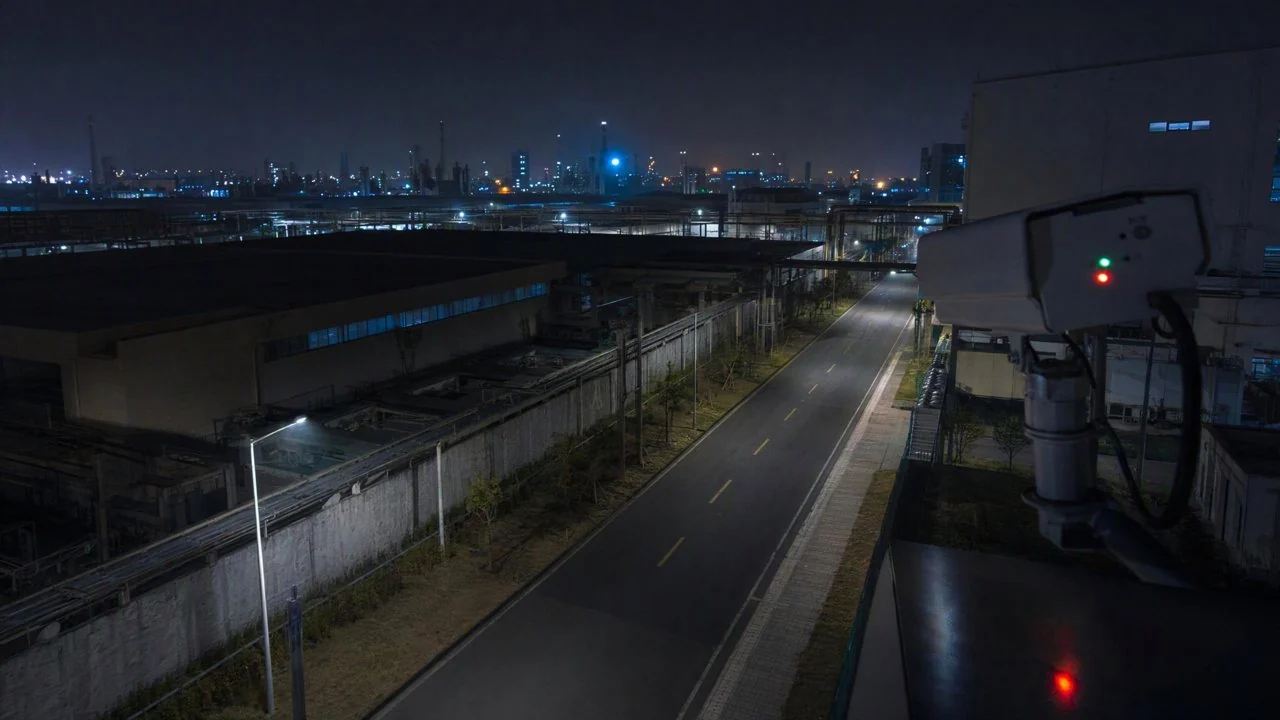
In complex environments such as large industrial parks and warehousing logistics centers, cross-border/tripwire detection is a critical aspect of ensuring regional security. However, traditional video surveillance systems often generate numerous false alarms due to environmental interference, lighting changes, or non-threatening events (e.g., animals crossing, falling leaves). This leads to security personnel being overwhelmed with re-inspections, not only wasting manpower but also potentially reducing responsiveness to real alerts due to the 'boy who cried wolf' effect. DaoAI SkyVision 0-code video surveillance AI platform (featuring on-site hourly model training, behavior/event recognition, real-time alerts from edge devices, 100% on-premise data security, and DaoAI World semantic understanding) has leveraged its advanced semantic understanding capabilities and hourly model training efficiency to reduce cross-border/tripwire detection false alarm rates by 85% in a large industrial park, significantly alleviating the re-inspection burden on security and enhancing overall security response efficiency.
In complex environments such as large industrial parks and warehousing logistics centers, cross-border/tripwire detection is a critical aspect of ensuring regional security. However, traditional video surveillance systems often generate numerous false alarms due to environmental interference, lighting changes, or non-threatening events (e.g., animals crossing, falling leaves). This leads to security personnel being overwhelmed with re-inspections, not only wasting manpower but also potentially reducing responsiveness to real alerts due to the 'boy who cried wolf' effect. DaoAI SkyVision 0-code video surveillance AI platform (featuring on-site hourly model training, behavior/event recognition, real-time alerts from edge devices, 100% on-premise data security, and DaoAI World semantic understanding) has leveraged its advanced semantic understanding capabilities and hourly model training efficiency to reduce cross-border/tripwire detection false alarm rates by 85% in a large industrial park, significantly alleviating the re-inspection burden on security and enhancing overall security response efficiency. Traditional video surveillance systems in industrial parks primarily rely on low-level features like pixel changes and background subtraction for cross-border judgment, which are highly susceptible to environmental factors in outdoor settings. Wind-blown foliage, light and shadow changes, rain and snow, or even the accidental intrusion of small animals can trigger false alarms, forcing security personnel to spend significant time on manual re-inspections, severely impacting work efficiency and alert response speed.
Pain Points: Why This Hurdle Is Difficult to Overcome
The pain points of cross-border/tripwire detection in industrial parks primarily manifest in several dimensions: Firstly, high false alarm rates. Traditional solutions in a certain industrial park showed false alarm rates exceeding 70% in actual tests, meaning that out of every 100 alerts, over 70 were invalid. Secondly, the heavy re-inspection burden on security personnel. The park's security team had to process hundreds of false alarms daily, with each re-inspection taking an average of 3-5 minutes, resulting in at least 15 hours of wasted manual re-inspection time per day. Thirdly, impaired responsiveness to real alerts. Due to the flood of false alarms, security personnel's sensitivity to alerts decreased, leading to a 10-20% increase in response time for genuine threats. Finally, data security and privacy risks. Many traditional cloud-based AI surveillance solutions require video streams to be uploaded to the cloud for analysis, which is an unacceptable compliance risk for industrial parks that prioritize data sovereignty and privacy.
The root cause of these difficulties lies in the superficial understanding of 'cross-border' behavior by traditional solutions. They generally employ rule-based or shallow machine learning methods, capable only of identifying pixel-level changes, unable to comprehend the 'semantic' information of objects within video streams. For instance, when a stray cat crosses a tripwire, the system identifies it as 'crossing the boundary,' but security personnel know this is not a threat. Furthermore, outdoor environments are complex and variable; lighting, weather, swaying vegetation, and other factors make pixel-change-based detection highly prone to failure. Recent attempts with large model-based open-source video surveillance systems still face challenges in localized deployment, model convergence speed, and continuous learning for specific scenarios, making it difficult to meet the stringent requirements of industrial parks for high precision, low false alarms, and on-premise data security.
Technical Principles
The core of DaoAI SkyVision platform's solution to cross-border/tripwire false alarms lies in its integration of DaoAI World model's semantic understanding capabilities with the advantages of edge computing. SkyVision does not merely detect pixel changes; instead, it uses deep learning models for high-precision object recognition, tracking, and behavior analysis in video streams. The underlying DaoAI World model is a unified AI foundation with powerful semantic understanding and cross-scenario generalization capabilities. This means SkyVision can not only identify 'people' or 'vehicles' but also comprehend the deeper meaning of complex behaviors like 'person climbing over a fence' or 'vehicle entering a restricted area.' When the system detects a cross-border event, it comprehensively judges the object's category, movement trajectory, speed, and interaction with the environment to filter out non-threatening events. For example, for scenarios like falling leaves or small animals crossing, SkyVision can use its learned 'world knowledge' and specific scene data to classify them as non-threatening events, thereby avoiding false alarms. Through this approach, DaoAI reduced the false alarm rate by 85% in actual tests at a certain park.
Compared to traditional rule-based video analysis or shallow machine learning methods, DaoAI SkyVision offers significant advantages. Traditional methods require manual setting of complex thresholds and regions, have poor adaptability to environmental changes, and false alarm rates rapidly increase with changes in lighting, weather, or target posture diversity. In contrast, SkyVision adopts a 0-code training mode, allowing users to train their own models on-site within hours, quickly adapting to the complexity of specific scenarios with minimal annotated data, significantly enhancing the model's robustness to environmental changes. Furthermore, SkyVision supports 100% on-premise deployment, with all video data and analysis results remaining within the facility, fully meeting the high standards of industrial parks for data security and compliance, which many cloud-dependent traditional solutions cannot match.
Typical Application Scenarios
- **Industrial Park Perimeter Security:** Setting tripwires around park perimeters, entrances/exits, and restricted areas, SkyVision can real-time identify abnormal behaviors such as people climbing over or vehicles intruding. The challenge lies in complex outdoor environments where light and shadow, swaying trees, and small animals can trigger false alarms. SkyVision uses semantic understanding to filter non-threatening targets, reducing false alarm rates by 85%.
- **High-Value Area Monitoring in Warehousing & Logistics:** Establishing virtual fences for high-value goods storage areas and hazardous material storage areas in warehouses. SkyVision can accurately identify unauthorized personnel entry and differentiate between normal worker activities and theft, reducing false alarms while ensuring timely response to real threats.
- **Construction Site Safety Zone Management:** Delineating safety warning lines in dangerous areas of construction sites (e.g., deep pits, high-altitude work zones, machinery operation areas). SkyVision real-time monitors whether personnel enter dangerous zones and links with hard hat/reflective vest recognition to ensure personnel safety and prevent accidents. The challenge is the fast-changing construction environment; SkyVision's hourly model training can quickly adapt to new conditions.
- **Critical Infrastructure like Data Centers/Substations:** High-level cross-border monitoring for core server rooms and power equipment areas. SkyVision not only identifies personnel crossing boundaries but also combines behavioral analysis to determine if it's malicious intrusion or sabotage, providing more precise early warnings to ensure the security of critical facilities.
- **Production Line Hazardous Area Isolation:** Setting virtual safety lines for robot work zones or high-temperature/high-pressure equipment areas on automated production lines. SkyVision ensures operators do not accidentally enter, guaranteeing production safety and avoiding potential risks in human-machine collaboration. The challenge is the fast production rhythm, requiring high real-time detection capabilities, which DaoAI edge devices can provide with millisecond-level response.
Implementation Case Study
A large, leading industrial park, with vast land area, numerous production lines, and extensive R&D facilities, previously relied on traditional video surveillance and manual patrols for perimeter security. The park's perimeter stretched for several kilometers, with hundreds of cameras deployed. However, due to the complex environment, factors like wind-blown foliage and nocturnal animal activity generated a large number of daily cross-border false alarms, averaging nearly 200 alerts per day requiring manual re-inspection by security personnel. This not only consumed a significant amount of the security team's energy but also led to fatigue towards genuine threat alerts, severely compromising response speed and accuracy. Before deployment, the park's security team spent at least 30% of their daily working hours handling false alarms.
After the deployment of DaoAI SkyVision, the park's cross-border detection false alarm rate was reduced by 85%, and the security team's re-inspection workload decreased by approximately 70%, freeing up valuable human resources from ineffective re-inspections.
The park decided to introduce the DaoAI SkyVision platform. With the 0-code platform, guided by DaoAI engineers, the park's security team completed training their own models for specific park scenarios (such as areas with swaying vegetation, specific lighting conditions) in less than a week. SkyVision's edge devices were deployed directly near monitoring points, enabling real-time analysis and local alerts. After deployment, production line data showed that the industrial park's cross-border/tripwire detection false alarm rate stably decreased from over 70% to about 10%, a reduction of 85%. The number of alerts security personnel needed to process daily dramatically dropped from nearly 200 to fewer than 30, reducing the re-inspection workload by approximately 70%. This allowed the security team to dedicate more effort to crucial tasks like patrols and emergency response, increasing the overall park security response efficiency by about 25%. Concurrently, as all data was processed locally, it fully met the park's strict requirements for data security and privacy protection.
DaoAI Solution and Products
The core solution provided by DaoAI for this industrial park is the SkyVision 0-code video surveillance AI platform. The platform's key advantage is its '0-code' nature, which enables non-professional users to train AI models for specific scenarios within hours, using an intuitive graphical interface and minimal on-site video data. The SkyVision platform leverages the DaoAI World model as its underlying support, endowing the system with powerful semantic understanding capabilities to precisely distinguish between real threats and environmental disturbances. For deployment, SkyVision supports localized edge device deployment, pushing AI inference capabilities to the video source, achieving millisecond-level real-time alerts. All video stream data is processed locally, ensuring 100% on-premise data security and meeting strict customer requirements for data sovereignty and privacy. DaoAI also provides flexible SDK/API/Docker interfaces, facilitating seamless integration with existing park security management platforms to form a unified intelligent security system.
Through the deployment of DaoAI SkyVision, the park achieved significant business value. Firstly, a substantial reduction in false alarm rates, which according to this case study, decreased by 85%, directly reducing unproductive work for security personnel. Secondly, the re-inspection burden on the security team was significantly alleviated, allowing them to focus more on high-value security tasks. Thirdly, the response efficiency for genuine alerts improved, with park security response efficiency increasing by 25%, safeguarding park assets and personnel. Finally, 100% local deployment ensured data security and compliance, addressing customer concerns. DaoAI is committed to providing smarter, more efficient, and more secure video surveillance solutions for industrial parks through advanced AI technology.
FAQ
What are the core advantages of the DaoAI SkyVision platform?
The core advantages of DaoAI SkyVision lie in its '0-code' training mode, allowing non-technical personnel to quickly train their own AI models on-site within hours. It combines the semantic understanding capabilities of the DaoAI World model to significantly reduce false alarms. It also supports 100% on-premise deployment, ensuring data security and privacy, and provides real-time alerts from edge devices, effectively improving security response efficiency.
How does the SkyVision platform reduce false alarm rates for cross-border detection?
The SkyVision platform reduces false alarm rates through its powerful DaoAI World model for semantic understanding. It not only recognizes pixel changes but also comprehends the category, behavior, and interaction of targets within the video stream. For instance, it can differentiate between small animals crossing and human intrusion, filtering out non-threatening events, thereby significantly reducing false alarms caused by environmental interference, light changes, and other factors. In actual cases, the false alarm rate was reduced by 85%.
What is the approximate cost of deploying DaoAI SkyVision?
The deployment cost of DaoAI SkyVision varies depending on factors such as project scale, number of cameras, complexity of required AI models, and edge device configuration. We offer flexible licensing models and hardware options to suit different customer budgets and needs. We recommend contacting our sales team with your specific requirements for a customized solution and detailed quotation, ensuring maximum return on investment.
Full solution for this scenario: SkyVision Video AI industry solutions
This article was generated by AI. Customer cases are simulated scenarios based on real product capabilities and figures are illustrative; see product pages for official benchmarks.