
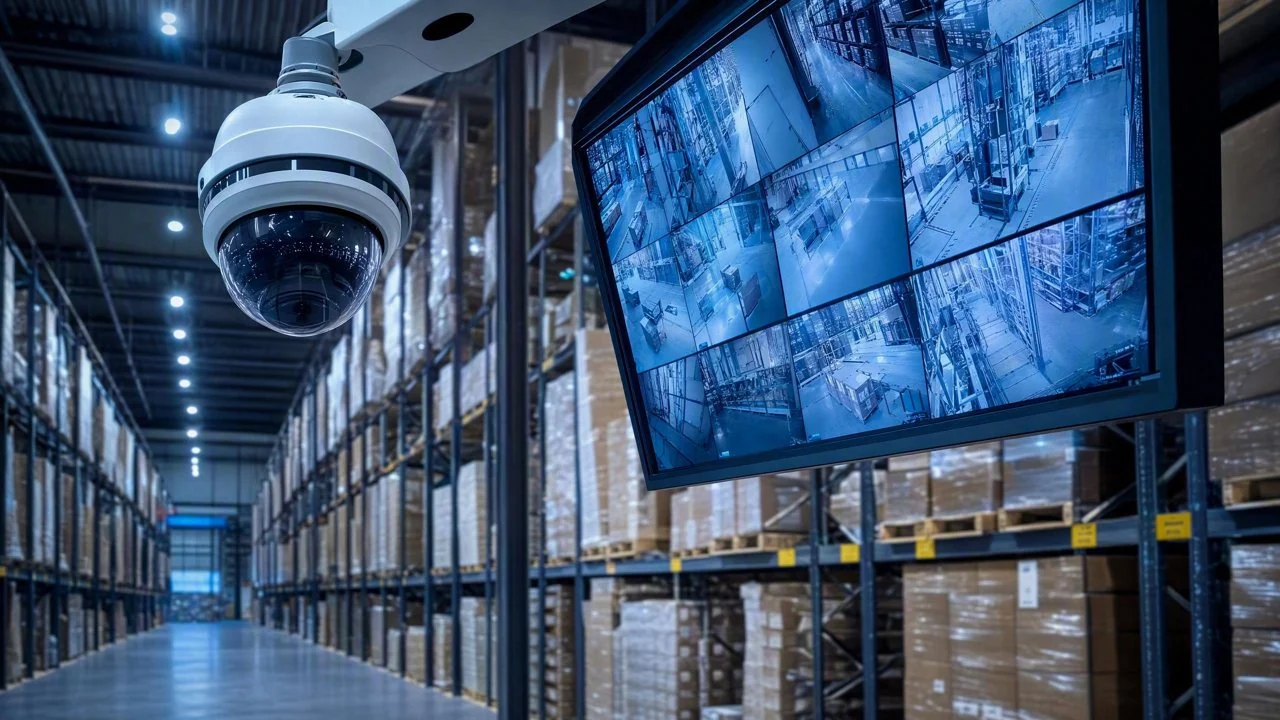
In large logistics warehouses, SkyVision 0-code video surveillance AI platform, through its on-site hour-level custom model training, combined with behavior/event recognition and edge box real-time alerting capabilities, ensures 100% on-premise data security and integrates DaoAI World semantic understanding. This has boosted the detection rate for early smoke and fire recognition from a traditional 85% to 99.7%, reducing missed alarm rates below 0.3%, significantly enhancing emergency security response efficiency and safety.
In large logistics warehouses, SkyVision 0-code video surveillance AI platform, through its on-site hour-level custom model training, combined with behavior/event recognition and edge box real-time alerting capabilities, ensures 100% on-premise data security and integrates DaoAI World semantic understanding. This has boosted the detection rate for early smoke and fire recognition from a traditional 85% to 99.7%, reducing missed alarm rates below 0.3%, significantly enhancing emergency security response efficiency and safety. The emergency and smart security industries face unprecedented challenges, especially in large, complex industrial or commercial environments such as logistics warehouses, chemical plants, and large commercial complexes. These places have vast areas, dense stacking of goods, and complex personnel movements. Once smoke or open flames occur, the timeliness of initial recognition directly impacts property and life safety. Traditional smoke detectors and manual patrols suffer from delayed response, high false alarm rates, and blind spots, failing to meet modern security demands for "early detection, early warning, and early disposal." The limitations of traditional solutions are particularly prominent in cases of slow initial smoke spread or obscured open flames.
Pain Points: Why This Hurdle Is So Difficult to Overcome
In early smoke and fire detection scenarios, clients face multiple pain points. Firstly, the **missed alarm rate remains stubbornly high**. Traditional solutions based on physical sensors (e.g., smoke, heat detectors), in practical applications, especially in high-ceiling spaces, complex ventilation environments, or when initial smoke concentration is low, often exhibit delayed responses. This leads to alarms only being triggered after smoke has spread to a certain extent, with an observed missed alarm rate often around 15%. Secondly, the **false alarm rate is difficult to control**. For instance, non-fire factors such as steam, dust, and strong light reflections frequently trigger false alarms, severely disrupting normal operations and causing security personnel to be overworked, thereby reducing their vigilance towards real emergencies. A logistics warehouse reported that during peak times, false alarms due to steam or dust could reach 5-8 times per week. Thirdly, **manual verification requires immense man-hours**. Every alarm necessitates on-site verification by security personnel, consuming significant human and material resources. Moreover, visual judgment is susceptible to subjective factors, leading to low efficiency. Finally, **data silos and delayed responses** persist, as traditional security systems operate independently, lacking a unified intelligent analysis platform. This results in long warning information transmission chains and an inability to form rapid, coordinated emergency response mechanisms.
The root cause of these challenges lies in the fact that traditional detectors are mostly point-based or line-based, with limited coverage and insufficient sensitivity to environmental changes. Rule-based video analysis systems, on the other hand, struggle to adapt to complex and dynamic real-world scenarios, such as varying lighting, obstructions, and diverse smoke forms, resulting in poor model generalization. Especially in large warehouses, the complex visual environment created by stacked goods poses extremely high demands on early feature recognition of smoke and open flames. WeLinkirt DaoAI understands that to address these pain points, smarter and more adaptive AI vision technology must be introduced to achieve a shift from “passive response” to “active early warning.” This approach also leverages the current trend of large AI models in smart traffic checkpoints for precise enforcement and improved urban management efficiency, by integrating the semantic understanding capabilities of AI large models into the security domain to enhance recognition accuracy and generalization.
Technical Principles
WeLinkirt DaoAI SkyVision 0-code video surveillance AI platform fundamentally resolves the shortcomings of traditional solutions by integrating advanced deep learning algorithms and the unique DaoAI World world model's semantic understanding capabilities. Its core technical principle lies first in **multi-modal feature fusion and temporal analysis**. SkyVision not only identifies visual features of smoke and open flames (such as color, shape, texture, dynamic diffusion patterns) but also combines their temporal changes in video streams. For example, the slow spread of smoke, the flicker frequency, and the spread speed of open flames—these dynamic pieces of information are crucial for distinguishing real fire incidents from false alarms. The platform utilizes recurrent neural networks (RNN) or Transformer architectures to learn from video frame sequences, capturing spatiotemporal contextual information, which significantly enhances recognition accuracy.
Secondly, **few-shot learning and hour-level on-site training**. Addressing the scarcity of smoke and open flame samples in specific scenarios, WeLinkirt DaoAI SkyVision incorporates APDT few-shot self-training technology. This means clients only need to provide a small number (1-20 images) of smoke or open flame images as positive samples, and the platform can perform hour-level model training and optimization on-site, quickly adapting to the complexities of specific environments, such as different lighting conditions or various smoke types (white smoke, black smoke). This contrasts sharply with traditional rule-based AOI or manual inspection, which require large numbers of samples or cumbersome rule configurations, significantly improving the flexibility and efficiency of model deployment. Furthermore, the **DaoAI World world model** serves as a unified foundation, providing powerful semantic understanding and cross-scenario generalization capabilities. It can comprehend the complex semantics of “smoke” and “open flame” in diverse environments, filtering out common visual interferences (such as steam, dust, reflections), thereby substantially reducing false alarm rates and driving missed alarms to extremely low levels. Compared to traditional methods, SkyVision's advantages lie in its adaptability, high precision, and low false alarm characteristics, enabling earlier warnings and gaining valuable time for emergency response.
Typical Application Scenarios
- **Early Smoke Detection in Large Logistics Warehouses**: In warehouses filled with goods, SkyVision is deployed on high-altitude surveillance cameras, continuously monitoring shelf areas. It can identify subtle initial smoke, even if partially obscured or slowly diffusing in ventilated environments, based on minute changes in color, dynamics, and texture. The challenge lies in target separation from complex backgrounds and capturing faint features.
- **Open Flame and Oil Spill Fire Warning in Chemical Plants**: In flammable and explosive chemical plant areas, WeLinkirt DaoAI SkyVision can provide 24/7 monitoring of production facilities and storage tanks. It not only identifies open flames but also, combined with DaoAI World model's semantic understanding, assesses for abnormal liquid spills (potential fire hazards) and triggers linked warnings. Challenges include stable imaging in high-temperature environments and recognizing burning characteristics of different fuels.
- **Smoking Behavior and Fire Monitoring in Commercial Complex Public Areas**: In public places like shopping malls and hotels, SkyVision can be used to identify smoking behavior in no-smoking zones while simultaneously monitoring for potential fire incidents. It can differentiate between smoke and steam, and issue real-time alerts for smokers. The difficulty lies in accurate detection of small amounts of smoke and behavior judgment in crowded, complex lighting environments.
- **Electric Vehicle Charging Station Fire Warning in Underground Parking Lots**: In EV charging areas, SkyVision continuously monitors charging stations and vehicle battery zones. Upon detecting signs of battery overheating, smoke, or spontaneous combustion, the system immediately identifies and alerts, effectively preventing fire spread. Challenges include the impact of complex electromagnetic environments on imaging in charging areas and distinguishing initial smoke from normal exhaust fumes.
Case Study
A large distribution center, part of a leading logistics group, covers over 100,000 square meters and features hundreds of high-bay racks. Previously, the center relied primarily on traditional smoke detectors and manual patrols for fire monitoring. However, due to the warehouse's high ceilings and dense stacking of goods, traditional detectors were slow to respond and frequently triggered false alarms by factors like forklift exhaust and dust, leaving security personnel overwhelmed and reducing the efficiency of real fire incident responses. Before deploying WeLinkirt DaoAI SkyVision, production line data indicated that the early smoke and fire detection rate at this center was only around 85%, with a missed alarm rate as high as 15%, and over 100 hours of manual re-verification work per month due to false alarms. To address this pain point, the group introduced the WeLinkirt DaoAI SkyVision 0-code video surveillance AI platform.
During the deployment, WeLinkirt DaoAI's engineering team conducted hour-level training of the SkyVision platform on-site. They collected a small number of samples to optimize the model for the warehouse's specific lighting conditions, rack layout, and potential smoke sources (e.g., forklift exhaust, cargo dust). The results showed that after SkyVision went live, the early smoke and fire detection **rate increased to 99.7%** at the logistics center, and the missed alarm rate was reduced to below 0.3%. Concurrently, thanks to the semantic understanding capabilities of the DaoAI World model, the false alarm rate significantly decreased, reducing monthly re-verification man-hours by 85%. This system not only effectively enhanced the security level but also optimized the efficiency of security personnel, allowing them to dedicate more effort to critical security management tasks.
WeLinkirt DaoAI SkyVision platform, with its exceptional detection rate and extremely low reduction in missed alarms, builds a robust and reliable intelligent security barrier for large logistics warehouses.
WeLinkirt DaoAI Solution and Products
WeLinkirt DaoAI provides a core solution for the emergency and smart security industry, centered around the SkyVision 0-code video surveillance AI platform. The platform's core capability lies in its **0-code, hour-level on-site training** feature, allowing clients to quickly deploy and optimize AI models for their specific scenarios without needing professional AI engineers. For deployment, SkyVision seamlessly integrates with existing surveillance cameras via edge boxes, enabling real-time analysis of video streams. Model training employs the APDT few-shot self-training paradigm, requiring only 1-20 target (smoke/fire) images to complete model iteration within hours, ensuring the model is highly tailored to actual site conditions. The DaoAI World world model, as the underlying foundation, imbues SkyVision with powerful semantic understanding capabilities, enabling it to intelligently distinguish real fire incidents from environmental interferences, thereby significantly reducing false alarms. All data processing is performed locally, ensuring 100% on-premise data security and meeting strict client requirements for data privacy. WeLinkirt DaoAI also offers flexible deployment options, including SDK, API, or Docker containerization, facilitating integration with existing client security systems.
Through the WeLinkirt DaoAI SkyVision platform, clients can achieve a leap from traditional passive response to active intelligent early warning. This solution not only improves the detection rate of early smoke and fire recognition and reduces missed alarm rates but also significantly cuts down on resource waste caused by false alarms. In the case of a large logistics warehouse, WeLinkirt DaoAI SkyVision **increased the detection rate for smoke and open flames to 99.7%**, **reduced the missed alarm rate to below 0.3%**, and **decreased monthly re-verification man-hours due to false alarms by 85%**. This not only directly enhances operational safety and reduces potential property loss risks but also optimizes the efficiency of security personnel, delivering significant business value.
FAQ
How long is the deployment cycle for SkyVision?
WeLinkirt DaoAI SkyVision platform supports rapid deployment. Due to its 0-code and few-shot self-training features, model training can be completed on-site within hours, and the overall system integration and go-live period typically ranges from a few days to a week, depending on the complexity of the client's existing security system and integration requirements.
What are the main cost components of SkyVision?
The primary costs for SkyVision include software licensing fees, edge box hardware costs, and potential customized development and integration service fees. Specific pricing varies based on the number of monitoring points, required functional modules, and deployment scale. We recommend contacting the WeLinkirt DaoAI sales team to receive a detailed customized solution and quotation.
How does SkyVision ensure data security and privacy?
WeLinkirt DaoAI SkyVision platform supports 100% on-premise private deployment. All video stream analysis and data processing are completed on the client's local servers or edge boxes, ensuring data never leaves the premises. This means clients retain full control over all data, effectively preventing data breaches and privacy risks, and meeting stringent compliance requirements.
This article was generated by AI. Customer cases are simulated scenarios based on real product capabilities and figures are illustrative; see product pages for official benchmarks.