
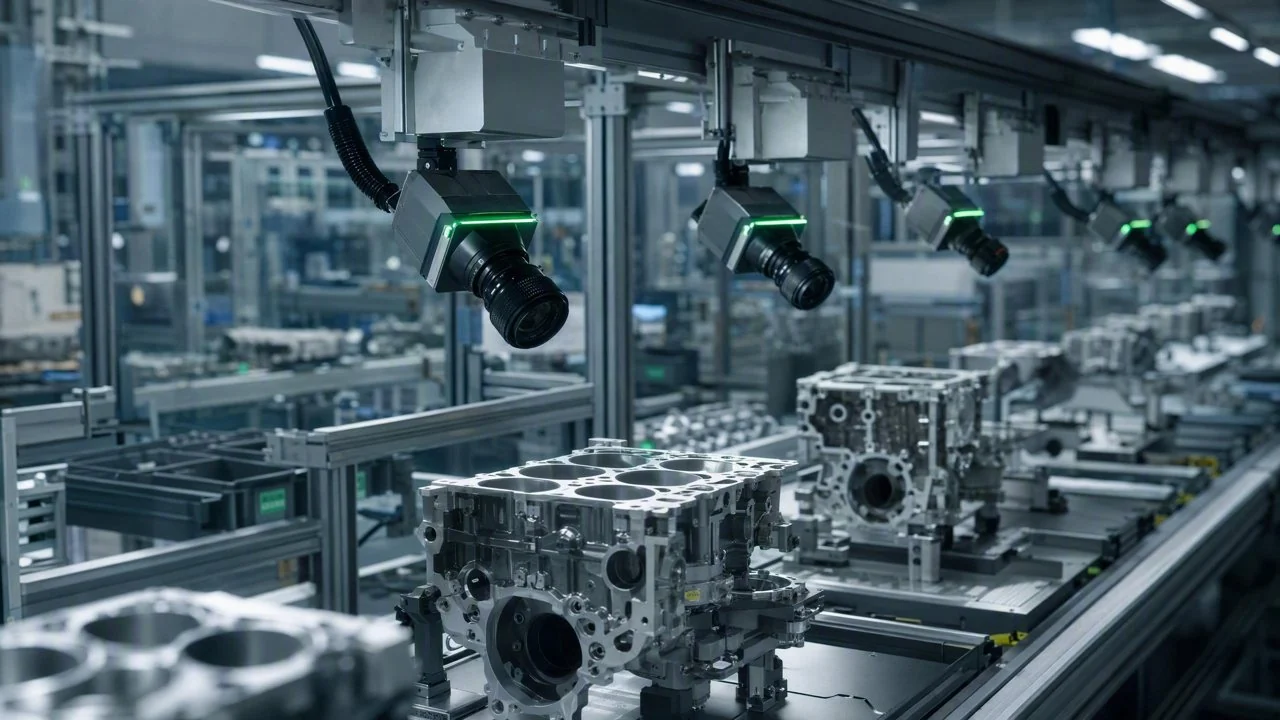
On high-speed industrial production lines, any minor omission in assembly processes can lead to serious quality issues and rework costs. Especially in high-precision, high-rhythm industries such as automotive component manufacturing, balancing 100% full inspection with production rhythm has long been a challenge for manufacturers. DaoAI SkyVision 0-code video surveillance AI platform offers a breakthrough solution, effectively reducing assembly omission rates through precise behavior recognition, ensuring efficient line operation.
On high-speed industrial production lines, any minor omission in assembly processes can lead to serious quality issues and rework costs. Especially in high-precision, high-rhythm industries such as automotive component manufacturing, balancing 100% full inspection with production rhythm has long been a challenge for manufacturers. DaoAI SkyVision 0-code video surveillance AI platform offers a breakthrough solution, effectively reducing assembly omission rates through precise behavior recognition, ensuring efficient line operation.
Pain Points: Why This Hurdle Is Difficult to Overcome
In the assembly of precision components like engines, bolt tightening is a critical step. Traditional manual inspection or simple sensor detection struggles when faced with high-mix, multi-model production lines and extremely high production rhythms. A leading automotive component supplier once faced a bolt tightening omission rate as high as 0.8%, which directly led to a roughly 15% increase in rework rates in downstream processes, and immeasurable recall risks and brand reputation losses due to quality issues annually. Furthermore, to meet 100% inspection requirements, the manufacturer had to invest significant human resources in sampling or end-of-line re-inspection, with manual re-judgment accounting for up to 30% of working hours, severely slowing down the overall production rhythm and driving up the inspection cost per unit. Even so, in some complex workstations, such as bolt tightening inside engine blocks, due to confined spaces and limited visibility, the risk of omissions in manual inspection persisted.
The root cause of these challenges lies in the difficulty of real-time, precise, and non-intrusive monitoring of industrial SOP (Standard Operating Procedure) execution. Complex assembly sequences, such as tightening multiple bolts of different specifications and torques, require workers to perform a series of precise actions. Traditional solutions, like torque sensors, can only detect if a preset torque is reached, but cannot confirm if the bolt is correctly installed or if it's missed. Manual patrols, on the other hand, are limited by human eye fatigue, individual differences, and subjective judgment, making it difficult to guarantee 100% coverage and accuracy at high rhythms. Current cases of traffic checkpoints using AI to improve vehicle and pedestrian recognition accuracy in complex dynamic scenarios demonstrate that AI visual recognition's robustness and accuracy far exceed traditional methods, offering a new approach for industrial SOP monitoring. However, the specificity of industrial scenarios demands higher efficiency in model training and localized deployment to cope with rapid changeovers and data security concerns.
Technical Principles
DaoAI SkyVision 0-code video surveillance AI platform fundamentally transforms industrial SOP monitoring with its unique “0-code” and “on-site hourly training” capabilities. Its core technology integrates advanced computer vision algorithms with the DaoAI World universal model to provide real-time, high-precision semantic understanding of worker behavior and material status in video streams. Specifically for bolt tightening omission detection, SkyVision employs multi-modal feature extraction combined with temporal action recognition models. By analyzing worker hand movements, tool trajectories, and changes in bolt status (such as color, position, angle), it determines if all predefined tightening steps have been completed. Even in environments with uneven lighting or partial obstructions, SkyVision maintains high recognition accuracy thanks to its powerful feature recognition capabilities.
Compared to traditional rule-based machine vision (Rule-based AOI) or manual inspection, DaoAI SkyVision's advantage lies in its self-learning and generalization capabilities. Traditional rule-based AOI requires engineers to spend significant time writing fixed rules and is less robust to environmental changes; any product changeover or minor process adjustment necessitates reprogramming. In contrast, the SkyVision platform supports APDT (few-shot self-training), requiring only 1–20 positive sample images to quickly train an AI model for specific tightening processes within hours on-site, significantly reducing deployment and changeover times. Furthermore, its edge box real-time alerting mechanism can trigger auditory and visual alarms or line stops within milliseconds upon detecting a bolt tightening omission, ensuring that defects do not propagate to the next process. This keeps the bolt tightening omission rate consistently below <0.2%, far superior to traditional methods. All data is processed 100% locally, ensuring enterprise data security and compliance with stringent industrial requirements.
Typical Application Scenarios
- **Engine Block Bolt Tightening Detection**: Real-time monitoring of all critical bolt tightening actions on engine blocks, including bolt seating, tool usage, and final status. Challenges include a large number of bolts, complex distribution, partial obstructions, and the need to recognize differentiated tightening sequences for various engine models. DaoAI SkyVision can accurately identify the tightening status of each bolt by learning assembly specifications for different models.
- **Automotive Interior Fastener Installation Detection**: Ensuring all clips and fasteners are correctly installed in automotive interior panels, center consoles, and other components. Challenges include small clip sizes, similar colors to the background, and potential obstruction of some clips by wiring harnesses. SkyVision uses high-resolution video streams combined with fine-grained feature recognition to effectively detect missing or incompletely fastened clips.
- **Electronic Product PCB Component Insertion Omission Detection**: Monitoring the manual insertion process of specific components (e.g., connectors, capacitors) onto PCB boards, detecting any missing or incorrectly oriented insertions. Challenges include a wide variety of components, differing sizes, and similar insertion actions. DaoAI SkyVision can distinguish the shapes and physical states of different components after insertion to ensure compliance.
- **Large Equipment Piping Connector Installation Compliance**: Ensuring all connectors, flanges, and seals in large industrial equipment piping systems are installed according to standards. Challenges include a wide variety of connectors, high and complex installation locations, and time-consuming manual inspection. SkyVision achieves comprehensive monitoring of critical connection points through multi-angle camera collaboration, improving installation quality.
Deployment Case Study
A leading automotive component supplier, whose engine assembly line demands extremely high precision and rhythm for bolt tightening, faced significant bolt tightening omission issues before adopting DaoAI SkyVision. The average omission rate was around 0.8%, leading to at least 200 engines being reworked each month due to assembly defects, severely impacting production efficiency and delivery schedules. To address this challenge, the manufacturer deployed the DaoAI SkyVision platform, installing industrial-grade cameras at critical tightening workstations to monitor worker operations in real-time. In the initial phase, DaoAI engineers collaborated closely with the client's team, using SkyVision's 0-code training interface to complete the training and deployment of bolt tightening behavior recognition models for two mainstream engine models in just 3 hours. Real-world data showed that after DaoAI SkyVision went live, the bolt tightening omission rate on this production line immediately dropped to below 0.2%, significantly outperforming traditional methods. More importantly, production line data indicated that due to the reduction in omissions, the downstream rework rate decreased by approximately 70%, and the average assembly time per engine was reduced by 15 seconds, directly improving the overall production rhythm and the ability to achieve 100% full inspection.
“DaoAI SkyVision not only helped us solve the long-standing assembly omission problem, but more importantly, it enabled us to achieve full-process quality monitoring without sacrificing production rhythm, something we never thought possible before.” — Client Production Director
DaoAI Solution and Products
DaoAI SkyVision 0-code video surveillance AI platform provided an end-to-end solution for this client. In the modeling phase, the client only needed to provide a few compliant video clips. Through SkyVision's intuitive graphical interface, AI models could be quickly annotated and trained without any programming knowledge. For production line changeovers, SkyVision's APDT few-shot self-training capability allows detection models for new product types to be iterated within hours, ensuring rapid adaptation of the production line. In terms of deployment, DaoAI SkyVision uses an edge box deployment model, decentralizing AI inference capabilities to the production line edge, achieving millisecond-level real-time response to ensure timely alerts. The edge box integrates seamlessly with the production line's PLC or MES system, automatically triggering line stops, auditory/visual alarms, or data uploads based on detection results, forming a closed-loop management. Concurrently, all video data and inference results are processed within the local private deployment environment, strictly adhering to the principle of data never leaving the factory, ensuring the security of sensitive customer data. Furthermore, the DaoAI World universal model serves as the underlying unified foundation, providing SkyVision with powerful semantic understanding and cross-scenario generalization capabilities, enabling it to continuously learn from production line feedback and optimize model performance in increasingly complex industrial environments.
Through the deployment of DaoAI SkyVision, the automotive component supplier achieved significant quantified results and business value. The bolt tightening omission rate was reduced to below 0.2%, significantly lower than the industry average. Production rhythm was optimized, leading to an overall production efficiency increase of approximately 8%. Manual re-inspection hours decreased by over 60%, greatly saving labor costs. More importantly, the improved product quality effectively avoided potential quality recall risks and substantial penalties, enhancing customer satisfaction and brand competitiveness. DaoAI SkyVision not only solved immediate quality issues but also laid a solid foundation for the enterprise's future intelligent upgrades.
FAQ
How does DaoAI SkyVision platform ensure data security?
DaoAI SkyVision platform employs a 100% localized private deployment model. All video data and AI inference results are processed and stored on the client's on-site servers or edge devices. Data is never uploaded to public clouds or leaves the client's premises. This deployment method fundamentally ensures the security and privacy of sensitive enterprise data, complying with industrial-grade data compliance requirements.
What factors primarily influence the cost of deploying DaoAI SkyVision?
The deployment cost of DaoAI SkyVision is mainly influenced by factors such as the number of monitoring workstations, the type and quantity of cameras, the required edge computing hardware configuration, and the complexity and customization level of the AI models needed. We offer flexible licensing models and provide customized solutions and detailed quotes based on the client's specific needs. We recommend contacting our sales team for a detailed consultation to get the most suitable solution and quotation for your business.
How does the SkyVision platform quickly adapt to new products during production line changeovers?
The SkyVision platform features unique APDT (Few-Shot Self-Training) capabilities, allowing users to quickly train and iterate new AI models within hours on-site, using only 1-20 positive sample images or short video clips of the new product. This '0-code' training approach significantly reduces changeover downtime, ensuring the production line can flexibly adapt to multi-variety, small-batch production demands.
This article was generated by AI. Customer cases are simulated scenarios based on real product capabilities and figures are illustrative; see product pages for official benchmarks.