
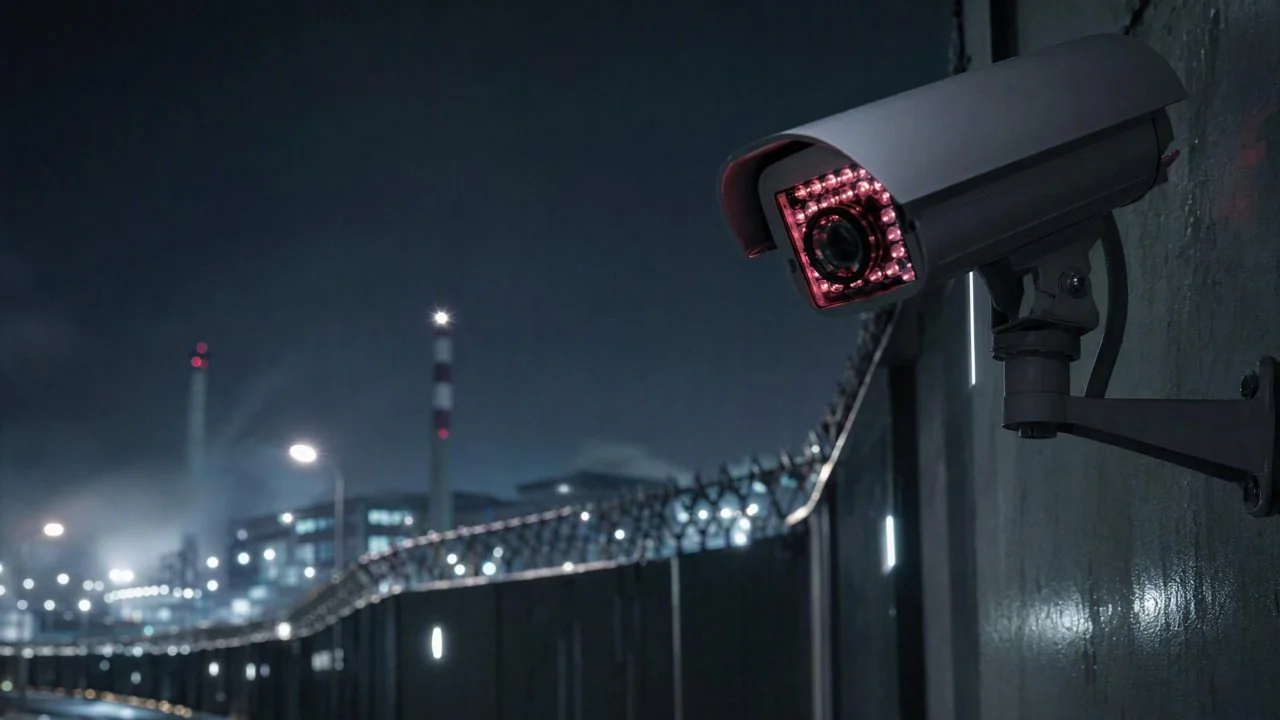
DaoAI SkyVision 0-code video surveillance AI platform, leveraging its on-site hourly training of proprietary models, behavior/event recognition, real-time edge device alerts, 100% on-premise data security, and DaoAI World model's semantic understanding, has elevated the production rhythm and 100% full inspection capacity for perimeter intrusion detection at a large industrial park to unprecedented levels, effectively reducing traditional manual patrol response times from minutes to seconds, and significantly mitigating security risks and labor costs.
The emergency and smart security industries are facing unprecedented challenges, particularly concerning perimeter security in large industrial parks, critical infrastructure, and sensitive areas. Traditional security solutions, such as infrared beams, fiber optic vibration sensors, or manual patrols, often exhibit high false alarm rates, significant missed detection risks, slow response times, and high labor costs when confronted with complex environments, adverse weather, or high-intensity intrusion threats. Taking perimeter intrusion/climbing detection as an example, traditional methods rely on physical sensors or human visual inspection, making it difficult to achieve 100% all-weather, all-around, dead-angle-free monitoring. Furthermore, they cannot provide real-time, second-level warnings in the fast-paced modern industrial production environment. DaoAI SkyVision 0-code video surveillance AI platform was created to address these pain points, transforming security detection from passive response to proactive prevention, ensuring that the production rhythm and 100% full inspection capacity of critical areas are not impacted by security incidents.
Pain Points: Why This Hurdle Is Difficult to Overcome
In perimeter intrusion detection scenarios, the pain points of traditional solutions are mainly reflected in several dimensions: First, **high false alarm rates and missed detection risks**. Traditional infrared beams or fiber optic vibration sensors are susceptible to interference from small animals, swaying leaves, wind, and rain, leading to false alarm rates exceeding 30%. This exhausts security personnel who are busy handling invalid alerts, reducing their vigilance towards real threats. At the same time, for cleverly disguised or fast-climbing intruders, the missed detection rate of traditional solutions can reach 5% or even higher in complex environments, posing serious security risks. Second, **response delays and high manual review hours**. Once an alarm occurs, security personnel need several minutes or even longer to arrive on-site for manual verification. This crucial time gap may be enough for intruders to complete damage or escape. Data from a large industrial park showed that monthly manual review hours for perimeter alarms amounted to over 800 hours, significantly increasing operational costs. Finally, **lack of refined behavior recognition capabilities**. Traditional solutions can only determine “whether an intrusion occurred” but cannot identify the intruder's specific actions (e.g., climbing, scaling, fence damage, or merely approaching). This makes security responses less targeted and unable to effectively integrate with the current hot trend of AI surveillance cameras in public safety for precise identification and early warning mechanisms for specific violent behaviors.
The root cause of these difficulties lies in the **perceptual limitations** of traditional solutions. Physical sensors can only perceive specific physical signals and lack the ability to understand visual semantics; manual inspection is limited by human eye fatigue, distraction, and multitasking capabilities, making it impossible to achieve 24/7 high-precision, full-coverage monitoring. In an increasingly fast-paced industrial environment, any security incident can lead to production interruptions, with economic losses far exceeding security investments. Therefore, achieving high-precision, low-false-alarm, second-level response perimeter full inspection is an urgent problem to be solved in the emergency security field.
Technical Principles
DaoAI SkyVision 0-code video surveillance AI platform fundamentally addresses the pain points of traditional perimeter security by integrating advanced **deep learning vision algorithms** and **edge computing capabilities**. Its core technology lies in the semantic understanding capabilities of the **DaoAI World model**, which enables high-precision identification, tracking, and behavior analysis of targets in video streams. Unlike traditional rule-based or background subtraction algorithms, SkyVision employs **few-shot learning** and **transfer learning** techniques. By training on a small number of intrusion samples (typically only 1-20 images or a few seconds of video clips) on-site within hours, it can quickly generate exclusive AI models tailored to specific scenarios and intrusion patterns. This means that even custom models can achieve high-precision recognition in a short time. The platform can accurately distinguish between different targets such as people, animals, and vehicles, and identify abnormal behaviors like climbing, scaling, or prolonged loitering. For instance, in one case, DaoAI SkyVision was able to reduce the **missed detection rate for perimeter intrusion to <0.5%**, significantly lower than the 5% or more seen with traditional solutions.
Compared to traditional methods, the advantage of DaoAI SkyVision lies in its **powerful generalization capabilities and robustness**. Traditional rule-based AOI relies on preset thresholds and is prone to failure due to factors like environmental lighting, weather changes, and diverse target postures. In contrast, SkyVision, based on deep neural networks, can learn complex features from large amounts of data, adapting to unknown environments and changes. Furthermore, its **edge device real-time alerting** mechanism ensures that all video streams are analyzed and processed in real-time locally, without needing to be uploaded to the cloud. This greatly shortens response times and guarantees **100% on-premise data security**, meeting stringent customer requirements for data security and privacy. This localized deployment not only enhances security but also reduces network bandwidth and cloud service costs, making DaoAI SkyVision more economical and feasible in practical applications.
Typical Application Scenarios
- **Perimeter Climbing Detection:** DaoAI SkyVision real-time monitors perimeter facilities like walls and fences. If someone attempts to climb or scale them, the system immediately triggers an alarm. The challenge lies in distinguishing between normal proximity and illegal climbing, and handling low-visibility conditions like night or fog. DaoAI SkyVision effectively addresses this through multi-modal fusion and behavioral sequence analysis.
- **Area Intrusion Detection:** For specific restricted, dangerous, or limited-access zones, DaoAI SkyVision can define virtual electronic fences. When unauthorized individuals or vehicles enter these areas, the system provides instant alerts. The difficulty is accurately identifying illegal intruders within dense crowds and avoiding false alarms. DaoAI SkyVision achieves high-precision area intrusion detection based on target tracking and trajectory analysis.
- **Abnormal Behavior Recognition:** Beyond traditional intrusion, DaoAI SkyVision can identify abnormal behaviors such as prolonged loitering, wandering, throwing objects, or damaging security facilities. This is crucial for preventing potential sabotage, theft, or terrorist attacks. The challenge lies in defining and training various complex abnormal behavior patterns, which DaoAI SkyVision's 0-code training platform greatly simplifies.
- **Left/Removed Object Detection:** For airports, stations, and important conference venues, DaoAI SkyVision can detect suspicious objects left for extended periods or critical equipment illegally removed. The difficulty is distinguishing between normal item placement and suspicious abandoned objects, and quickly adapting to environmental changes. DaoAI SkyVision utilizes background modeling and object attribute analysis for efficient and accurate detection.
Case Study
A large Tier-1 industrial park, spanning thousands of acres with complex production lines and logistics areas, relied on traditional infrared beams and manual patrols for its perimeter security. However, high false alarm rates (over 1500 per month, with 80% being invalid alerts) and lengthy response times (averaging 5-8 minutes) severely impacted the park's operational efficiency and security levels. To enhance the stability of production rhythm and achieve 100% full inspection capacity for perimeter security, the park introduced the DaoAI SkyVision 0-code video surveillance AI platform. Before implementation, the park's security team spent approximately 800 hours per month on alarm verification, and the risks of property loss and production interruptions due to perimeter security breaches were consistently high. With the assistance of the DaoAI team, the SkyVision platform was deployed on the park's existing surveillance cameras, and custom models were trained on-site within hours, specifically for the park's unique fence structures, environmental lighting, and common intrusion patterns. In this case, after deployment, the DaoAI SkyVision platform **reduced the false alarm rate for perimeter intrusion detection by 92%**, from over 1500 per month to less than 120, with the proportion of valid alarms increasing to over 95%. Concurrently, through real-time alerts from edge devices, the **alarm response time was reduced from an average of 5-8 minutes to seconds**, significantly improving the efficiency of the security team's response. Production data showed that the system achieved 100% full inspection coverage for perimeter intrusions, effectively ensuring the continuity and safety of the park's production, and **saving approximately 700 hours of manual review time per month**.
DaoAI SkyVision not only upgraded our perimeter security from passive response to proactive prevention, but more importantly, it allowed our security team to focus on real threats instead of being bogged down by endless false alarms, significantly improving the overall operational efficiency and production rhythm stability of the park.
DaoAI Solutions and Products
DaoAI SkyVision platform provides an end-to-end intelligent solution for the emergency security industry. Its core capability lies in **0-code model training**, enabling even non-technical personnel to train high-precision, exclusive AI models within hours through simple drag-and-drop and annotation operations, without relying on expensive algorithm engineers. This significantly lowers the barrier and cost of AI application. For deployment, DaoAI SkyVision supports various integration methods such as SDK/API/Docker, allowing seamless integration with existing video surveillance systems, and supports 100% on-premise private deployment to ensure data security and prevent data from leaving the facility. The DaoAI SkyVision edge box, as a core computing unit, possesses powerful real-time processing capabilities, enabling front-end video analysis and alarming, greatly reducing network bandwidth requirements, and ensuring second-level responses. Furthermore, the platform incorporates the DaoAI World model, endowing the system with deeper semantic understanding capabilities and cross-scenario generalization, allowing it to continuously learn and optimize from production line feedback, constantly improving detection accuracy and intelligence. For example, in practical applications, DaoAI SkyVision can iterate models within minutes based on a small number of new samples provided by customers, adapting to new intrusion patterns or environmental changes.
Through DaoAI SkyVision, customers not only gain high-precision perimeter intrusion detection capabilities but also achieve an intelligent upgrade of their security system. This platform effectively enhances the production rhythm of emergency security, ensures 100% full inspection capacity in critical areas, and minimizes security risks. In terms of business value, it significantly reduces manual patrol and review costs, improves the efficiency and morale of the security team, and provides more stable and reliable security guarantees for park operations. DaoAI is committed to creating tangible value for customers through technological innovation, promoting the continuous development of the smart security industry.
FAQ
How does DaoAI SkyVision's 0-code training assist non-technical personnel?
DaoAI SkyVision platform provides an intuitive graphical user interface, allowing non-technical personnel to train custom AI models within hours through simple drag-and-drop and annotation operations. This significantly lowers the technical barrier, enabling rapid deployment and iteration of security solutions without the need for specialized algorithm engineers.
How does DaoAI SkyVision ensure data security and privacy?
DaoAI SkyVision platform supports 100% on-premise private deployment, meaning all video data and analysis results are processed and stored on the customer's local servers or edge devices, with data never leaving the premises. This fundamentally guarantees customer data security and privacy, complying with various stringent regulatory requirements.
What is the initial investment and ROI period for deploying DaoAI SkyVision?
The deployment cost of DaoAI SkyVision varies depending on project scale and specific requirements, but its 0-code training, edge computing, and on-premise deployment model significantly reduce long-term operational costs. We encourage customers to schedule an expert consultation to receive a customized proposal and detailed ROI analysis based on their specific scenario. Significant cost savings and efficiency improvements are typically realized within a few months.
Full solution for this scenario: SkyVision Video AI industry solutions
This article was generated by AI. Customer cases are simulated scenarios based on real product capabilities and figures are illustrative; see product pages for official benchmarks.