
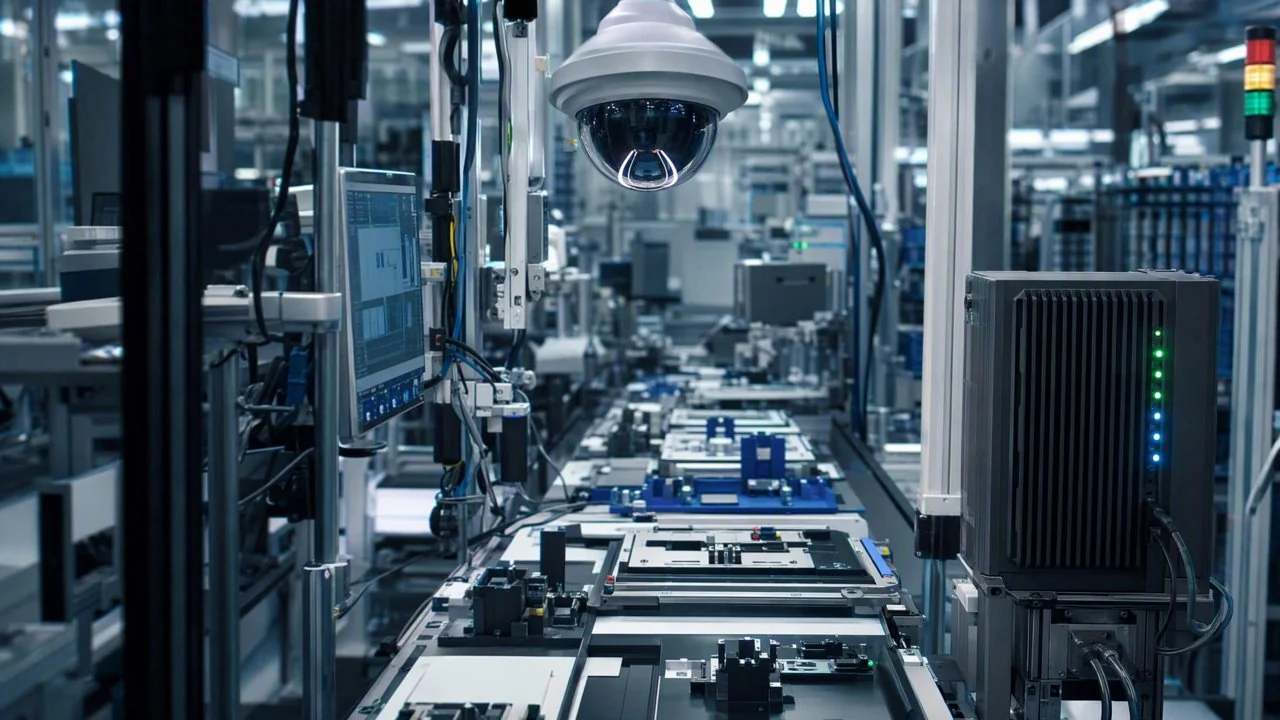
DaoAI SkyVision 0-code video surveillance AI platform (on-site hourly training of proprietary models, behavior/event recognition, real-time alerts from edge boxes, 100% local data processing, DaoAI World semantic understanding) significantly reduced the omission rate of dual-hand operation non-compliance from an average of 3.5% to below 0.4% in complex assembly processes, by real-time comparison and anomaly behavior recognition, greatly enhancing operational compliance and product quality consistency.
In industrial production, especially in precision manufacturing, Dual-Hand Operation SOP (Standard Operating Procedure) is crucial for ensuring product quality, improving production efficiency, and safeguarding employee safety. The assembly of many complex products requires workers to strictly follow established steps, using both hands simultaneously or alternately to complete specific operations. For instance, in the assembly of aerospace components, precision medical devices, or high-end electronic modules, even a slight deviation in dual-hand movements can lead to degraded product performance or even scrap. Traditionally, the enforcement of these procedures primarily relies on team leaders or quality inspectors conducting on-site patrols and spot checks. However, this method is not only inefficient but also prone to omissions due to eye fatigue and subjective judgment, especially in high-tempo, multi-variety production environments. Enhancing the detection rate and reducing omissions in work instructions has become an urgent challenge. The DaoAI SkyVision 0-code video surveillance AI platform was developed to address such issues, achieving real-time, precise monitoring of dual-hand operation SOPs through advanced computer vision technology.
Pain Points: Why This Hurdle Is Difficult to Overcome
In the scenario of dual-hand operation SOP comparison within the precision machinery processing industry, traditional solutions face multiple difficulties. Firstly, **high omission rates persist**: manual inspection typically results in an average omission rate of 3% to 5%. Subtle motion deviations or brief non-compliance are hard for human eyes to catch. For example, a precision machinery factory assembling hydraulic valve bodies requires workers to simultaneously fix and tighten bolts with both hands. If operated with one hand or if hand movements are not synchronized, it could lead to loose bolts. However, manual inspection struggles to continuously monitor every product, resulting in approximately 3.5% of non-compliant operations being missed. Secondly, **data privacy and compliance risks**: while enhancing monitoring capabilities, ensuring the privacy protection and compliance of employee behavior data is a significant challenge for enterprises. Traditional cloud video surveillance systems may face security risks during data upload, storage, and processing. This contrasts sharply with the current industry hot topic—data encryption and privacy protection strategies in cloud video surveillance systems for enhancing enterprise security—as companies are generally concerned about the leakage of core production data and employee behavior data. Thirdly, **re-inspection hours and efficiency bottlenecks**: when potential problems are found, significant human resources are required to review videos for re-inspection, which is not only inefficient but also increases operational costs. Under traditional solutions, troubleshooting a quality issue might take hours or even days of manual video playback, which is unacceptable in modern factories striving for high efficiency.
The root causes of these challenges lie in: **process complexity**—many dual-hand operation SOPs involve intricate muscle memory and temporal requirements, with long and easily confused action sequences; **imaging challenges**—uneven lighting in the work area, worker clothing obstruction, or high-speed hand movements can all affect video image quality; **limitations of traditional solutions**—rule-based traditional machine vision systems struggle to adapt to complex and variable body movements, and changeover costs are high; while pure manual visual inspection is limited by physiological constraints and subjective judgment, making 100% full inspection impossible. These factors collectively make it difficult to improve the detection rate and reduce the omission rate of work instructions.
Technical Principles
The DaoAI SkyVision platform fundamentally addresses these pain points by combining cutting-edge deep learning algorithms and edge computing technology. Its core lies in the powerful capabilities of the **0-code video surveillance AI platform**, allowing on-site engineers to train **proprietary models** for specific dual-hand operation SOPs within **hours**. This is made possible by the unified foundation provided by the DaoAI World model, which possesses strong **semantic understanding** and **cross-scenario generalization** capabilities, enabling it to learn and comprehend complex limb movement sequences and temporal logic from a small number of samples. Specifically, the platform achieves high detection rates and low omission rates through the following mechanisms: Firstly, it employs multi-view video stream fusion technology to overcome single-view occlusion issues, ensuring complete capture of dual-hand movements. Secondly, based on skeleton keypoint detection and behavior recognition algorithms, it precisely extracts the trajectories and postures of key body parts such as hands and arms, and performs real-time comparison with preset SOP templates. The behavior/event recognition module of DaoAI SkyVision can identify specific non-compliant behaviors such as "hands not simultaneously in place," "single-hand operation replacing dual-hand," or "reversed operation sequence." Compared to traditional rule-based AOI systems or manual visual inspection, the DaoAI SkyVision platform offers significant advantages: it is not limited by fixed templates, can adapt to individual worker differences, and continuously optimizes models through ongoing learning, pushing omission rates to levels unattainable by traditional methods. Furthermore, the **real-time alerts from edge boxes** mechanism ensures that abnormal behaviors are detected and notified to relevant personnel at the first instance, preventing issues from escalating.
Regarding data privacy, the DaoAI SkyVision platform adheres to a **100% local data processing** deployment strategy, ensuring data never leaves the premises. All video data, training models, and inference results are processed and stored on the customer's local servers or edge devices, eliminating the risk of data leakage at the source. This fully complies with current stringent enterprise requirements for data encryption and privacy protection. This localized deployment model not only guarantees data security but also avoids latency caused by network transmission, ensuring the timeliness of real-time alerts.
Typical Application Scenarios
- **Dual-hand collaborative operations in precision component assembly**: For instance, on the assembly line for micro-motors or sensor modules, workers are required to simultaneously insert two tiny connectors with both hands. The challenge lies in the small size and easy slippage of connectors, and the need for highly synchronized dual-hand movements. DaoAI SkyVision detects this by identifying if both hands are simultaneously present in the designated area and complete the insertion action.
- **Sterile operation procedures in medical device assembly**: For example, when assembling surgical instruments in a sterile environment, workers must wear gloves and complete disinfection and assembly within a specific area to avoid cross-contamination. Challenges include glove reflection and narrow operating areas. DaoAI SkyVision ensures compliance by identifying glove wearing status and the trajectory of hands within the sterile zone.
- **Dual-check after PCBA board soldering in electronic products**: After PCBA board soldering, certain critical components require workers to perform visual inspection or simple functional tests with both hands. The difficulty lies in dense components and complex testing steps. DaoAI SkyVision identifies whether workers follow the prescribed sequence and touch or operate designated areas with both hands to ensure the completeness of the testing process.
- **Dual-hand installation and tightening of heavy machinery parts**: For example, during the installation of large industrial pumps or valves, workers are required to simultaneously operate wrenches or tools with both hands for tightening to ensure even force distribution. Challenges include tool obstruction and judging force. DaoAI SkyVision identifies the posture of hands holding tools and the sequence of actions to determine if they comply with dual-person or dual-hand collaborative operation requirements.
Deployment Case Study
A mid-sized precision machinery factory, specializing in critical actuator components for industrial automation equipment, faced challenges on a core assembly line involving a 20-step dual-hand assembly process for hydraulic control modules. Previously, this line relied on team leaders and quality engineers for random spot checks, averaging 3-4 patrols per shift. However, due to the complex process and fast cycle times, the omission rate for manual inspections was as high as 3.5%, leading to approximately 15-20 products per month with potential quality issues due to non-compliant operations, increasing rework costs and customer complaint risks. After introducing the DaoAI SkyVision platform, the factory first deployed high-definition industrial cameras at key workstations and connected the video streams to edge boxes. Under the guidance of DaoAI engineers, the factory's internal technical personnel utilized SkyVision's 0-code training interface to complete custom model training for core action norms like "simultaneously grasping and installing gaskets with both hands" and "synchronously tightening bolts with both hands" in just 3 hours. Post-deployment, the system achieved 100% continuous automatic monitoring. Production line data showed that after the DaoAI SkyVision system went live, the omission rate for dual-hand operation compliance **significantly dropped from 3.5% to <0.4%**, and the **detection rate increased to over 99.6%**. Concurrently, due to real-time alerts for abnormal behaviors, **manual re-inspection hours were reduced by approximately 85%**, from an average of 15 hours per week to less than 2 hours. This improvement not only greatly enhanced product quality stability but also significantly reduced rework and after-sales costs caused by quality issues. Furthermore, DaoAI's 100% local deployment solution completely alleviated the factory's concerns about data privacy.
The DaoAI SkyVision platform reduced the omission rate of dual-hand operation compliance from 3.5% to below 0.4%, while ensuring data remains on-site, providing robust assurance for precision manufacturing.
DaoAI Solutions and Products
The DaoAI SkyVision platform provides an end-to-end solution for industrial SOP / work instruction scenarios. Its core capability lies in its **0-code video surveillance AI platform** feature, which enables non-AI professionals to quickly get started and complete the training and deployment of proprietary models **on-site within hours**. This greatly shortens the cycle from demand to implementation, lowering the barrier to AI application. In the model training phase, users only need to upload a small number of video clips, either compliant or non-compliant with the SOP. The SkyVision platform, based on its built-in DaoAI World model, can quickly learn and build high-precision behavior recognition models. This model can accurately identify various complex dual-hand action sequences, postures, and temporal relationships, achieving real-time comparison with work instructions. For deployment, DaoAI SkyVision adopts flexible SDK / API / Docker forms, supporting **100% local private deployment**, ensuring all data is processed locally and never uploaded to the cloud, fully meeting enterprises' strict requirements for data security and privacy protection. The real-time alerts from edge boxes feature can instantly notify relevant personnel of identified abnormal behaviors through various means such as sound and light, SMS, and email, enabling rapid response and intervention to issues. In addition, the platform provides detailed work compliance reports and data analysis functions to help enterprises continuously optimize production processes and employee training.
Through the DaoAI SkyVision platform, enterprises can not only significantly improve the detection rate of work instructions and effectively reduce omissions but also achieve intelligent management of production processes while ensuring data security. This system transforms the inefficiency and high risks of traditional manual inspection into efficient, precise automated monitoring, significantly enhancing product quality consistency, reducing operational costs, and building a safer, more compliant production environment for enterprises. In the aforementioned case, the precision machinery factory, by introducing DaoAI SkyVision, achieved a significant reduction in the omission rate of work instructions, from 3.5% down to <0.4%, while also improving compliance, demonstrating its immense value in industrial SOP scenarios.
FAQ
How does DaoAI SkyVision platform ensure data privacy?
The DaoAI SkyVision platform adopts a 100% local private deployment strategy. All video data, trained models, and inference results are processed and stored on the customer's local servers or edge devices, ensuring data never leaves the premises. This fundamentally eliminates data leakage risks and fully complies with stringent enterprise requirements for data security and privacy protection.
What is the typical deployment cost and timeline for DaoAI SkyVision?
The deployment cost of DaoAI SkyVision is influenced by the number of cameras, complexity of monitoring workstations, and required functional modules. Thanks to 0-code training and edge box deployment, on-site model training can be completed within hours, and the overall deployment cycle typically ranges from days to weeks. Specific pricing requires an assessment based on your actual needs; please feel free to schedule a consultation for a detailed proposal.
How does DaoAI SkyVision adapt to different worker operation variations?
DaoAI SkyVision, based on the DaoAI World model, possesses strong semantic understanding and cross-scenario generalization capabilities. Through few-shot learning and continuous optimization, the platform can learn and adapt to different workers' operating habits and subtle motion variations, rather than relying on fixed templates. This ensures high robustness and accuracy of the model in real production environments.
Full solution for this scenario: SkyVision Video AI industry solutions
This article was generated by AI. Customer cases are simulated scenarios based on real product capabilities and figures are illustrative; see product pages for official benchmarks.