
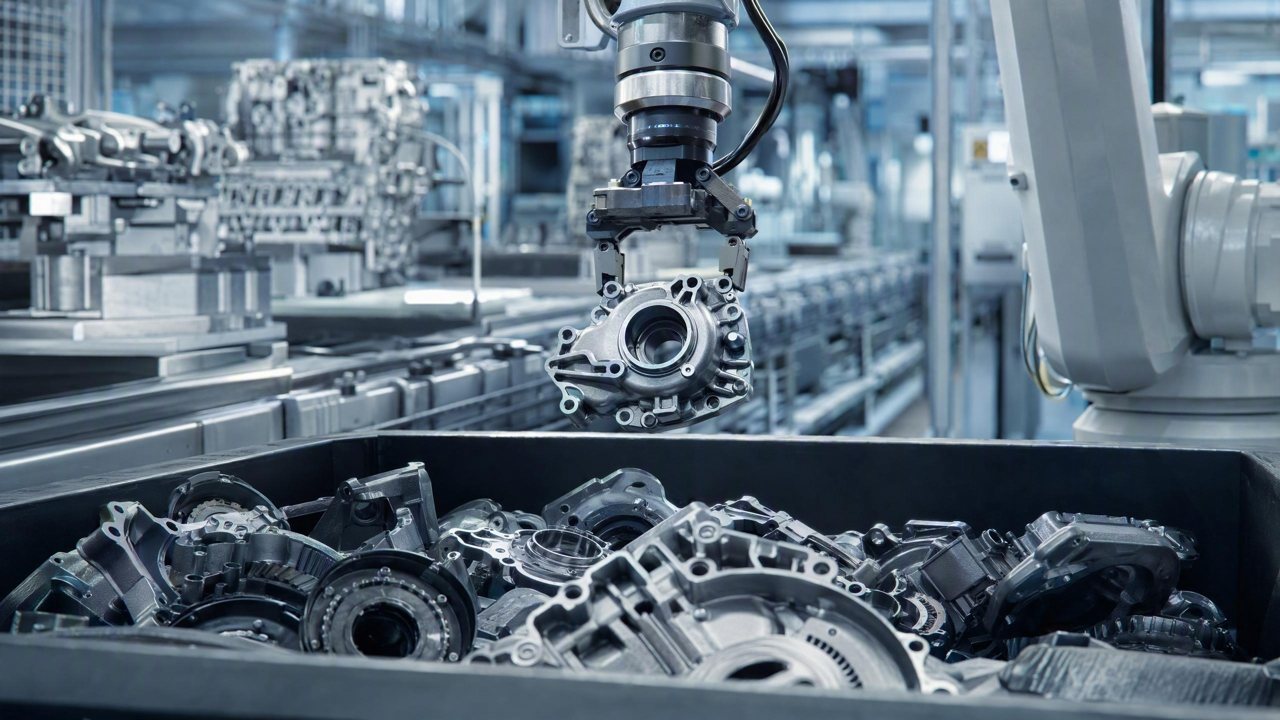
WeLinkirt's DaoAI 3D Robot Vision (proprietary 3D camera + 6D pose estimation, bin picking, glue dispensing/assembly/loading/unloading guidance, brain-eye-body closed loop, sub-millimeter hand-eye coordination), with its innovative "zero-code rapid changeover" capability, has reduced the changeover time for high-mix, low-volume bin picking of automotive components from an average of 45 minutes to under 3 minutes, significantly boosting production flexibility and efficiency. In the automotive and parts manufacturing sector, the accelerating trends of electrification and intelligence have led to shorter product iteration cycles and a wider variety of models. Production models for components are shifting from large-scale standardization to high-mix, low-volume, customized approaches. For a leading automotive Tier-1 supplier's engine core component assembly line, multiple types of irregularly shaped metal stampings need to be picked from bins in an unordered manner for loading and unloading. These components are complex in shape, have reflective surfaces, and batch volumes fluctuate significantly, posing severe challenges to traditional automation solutions.
WeLinkirt's DaoAI 3D Robot Vision (proprietary 3D camera + 6D pose estimation, bin picking, glue dispensing/assembly/loading/unloading guidance, brain-eye-body closed loop, sub-millimeter hand-eye coordination), with its innovative "zero-code rapid changeover" capability, has reduced the changeover time for high-mix, low-volume bin picking of automotive components from an average of 45 minutes to under 3 minutes, significantly boosting production flexibility and efficiency. In the automotive and parts manufacturing sector, the accelerating trends of electrification and intelligence have led to shorter product iteration cycles and a wider variety of models. Production models for components are shifting from large-scale standardization to high-mix, low-volume, customized approaches. For a leading automotive Tier-1 supplier's engine core component assembly line, multiple types of irregularly shaped metal stampings need to be picked from bins in an unordered manner for loading and unloading. These components are complex in shape, have reflective surfaces, and batch volumes fluctuate significantly, posing severe challenges to traditional automation solutions.
Pain Points: Why This Hurdle is Difficult to Overcome
The core dilemma faced by this Tier-1 supplier was the inefficiency of traditional robot vision systems in changeovers for high-mix, low-volume production. Firstly, each time a new product or model was introduced, experienced vision engineers spent significant time (averaging 2-4 hours) on programming and parameter adjustments, leading to long production line downtime and disrupted production cycles. Secondly, due to the diverse shapes of components, random stacking methods, and the highly reflective or absorptive surfaces of some parts, traditional vision algorithms based on rules or geometric matching struggled to achieve stable recognition and localization. This resulted in fluctuating pick success rates, frequent mispicks or missed picks, affecting the efficiency of subsequent processes and product quality. Furthermore, with shortened product lifecycles, frequent changeover demands made the ROI of traditional solutions extremely low, failing to meet the requirements for rapid market response. This predicament is analogous to the challenges faced by embodied AI robots in outdoor complex environments for perception and autonomous navigation: how to quickly adapt and execute precise tasks in varied, unstructured environments, where traditional solutions relying on pre-programming and single models are clearly insufficient.
Specifically, the metal stampings on the client's production line had complex 3D shapes, irregular edges, and were chaotically stacked in bins with severe occlusions. Traditional 2D vision lacked depth information, making it difficult to distinguish stacked parts. Conventional 3D vision systems, when encountering highly reflective metal surfaces, often suffered from specular reflections or absorption during structured light projection, leading to missing or noisy point cloud data, severely impacting the accuracy and stability of 6D pose estimation. Moreover, even minor changes in product models could necessitate retraining or extensive parameter adjustments for the entire vision recognition model, which was an unacceptable time and labor cost for high-mix, low-volume production lines emphasizing rapid deployment and flexible switching.
Technical Principles
WeLinkirt's DaoAI 3D Robot Vision system fundamentally addresses these pain points through its proprietary high-precision 3D camera and advanced 6D pose estimation algorithms. Its core technology lies in integrating deep learning with geometric principles to achieve robust recognition and precise localization of complex 3D objects. WeLinkirt's self-developed 3D camera employs multi-spectral fusion and dynamic exposure technology, effectively overcoming the challenges of highly reflective metal surfaces. It consistently acquires high-quality, high-density point cloud data, ensuring data integrity even in bright or low-light conditions. For 6D pose estimation, DaoAI utilizes deep learning-based semantic and instance segmentation techniques, combined with geometric feature extraction, to rapidly and accurately identify individual target parts from unordered point clouds. Through a multi-task learning network, it outputs the target's X, Y, Z 3D coordinates, along with roll, pitch, and yaw angles in real-time, achieving sub-millimeter pose accuracy.
Compared to traditional robot vision solutions based on CAD model matching or rule bases, the advantage of WeLinkirt's DaoAI lies in its powerful generalization capability and "zero-code" changeover feature. Traditional methods require precise CAD models for each new part and manual adjustment of matching parameters, which is time-consuming and labor-intensive. In contrast, the DaoAI 3D Robot Vision system leverages its pre-trained vision foundation model, enabling new part learning and model deployment within 5 minutes, using only 1-20 good sample images via APDT few-shot self-training technology, without writing any code. This means production line engineers do not need specialized vision programming knowledge to easily complete product changeovers. Furthermore, its brain-eye-body closed-loop control system dynamically adjusts grasping strategies and robot arm trajectories based on real-time picking feedback, further improving picking success rates and stability.
Typical Application Scenarios
- **Unordered Picking of Engine Block/Cylinder Head Internal Parts:** On engine assembly lines, parts like pistons, connecting rods, and valves are often placed randomly in bins. DaoAI 3D Robot Vision accurately identifies and picks these complex-shaped, tightly stacked internal parts, guiding the robotic arm to precisely place them in designated positions, solving the problems of low efficiency and fatigue associated with manual picking.
- **Unordered Loading/Unloading of Transmission Gears/Bearings:** Various gears and bearings inside transmissions differ in size, have smooth surfaces, and are prone to rolling. WeLinkirt's DaoAI system overcomes reflective interference to stably identify and precisely pick these circular or cylindrical parts, enabling automated loading/unloading, improving assembly efficiency, and reducing part damage.
- **Unordered Sorting and Assembly of Body Stamping Parts:** Large body stamping parts, such as inner door panels and body frame components, are often randomly stacked during transport or storage. DaoAI 3D Robot Vision effectively handles large, varied stamping parts, performing rapid identification and 6D pose estimation to guide robots for precise sorting or assembly, avoiding safety hazards and efficiency bottlenecks from manual handling.
- **Glue Dispensing Guidance for New Energy Battery Module Connectors:** In new energy vehicle battery module production, glue dispensing on flexible connectors requires extremely high precision. The DaoAI 3D Robot Vision system obtains the precise 6D pose of connectors in real-time, guiding the dispensing robot to apply glue with high precision along predefined paths, ensuring uniform and consistent application, and improving battery module reliability.
- **Automotive Electronic Control Unit (ECU) Assembly Guidance:** ECU internal circuit board and connector assembly demands extreme precision. WeLinkirt's DaoAI 3D Robot Vision can identify tiny and densely arranged electronic components, providing sub-millimeter assembly guidance to ensure the accuracy of connector insertion, screw tightening, and other operations, reducing assembly error rates.
Case Study
A leading Tier-1 automotive component supplier faced the challenge of unordered picking for up to 15 different types of metal stampings on its engine assembly line. Previously, each product model change required engineers to manually adjust camera positions, rewrite vision recognition code, and perform extensive debugging, resulting in an average downtime of 45 minutes for changeovers. This severely limited production line flexibility, preventing the efficient handling of small-batch, multi-variety orders. After implementing WeLinkirt's DaoAI 3D Robot Vision solution, with its "zero-code rapid changeover" capability, the client only needed to select the new product model in the control interface and place 1-2 good samples for quick learning. The system then completed model switching and parameter self-adaptation within 3 minutes. After deployment, the picking success rate consistently exceeded 99.8%, the mispick rate was reduced by −95%, and line uptime significantly improved. This achievement enabled the manufacturer to respond more flexibly to market demands, expanding its competitiveness in high-mix, low-volume production.
The 'zero-code rapid changeover' capability of WeLinkirt's DaoAI 3D Robot Vision has completely transformed our high-mix, low-volume production model, shifting from 'build-to-order' to 'rapid switching on demand'.
WeLinkirt Solution and Products
WeLinkirt's DaoAI 3D Robot Vision solution is centered around its proprietary high-precision 3D camera and powerful 6D pose estimation algorithms. During implementation, we first collect 3D data and train models for the client's various components, utilizing the unified foundation of the DaoAI World Model for semantic understanding and cross-scenario generalization. Through APDT few-shot self-training technology, new products only require a small number of good sample images (1-20 images) for rapid model learning, without any coding. For deployment, WeLinkirt offers various integration methods such as SDK/API/Docker, supporting 100% local private deployment to ensure client data security. The DaoAI Robot Vision system also integrates brain-eye-body closed-loop control, allowing the robotic arm to receive real-time visual feedback during picking and dynamically adjust its grasping strategy, ensuring sub-millimeter picking precision and a high success rate. Furthermore, combined with WeLinkirt's AI AOI software system, it can be extended to quality inspection after picking, achieving full-process automation and intelligence.
This solution not only addresses current challenges in unordered bin picking but, more importantly, the "zero-code rapid changeover" feature of WeLinkirt's DaoAI 3D Robot Vision provides a solid technical foundation for clients' future rapid product iterations and production line upgrades. By reducing changeover downtime by −93%, it significantly enhances line flexibility and efficiency, enabling clients to easily adapt to market changes and substantially lowering production costs and reliance on senior vision engineers. In practical applications, the WeLinkirt team provides end-to-end services from initial assessment, solution design, on-site deployment, to post-maintenance, ensuring stable and efficient system operation and creating continuous business value for clients.
FAQ
How does DaoAI 3D Robot Vision achieve “zero-code rapid changeover”?
DaoAI 3D Robot Vision leverages its pre-trained vision foundation models and APDT few-shot self-training technology. Users only need to upload a 3D model of the new part or provide 1-20 good sample images via a graphical interface. The system then automatically learns and deploys, eliminating the need for manual programming or complex parameter adjustments, thus enabling rapid changeover.
What are the advantages of this system in handling highly reflective or complex geometry automotive components?
WeLinkirt's proprietary 3D camera utilizes multi-spectral fusion and dynamic exposure technology, effectively overcoming interference from highly reflective metal surfaces to acquire high-quality point cloud data. Combined with deep learning-based 6D pose estimation algorithms, it can stably identify and achieve sub-millimeter precise picking even for complex geometries and unordered stacking.
How does DaoAI 3D Robot Vision ensure picking accuracy and stability?
The system acquires detailed 3D information through its high-precision 3D camera and employs advanced deep learning algorithms for 6D pose estimation, achieving sub-millimeter accuracy. Concurrently, its brain-eye-body closed-loop control mechanism provides real-time feedback on picking results, dynamically adjusting the robot's motion trajectory, ensuring each pick is precise and stable, significantly reducing mispicks and missed picks.
This article was generated by AI. Customer cases are simulated scenarios based on real product capabilities and figures are illustrative; see product pages for official benchmarks.