
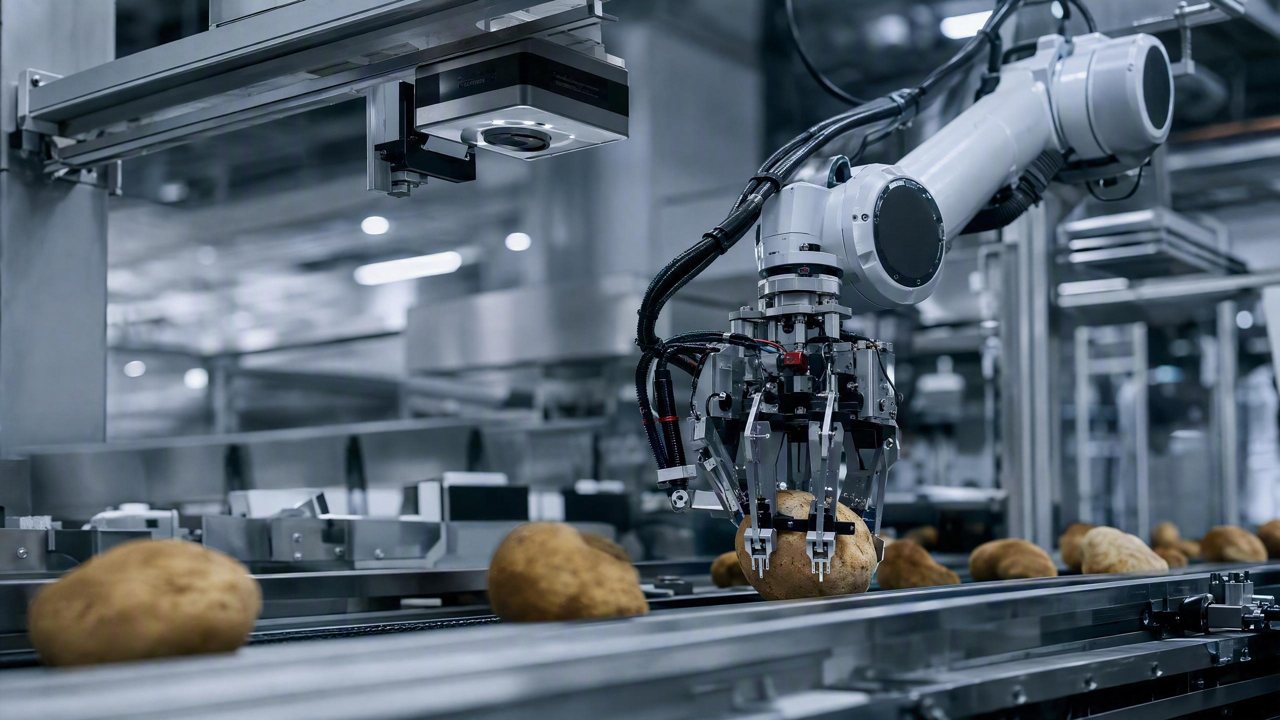
DaoAI 3D Robot Vision from WeLinkirt (proprietary 3D camera + 6D pose estimation, bin picking, guidance for dispensing/assembly/loading/unloading, brain-eye-body closed loop, sub-millimeter hand-eye coordination), through on-premise deployment, addresses critical issues of high-precision recognition and data security in agricultural produce ripeness sorting, reducing traditional manual sorting defect rates from 5% to <0.7%.
WeLinkirt's DaoAI 3D Robot Vision (proprietary 3D camera + 6D pose estimation, bin picking, guidance for dispensing/assembly/loading/unloading, brain-eye-body closed loop, sub-millimeter hand-eye coordination), through on-premise deployment, addresses critical issues of high-precision recognition and data security in agricultural produce ripeness sorting, reducing traditional manual sorting defect rates from 5% to <0.7%. The food and agriculture industry is undergoing a profound intelligent transformation to meet growing consumer demand, rising labor costs, and stringent requirements for product quality and traceability. In post-harvest sorting, especially for judging fruit and vegetable ripeness, reliance on human experience is common. This is not only inefficient but also prone to inconsistent sorting standards, missed defects, or misjudgments due to subjective human factors. For large agricultural processing enterprises, handling tens of thousands or even hundreds of thousands of kilograms of produce daily, achieving standardized, precise sorting at scale while ensuring absolute security of production data is a pressing challenge.
Pain Points: Why This Hurdle Is Difficult to Overcome
Agricultural produce ripeness sorting faces multiple challenges. Firstly, **recognition accuracy and consistency**: under varying batches and lighting conditions, the ripeness of the same produce may exhibit subtle differences, such as color, texture, or minor damage. Manual visual inspection is prone to fatigue and subjective bias, leading to defect rates as high as 5% to 8%, significantly impacting product grade and market value. Secondly, **data security and compliance**: for large agricultural groups, production data, especially core information related to yield rates, defect types, and supply chain traceability, is a vital business asset. Uploading this data to the cloud for processing poses potential data leakage risks and compliance challenges, especially given the increasingly stringent industry standards for embodied AI and humanoid robots. On-premise deployment becomes critical for safeguarding data sovereignty. Thirdly, **high-intensity repetitive labor and human costs**: sorting work is often tedious, repetitive, and visually demanding, leading to high employee turnover, escalating recruitment and training costs, and an inability to meet capacity demands during peak seasons. Finally, **changeover efficiency**: with a wide variety of agricultural products, sorting categories and standards may change frequently across seasons and batches. Traditional rule-based machine vision systems require significant time for changeovers, affecting production takt time.
The root cause of these pain points lies in the **non-standardized nature of agricultural products** and the **sensitivity of data processing**. Agricultural products are naturally grown, exhibiting high randomness and variability in their form, color, texture, and luster. This makes it difficult for traditional 2D machine vision, based on fixed thresholds or simple feature extraction, to accurately capture ripeness information. This is particularly true for situations requiring internal quality assessment or detection of minute surface defects (e.g., slight bruising, early insect damage), where 2D image information is limited. Furthermore, strict customer control over production data stems from the protection of trade secrets and adherence to national data security regulations, making most solutions involving data externalization unacceptable. WeLinkirt understands these challenges and is committed to providing solutions that not only solve technical difficulties but also meet customer compliance requirements.
Technical Principles
WeLinkirt's DaoAI 3D Robot Vision system, with its proprietary 3D camera and advanced 6D pose estimation algorithms, offers a revolutionary solution for agricultural produce ripeness sorting. Our 3D camera utilizes structured light or laser triangulation principles to reconstruct the precise three-dimensional morphology of agricultural products, capturing their accurate size, shape, and surface texture in space. This addresses the limitation of 2D vision in providing insufficient information when identifying non-standardized objects. For example, even if two apples have similar colors in a 2D image, 3D data can reveal subtle dents, protrusions, or deformations caused by varying ripeness. Combined with multispectral imaging technology, DaoAI 3D Robot Vision can also capture ripeness physiological indicators imperceptible to the human eye, such as chlorophyll content and anthocyanin distribution, enabling more scientific and refined ripeness grading. WeLinkirt leverages advanced deep learning models to fuse and analyze this multimodal data, establishing complex mappings between agricultural product ripeness and visual features.
At the algorithmic level, the core of DaoAI 3D Robot Vision is its powerful 6D pose estimation capability. It can accurately calculate the real-time position and orientation (X, Y, Z, Rx, Ry, Rz) of agricultural products stacked randomly in bins or on conveyors. This allows collaborative robots to achieve sub-millimeter hand-eye coordination, precisely grasping target objects, avoiding collisions, and placing them in designated locations. Compared to traditional rule-based AOI or manual inspection, WeLinkirt's DaoAI 3D Robot Vision offers several advantages: **non-contact, high-precision, and high-efficiency**, eliminating the subjectivity and fatigue of manual inspection; **data-driven and adaptive**, models are automatically trained from a large number of samples to learn and adapt to the natural variability of agricultural products, without complex rule programming; most importantly, **100% on-premise private deployment** capability ensures that critical customer production data is processed and stored entirely within the factory, meeting the most stringent data security and compliance requirements, an advantage that cloud-based solutions cannot match. WeLinkirt's technological accumulation in this area actively responds to the current trend in embodied AI emphasizing “brain-eye-body closed loop” and localized decision-making.
Typical Application Scenarios
- **Fruit and Vegetable Ripeness Grading**: DaoAI 3D Robot Vision analyzes the color, luster, shape, surface texture, and microscopic deformation of fruits and vegetables, combined with multispectral data, to accurately determine their ripeness level (e.g., unripe, ripe, overripe) for automated sorting. The challenge lies in the continuous and complex changes in characteristics of the same produce at different growth stages, and susceptibility to light and humidity.
- **Surface Defect Detection and Rejection**: Detect minor defects such as scratches, bruises, insect damage, mold, and cracks on the surface of fruits and vegetables. DaoAI 3D cameras can capture subtle depressions or protrusions imperceptible in 2D images, combined with AI algorithms for precise classification and localization. The difficulty lies in the diverse forms of defects and their low distinction from normal textures.
- **Foreign Object Detection and Separation**: Identify and remove mixed-in stems, leaves, stones, soil, or other impurities during the sorting process. WeLinkirt's DaoAI 3D Robot Vision leverages its powerful three-dimensional perception to effectively differentiate agricultural products from foreign objects based on shape, volume, and material differences. The challenge is that foreign objects may share some characteristics with agricultural products.
- **Fruit and Vegetable Size and Shape Grading**: Precisely measure and classify the size, weight, and shape of agricultural products to meet different market demands. DaoAI 3D Robot Vision can quickly acquire accurate three-dimensional size data for automated, standardized grading. The challenge lies in the precise measurement of irregularly shaped produce and the efficiency of batch processing.
Case Study
A leading large agricultural group, with multiple modern fruit and vegetable processing bases, handles enormous daily volumes. Previously, the ripeness sorting of their core product—a certain type of high-value berry—relied entirely on manual labor. Due to the delicate nature of berries, the difficulty of judging ripeness, and strict sorting speed requirements, labor costs remained high during peak seasons, and manual sorting's defect rate consistently hovered around 5%, directly impacting the quality and brand reputation of products in the high-end market. Furthermore, the group placed extreme importance on production data security, strictly prohibiting any data transfer to third-party cloud platforms. This rendered most cloud-based AI vision solutions on the market unsuitable for their needs. After thoroughly understanding the client's pain points, the WeLinkirt DaoAI 3D Robot Vision team provided an on-premise deployed robotic sorting solution for berry ripeness.
Before project deployment, each sorting line at this client required 15 workers for initial screening and fine selection of berries, processing approximately 10 tons per day. After deployment, four sets of the WeLinkirt DaoAI 3D Robot Vision system were installed, each comprising a proprietary 3D camera, a collaborative robot, and the DaoAI 3D Robot Vision software. The system accurately identified berry color, luster, subtle surface damage, and 3D shape, performing unstructured bin picking and graded placement according to preset ripeness standards (3 levels). Following initial data collection and model training (requiring only 20 good samples, utilizing WeLinkirt's APDT few-shot self-training technology), the system was deployed and integrated on the client's site. Three months post-launch, the client reported an **−80% reduction in manual re-inspection volume** across the entire sorting line, and the berry **defect rate decreased from 5% to <0.7%**, significantly improving product consistency. Most importantly, all production data, including 3D images, sorting results, and defect types, were strictly stored on the client's local servers, fully meeting their stringent requirements for data security and compliance. WeLinkirt's DaoAI 3D Robot Vision's on-premise deployment capability perfectly aligned with the client's need for data sovereignty.
“The on-premise private deployment of WeLinkirt's DaoAI 3D Robot Vision not only solved our berry sorting accuracy and efficiency issues but, more importantly, it completely alleviated our data security concerns. In this day and age, that is paramount.” — Production Manager, a leading agricultural group
WeLinkirt Solution and Products
WeLinkirt's DaoAI 3D Robot Vision system is the core of this agricultural produce ripeness sorting solution. It integrates our independently developed high-precision 3D camera, capable of acquiring full-dimensional 3D information of agricultural products in milliseconds. Combined with DaoAI's powerful 6D pose estimation algorithms, the system can accurately identify randomly stacked berries and guide collaborative robots for grasping with sub-millimeter precision. Our “brain-eye-body closed loop” technology ensures smooth synergy between visual perception, intelligent decision-making, and robot movement, achieving truly intelligent sorting. For modeling and changeovers, WeLinkirt DaoAI 3D Robot Vision supports APDT few-shot self-training. Clients only need to provide a small number (1-20) of good samples to complete model training for new products or sorting standards within 5 minutes, significantly reducing changeover time and enhancing production line flexibility. The WeLinkirt DaoAI World world model, as a unified foundation, further enhances the system's semantic understanding and cross-scenario generalization capabilities, allowing the model to continuously learn from production line feedback and optimize sorting strategies. In terms of deployment, we offer various forms such as SDK/API/Docker, fully supporting 100% on-premise private deployment to ensure customer data remains within the factory, meeting the highest level of data security requirements. Additionally, our SkyVision platform can serve as auxiliary monitoring, enabling on-site model training in hours, further increasing flexibility.
Through the deployment of WeLinkirt's DaoAI 3D Robot Vision, the client achieved significant business value. Quantified results include: **defect rate reduced by over −85%** (from 5% to <0.7%), significantly improving the quality consistency of high-end products; **manual re-inspection hours reduced by 80%**, effectively alleviating labor pressure and saving labor costs; **sorting efficiency increased by 30%**, optimizing production takt time and meeting peak capacity demands; **data security 100% guaranteed**, with all core production data processed and stored on the client's local servers, fully complying with their strict internal compliance and external regulatory requirements. WeLinkirt's DaoAI 3D Robot Vision not only brought direct economic benefits to the client but also enhanced its market competitiveness in the era of digital agriculture.
FAQ
How does DaoAI 3D Robot Vision ensure data security in agricultural produce sorting?
WeLinkirt's DaoAI 3D Robot Vision system supports 100% on-premise private deployment. All 3D image data, model training data, and sorting results are processed and stored on the client's local servers, ensuring that data never leaves the factory. This fully complies with stringent data security and compliance requirements, eliminating potential data leakage risks associated with cloud deployment and safeguarding client data sovereignty.
How does DaoAI 3D Robot Vision address the challenges posed by the non-standardized nature of agricultural products?
DaoAI 3D Robot Vision utilizes a proprietary high-precision 3D camera to acquire the three-dimensional morphology of agricultural products. Combined with multispectral imaging technology, it captures ripeness physiological indicators imperceptible to the human eye. Through deep learning models that fuse multimodal data, the system adaptively learns the natural variability of agricultural products, achieving high-precision and consistent ripeness grading, far surpassing traditional 2D vision and manual inspection.
What is the changeover efficiency of DaoAI 3D Robot Vision when new agricultural product types or sorting standards are introduced?
WeLinkirt's DaoAI 3D Robot Vision supports APDT few-shot self-training technology. Clients only need to provide 1-20 good samples to quickly complete model training for new products or sorting standards within 5 minutes. This significantly reduces changeover time, allowing production lines to flexibly adapt to multi-variety, small-batch production demands and enhancing overall operational efficiency.
This article was generated by AI. Customer cases are simulated scenarios based on real product capabilities and figures are illustrative; see product pages for official benchmarks.